
惯性聚合 高效追踪和阅读你感兴趣的博客、新闻、科技资讯
阅读原文 在惯性聚合中打开

推荐订阅源

WordPress大学
WordPress大学
Microsoft Azure Blog
aimingoo的专栏
aimingoo的专栏
Vercel News
Vercel News
U
Unit 42
L
LangChain Blog
J
Java Code Geeks
钛媒体:引领未来商业与生活新知
钛媒体:引领未来商业与生活新知
The Cloudflare Blog
F
Fortinet All Blogs
小众软件
小众软件
I
InfoQ
P
Proofpoint News Feed
D
DataBreaches.Net
Martin Fowler
Martin Fowler
H
Help Net Security
T
Tailwind CSS Blog
N
Netflix TechBlog - Medium
有赞技术团队
有赞技术团队
Y
Y Combinator Blog
Recent Announcements
B
Blog RSS Feed
酷 壳 – CoolShell
酷 壳 – CoolShell
B
Blog

www.infosecurity-magazine.com

Just Three Ransomware Gangs Accounted for 40% of Attacks Last Month Google Chrome Rolls Out Protection Against Infostealers Targeting Session Cookies STX RAT Targets Finance Sector With Advanced Stealth Tactics Bitcoin Depot Reports $3.6m Crypto Theft After System Breach Atomic Stealer MacOS ClickFix Attack Bypasses Apple Security Warnings Middle East Hack-for-Hire Operation Traced to South Asian Cyber Espionage Group Governance Gaps Emerge as AI Agents Drive 76% Increase in NHIs Google Warns of New Threat Group Targeting BPOs and Helpdesks Google API Keys Quietly Gain Access to Gemini on Android Devices Critical Vulnerability in Ninja Forms Exposes WordPress Sites Anthropic Launches Project Glasswing to Use AI to Find and Fix Critical Software Vulnerabilities US Thwarts DNS Hijacking Network Controlled by Russian APT28 Hackers Claude Discovers Apache ActiveMQ Bug Hidden for 13 Years Iran‑Backed Threat Actors Hit US CNI Providers via Internet‑Facing OT Assets Russian APT28 Hackers Hijack Routers to Steal Credentials, UK Security Agency Warns GPU Rowhammer Attack Enables Privilege Escalation and Full System Compromise GrafanaGhost Exploit Bypasses AI Guardrails for Silent Data Exfiltration Over $17bn Lost to Cyber Fraud in the Last Year, Warns FBI Storm-1175 Exploits Flaws in High-Velocity Medusa Attacks Fortinet Releases Emergency Patch After FortiClient EMS Bug Is Exploited New Phishing Platform Used in Credential Theft Campaigns Against C-Suite Execs New 'Storm' Infostealer Remotely Decrypts Stolen Credentials NCSC Issues Security Alert Over Hackers Targeting WhatsApp and Signal Accounts Apple Expands iOS 18 Security Updates Amid DarkSword Threat Researchers Observe Sub-One-Hour Ransomware Attacks GitHub Used as Covert Channel in Multi-Stage Malware Campaign Most CNI Firms Face Up to £5m in Downtime from OT Attacks Google Introduces Android Dev Verification Amid Openness Debate New Venom Stealer MaaS Platform Automates Continuous Data Theft Chinese Hackers Target European Governments in Espionage Campaigns
Munich Security Conference: Cyber Threats Lead G7 Risk In...
2026-02-13 · via www.infosecurity-magazine.com

G7 nations have identified cyber threats as the most significant risk they face, for the second consecutive year.

As the Munich Security Conference (MSC) opened in Germany on February 13, the event’s partner consultancy, Kekst CNC, released the latest edition of its annual security risk report, the Munich Security Index (MSI) 2026.

The findings show that G7 countries (Canada, France, Germany, Italy, Japan, the UK and the US) ranked "cyber-attacks on their country" as their top concern in 2025, followed by "economic or financial crisis" and "disinformation campaigns from enemies."

This marked the second year in a row that cyber threats have held the top spot, rising sharply from fourth place in 2021 and seventh in 2022.
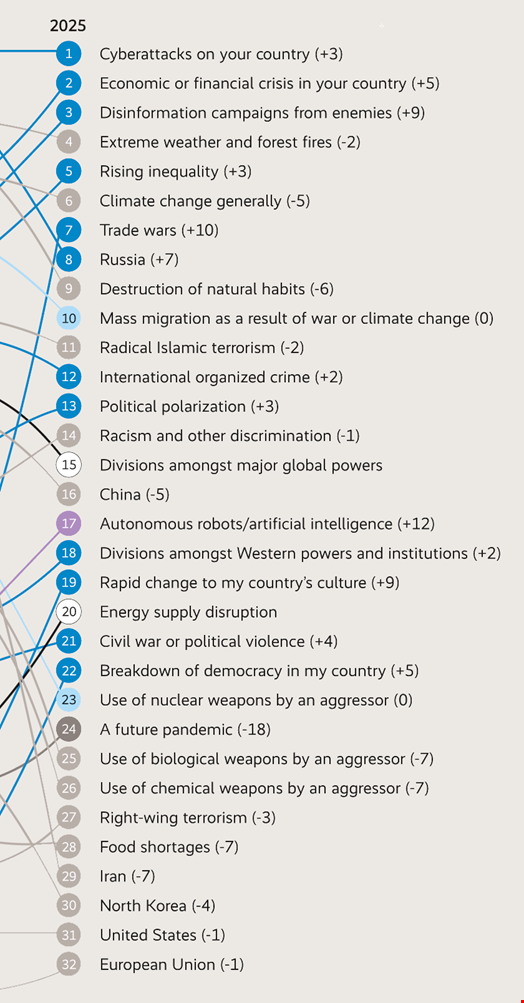
The G7 risk chart, Munich Security Index 2026. Source: Munich Security Conference

Cyber threats are detailed a top priority in Germany, the UK and Japan, where 75%, 74%, and 70% of respondents, respectively, identified cyber-attacks as one of their nation’s most serious risks.

Meanwhile, in the Brazil, India, China, and South Africa (BICS) grouping, cyber-attacks have fallen to eighth place in 2025, down from fourth in 2024.

These nations now view "climate change" as their most urgent risk, followed by "extreme weather and forest fires" and "rising inequality." Disinformation ranks seventh on their list.
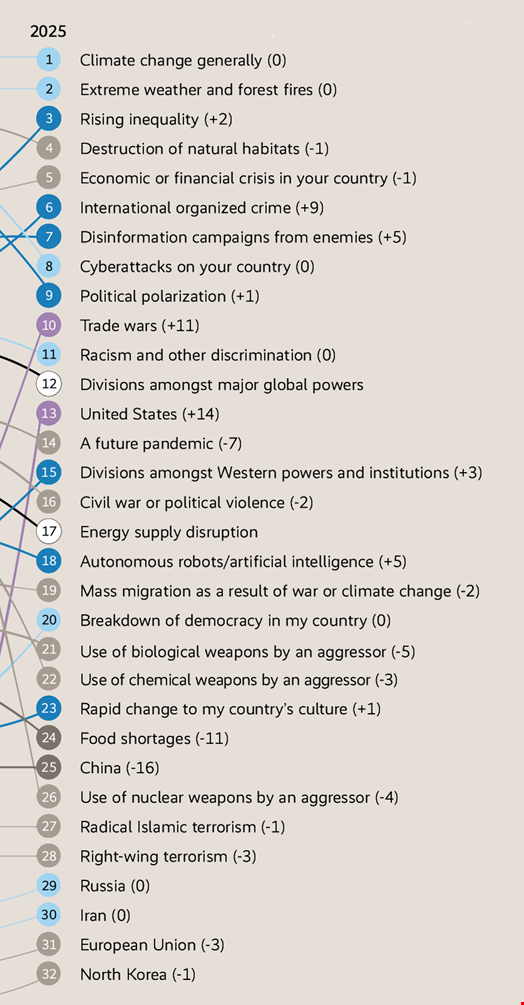
The BICS risk chart, Munich Security Index 2026. Source: Munich Security Conference

Rising Concerns in the UK, US and India

Across most countries, the majority of risks are now seen as less severe compared to last year. However, this trend reverses in the UK, the US, and India, where concerns over threats have grown.

The US, in particular, has seen a sharp rise in perceived risks tied to its economic and political landscape, including fears of food shortages, democratic instability, widening inequality, financial crises, civil unrest or political violence and escalating trade conflicts.

This year’s edition of the MSI was based on representative samples of around 1000 adults from each G7 and BICS nation, with 11,099 people surveyed in total. Polling was conducted by Kekst CNC and fieldwork partners between November 5 and 25, 2025, using industry-leading online panels.

The seriousness of each identified risk was measured based on five dimensions (severity, imminence, preparedness, trajectory and an overall criteria), each captured by a separate question. Respondents were selected according to stratified quotas for gender, age, residency, formal education and income to ensure representativeness. The final data was then weighted

to exactly match the quotas. The margin of error is 3.1 percent.

“Polling in autocracies is always challenging, as respondents may not feel that they can freely express their views. The results from China should therefore be interpreted with caution,” said the MSI authors.

Read now: Nation-State Hackers Embrace Gemini AI for Malicious Campaigns, Google Finds