

惯性聚合 高效追踪和阅读你感兴趣的博客、新闻、科技资讯
阅读原文 在惯性聚合中打开

推荐订阅源

T
Threat Research - Cisco Blogs
C
CERT Recently Published Vulnerability Notes
cs.CL updates on arXiv.org
S
Securelist
K
Kaspersky official blog
V
Vulnerabilities – Threatpost
C
Cisco Blogs
Application and Cybersecurity Blog
Hacker News: Ask HN
Hacker News: Ask HN
cs.AI updates on arXiv.org
S
Security Affairs
Forbes - Security
Forbes - Security
Spread Privacy
Spread Privacy
C
CXSECURITY Database RSS Feed - CXSecurity.com
P
Palo Alto Networks Blog
H
Hacker News: Front Page
L
Lohrmann on Cybersecurity
Cloudbric
Cloudbric
S
Schneier on Security
Simon Willison's Weblog
I
InfoQ
人人都是产品经理
人人都是产品经理
PCI Perspectives
PCI Perspectives
月光博客
月光博客
爱范儿
爱范儿
Jina AI
Jina AI
WordPress大学
WordPress大学
N
News and Events Feed by Topic
Cyberwarzone
Cyberwarzone
freeCodeCamp Programming Tutorials: Python, JavaScript, Git & More
小众软件
小众软件
Google Online Security Blog
W
WeLiveSecurity
V
V2EX
阮一峰的网络日志
阮一峰的网络日志
美团技术团队
博客园 - 司徒正美
Scott Helme
Scott Helme
AI
AI
L
LangChain Blog
A
Arctic Wolf
博客园 - 【当耐特】
量子位
S
SegmentFault 最新的问题
The GitHub Blog
The GitHub Blog
MyScale Blog
MyScale Blog
腾讯CDC
博客园 - 叶小钗
Last Week in AI
Last Week in AI
S
Secure Thoughts

www.infosecurity-magazine.com

Just Three Ransomware Gangs Accounted for 40% of Attacks Last Month Google Chrome Rolls Out Protection Against Infostealers Targeting Session Cookies STX RAT Targets Finance Sector With Advanced Stealth Tactics Bitcoin Depot Reports $3.6m Crypto Theft After System Breach Atomic Stealer MacOS ClickFix Attack Bypasses Apple Security Warnings Middle East Hack-for-Hire Operation Traced to South Asian Cyber Espionage Group Governance Gaps Emerge as AI Agents Drive 76% Increase in NHIs Google Warns of New Threat Group Targeting BPOs and Helpdesks Google API Keys Quietly Gain Access to Gemini on Android Devices Critical Vulnerability in Ninja Forms Exposes WordPress Sites Anthropic Launches Project Glasswing to Use AI to Find and Fix Critical Software Vulnerabilities US Thwarts DNS Hijacking Network Controlled by Russian APT28 Hackers Claude Discovers Apache ActiveMQ Bug Hidden for 13 Years Iran‑Backed Threat Actors Hit US CNI Providers via Internet‑Facing OT Assets Russian APT28 Hackers Hijack Routers to Steal Credentials, UK Security Agency Warns GPU Rowhammer Attack Enables Privilege Escalation and Full System Compromise GrafanaGhost Exploit Bypasses AI Guardrails for Silent Data Exfiltration Over $17bn Lost to Cyber Fraud in the Last Year, Warns FBI Storm-1175 Exploits Flaws in High-Velocity Medusa Attacks Fortinet Releases Emergency Patch After FortiClient EMS Bug Is Exploited New Phishing Platform Used in Credential Theft Campaigns Against C-Suite Execs New 'Storm' Infostealer Remotely Decrypts Stolen Credentials NCSC Issues Security Alert Over Hackers Targeting WhatsApp and Signal Accounts Apple Expands iOS 18 Security Updates Amid DarkSword Threat Researchers Observe Sub-One-Hour Ransomware Attacks GitHub Used as Covert Channel in Multi-Stage Malware Campaign Most CNI Firms Face Up to £5m in Downtime from OT Attacks Google Introduces Android Dev Verification Amid Openness Debate New Venom Stealer MaaS Platform Automates Continuous Data Theft Chinese Hackers Target European Governments in Espionage Campaigns Eight in 10 UK Manufacturers Hit by Cyber Incident in a Year Hackers Hijack Axios npm Package to Spread RATs Maryland Man Charged Over $53m Uranium Finance Crypto Hack Phantom Project Bundles Infostealer, Crypter and RAT For Sale ChatGPT Security Issue Enabled Data Theft via Single Prompt TeamPCP Explores Ways to Exploit Stolen Supply Chain Secrets Employee Data Breaches Surge to Seven-Year High NCSC Urges Immediate Patching of F5 BIG-IP Bug Cybercriminals Exploit Tax Season With New Phishing Tactics Lloyds IT Glitch Exposed Data of Nearly 500,000 Banking Customers DeepLoad Malware Combines ClickFix With AI-Generated Code to Avoid Detection Critical Citrix NetScaler Vulnerability Exploited in the Wild ICO Fines UK Nuisance Call Scammers £100,000 European Commission Confirms Cloud Data Breach New Wave of AiTM Phishing Targets TikTok for Business TeamPCP Targets Telnyx Package in Latest PyPI Software Supply Chain Attack Quantum Computing Threat to Encryption Is Closer Than Expected, Warns Google UK Cracks Down on Chinese Crypto Marketplace for Funding Southeast Asia Scam Hubs Security Researchers Sound the Alarm on Vulnerabilities in AI-Generated Code Attackers Rapidly Weaponize Critical Oracle WebLogic RCE, Honeypot Study Finds EtherRAT Techniques Bypass Security Via Ethereum Smart Contracts AI Becomes the Top Cybersecurity Priority for Defenders as Criminals Exploit It, PwC Warns OpenAI Expands Bug Bounty to Cover AI Abuse and 'Safety' Concerns Iran-Linked Pay2Key Ransomware Group Re-Emerges Invoice Fraud Costs UK Construction Sector Millions, NCA Warns Cloud Phones Linked to Rising Financial Fraud Threat Hackers Exploit Compromised Enterprise Identities at Industrial Scale, Warns SentinelOne US: FCC Bans Foreign-Made Routers Over National Security Concerns TeamPCP Expands Supply Chain Campaign With LiteLLM PyPI Compromise Experts Sound Alarm Over “Prompt Poaching” Browser Extensions Operation Henhouse Nets Over 500 Arrests in UK Fraud Crackdown RSA Conference: UK NCSC Head Urges Industry to Develop Vibe Coding Safeguards Silver Fox Cyber Campaigns Show Shift Toward Dual Espionage Citrix Urges Immediate Patching for Critical NetScaler Vulnerabilities New Npm 'Ghost Campaign' Uses Fake Install Logs to Hide Malware Former Ukrainian Foreign Minister Dmytro Kuleba to Address the New Cyber Frontline at Infosecurity Europe Enterprise Cybersecurity Software Fails 20% of the Time, Warns Absolute Security Russian Initial Access Broker Handed 81-Month Sentence Handala Group Tied to Iranian Hack‑and‑Leak Operations, FBI Reveals Most Cybersecurity Staff Don’t Know How Fast They Could Stop a Cyber-Attack on AI Systems Tycoon2FA Phishing Service Resumes Activity Post-Takedown High-Tech Sector Overtakes Finance as Top Target for Cyber-Attacks, Mandiant Reports Trivy Supply Chain Attack Expands With New Compromised Docker Images CISA Orders US Government to Patch Maximum Severity Cisco Flaw Operation Alice Takes Down 370,000+ Dark Web Sites Hackers Exploit Critical Langflow Bug in Just 20 Hours NCA Boss Warns That Teens Are Being “Radicalized” Into Cybercrime Online Ransomware Affiliate Exposes Details of 'The Gentlemen' Operation Financial Brands Targeted in Global Mobile Banking Malware Surge FCA Updates Cyber Incident and Third-Party Reporting Rules AWS Warns Hackers Have Abused Cisco Firewall Zero-Day Since January UK: Regulation Drives Cyber Spending for Critical Infrastructure Orgs New Ubuntu Flaw Enables Local Attackers to Gain Root Access Crypto Scam "ShieldGuard" Dismantled After Malware Discovery AI-Enabled Adversaries Compress Time-to-Exploit Following Vulnerability Disclosure Vidar Stealer 2.0 Exploits GitHub, Reddit to Deliver Malware via Fake Game Cheats AI Issues Will Drive Half of Incident Response Efforts by 2028, Says Gartner Android OS-Level Attack Bypasses Mobile Payment Security 'CursorJack’ Attack Path Exposes Code Execution Risk in AI Development Environment Surge in Nation State Attacks on UK Firms Amid Cyber Warfare Fears Aeternum Botnet Shifts Command Control to Polygon Blockchain Leading Semiconductor Supplier Advantest Hit by Ransomware Attack Remcos RAT Expands Real-Time Surveillance Capabilities SMEs Wrong to Assume They Won’t Be Hit by Cyber-Attacks, NCSC Boss Warns Google Warns of In the Wild Exploit as It Patches New Chrome Zero Day Phorpiex Phishing Delivers Low-Noise Global Group Ransomware BridgePay Confirms Ransomware Attack, No Card Data Compromised New Hacking Campaign Exploits Microsoft Windows WinRAR Vulnerability Labyrinth Chollima Evolves into Three North Korean Hacking Groups Google Disrupts Extensive Residential Proxy Networks
Nation-State Hackers Embrace Gemini AI for Malicious Campaigns, Google Finds
2026-02-12 · via www.infosecurity-magazine.com

Many government-backed cyber threat actors now use AI throughout the attack lifecycle, especially for reconnaissance and social engineering, a new Google study found.

In a report published on February 12, ahead of the Munich Security Conference, Google Threat Intelligence Group (GTIG) and Google DeepMind shared new findings on how cybercriminals and nation-state groups used AI for malicious purposes during the last quarter of 2025.

The researchers observed a wide range of AI misuse by advanced persistent threat (APT) groups. They used AI for tasks including coding and scripting, gathering information about potential targets, researching publicly known vulnerabilities and enabling post-compromise activities.

Iran, China and North Korea Use AI to Boost Cyber-Attacks

In one instance, Iranian government-backed actor APT42 leveraged generative AI models to search for official email addresses for specific entities and conduct reconnaissance on potential business partners to establish a credible pretext. 

Google researchers also observed a North Korean government-backed group (UNC2970) using Gemini, one of Google’s large language models (LLM), to synthesize open-source intelligence (OSINT) and profile high-value targets to support campaign planning and reconnaissance. The group typically impersonates corporate recruiters in their campaigns to target defense companies.

In another APT campaign, TEMP.Hex, a Chinese-nexus group also known as Mustang Panda, Twill Typhoon and Earth Preta, used Gemini and other AI tools to compile detailed information on specific individuals, including targets in Pakistan, and to collect operational and structural data on separatist organizations in various countries.

“While we did not see direct targeting as a result of this research, shortly after the threat actor included similar targets in Pakistan in their campaign. Google has taken action against this actor by disabling the assets associated with this activity,” the report indicated.

Some APT groups have also started toying with AI agents. APT31 (aka Violet Typhoon, Judgment Panda, Zirconium), another Chinese-backed group, has been observed by Google researchers using "expert cybersecurity personas" to automate the analysis of vulnerabilities and generate testing plans against US-based targets.

“For government-backed threat actors, LLMs have become essential tools for technical research, targeting, and the rapid generation of nuanced phishing lures,” the report noted.

However, Google researchers have not yet seen direct attacks on frontier AI models or generative AI products from any APT actors.

Rise of Model Extraction Attacks

In contrast, financially motivated cybercriminal groups have actively tried to hijack AI models to power their malicious campaigns.

Google identified a notable increase in model extraction attempts, specifically attempts at model stealing and capability extraction emanating from researchers and private sector companies globally.

Also known as a ‘distillation attack,’ a model extraction attack (MEA) uses legitimate access to systematically probe a mature machine learning (ML) model to extract information used to train a new model.

Typically, an MEA uses a technique called knowledge distillation (KD) to take information from one model and transfer the knowledge to another. These enable the attacker to accelerate AI model development quickly and at a significantly lower cost.
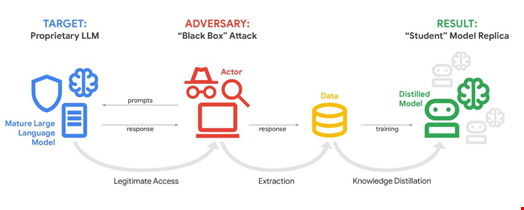
Illustration of a model extraction attack. Source: Google Cloud

While MEA and distillation attacks do not typically represent a risk to average users, as they do not threaten the confidentiality, availability or integrity of AI services, Google said they pose a risk of intellectual property (IP) theft for model developers and service providers - and thus violates Google’s terms of service.

Jailbroken Models and AI-Enabled Malware

Another prime AI threat Google identified is the rise of the underground ‘jailbreak’ ecosystem which includes new AI tools and services purpose-built to enable illicit activities.

Google noted that malicious services are emerging on underground marketplaces. These services claim to be independent models but rely on jailbroken commercial application programming interfaces (APIs) and open-source model context protocol (MCP) servers.

For example, Xanthorox’ is an underground toolkit that advertises itself as a "bespoke, privacy preserving self-hosted AI" designed to autonomously generate malware, ransomware and phishing content.

“However, our investigation revealed that Xanthorox is not a custom AI but actually powered by several third-party and commercial AI products, including Gemini,” the Google report said.

Google also observed threat actors abusing the public sharing features of AI platforms like Gemini and OpenAI’s ChatGPT to host deceptive social engineering content, using common techniques like ‘ClickFix’ to trick users into manually executing malicious commands by hosting the instructions on trusted AI domains to bypass security filters.

Finally, GTIG continued to observe threat actors experimenting with AI to implement novel capabilities in malware families in late 2025.

In September 2025, GTIG identified the Honestcue malware leveraging Google Gemini’s API to dynamically generate and execute malicious C# code in memory, showcasing how threat actors exploit AI to evade detection while refining fileless attack techniques.
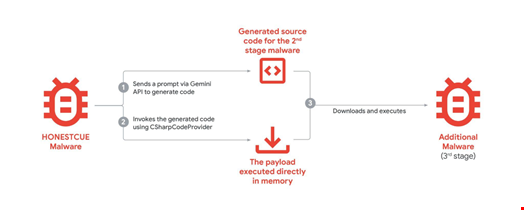
Illustration of the Honestcue malware lifecycle. Source: Google Cloud

This report is an update to Google’s November 2025 findings regarding the advances in threat actor usage of AI tools.

Read now: What is ClickFix and How to Prevent It