


惯性聚合 高效追踪和阅读你感兴趣的博客、新闻、科技资讯
阅读原文 在惯性聚合中打开

推荐订阅源

Recent Announcements
奇客Solidot–传递最新科技情报
奇客Solidot–传递最新科技情报
MongoDB | Blog
MongoDB | Blog
H
Help Net Security
钛媒体:引领未来商业与生活新知
钛媒体:引领未来商业与生活新知
人人都是产品经理
人人都是产品经理
freeCodeCamp Programming Tutorials: Python, JavaScript, Git & More
The GitHub Blog
The GitHub Blog
V
V2EX
Microsoft Security Blog
V
Visual Studio Blog
A
About on SuperTechFans
博客园_首页
L
LangChain Blog
量子位
雷峰网
雷峰网
Cyber Security Advisories - MS-ISAC
Jina AI
Jina AI
月光博客
月光博客
阮一峰的网络日志
阮一峰的网络日志
博客园 - 聂微东
Microsoft Azure Blog
M
MIT News - Artificial intelligence
N
Netflix TechBlog - Medium

www.infosecurity-magazine.com

Just Three Ransomware Gangs Accounted for 40% of Attacks Last Month Google Chrome Rolls Out Protection Against Infostealers Targeting Session Cookies STX RAT Targets Finance Sector With Advanced Stealth Tactics Bitcoin Depot Reports $3.6m Crypto Theft After System Breach Atomic Stealer MacOS ClickFix Attack Bypasses Apple Security Warnings Middle East Hack-for-Hire Operation Traced to South Asian Cyber Espionage Group Governance Gaps Emerge as AI Agents Drive 76% Increase in NHIs Google Warns of New Threat Group Targeting BPOs and Helpdesks Google API Keys Quietly Gain Access to Gemini on Android Devices Critical Vulnerability in Ninja Forms Exposes WordPress Sites Anthropic Launches Project Glasswing to Use AI to Find and Fix Critical Software Vulnerabilities US Thwarts DNS Hijacking Network Controlled by Russian APT28 Hackers Claude Discovers Apache ActiveMQ Bug Hidden for 13 Years Iran‑Backed Threat Actors Hit US CNI Providers via Internet‑Facing OT Assets Russian APT28 Hackers Hijack Routers to Steal Credentials, UK Security Agency Warns GPU Rowhammer Attack Enables Privilege Escalation and Full System Compromise GrafanaGhost Exploit Bypasses AI Guardrails for Silent Data Exfiltration Over $17bn Lost to Cyber Fraud in the Last Year, Warns FBI Storm-1175 Exploits Flaws in High-Velocity Medusa Attacks Fortinet Releases Emergency Patch After FortiClient EMS Bug Is Exploited New Phishing Platform Used in Credential Theft Campaigns Against C-Suite Execs New 'Storm' Infostealer Remotely Decrypts Stolen Credentials NCSC Issues Security Alert Over Hackers Targeting WhatsApp and Signal Accounts Apple Expands iOS 18 Security Updates Amid DarkSword Threat Researchers Observe Sub-One-Hour Ransomware Attacks GitHub Used as Covert Channel in Multi-Stage Malware Campaign Most CNI Firms Face Up to £5m in Downtime from OT Attacks Google Introduces Android Dev Verification Amid Openness Debate New Venom Stealer MaaS Platform Automates Continuous Data Theft Chinese Hackers Target European Governments in Espionage Campaigns
CrowdStrike, Google Take Down Glassworm Botnet
Kevin Poireault · 2026-05-27 · via www.infosecurity-magazine.com

Written by

An industry effort involving CrowdStrike, Google and the Shadowserver Foundation has led to the disruption of the Glassworm botnet.

Working together, the three organizations managed to simultaneously take down all four of Glassworm's command-and-control (C2) channels, severing the operators from their infected machines and their ability to deliver new malicious payloads.

These channels included traditional C2 servers hosted on commercial virtual private servers (VPS).

The botnet also relied on less common and more stealthy assets, such as Google Calendar event titles which were used as dead-drop locations for Base64-encoded C2 paths, peer-to-peer networks and blockchain-based infrastructure, notably with C2 server addresses encoded in the memo fields of transactions on the Solana blockchain.

The Glassworm remote access tool queried the BitTorrent peer-to-peer network for configuration data stored against hardcoded public keys.

“The combination of blockchain, peer-to-peer, and legitimate web services as resolution layers was designed to be resilient against takedowns — a dynamic front protecting the actual C2 servers behind multiple layers of indirection,” CrowdStrike noted in a report published on May 26.

This is why the threat hunters had to disrupt all channels simultaneously.

“Taking down only one channel would have left the others operational, allowing the operators to quickly reconstitute,” CrowdStrike added.
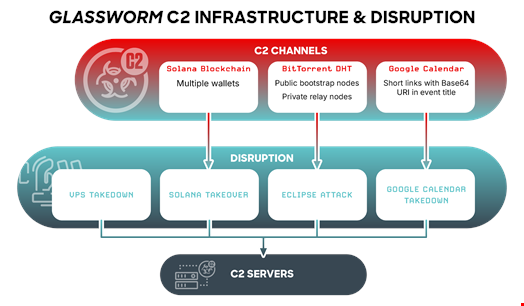
Representation of Glassworm infrastructure and disruption operations run by CrowdStrike, Google and the Shadowserver Foundation. Source: CrowdStrike

Glassworm Tied to Poisonous VS Code Extensions, Npm and Python Packages

A household name in open-source software supply chain attacks, Glassworm has been a network of devices controlled by malicious operators since at least early 2025.

It had been used in several multi-pronged malicious campaigns targeting software developers by poisoning open-source packages they rely upon across Windows, macOS and Linux systems.

Some of the activities linked to Glassworm included trojanized extensions of Microsoft Visual Studio Code (VS Code), published to the OpenVSX marketplace, compromised npm and Python packages introducing malicious code through postinstall hooks and setup scripts and

More than 300 GitHub repositories were poisoned using stolen developer credentials harvested from earlier Glassworm infections, CrowdStrike added.

The company highlighted that Glassworm “marked a significant shift in the threat landscape” that should “serve as a wake-up call for every organization that ships or consumes software.”

“Adversaries are no longer just targeting products, they're targeting the developers who build them. The barrier to poisoning a package or extension is low; the potential blast radius is enormous. As long as developer environments, build pipelines, and code repositories remain under-protected, every organization that consumes software inherits the risk of everyone who produces it,” CrowdStrike threat hunters warned.