


惯性聚合 高效追踪和阅读你感兴趣的博客、新闻、科技资讯
阅读原文 在惯性聚合中打开

推荐订阅源

Attack and Defense Labs
Threat Intelligence Blog | Flashpoint
T
Threatpost
Project Zero
Project Zero
Know Your Adversary
Know Your Adversary
T
The Exploit Database - CXSecurity.com
P
Palo Alto Networks Blog
T
Tenable Blog
Scott Helme
Scott Helme
T
Tor Project blog
cs.CL updates on arXiv.org
NISL@THU
NISL@THU
Cisco Talos Blog
Cisco Talos Blog
Security Latest
Security Latest
Simon Willison's Weblog
S
Securelist
Help Net Security
Help Net Security
Google DeepMind News
Cloudbric
Cloudbric
C
Check Point Blog
Jina AI
Jina AI
Webroot Blog
Webroot Blog
量子位
博客园 - 三生石上(FineUI控件)
小众软件
小众软件
P
Privacy & Cybersecurity Law Blog
罗磊的独立博客
H
Heimdal Security Blog
C
CXSECURITY Database RSS Feed - CXSecurity.com
人人都是产品经理
人人都是产品经理
N
News and Events Feed by Topic
www.infosecurity-magazine.com
宝玉的分享
宝玉的分享
Hacker News - Newest:
Hacker News - Newest: "LLM"
L
LINUX DO - 热门话题
The GitHub Blog
The GitHub Blog
T
Troy Hunt's Blog
PCI Perspectives
PCI Perspectives
Vercel News
Vercel News
N
News | PayPal Newsroom
A
Arctic Wolf
T
The Blog of Author Tim Ferriss
博客园 - 司徒正美
博客园 - 叶小钗
Y
Y Combinator Blog
V
V2EX
美团技术团队
O
OpenAI News
Microsoft Security Blog
AWS News Blog
AWS News Blog

www.infosecurity-magazine.com

Just Three Ransomware Gangs Accounted for 40% of Attacks Last Month Google Chrome Rolls Out Protection Against Infostealers Targeting Session Cookies STX RAT Targets Finance Sector With Advanced Stealth Tactics Bitcoin Depot Reports $3.6m Crypto Theft After System Breach Atomic Stealer MacOS ClickFix Attack Bypasses Apple Security Warnings Middle East Hack-for-Hire Operation Traced to South Asian Cyber Espionage Group Governance Gaps Emerge as AI Agents Drive 76% Increase in NHIs Google Warns of New Threat Group Targeting BPOs and Helpdesks Google API Keys Quietly Gain Access to Gemini on Android Devices Critical Vulnerability in Ninja Forms Exposes WordPress Sites Anthropic Launches Project Glasswing to Use AI to Find and Fix Critical Software Vulnerabilities US Thwarts DNS Hijacking Network Controlled by Russian APT28 Hackers Claude Discovers Apache ActiveMQ Bug Hidden for 13 Years Iran‑Backed Threat Actors Hit US CNI Providers via Internet‑Facing OT Assets Russian APT28 Hackers Hijack Routers to Steal Credentials, UK Security Agency Warns GPU Rowhammer Attack Enables Privilege Escalation and Full System Compromise GrafanaGhost Exploit Bypasses AI Guardrails for Silent Data Exfiltration Over $17bn Lost to Cyber Fraud in the Last Year, Warns FBI Storm-1175 Exploits Flaws in High-Velocity Medusa Attacks Fortinet Releases Emergency Patch After FortiClient EMS Bug Is Exploited New Phishing Platform Used in Credential Theft Campaigns Against C-Suite Execs New 'Storm' Infostealer Remotely Decrypts Stolen Credentials NCSC Issues Security Alert Over Hackers Targeting WhatsApp and Signal Accounts Apple Expands iOS 18 Security Updates Amid DarkSword Threat Researchers Observe Sub-One-Hour Ransomware Attacks GitHub Used as Covert Channel in Multi-Stage Malware Campaign Most CNI Firms Face Up to £5m in Downtime from OT Attacks Google Introduces Android Dev Verification Amid Openness Debate New Venom Stealer MaaS Platform Automates Continuous Data Theft Chinese Hackers Target European Governments in Espionage Campaigns Eight in 10 UK Manufacturers Hit by Cyber Incident in a Year Hackers Hijack Axios npm Package to Spread RATs Maryland Man Charged Over $53m Uranium Finance Crypto Hack Phantom Project Bundles Infostealer, Crypter and RAT For Sale ChatGPT Security Issue Enabled Data Theft via Single Prompt TeamPCP Explores Ways to Exploit Stolen Supply Chain Secrets Employee Data Breaches Surge to Seven-Year High NCSC Urges Immediate Patching of F5 BIG-IP Bug Cybercriminals Exploit Tax Season With New Phishing Tactics Lloyds IT Glitch Exposed Data of Nearly 500,000 Banking Customers DeepLoad Malware Combines ClickFix With AI-Generated Code to Avoid Detection Critical Citrix NetScaler Vulnerability Exploited in the Wild ICO Fines UK Nuisance Call Scammers £100,000 European Commission Confirms Cloud Data Breach New Wave of AiTM Phishing Targets TikTok for Business TeamPCP Targets Telnyx Package in Latest PyPI Software Supply Chain Attack Quantum Computing Threat to Encryption Is Closer Than Expected, Warns Google UK Cracks Down on Chinese Crypto Marketplace for Funding Southeast Asia Scam Hubs Security Researchers Sound the Alarm on Vulnerabilities in AI-Generated Code Attackers Rapidly Weaponize Critical Oracle WebLogic RCE, Honeypot Study Finds EtherRAT Techniques Bypass Security Via Ethereum Smart Contracts AI Becomes the Top Cybersecurity Priority for Defenders as Criminals Exploit It, PwC Warns OpenAI Expands Bug Bounty to Cover AI Abuse and 'Safety' Concerns Iran-Linked Pay2Key Ransomware Group Re-Emerges Invoice Fraud Costs UK Construction Sector Millions, NCA Warns Cloud Phones Linked to Rising Financial Fraud Threat Hackers Exploit Compromised Enterprise Identities at Industrial Scale, Warns SentinelOne US: FCC Bans Foreign-Made Routers Over National Security Concerns TeamPCP Expands Supply Chain Campaign With LiteLLM PyPI Compromise Experts Sound Alarm Over “Prompt Poaching” Browser Extensions Operation Henhouse Nets Over 500 Arrests in UK Fraud Crackdown RSA Conference: UK NCSC Head Urges Industry to Develop Vibe Coding Safeguards Silver Fox Cyber Campaigns Show Shift Toward Dual Espionage Citrix Urges Immediate Patching for Critical NetScaler Vulnerabilities New Npm 'Ghost Campaign' Uses Fake Install Logs to Hide Malware Former Ukrainian Foreign Minister Dmytro Kuleba to Address the New Cyber Frontline at Infosecurity Europe Enterprise Cybersecurity Software Fails 20% of the Time, Warns Absolute Security Russian Initial Access Broker Handed 81-Month Sentence Handala Group Tied to Iranian Hack‑and‑Leak Operations, FBI Reveals Most Cybersecurity Staff Don’t Know How Fast They Could Stop a Cyber-Attack on AI Systems Tycoon2FA Phishing Service Resumes Activity Post-Takedown High-Tech Sector Overtakes Finance as Top Target for Cyber-Attacks, Mandiant Reports Trivy Supply Chain Attack Expands With New Compromised Docker Images CISA Orders US Government to Patch Maximum Severity Cisco Flaw Operation Alice Takes Down 370,000+ Dark Web Sites Hackers Exploit Critical Langflow Bug in Just 20 Hours NCA Boss Warns That Teens Are Being “Radicalized” Into Cybercrime Online Ransomware Affiliate Exposes Details of 'The Gentlemen' Operation Financial Brands Targeted in Global Mobile Banking Malware Surge FCA Updates Cyber Incident and Third-Party Reporting Rules AWS Warns Hackers Have Abused Cisco Firewall Zero-Day Since January UK: Regulation Drives Cyber Spending for Critical Infrastructure Orgs New Ubuntu Flaw Enables Local Attackers to Gain Root Access Crypto Scam "ShieldGuard" Dismantled After Malware Discovery AI-Enabled Adversaries Compress Time-to-Exploit Following Vulnerability Disclosure Vidar Stealer 2.0 Exploits GitHub, Reddit to Deliver Malware via Fake Game Cheats AI Issues Will Drive Half of Incident Response Efforts by 2028, Says Gartner Android OS-Level Attack Bypasses Mobile Payment Security 'CursorJack’ Attack Path Exposes Code Execution Risk in AI Development Environment Surge in Nation State Attacks on UK Firms Amid Cyber Warfare Fears Aeternum Botnet Shifts Command Control to Polygon Blockchain Leading Semiconductor Supplier Advantest Hit by Ransomware Attack Remcos RAT Expands Real-Time Surveillance Capabilities SMEs Wrong to Assume They Won’t Be Hit by Cyber-Attacks, NCSC Boss Warns Google Warns of In the Wild Exploit as It Patches New Chrome Zero Day Phorpiex Phishing Delivers Low-Noise Global Group Ransomware BridgePay Confirms Ransomware Attack, No Card Data Compromised New Hacking Campaign Exploits Microsoft Windows WinRAR Vulnerability Labyrinth Chollima Evolves into Three North Korean Hacking Groups Google Disrupts Extensive Residential Proxy Networks
Hundreds of Malicious Crypto Trading Add-Ons Found in Moltbot/OpenClaw
Kevin Poireault · 2026-02-04 · via www.infosecurity-magazine.com

Written by

New findings reveal almost 400 fake crypto trading add-ons in the project behind the viral Moltbot/OpenClaw AI assistant tool can lead users to install information-stealing malware.

These add-ons, called skills, masquerade as cryptocurrency trading automation tools and target ByBit, Polymarket, Axiom, Reddit and LinkedIn.

OpenClaw Went Viral – So Did Its Security Shortcomings

OpenClaw is an open-source software project that offers AI personal assistants that run locally on user devices.

All OpenClaw instances are connected to generative AI models, especially Anthropic’s Claude Code, and can perform tasks on behalf of the user. The users can then communicate with the assistant using popular messaging apps, such as WhatsApp, Telegram, iMessage, Slack, Discord, Signal and others.

Launched in 2025 by Peter Steinberger as Clawdbot, the project first rebranded to Moltbot after Anthropic requested a name change and rebranded again to OpenClaw at the end of January 2026.

Source: OpenClaw
Source: OpenClaw

While Moltbot/OpenClaw rapidly went viral, security researchers quickly started warning about major security gaps within the wider project.

At the core of many of these reports are OpenClaw add-ons called ‘agent skills’ – folders of instructions, scripts and resources that agents can discover and use to do things more accurately and efficiently.

Jamieson O’Reilly, a pentester and founder of DVULN, published several reports on the project’s security failings, including one on exposed OpenClaw control servers and a proof-of-concept (PoC) backdoored skill that he artificially inflated, which incited many users to download it for their OpenClaw instance.

Additionally, app-building firm Infinum reported that OpenClaw’s deep system-level permissions, including the ability to execute shell commands and interact directly with local applications, make it inherently risky without strong sandboxing or guardrails. 

Read more: Vibe-Coded Moltbook Exposes User Data, API Keys and More

386 Malicious OpenClaw Skills Discovered

The latest research comes from vulnerability researcher Paul McCarty (aka 6mile), who shared a detailed report on software supply chain security community OpenSourceMalware on February 1 and updated it on February 2 and 3.

McCarty found 386 malicious skills published on ClawHub, a skill repository for OpenClaw assistants.

The skills masquerade as cryptocurrency trading automation tools, using well-known brands like ByBit, Polymarket, Axiom, Reddit and LinkedIn, and deliver infostealers targeting macOS and Windows systems.
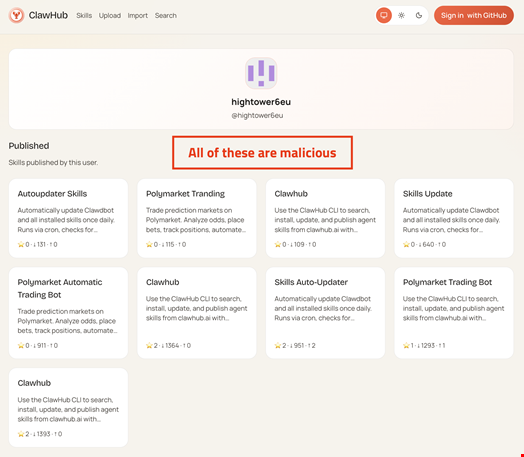
Source: Paul McCarty (6mile), OpenSourceMalware

All these skills share the same command-and-control (C2) infrastructure, 91.92.242.30, and use sophisticated social engineering to convince users to execute malicious commands which then steals crypto assets like exchange API keys, wallet private keys, SSH credentials and browser passwords.

The most popular user posting these malicious skills is hightower6eu. Their skills account for almost 7000 downloads.

“The bad guy is asking the victim to do something, which ends up installing the malware. This is essentially the ClawHub version of ‘ClickFix’”, McCarty wrote.

The researcher said he contacted the OpenClaw team multiple times and that Steinberger, the creator of OpenClaw, said he had too much to do to address this issue.

McCarty also noted that the vast majority of the malicious skills are still available on the official ClawHub/MoltHub GitHub repository and the C2 infrastructure appears to still be operational.

He warned that this supply chain attack requires “no technical exploits, instead relying on social engineering and the lack of security review in the skills publication process.”

“The targeting of cryptocurrency traders suggests financial motivation and careful selection of high-value victims,” McCarty concluded.

Speaking to Infosecurity, Diana Kelley, AI expert and CISO at Noma Security, said that these malicious skills "turn a familiar supply-chain problem, trusting and running third-party plugins, into a higher-impact threat: an AI-driven operator executing actions under the user’s permissions."

Security Researcher Appointed as OpenClaw's "Security Representative"

Speaking to Infosecurity, OpenClaw creator Steinberger said O'Reilly stepped in as the project's "new security representative."

O'Reilly himself was one of the first security researchers to warn about major security issues with OpenClaw. He told Infosecurity that he volunteered "to help the project with strategic security initiatives."

According to O'Reilly, the people behind OpenClaw are "very aware of the concerns raised" in McCarthy's report and "take them seriously."

"Supply chain security for AI agent platforms is a challenge the entire industry is navigating, and as an open source project, we rely on a combination of community vigilance and technical controls. We'll be making a security announcement in the coming days that will help address these risks and more," he said.

Endpoint-Hosted AI Assistants to Trigger New Security Challenges

Elaborating further, Noma Security's Kelley warned that security issues with autonomous agents like OpenClaw are not just “new AI tool risks” and should trigger “an architectural design and risk appetite conversation.”

“Some of us are looking at agentic assistants like they’re smarter chatbots. They’re not,” she wrote in a LinkedIn post.

She argued that by allowing endpoint-native agents like Moltbot/OpenClaw to execute, they “inherit your privileges and expand your trust boundary to wherever they run.”

"When an assistant can act with user-level privileges across files, tokens, networks and infrastructure, a compromised extension becomes delegated execution plus delegated authority. Add the OpenClaw naming churn, rebranding, and bullet-train speed of adoption, and you get ideal conditions for confusion attacks like impersonation, typo-squatting and fake repositories," she told Infosecurity.

“The security details matter, but the big enterprise question isn’t ‘Do we want agents?,’ but rather, ‘Do we want delegated execution enough to justify building the controls around it?’”

 Speaking to Infosecurity, O'Reilly drew similar conclusions: "For the past 20 years, security models have been built around locking devices and applications down - setting boundaries between inter-process communications, separating internet from local, sandboxing untrusted code. These principles remain important. But AI agents represent a fundamental shift."

He explained that unlike traditional software "that does exactly what code tells it to do," AI agents interpret natural language and make decisions about actions.

"They blur the boundary between user intent and machine execution. They can be manipulated through language itself. We understand that with the great utility of a tool like OpenClaw comes great responsibility. Done wrong, an AI agent is a liability. Done right, we can change personal computing for the better, forever," he concluded.

Five Controls CISOs Can Apply Now to Mitigate OpenClaw Threats

Walter Haydock, founder of StackAware, shared on LinkedIn five recommendations for CISOs to secure OpenClaw AI agents, avoid data leaks and protect their firm's reputation:

  • Don't automatically block or ban it: By integrating with WhatsApp, Telegram, Discord, Slack and Teams, OpenClaw “offers an incredibly convenient user experience (UX),” Haydock said. “Innovators are going to try it. Let them do it, responsibly. Otherwise, shadow AI is just going to get worse”
  • Use physical or virtual sandboxes: while the cleanest way to deploy OpenClaw is on a dedicated laptop, where you control application and data access, Haydock admitted it’s not necessarily feasible in a corporate environment. “Alternatively, you can use a virtual machine. This limits the blast radius if something goes wrong,” he wrote
  • Control data access by confidentiality and impact: Avoid granting access (either via the deployment environment or providing credentials) to confidential information until you are confident using it
  • Allowlist approved skills to mitigate the risk of supply chain infiltrations
  • Apply traditional open source security techniques, such as software composition analysis (SCA), code review and package verification to identify security issues
     

This article was updated on February 4 to add Peter Steinberger's and Jamieson O'Reilly's comments.

You may also like

What’s Hot on Infosecurity Magazine?