




惯性聚合 高效追踪和阅读你感兴趣的博客、新闻、科技资讯
阅读原文 在惯性聚合中打开

推荐订阅源

宝玉的分享
宝玉的分享
Engineering at Meta
Engineering at Meta
让小产品的独立变现更简单 - ezindie.com
博客园 - 聂微东
钛媒体:引领未来商业与生活新知
钛媒体:引领未来商业与生活新知
Last Week in AI
Last Week in AI
酷 壳 – CoolShell
酷 壳 – CoolShell
博客园 - 三生石上(FineUI控件)
T
Tailwind CSS Blog
Apple Machine Learning Research
Hugging Face - Blog
Hugging Face - Blog
爱范儿
爱范儿
博客园 - 司徒正美
人人都是产品经理
人人都是产品经理
Jina AI
Jina AI
博客园 - 叶小钗
雷峰网
雷峰网
罗磊的独立博客
OSCHINA 社区最新新闻
OSCHINA 社区最新新闻
博客园 - Franky
WordPress大学
WordPress大学
奇客Solidot–传递最新科技情报
奇客Solidot–传递最新科技情报
阮一峰的网络日志
阮一峰的网络日志
量子位

www.infosecurity-magazine.com

Just Three Ransomware Gangs Accounted for 40% of Attacks Last Month Google Chrome Rolls Out Protection Against Infostealers Targeting Session Cookies STX RAT Targets Finance Sector With Advanced Stealth Tactics Bitcoin Depot Reports $3.6m Crypto Theft After System Breach Atomic Stealer MacOS ClickFix Attack Bypasses Apple Security Warnings Middle East Hack-for-Hire Operation Traced to South Asian Cyber Espionage Group Governance Gaps Emerge as AI Agents Drive 76% Increase in NHIs Google Warns of New Threat Group Targeting BPOs and Helpdesks Google API Keys Quietly Gain Access to Gemini on Android Devices Critical Vulnerability in Ninja Forms Exposes WordPress Sites Anthropic Launches Project Glasswing to Use AI to Find and Fix Critical Software Vulnerabilities US Thwarts DNS Hijacking Network Controlled by Russian APT28 Hackers Claude Discovers Apache ActiveMQ Bug Hidden for 13 Years Iran‑Backed Threat Actors Hit US CNI Providers via Internet‑Facing OT Assets Russian APT28 Hackers Hijack Routers to Steal Credentials, UK Security Agency Warns GPU Rowhammer Attack Enables Privilege Escalation and Full System Compromise GrafanaGhost Exploit Bypasses AI Guardrails for Silent Data Exfiltration Over $17bn Lost to Cyber Fraud in the Last Year, Warns FBI Storm-1175 Exploits Flaws in High-Velocity Medusa Attacks Fortinet Releases Emergency Patch After FortiClient EMS Bug Is Exploited New Phishing Platform Used in Credential Theft Campaigns Against C-Suite Execs New 'Storm' Infostealer Remotely Decrypts Stolen Credentials NCSC Issues Security Alert Over Hackers Targeting WhatsApp and Signal Accounts Apple Expands iOS 18 Security Updates Amid DarkSword Threat Researchers Observe Sub-One-Hour Ransomware Attacks GitHub Used as Covert Channel in Multi-Stage Malware Campaign Most CNI Firms Face Up to £5m in Downtime from OT Attacks Google Introduces Android Dev Verification Amid Openness Debate New Venom Stealer MaaS Platform Automates Continuous Data Theft Chinese Hackers Target European Governments in Espionage Campaigns
OpenAI Expands Daybreak to Help Defenders Patch Flaws
https://www.infosecurity-magazine.com/profile/alessandro-mascell · 2026-06-23 · via www.infosecurity-magazine.com

Written by

OpenAI has expanded its cyber-defense program Daybreak, arguing that artificial intelligence (AI) has flipped the hardest part of security from finding software flaws to fixing them.

In an announcement on June 22, the company said the expansion centered on patch automation. It released the full version of a cyber-focused model, GPT-5.5-Cyber, alongside updates to its Codex Security tool and a new open-source patching initiative.

A More Capable, More Permissive Model

GPT-5.5-Cyber has now moved from preview to full release. However, access remains restricted and OpenAI said it was only offering access to the model to verified defenders through a limited release, paired with extra monitoring and controls.

The firm described it as both more capable and more permissive than its general models for authorized security work.

On CyberGym, a test of whether an AI agent can reproduce known vulnerabilities, OpenAI said the model scored a record 85.6%, against 81.8% for the standard GPT-5.5. It also reported gains in exploit writing and proof-of-concept (PoC) generation tests. Those same offensive-leaning skills are why access remains tightly gated, the company said. 
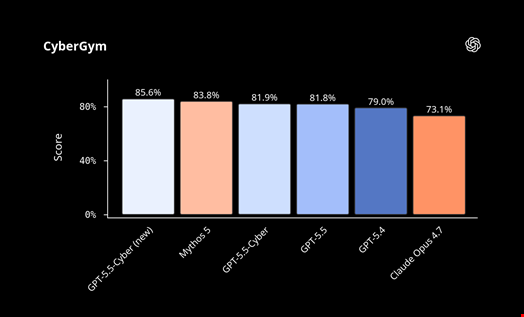
Credit: OpenAI.
Credit: OpenAI.

Read more on AI and the patching burden: Patch Responsibility Remains Up for Grabs as AI Unearth Flaws At Scale

From Findings to Fixes

The patching push ran mainly through Codex Security, a tool that plugs into OpenAI's Codex coding assistant to scan code, validate flaws and generate fixes for human review.

OpenAI said that since a March preview, it had scanned more than 30 million commits across 30,000 codebases, with over 500,000 findings logged as fixed.

A newly launched initiative, Patch the Planet, founded with Trail of Bits and others, aims the same tools at open-source software. It funds researchers to help maintainers fix bugs, with more than 30 projects signed up, including cURL, Go and Python.

OpenAI also opened a partner program letting security vendors such as CrowdStrike, Sophos and Fortinet, among others, build its models into their own products.

OpenAI framed the effort as keeping humans in control and getting defensive tools to more organizations before attackers gain the same edge. It said it had agreed cyber partnerships with several governments and would work with critical infrastructure operators.

The AI firm's benchmark figures came from its own testing, which it said was continuing on real-world fixes.

Rival AI lab Anthropic launched a comparable AI bug-fixing program, Project Glasswing, in April. 

Feature image credit: Samuel Boivin / Shutterstock.com