


惯性聚合 高效追踪和阅读你感兴趣的博客、新闻、科技资讯
阅读原文 在惯性聚合中打开

推荐订阅源

小众软件
小众软件
让小产品的独立变现更简单 - ezindie.com
WordPress大学
WordPress大学
月光博客
月光博客
Hugging Face - Blog
Hugging Face - Blog
博客园 - 聂微东
博客园 - 【当耐特】
博客园_首页
The Cloudflare Blog
freeCodeCamp Programming Tutorials: Python, JavaScript, Git & More
Apple Machine Learning Research
Last Week in AI
Last Week in AI
酷 壳 – CoolShell
酷 壳 – CoolShell
大猫的无限游戏
大猫的无限游戏
雷峰网
雷峰网
量子位
钛媒体:引领未来商业与生活新知
钛媒体:引领未来商业与生活新知
T
Tailwind CSS Blog
IT之家
IT之家
OSCHINA 社区最新新闻
OSCHINA 社区最新新闻
GbyAI
GbyAI
V
Visual Studio Blog
F
Fortinet All Blogs
Martin Fowler
Martin Fowler

www.infosecurity-magazine.com

Just Three Ransomware Gangs Accounted for 40% of Attacks Last Month Google Chrome Rolls Out Protection Against Infostealers Targeting Session Cookies STX RAT Targets Finance Sector With Advanced Stealth Tactics Bitcoin Depot Reports $3.6m Crypto Theft After System Breach Atomic Stealer MacOS ClickFix Attack Bypasses Apple Security Warnings Middle East Hack-for-Hire Operation Traced to South Asian Cyber Espionage Group Governance Gaps Emerge as AI Agents Drive 76% Increase in NHIs Google Warns of New Threat Group Targeting BPOs and Helpdesks Google API Keys Quietly Gain Access to Gemini on Android Devices Critical Vulnerability in Ninja Forms Exposes WordPress Sites Anthropic Launches Project Glasswing to Use AI to Find and Fix Critical Software Vulnerabilities US Thwarts DNS Hijacking Network Controlled by Russian APT28 Hackers Claude Discovers Apache ActiveMQ Bug Hidden for 13 Years Iran‑Backed Threat Actors Hit US CNI Providers via Internet‑Facing OT Assets Russian APT28 Hackers Hijack Routers to Steal Credentials, UK Security Agency Warns GPU Rowhammer Attack Enables Privilege Escalation and Full System Compromise GrafanaGhost Exploit Bypasses AI Guardrails for Silent Data Exfiltration Over $17bn Lost to Cyber Fraud in the Last Year, Warns FBI Storm-1175 Exploits Flaws in High-Velocity Medusa Attacks Fortinet Releases Emergency Patch After FortiClient EMS Bug Is Exploited New Phishing Platform Used in Credential Theft Campaigns Against C-Suite Execs New 'Storm' Infostealer Remotely Decrypts Stolen Credentials NCSC Issues Security Alert Over Hackers Targeting WhatsApp and Signal Accounts Apple Expands iOS 18 Security Updates Amid DarkSword Threat Researchers Observe Sub-One-Hour Ransomware Attacks GitHub Used as Covert Channel in Multi-Stage Malware Campaign Most CNI Firms Face Up to £5m in Downtime from OT Attacks Google Introduces Android Dev Verification Amid Openness Debate New Venom Stealer MaaS Platform Automates Continuous Data Theft Chinese Hackers Target European Governments in Espionage Campaigns
Researchers Warn of Global Surge in Fake Shipment Trackin...
Kevin Poireault · 2026-03-16 · via www.infosecurity-magazine.com

Written by

Photo of Kevin  Poireault

Fake shipment tracking scams are rapidly scaling across the world, exploiting the 161 billion annual parcel volume that fuels global e-commerce, according to threat intelligence provider Group-IB.

The firm’s Threat Intelligence research team detected a spike in this type of scheme exploiting the popularity of parcel delivery services in 2025.

From almost no such activity observed in 2024, the researchers identified over 100 fake shipment tracking campaigns almost every month throughout the past year, with peaks at 218 and 208 unique campaigns in June and December 2025, respectively.
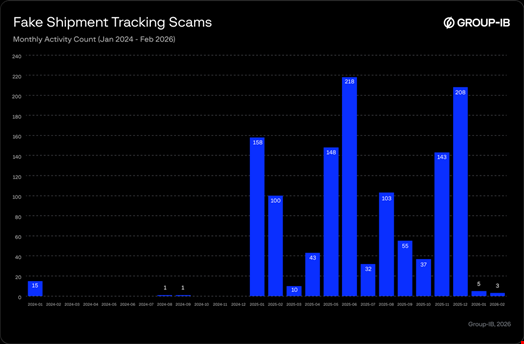
Source: Group-IB
Source: Group-IB

Some of these campaigns are linked to Darcula, a Chinese-language phishing-as-a-service (PhaaS) platform offering tools that are used in over 100 countries.

Fake Shipment Tracking Scams Explained

The researchers noted that, while many phishing and fake shipment tracking scams rely on cheap, disposable and lightly regulated domains to operate quickly and anonymously (such as [.]xyz,[.]help, [.]shop, [.]click and [.]top) they also abuse trusted extensions like .com through lookalike variations designed to mimic real brands.

A typical fake shipment tracking scam campaign starts with an attacker setting up a phishing domain and a fake website.

Next, they typically use one of the following methods to infect victims, both sent through an SMS that includes phishing messages claiming failed deliveries:

  • Using a legitimate-looking anonymous number (e.g. formatted like local mobile prefixes)
  • Using Sender ID spoofing so that the message appears to come from the same official sender the victim’s phone already trusts

The attackers typically use URL masks so that the malicious URLs embedded in the phishing SMS appear legitimate and the malicious page renders properly on mobile devices, increasing the likelihood of victim engagement.

Victims who click to "update address details" or "pay small fees" are then led to pages where they are encouraged to fill in missing personal and/or financial information. This is where victim funds and credentials are stolen.
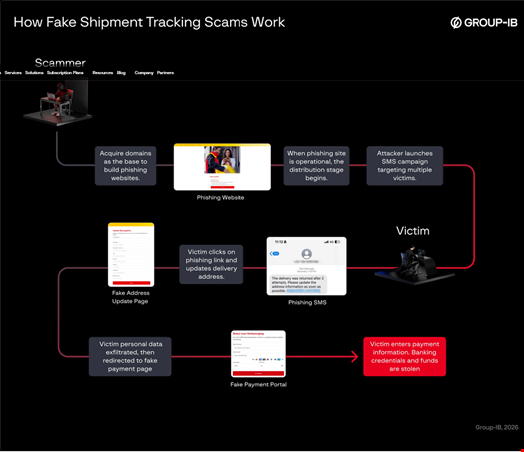
Source: Group-IB
Source: Group-IB

Observed Infrastructure Links to Dracula Phishkit

While no single threat actor has been definitively linked to these schemes, the Group-IB researchers observed that many of the phishing sites share infrastructure and characteristics commonly associated with Darcula.

Darcula Phishkit is a Chinese-language PhaaS platform that emerged in 2023 and has been used in phishing attacks against organizations (e.g. government, airlines, postal services, financial services) in over 100 countries.

It offers cybercriminals more than 20,000 counterfeit domains to spoof brands and over 200 phishing templates.

Dracula used to commercialize its PhaaS kit through Telegram. However, Group-IB noted that the group removed its public contact information, accounts, domains and platform following its exposure by security vendor Mnemonic.

The group continues to promote its tools through underground channels, confirmed the Group-IB researchers in a March 13 report.

Shipment Tracking Scam Mitigations

The Group-IB report provided a list of recommendations to prevent and mitigate fake shipment tracking scams for both individuals and businesses.

It urged business to:

  • Educate the public and customers by regularly publishing alerts about ongoing phishing attempts abusing their brands
  • Strengthen official domains using strong authentication and domain security protocols such as DMARC, SKIM and SPF to reduce emails sent under the company name
  • Employ a brand protection service that can actively track fake domains, fraudulent pages and suspicious TLD registrations impersonating the brand
  • Provide a public verification tool that allows customers to verify tracking numbers, and check and confirm official messages and communication channels to immediately reduce scam success rates
  • Ensure strong branding practices in official messages such as consistent short codes, single verified domain, and secure https links
  • Work with mobile operators to filter scam SMS patterns and block impersonation attempts before they reach the customer
  • Have a clear reporting channel (e.g. fraud@yourcompany.com)