








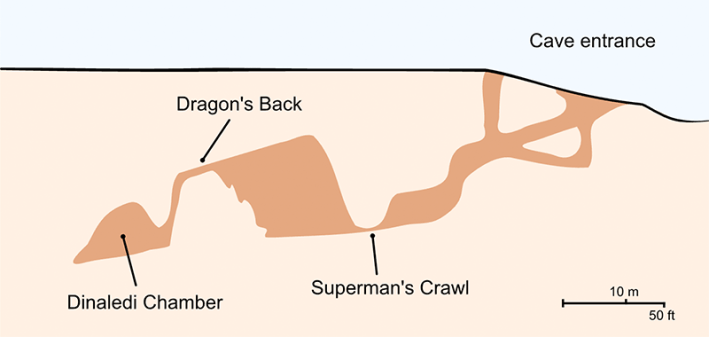
In an eyebrow-raising Facebook post in 2013, paleontologist Lee Berger made an interesting overture. He needed a team of people with paleontology and caving experience, with one other stipulation: They had to be small. Berger was assembling a team to descend into the Dinaledi Chamber of the Rising Star Cave system in South Africa, a journey that required squeezing through claustrophobic spaces (some only as large as seven inches). Inside were the bones of several members of a roughly 300,000-year-old hominin species previously unknown to science.
Read more: “The Beloved Mesolithic Girl”
Six women, dubbed “underground astronauts” in a nod to the risky subterranean mission, were selected to excavate the site. The bones they recovered belonged to the Homo naledi, which had a curious mix of modern and archaic features. H. naledi walked upright and had human-like hands and faces, but also smaller skulls like Australopithecus. Strangely, they seemed to lack any sexual dimorphism, something that puzzled the researchers for more than a decade. Now, a new analysis of their remains published in Cell has solved the mystery—just like the underground astronauts who recovered their bones, they were all female.
An international team of researchers from a variety of disciplines made the startling discovery using a cutting-edge method to analyze the proteins contained within H. naledi teeth. By carefully extracting samples using acid, they were able to determine the sequence of amino acids in peptide fragments of amelogenin, a protein involved in enamel formation. Amelogenin comes in two different isoforms: amelogenin-X from the X chromosome and amelogenin-Y from the Y chromosome. Normally, male teeth show a mix of 90 percent amelogenin-X and 10 percent amelogenin-Y, but there was no amelogenin-Y present in any of the H. naledi teeth.
But why only females?
Researchers believe the bodies, which include both adults and children, were placed in the Dinaledi Chamber because they were female, as part of a ritualized burial practice. If so, the implications are staggering. H.naledi could be the first non-human (or Neanderthal) species known to lay their dead to rest, a rite that hints at a larger culture, now lost to time. 
Enjoying Nautilus? Subscribe to our free newsletter.
Lead image: Lee Roger Berger research team
此内容由惯性聚合(RSS阅读器)自动聚合整理,仅供阅读参考。 原文来自 — 版权归原作者所有。