





Every moment of our lives, our bodies are awash in sensory signals. Photons hit our retinas. Waves of compressed air collide with our eardrums. Volatile molecules bind to receptors in our nostrils, and chemicals slather our taste buds. Pressure and heat activate nerve endings in our skin. We are able to navigate this torrent because the brain does an enormous amount of data compression. Through a process known as categorization, the brain turns the messy, noisy, information-rich world into objects, people, concepts, and emotions that we can understand and act on at the level of experience.
In neuroscience’s traditional view, categorization happens at the very end of sensory processing. The brain passively receives sensory details, then decodes their features and matches them to stored templates in memory, like a clerk shuffling through a neural filing cabinet. But this approach to categorization struggles to account for the extraordinary flexibility in the way we assign labels to features of the world. On a clear day on an open street, a sudden rhythmic patter is a pigeon taking flight, yet when we’re walking down a dimly lit alley at night, the same sound is the shuffle of a stranger’s footsteps. How can the brain categorize similar sets of sensory signals in radically different ways for different situations?
Two of the world’s leading neuroscientists have brought an updated understanding of brain function and structure to this question. In the pages of Nature Reviews Neuroscience, Lisa Feldman Barrett, who studies the psychology and neuroscience of emotion at Northeastern University, and Earl Miller, who studies how the brain carries out goal-directed behavior at the Massachusetts Institute of Technology, collaborated on a new view of categorization. They describe how the brain constantly reconstructs its categories moment to moment based not only on senses and memory, but on the body’s immediate physiological needs.
At the heart of their framework is a counterintuitive insight. While we may have the impression that our categories reflect an objective reality, the researchers argue that the brain projects categories onto the world in response to the body’s survival needs. Before we are even aware of our sensory impressions, the brain is already preparing the body to behave in ways that maintain the energetic resources that power our physiological systems. In this way, the brain’s predictions — rather than the cumulative effects of sensory information — ultimately shape and limit how we categorize objects and features of the world.
The duo’s framework is “a fresh perspective on categorization,” said Luiz Pessoa, a neuroscientist from the University of Maryland. Their idea of “the maintenance of the energetic constraints of life as fundamental to how we structure our categories,” he said, is “really important to pursue.”
Also new in Barrett and Miller’s framework is the hypothesis that categorization doesn’t happen in a particular area of the brain, but across the entire organ and beyond. To understand how organisms form categories, they argued, neuroscientists have to look all over the nervous system, from head to toe.
For many years, these two influential neuroscientists were in the same orbit, but had never collaborated directly.
Miller measures high-level electrical patterns in the brain to better understand the mechanisms driving a model of neural computation known as predictive coding. Predictive coding regards our perceptions as products of the brain’s predictions, rather than a scene built from sensory signals it passively receives.
Typically, if we are experiencing a normal sensory scene (relaxing at home, say) without any novel information, the brain generates predictive signals about the environment (known as feedback signals) that will dominate incoming sensory (or “feedforward”) signals. But if something unexpected happens — an event that deviates from the predictive model — the sensory feedforward signals, such as those arriving in the visual cortex, run up against the predictive feedback signals. This difference creates prediction errors. When sensory signals violate your predictive model, they might enter conscious experience as a feeling of surprise.
“Your brain has to constantly make predictions about what’s going to happen in the next few seconds because it’s got to filter out most of the incoming sensory information,” Miller said. “It can’t process it all, so it’s mainly looking for things that mismatch predictions because it’s more informative.”
In her work, Barrett has applied these ideas of prediction and anticipation to our theoretical understanding of emotions. Central to her work is the concept of allostasis: how an organism predictively regulates its energy use. In her view, emotion categories — fear, happiness, anger — resemble predictive “action plans” that the nervous system generates to activate behaviors that have served us well before. For example, a worked-up bodily state, with elevated heart rate, fast breathing, and tense muscles, in the context of being chased by a dog, would indicate the emotion category “fear” to activate certain behaviors and use our energy resources to fight or run away. Traditionally, emotions were thought to be hardwired in specific circuits present from birth. Barrett has helped show that we construct emotional categories in relation to signals both from within the body and from the external context.
In 2025, Barrett reached out to Miller to see if he’d be interested in putting their ideas together to create a new framework for categorization — one that would move beyond the filing-cabinet model to include their ideas about prediction and allostasis. “Even really brilliant scientists can sometimes be guided by traditional thinking, which can be hard to get beyond,” she said. “He understood what I was saying immediately.” So she asked if he wanted to write a paper together. Miller said yes.
“In our discussions it became clear we were cut from the same cloth,” Miller said. “What I love about Lisa is that she is always thinking in big-picture terms. … Both of us, we are not afraid to say things that run counter to the standard way of looking at things.”
As animals, we are tasked with surviving through change — in the environments we are embedded in, and in our own bodies as well. Because we have limited energy, time, and computational resources, understanding every detail of every situation is impossible. That means we have to take shortcuts to stay alive.
That’s where categories come in. “A category is an event in which different things are treated as similar or equivalent in a particular situation,” Barrett said. Categories might be as basic as “food,” “threat,” or “mate.” Humans have a remarkable ability to form much more detailed categories, including ones that are highly abstract: Visit a philosophy department to hear about categories such as “justice,” “truth,” and “beauty.”
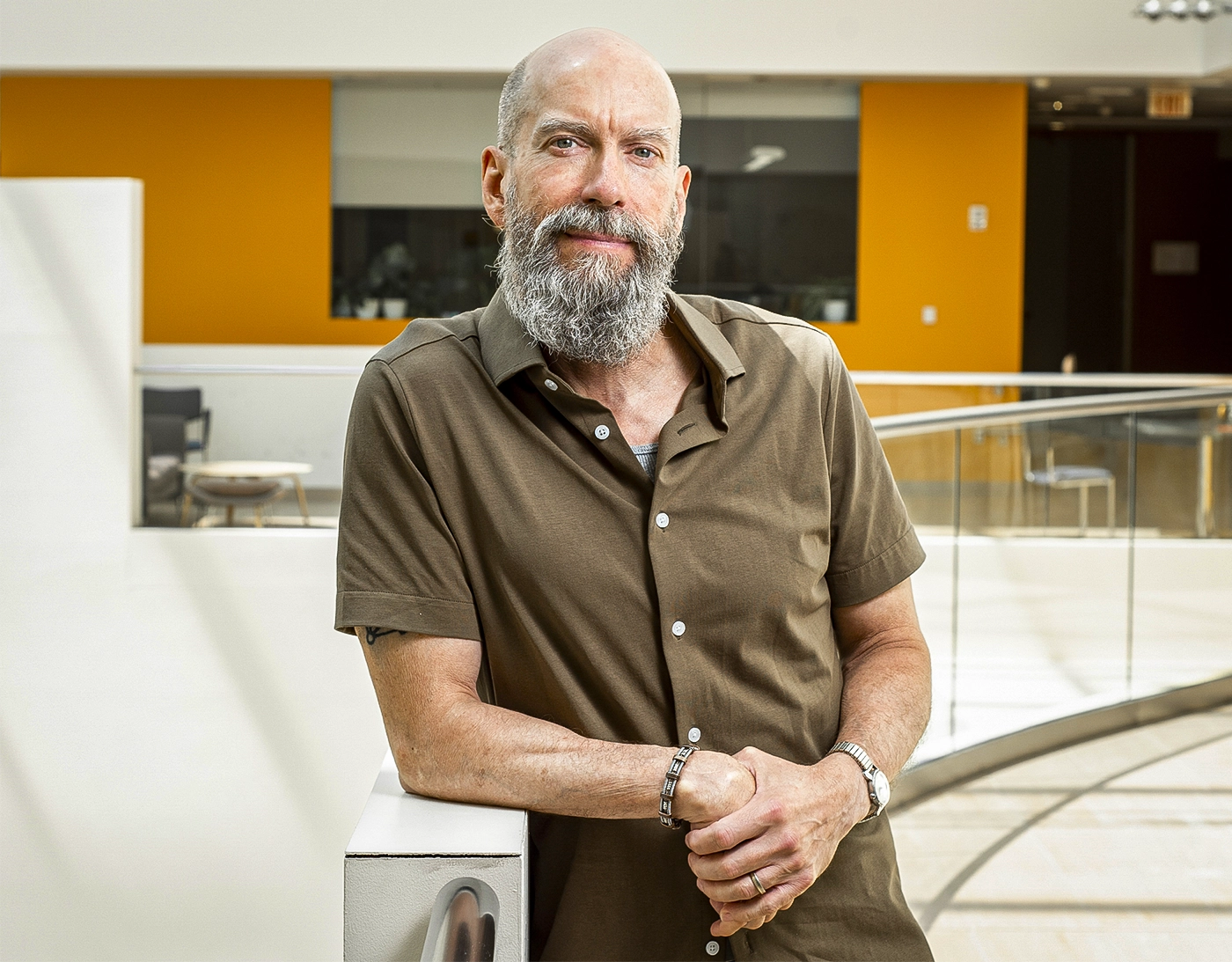
Earl Miller measures the dynamics of brain waves to study their role in cognition at the Massachusetts Institute of Technology.
Courtesy of Earl Miller
The function of categorization, Barrett said, is to use past experiences that resemble a new situation to implement behaviors that keep our bodily systems functioning. The category “apple” might be defined through physical features — smooth, round, red, palm-size — but it also includes a set of behavioral policies for how we should interact with it: “good for eating” or “throw out when rotten.”
“The point that is important about categorization is that you do all that for a purpose,” said Timothy Buschman, a neuroscientist from Princeton University. “The reason for categorization is to support the current task. Whatever it is that you want or whatever situation you are in, you are categorizing something according to what meaning it has for you.”
But how are categories formed? According to the traditional view, over time our experiences construct a generalized list of attributes to form a category such as “cat” that we can use to differentiate furry creatures. By this model, we take in sensory information and pare it down to match the categorical features in our memory: “Oh, there’s this thing that’s shaped like a tail; it has ears, it has fur — now I’ve figured out all those features,” Miller suggested. “Now I query my memory banks: Oh, it’s a cat.”
In Barrett and Miller’s view, however, the brain uses memories of similar past situations to predict a set of behaviors that are appropriate for the new situation before the senses have identified a traditional category.
Imagine you are walking, and you feel a scratch on your leg. If you’re in a safe place and are calm, you’ll carry on without giving the sensation a second thought. But let’s say you are walking through tall grass in an unfamiliar place; your heartbeat and breathing are faster than normal. You feel nervous because your brain has predictively allocated resources to your body to flee any potential threats. And by feeling nervous, you have been primed to assume the scratch is a potential threat — an insect bite or, worse, a snake.
In both situations, the sensation of the scratch is the same, but the brain categorizes it in vastly different ways. The fact that a much broader set of signals — environmental and corporeal — influences how we form categories sets the stage for Barrett and Miller’s new framework.
Their proposal is based on years of anatomical, electrophysiological, and brain-imaging research from their labs and others. They have built an argument that categorization is an ongoing predictive tool by which nervous systems guide behavior to keep the organism alive.
Some of their evidence is at the neuronal level. They cite research showing how brain connectivity is structured to favor predictive signals over sensory ones. For example, there are many more connections between neurons that facilitate the feedback flow of internally generated signals than between those handling the feedforward signals that originate from our senses. Even within the visual cortex, 90% of synaptic connections facilitate feedback signaling. That suggests that the brain is structured for predicting categories, perceptions, and behaviors, rather than for categorizing in reaction to stimuli.
On the feedforward side, the authors describe how circuits that carry sensory information undergo extensive compression as they travel deeper into the brain. They encounter many small neurons that are densely packed but scarcely connected, and their signals get whittled down through fewer, bigger, better-connected neurons. Traveling along this gradient, sensory signals become highly abstracted — and eventually reach integrative regions, which coordinate information from the senses, memory, and body to guide behavior.
The authors then draw on electrophysiological work from Miller’s lab to show how feedback and feedforward signals interact. In a zoomed-out view of the brain, traveling waves, which represent the activity of many neurons, carry information about goals, plans, and the energetic state of the body. These waves then encounter and combine with others carrying information from the senses.
According to Barrett and Miller, interaction between waves of information cascading across the brain can start to explain how the same set of external sensory signals might be categorized differently in different situations. If you are exhausted and hungry, a bruised, overripe apple is categorized as much-needed food. If you are well rested and energetically satiated, it’s a piece of subpar fruit to be passed over.
“Our internal state is just as, if not more, important than sensory input to us,” said Sandra Reinert of University College London, who has studied categorization in rodents. “It’s completely intuitive to see how an internal context remaps our rules [for how we form a category].”
A central component of Barrett and Miller’s framework is the origin of predictive signals in the brain. In most neuroscientific literature on visual categorization, integrative regions of the cortex (located on the outer surface of the brain) are considered the source of predictive expectations. “They [Barrett and Miller] make a different move,” Pessoa said. “They take the limbic core as the source of these predictive signals.”
The limbic core includes structures deep in the brain that combine signals carrying information from the body, senses, memory, and higher-level cognitive functions. This integrative network is both close to and highly connected to the hypothalamus, an ancient part of the brain that monitors basic bodily functions, such as body temperature, heart rate, and hunger.
Because the hypothalamus helps inform the cortex — the folded, outermost layer of the brain, which is involved in high-level cognition such as executive control — about the body’s energetic state, the authors hypothesized that the limbic core facilitates the brain’s ability to anticipate the body’s energy needs.
The limbic core is where the most compressed summaries of internal and external signals intersect. You can imagine the nervous system as being structured like two funnels, shaped like a bow tie, that meet at their narrowest point — the limbic core, the point of highest compression. Just as visual information is compressed as it travels through the visual cortex and deeper into the brain, physiological signals are compressed as they travel from the body up the vagus nerve and into the brain. They then reach the limbic core, where they are integrated with compressed sensory information. Together, these signals generate an appropriate category and its associated behavior.
Depending on the category — a visual category like “apple,” an abstract category like “justice,” or an emotion category like “awe” — the interaction of the predictive feedback signals with the compressed sensory feedforward signals can happen in any number of neural regions. The process spans the entire nervous system, the authors wrote.
Barrett emphasized that selecting any particular starting point for this process is arbitrary. “For the sake of having a scientific discussion, you have to say, ‘I’m going to pick this point as the start,’” Barrett said of the limbic core. “We could’ve easily just picked some other point.”
Miller agreed. “Lisa and I are arguing that this is something that is happening at every level, and it’s happening in lots of places, and it’s happening as a result of these opposing, interacting flows of information — feedforward and feedback,” he said. “It’s not at one end of the brain, which it has traditionally been thought.”
Barrett and Miller are asking the field to move beyond a model in which categories are stored like documents in the brain’s filing cabinet. From the way the brain is structured to compress sensory information, to how it predicts and prepares the body to respond, categorization is “baked” in, the authors wrote. It is a core organizational principle of the nervous system that draws on memory, perception, and behavior to help us survive well in an information-rich world.
此内容由惯性聚合(RSS阅读器)自动聚合整理,仅供阅读参考。 原文来自 — 版权归原作者所有。