惯性聚合 高效追踪和阅读你感兴趣的博客、新闻、科技资讯
阅读原文 在惯性聚合中打开

推荐订阅源

Engineering at Meta
Engineering at Meta
J
Java Code Geeks
I
InfoQ
腾讯CDC
Vercel News
Vercel News
IT之家
IT之家
V
Visual Studio Blog
P
Proofpoint News Feed
freeCodeCamp Programming Tutorials: Python, JavaScript, Git & More
G
Google Developers Blog
Cyber Security Advisories - MS-ISAC
博客园 - 叶小钗
有赞技术团队
有赞技术团队
月光博客
月光博客
Martin Fowler
Martin Fowler
量子位
L
LangChain Blog
B
Blog
Last Week in AI
Last Week in AI
博客园 - 司徒正美
Microsoft Security Blog
博客园 - 聂微东
Microsoft Azure Blog
A
About on SuperTechFans

PetaPixel

Polaroid Go Generation 3 Is the World’s Smallest Instant Analog Camera China Lucky’s New Color C200 Film Has Arrived in the US and Looks Great Chinese Private Equity Firm HSG Emerges as Leading Bidder to Buy Stake in Leica Camera Leica Cine Compact 1 Projector Promises a Plug-and-Play Home Theater Experience There Are No Photos Allowed at the Studio Ghibli Amusement Park Xiaomi 17T Pro Review: High-End Photography Without the Flagship Price Photographer Builds the iPhone Camera App He Always Wanted New $50 Y2K-Inspired Compact Camera Looks Thin In Form and Function Save Big on Macro Photography Essentials Nvidia’s New Chip Aims to Upend the Creative Laptop Market Japanese Zoo Considering Photo Ban After US Tourists Invade Punch the Monkey’s Enclosure Years in the Making, Glass Imaging Is Delivering on its Promise to Transform Smartphone Photography Gen Z are Five Times More Likely to Have a Plan for Photos After Death Long Island Beach Where Marilyn Monroe Posed for Iconic Photos Honored With Plaque Camera Trap Captures One-Armed Gorilla Raising Newborn in the Wild Photographer’s Camera Gear Gets Jet Washed by 20-Foot Wave in Tahiti Photojournalists Say ICE Agents Targeted Them and Their Cameras at Delaney Hall Protests Model Sues Fashion Brand After it AI-Generated Pictures of Her Easy Macro Photography Tips for Incredible Close-Up Photos The Myth of Intent in Photography Samsung’s Competitors Have a Better Samsung Camera Than Samsung Does Thypoch Simera 50mm f/1.4 Review: Crisp and Clean The AI Film ‘Dreams of Violets’ Is How You Get Me to Hate Movies Photographer Documents the Vanishing Wildlife of the ‘American Amazon’ Press Photographer Releases 30-Year Archive of Iconic Celebrity Images Photographer Granted Rare Access to Cambridge’s May Balls for 40 Years Atmos Is a Weather App By Photographers, for Photographers A Feature-Length AI-Generated ‘Live Action’ Movie Is Premiering at Tribeca for Some Reason Despite Being a Member, YoloLiv Isn’t Complying with the Micro Four Thirds Standard ArcBlue C42 Is the World’s First Smart Full-Frame Astrophotography System
This Is the Most Detailed Photo of the Milky Way's Center...
Jeremy Gray · 2026-06-24 · via PetaPixel
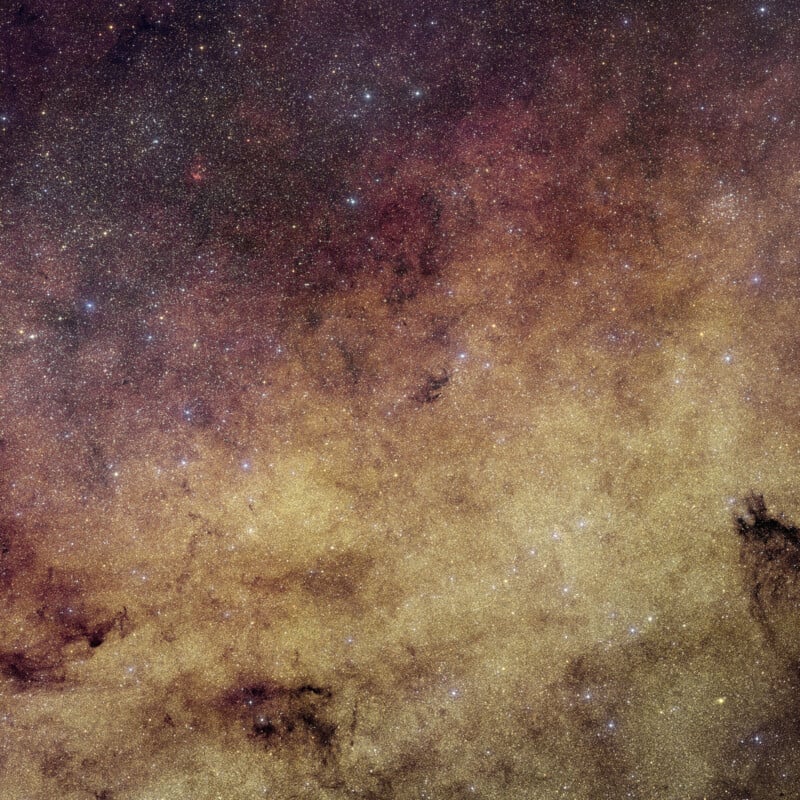
Dense region of the Milky Way galaxy with countless stars, interstellar dust clouds, and varying shades of yellow, brown, and dark patches across the image, giving a textured, cosmic appearance.
‘This is the largest high-resolution photo ever made of our Milky Way galaxy’s center in visible light. It was taken on 23 March 2025 by the European Space Agency’s Euclid space telescope. Packed with more than 60 million stars, this image opens the door for scientists to confirm the existence of any exoplanet found in this region and measure its mass using tiny changes in starlight over time.’

For just over a single day, the European Space Agency’s (ESA) cutting-edge Euclid Space Telescope pointed its lens toward the relatively close and extremely bright inner region of the Milky Way galaxy, known as the galactic bulge. The space telescope made good use of its time, capturing the largest and most detailed photo ever of the Milky Way’s galactic center.

Packed with more than 60 million stars, the Milky Way’s “crowded heart,” as ESA puts it, has never looked so good. It is just a blanket of color and light, with almost no blank space whatsoever.

The full-resolution is 18,000 by 18,000 pixels, which makes it a staggering 324 megapixels.

Although Euclid is designed to photograph extremely distant objects rather than its home galaxy, its visible-light camera is extremely high-resolution and very sensitive, making it well-suited to just about any cosmic exploratory task. What’s especially important about Euclid’s imaging system is that it can look directly at stars, even nearby ones, without being blinded. This enables scientists to use techniques like microlensing to find exoplanets, which are often challenging to spot due to their darkness and proximity to relatively bright host stars.
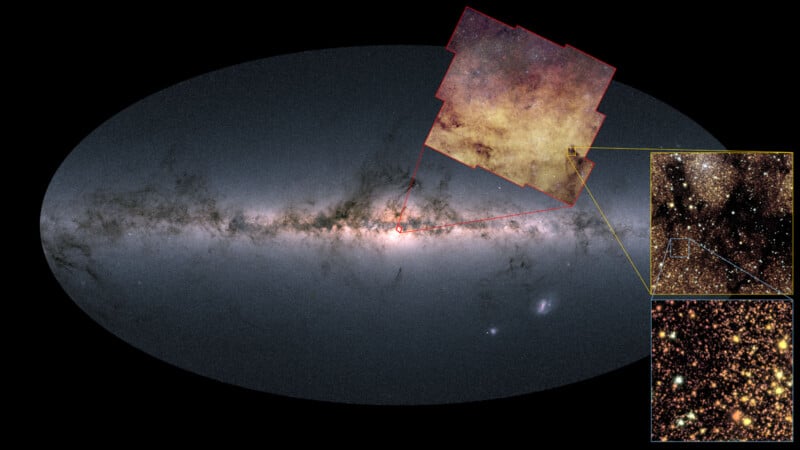
Wide view of the Milky Way galaxy with inset zoom panels showing progressively closer images of a dense star field near the galactic center, highlighting increasing detail and star density.
Location of Euclid’s galactic bulge survey

This is a very important scientific part of Euclid’s new Milky Way photo. The image mission let scientists study microlensing on a much smaller scale, where this distinct form of gravitational lensing is caused by individual stars and exoplanets in “our own galaxy.”

“To catch microlensing, you need to observe parts of the sky that are crowded with stars, such as close to the center of our galaxy,” explains Jean-Philippe Beaulieu of the Institut d’Astrophysique de Paris in France and the University of Tasmania in Australia. Beaulieu was the impetus behind Euclid’s new galactic bulge survey and co-led the exoplanet group in the Euclid Consortium.

“During the last twenty years, almost 300 exoplanets have been discovered using this technique, all with ground-based telescopes and all towards the center of our galaxy. This image from Euclid includes 51 known planetary systems — and it will assist in studying many more that will be found,” Beaulieu concludes.

ESA says that Euclid captured its enormous new Milky Way photo during a 26-hour observation on March 23, 2026. It is a mosaic of nine individual “pointings,” or images, and each photo captured a patch of the sky larger than the full Moon.

From a pure sharpness and sensitivity perspective, Euclid’s visible-light camera is similar to the Hubble Space Telescope’s Wide Field Camera (WFC), but what sets Euclid apart is how much larger an area it captures. Each Euclid image (pointing), captured in a few hours, covers an area 270 times larger than Hubble’s field of view.
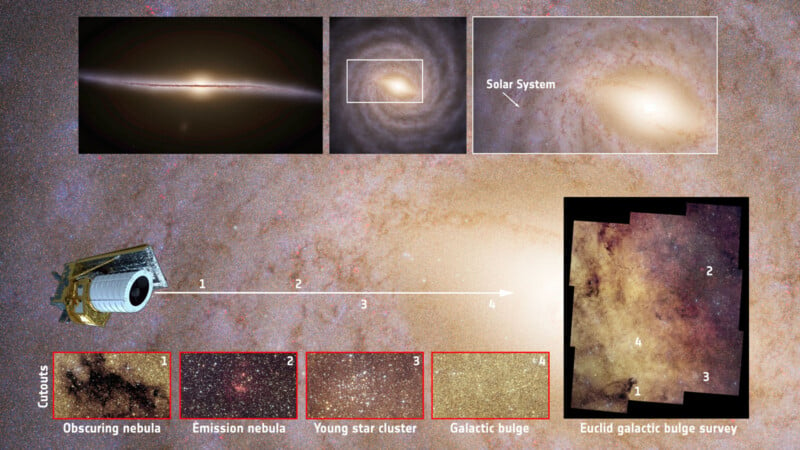
A labeled diagram shows the Milky Way’s structure, highlighting the galaxy’s side and top views, the Solar System, Euclid mission spacecraft, types of star regions, and a survey of the galaxy’s central bulge with numbered sections.
This infographic places Euclid’s galactic bulge survey in the broader context of the Milky Way’s structure, using data from ESA’s Gaia mission.

“Euclid is faster, and able to capture details from fainter stars that would be otherwise missed when observing from the ground,” ESA says. “This single mosaic also encompasses the entire region that the upcoming NASA Nancy Grace Roman Space Telescope will monitor for planet hunting.”

During its 26-hour mosaic, Euclid captured all the stars that will be included in all of Roman’s future microlensing events. Euclid’s data will prove instrumental during that and all future exoplanet missions in the region.

As the European Space Agency explained on Threads, there are so many interesting things to see in Euclid’s record-breaking mosaic, including deceptive and dense clouds of dust and gas, baby nebulae, and a huge cluster of suns.

“This means that anyone who detects a microlensing event in the same region, for example with Roman, will be able from now on to use Euclid data as a time reference in the past and see how the stars looked before they overlapped,” explains Natalia Rektsini of the Institut d’Astrophysique de Paris in France. Rektsini led the release of Euclid’s galactic bulge survey data for the broader scientific community.
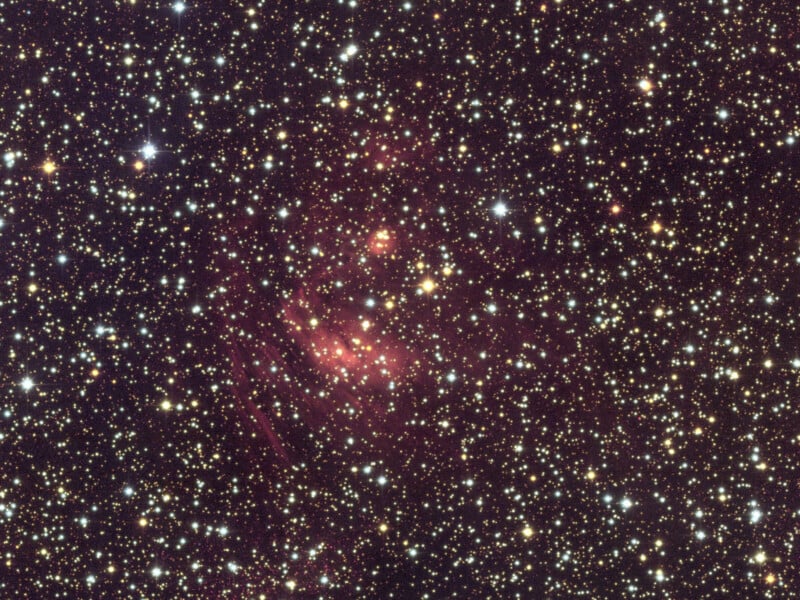
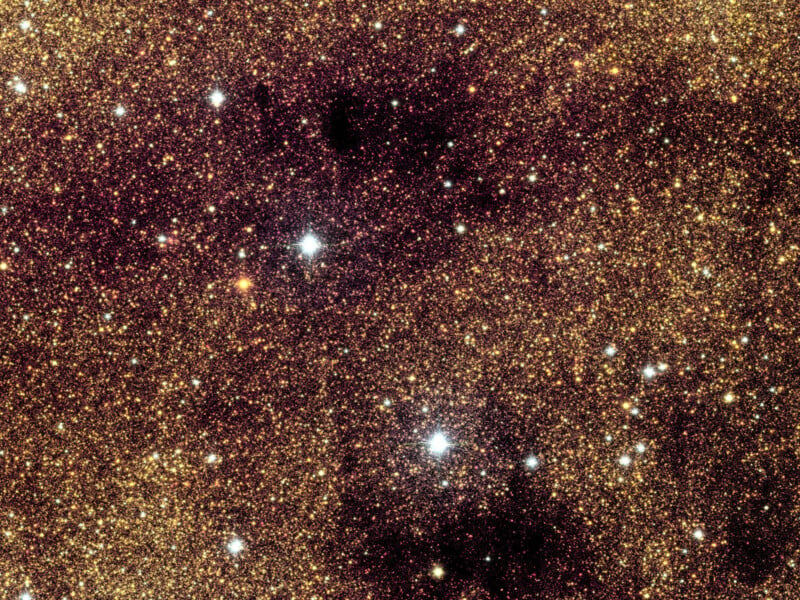
A dense field of stars scattered across a dark sky, with some areas showing faint reddish clouds of gas and dust, likely part of a nebula. The scene is bright with numerous white and yellow star points.
100% crop
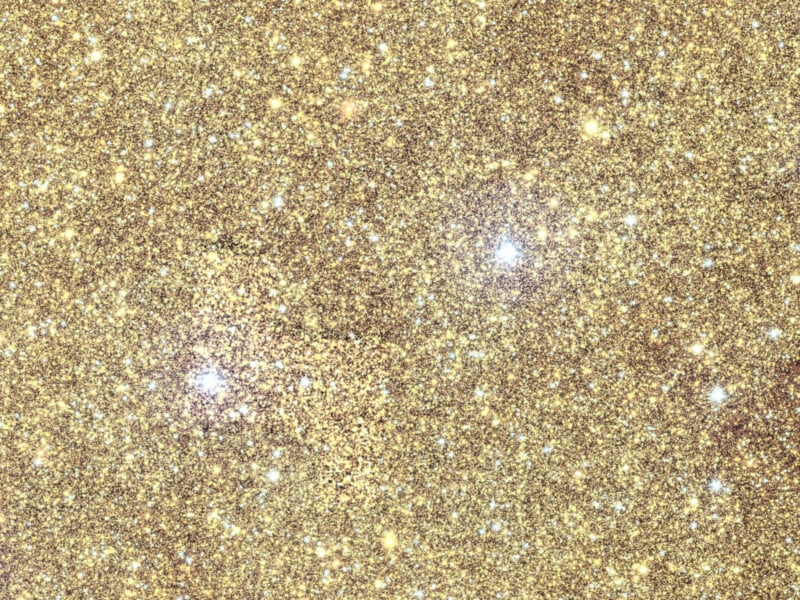
A close-up view of a sparkling gold glitter texture, with tiny reflective specks and bright spots of light scattered across the surface, creating a shimmering, festive effect.
100% crop
A dense field of yellow and white stars shines brightly against a dark background in deep space, with some dark patches where interstellar dust blocks the starlight.
100% crop

“Since Euclid can clearly separate individual stars, one can then measure how fast they move over time and use that information to confirm the existence of a planet and determine its mass. This would not be possible with data from one point in time,” she continues.


Image credits: ESA/Euclid/Euclid Consortium/NASA, CFHT, image processing by J.-C. Cuillandre and E. Bertin (CEA Paris-Saclay). The high-resolution image can be explored in ESA Sky.