


惯性聚合 高效追踪和阅读你感兴趣的博客、新闻、科技资讯
阅读原文 在惯性聚合中打开

推荐订阅源

雷峰网
雷峰网
MongoDB | Blog
MongoDB | Blog
D
Docker
Martin Fowler
Martin Fowler
人人都是产品经理
人人都是产品经理
GbyAI
GbyAI
Jina AI
Jina AI
酷 壳 – CoolShell
酷 壳 – CoolShell
M
MIT News - Artificial intelligence
腾讯CDC
阮一峰的网络日志
阮一峰的网络日志
H
Hackread – Cybersecurity News, Data Breaches, AI and More
N
Netflix TechBlog - Medium
B
Blog RSS Feed
云风的 BLOG
云风的 BLOG
Blog — PlanetScale
Blog — PlanetScale
Vercel News
Vercel News
The Cloudflare Blog
freeCodeCamp Programming Tutorials: Python, JavaScript, Git & More
有赞技术团队
有赞技术团队
G
Google Developers Blog
Stack Overflow Blog
Stack Overflow Blog
I
InfoQ
U
Unit 42

PetaPixel

The Camp Snap 2 Has More Photo Accessories and is Smaller Than Ever Polaroid Go Generation 3 Is the World’s Smallest Instant Analog Camera China Lucky’s New Color C200 Film Has Arrived in the US and Looks Great Chinese Private Equity Firm HSG Emerges as Leading Bidder to Buy Stake in Leica Camera Leica Cine Compact 1 Projector Promises a Plug-and-Play Home Theater Experience There Are No Photos Allowed at the Studio Ghibli Amusement Park Xiaomi 17T Pro Review: High-End Photography Without the Flagship Price Photographer Builds the iPhone Camera App He Always Wanted New $50 Y2K-Inspired Compact Camera Looks Thin In Form and Function Save Big on Macro Photography Essentials Nvidia’s New Chip Aims to Upend the Creative Laptop Market Japanese Zoo Considering Photo Ban After US Tourists Invade Punch the Monkey’s Enclosure Years in the Making, Glass Imaging Is Delivering on its Promise to Transform Smartphone Photography Gen Z are Five Times More Likely to Have a Plan for Photos After Death Long Island Beach Where Marilyn Monroe Posed for Iconic Photos Honored With Plaque Camera Trap Captures One-Armed Gorilla Raising Newborn in the Wild Photographer’s Camera Gear Gets Jet Washed by 20-Foot Wave in Tahiti Photojournalists Say ICE Agents Targeted Them and Their Cameras at Delaney Hall Protests Model Sues Fashion Brand After it AI-Generated Pictures of Her Easy Macro Photography Tips for Incredible Close-Up Photos The Myth of Intent in Photography Samsung’s Competitors Have a Better Samsung Camera Than Samsung Does Thypoch Simera 50mm f/1.4 Review: Crisp and Clean The AI Film ‘Dreams of Violets’ Is How You Get Me to Hate Movies Photographer Documents the Vanishing Wildlife of the ‘American Amazon’ Press Photographer Releases 30-Year Archive of Iconic Celebrity Images Photographer Granted Rare Access to Cambridge’s May Balls for 40 Years Atmos Is a Weather App By Photographers, for Photographers A Feature-Length AI-Generated ‘Live Action’ Movie Is Premiering at Tribeca for Some Reason Despite Being a Member, YoloLiv Isn’t Complying with the Micro Four Thirds Standard
Underwater Cameras Capture Seals Resting in Secret ‘Bubbl...
Pesala Bandara · 2026-05-24 · via PetaPixel
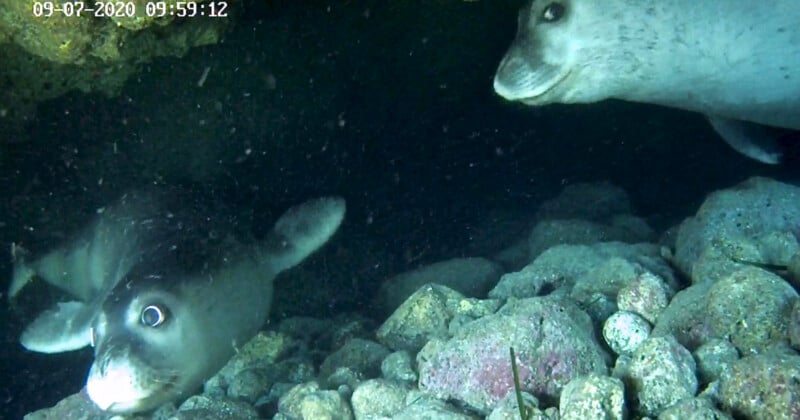
Two seals are underwater near a rocky seabed. One seal is swimming near the bottom left, facing the camera, while another seal looks on from the upper right. The timestamp reads "09-07-2020 09:59:12.
Monk seals seen in an underwater cave in July 2020. This is not a bubble cave | Image credit: The Octopus Foundation

Scientists used remote cameras to reveal how some of the world’s rarest seals are resting in secret underwater “bubble caves” to stay out of sight of humans.

According to a report by IFLScience, researchers have identified previously unknown resting spots used by the extremely rare Mediterranean monk seals, a species with only a few hundred individuals left in the wild and considered one of the most threatened seals in the world.

The animals are often seen swimming along the coast of Greece’s Ionian Islands, but they tend to disappear when scientists arrive to observe them resting. Known beach caves were found empty, and early searches in nearby underwater caves did not explain where the seals were going.

To investigate, researchers from the Tethys Research Institute and the Octopus Foundation placed remote cameras in hard-to-reach parts of coastal caves.
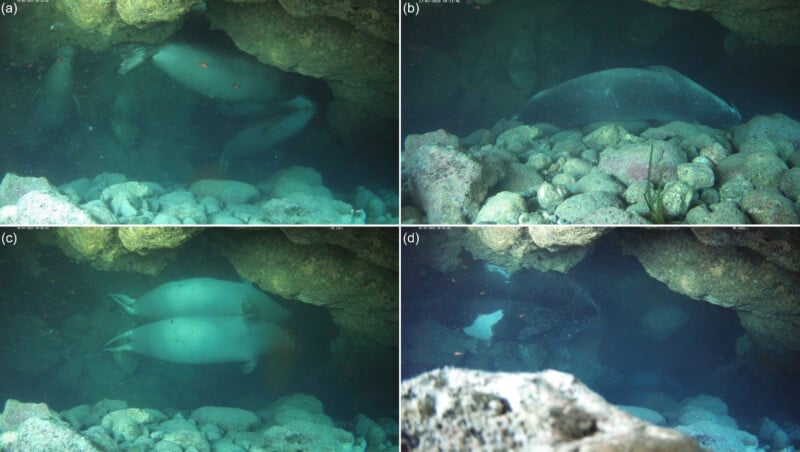
Four underwater images show seals resting or swimming among rocks and in small caves on the seafloor. The water is slightly murky, and the rocky environment is dimly lit.
Mediterranean monk seals (Monachus monachus) using an underwater “bubble cave”: (a) three seals resting or sleeping at the surface; (b) a seal sleeping on the seafloor; (c) a female sleeping sideways underwater; and (d) a large, heavily scarred male sleeping at the surface. | Joan Gonzalvo, André Guinand, Julien Pfyffer, Cédric Georges, Carmen Andrés-Hervías, Manel Gazo, 2026. Published by Cambridge University Press on behalf of Fauna & Flora International

They eventually discovered a small submerged passage just beyond a main cave entrance leading into a sealed chamber with a trapped air pocket at the top. When they reviewed the footage, they found the seals were using this space as a hidden underwater “bubble cave.”

“When we discovered remotely that several seals were inspecting the waterproof camera less than an hour after we installed it, we were really amazed,” Julien Pfyffer, study author and president of the Octopus Foundation, tells IFLScience. “Very quickly, we had this ‘eureka moment’ because we were looking at the factual confirmation of the intuition they might be hiding somewhere.”

Footage showed the seals resting in different ways. Some were floating at the surface, others were sleeping in deeper water or lying still on the cave floor. Researchers also saw a behaviour called “bottling,” where seals float upright while resting, sometimes even upside down with their noses underwater.

In a recent study published in the journal Oryx, the researchers detail how Mediterranean monk seals were once commonly found hauling out on open beaches, but in recent years, they have increasingly moved into remote marine caves, likely due to human disturbance. These caves usually have both underwater and above-water entrances, internal pools, and dry areas where seals can rest.

The newly observed “bubble caves” are different because they are fully submerged chambers containing trapped air, accessed through underwater passages. This means the seals can remain in water without needing a dry surface to rest on. Researchers say these spaces may be especially important in busy coastal areas, where disturbance from humans is higher.

“Before this discovery, I believe some scientists had the intuition that Med monk seals were temporarily using these bubble caves, but not to this extent,” Pfyffer tells IFLScience. “Additionally, scientists did not have proof — namely pictures and videos — for such a long time.”

PetaPixel articles may include affiliate links; if you buy something through such a link, PetaPixel may earn a commission.

Become a PetaPixel Member!

Want an ad-free experience, access to our Sample Galleries, and sweet discounts from photo brands all while supporting independent photo industry publishing? Become a PetaPixel Member today!