







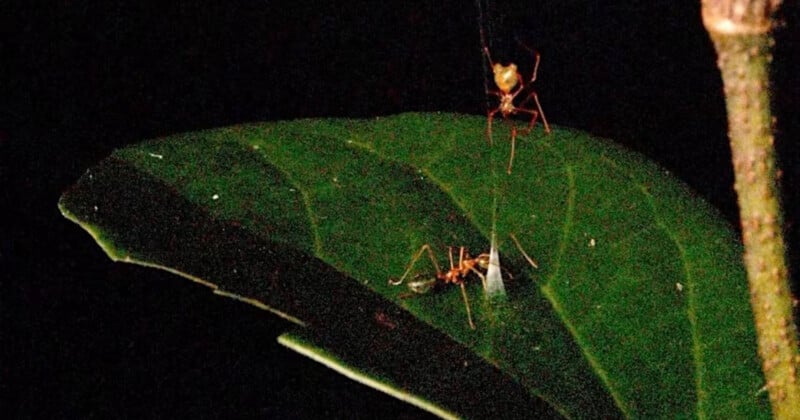
Scientists have captured incredible footage of a spider building an ingenious snare trap to catapult its prey into its web.
In the extraordinary video, the newly discovered spider, that lives in the rainforests of Queensland, Australia, launches a green tree ant into a web with a g-force that would kill a human, according to a report by New Scientist.
Researchers recorded accelerations of up to 4484 feet (1,367 meters) per second squared when green tree ants trigger the snare trap. This is about 130 times the force of gravity, a level of force that would be lethal to humans. Once the ant is immobilized in the web, the spider wraps it in silk before feeding.
The tiny and newly discovered species has been named the ballista spider after an ancient Roman weapon that used a spring to launch a stone. In a recent paper published in Current Biology, researchers report that the spider appears to target a single prey species: the highly territorial and aggressive green tree ant.
According to New Scientist, the behavior was first observed in 2022 by Greg Anderson at the QIMR Berghofer Medical Research Institute in Brisbane, Australia. At the time, he saw a green tree ant being suddenly launched in a spider trap in far north Queensland, but without specialized camera equipment, he could only observe a blur of movement as the prey was thrown upward by a cone-shaped web.
Then, in early 2023, research professor Ajay Narendra of Macquarie University and postgraduate student Pranav Joshi spent 10 days and nights in rainforest near Cooktown locating specimens. Using high-speed and infrared cameras, they were able to observe the ballista spiders’ hunting behavior in detail.
First, the nocturnal spider builds an anchor point on a leaf, a branch, or the forest floor, before spending up to four hours spinning up to 60 vertical tension lines bundled together in a cone near the ground. The spider then wraps the cone with extra silk before retreating upwards. When the ant is attracted, it reacts aggressively, biting the cone — and detaching it from the anchor point.
The ant is then catapulted more than 11 inches (30 centimeters) upwards into the spider’s core web, at an acceleration of more than 4265 feet (1,300 meters) per second.
“To capture the moment, we had to push the cameras to 5000 to 7000 frames per second, which I honestly have never had to do… when I’ve been filming animals,” Narendra tells New Scientist.
PetaPixel articles may include affiliate links; if you buy something through such a link, PetaPixel may earn a commission.
Love PetaPixel? Go Premium.
PetaPixel is the world’s largest independent photography publication and we’re only able to continue our work with your help. Become a PetaPixel Member now and support our mission to bring you regular, high-quality reviews, features, news, and more.
- Remove banner ads
- Gain access to full-resolution RAW and JPEG Sample Galleries
- Get 5% off orders from KEH.com
- Get a $15 coupon to spend at Moment
- Get 10% off lighting equipment from FJ Westcott
- Get 10% off film development, scanning, and printing from Blue Moon Camera and Machine