




惯性聚合 高效追踪和阅读你感兴趣的博客、新闻、科技资讯
阅读原文 在惯性聚合中打开

推荐订阅源

Hacker News - Newest:
Hacker News - Newest: "LLM"
W
WeLiveSecurity
罗磊的独立博客
Recent Commits to openclaw:main
PCI Perspectives
PCI Perspectives
L
LINUX DO - 最新话题
Hacker News: Ask HN
Hacker News: Ask HN
MongoDB | Blog
MongoDB | Blog
Forbes - Security
Forbes - Security
J
Java Code Geeks
OSCHINA 社区最新新闻
OSCHINA 社区最新新闻
博客园 - 聂微东
S
Security Archives - TechRepublic
H
Help Net Security
Webroot Blog
Webroot Blog
T
Tailwind CSS Blog
大猫的无限游戏
大猫的无限游戏
Schneier on Security
雷峰网
雷峰网
T
Troy Hunt's Blog
S
Security @ Cisco Blogs
K
KPMG report finds enterprise disconnect between AI and its ROI | CIO
月光博客
月光博客
V
Vulnerabilities – Threatpost
B
Blog
A
Arctic Wolf
O
OpenAI News
S
Schneier on Security
T
Tor Project blog
S
Security Affairs
H
Hacker News: Front Page
N
News and Events Feed by Topic
D
DataBreaches.Net
cs.AI updates on arXiv.org
P
Palo Alto Networks Blog
T
The Exploit Database - CXSecurity.com
Recorded Future
Recorded Future
aimingoo的专栏
aimingoo的专栏
博客园_首页
L
LangChain Blog
博客园 - 【当耐特】
V
Visual Studio Blog
N
Netflix TechBlog - Medium
I
Intezer
Application and Cybersecurity Blog
M
MIT News - Artificial intelligence
T
Tenable Blog
爱范儿
爱范儿
L
LINUX DO - 热门话题
S
Securelist

PetaPixel

Polaroid Go Generation 3 Is the World’s Smallest Instant Analog Camera China Lucky’s New Color C200 Film Has Arrived in the US and Looks Great Chinese Private Equity Firm HSG Emerges as Leading Bidder to Buy Stake in Leica Camera Leica Cine Compact 1 Projector Promises a Plug-and-Play Home Theater Experience There Are No Photos Allowed at the Studio Ghibli Amusement Park Xiaomi 17T Pro Review: High-End Photography Without the Flagship Price Photographer Builds the iPhone Camera App He Always Wanted New $50 Y2K-Inspired Compact Camera Looks Thin In Form and Function Save Big on Macro Photography Essentials Nvidia’s New Chip Aims to Upend the Creative Laptop Market Japanese Zoo Considering Photo Ban After US Tourists Invade Punch the Monkey’s Enclosure Years in the Making, Glass Imaging Is Delivering on its Promise to Transform Smartphone Photography Gen Z are Five Times More Likely to Have a Plan for Photos After Death Long Island Beach Where Marilyn Monroe Posed for Iconic Photos Honored With Plaque Camera Trap Captures One-Armed Gorilla Raising Newborn in the Wild Photographer’s Camera Gear Gets Jet Washed by 20-Foot Wave in Tahiti Photojournalists Say ICE Agents Targeted Them and Their Cameras at Delaney Hall Protests Model Sues Fashion Brand After it AI-Generated Pictures of Her Easy Macro Photography Tips for Incredible Close-Up Photos The Myth of Intent in Photography Samsung’s Competitors Have a Better Samsung Camera Than Samsung Does Thypoch Simera 50mm f/1.4 Review: Crisp and Clean The AI Film ‘Dreams of Violets’ Is How You Get Me to Hate Movies Photographer Documents the Vanishing Wildlife of the ‘American Amazon’ Press Photographer Releases 30-Year Archive of Iconic Celebrity Images Photographer Granted Rare Access to Cambridge’s May Balls for 40 Years Atmos Is a Weather App By Photographers, for Photographers A Feature-Length AI-Generated ‘Live Action’ Movie Is Premiering at Tribeca for Some Reason Despite Being a Member, YoloLiv Isn’t Complying with the Micro Four Thirds Standard ArcBlue C42 Is the World’s First Smart Full-Frame Astrophotography System Film Friday: Kodak TMax 400 Is Far From a One-Trick Pony Sihoo Doro C300 Pro V2 Ergonomic Chair with Full-Body Adaptive Support Keeps You Comfortable and Creative Unknown Photographer Who Took First Royal Portrait Honored With Blue Plaque 15 of the Best Photos Smithsonian Just Added to Unsplash for Free The Challenge of Photographing Mountain Gorillas in the Mist of an Impenetrable Forest This Javelin Thrower Looks Like He is Impaling Himself in Crazy Optical Illusion Photo Capture One’s Private Equity Owner Is Trying to Sell It: Report Thypoch’s New Simera-C 16mm T1.9 Is its Widest Cinema Lens Yet Employee vs Contractor: What Photographers Need to Know Nat Geo’s New Documentary, ‘Time and Water,’ Tells a Story You’re Still Writing Massive Sample Gallery Update: Lumix L10, Sony a7R VI, and More Crafty Lens Cap for Leica M Hides AirTags Polaroid’s Limited Edition Purple Film Gives ‘Waste a Second Life’ Thypoch Voyager 24-50mm f/2.8 Review: Autofocus Zoom for a Bargain Xiaomi’s 17T Series Phones Feature Leica Tech and a New 5x Camera People Don’t Believe This Smartphone Wildlife Photographer’s Images are Real Leica’s Brand-New Metal Gray Paint Finish Looks Very Stylish Independent Audit Finds No Security Basis for Restricting DJI in the USA Witnesses in Nick Ut’s Defamation Trial Against Netflix Include ‘Napalm Girl’ Herself 70mm Film Festival to Show in Palm Springs This Weeekend Google’s New Gemini Omni AI Video Model Can Do Crazy Things Photographers Are Livid About a Photo Festival’s Camera-Busting Rage Room Capture One to Increase All Product Prices By 6% One-of-a-Kind Leica Rifle Camera Used by the Luftwaffe Could Fetch $160,000 The Ultimate ‘First Camera Purchase’ Accessory Tier List | The PetaPixel Podcast 8 Editing Problems Nik Collection 9 Actually Solves Halide Mark III Promises ‘Most Beautiful Photos Possible’ on iPhone New Film Will Chronicle the Life and Work of Brazilian Photographer Claudia Andujar Virginia Museum of Fine Arts Receives Major Gift of Nearly 2,000 Important Photographs Ilford and Expired Film Club Get Into the World Cup Spirit Photographer Arrested for Allegedly Failing to Deliver Quinceañera Photos Acer’s Three New Monitors Are Made for Photographers and Videographers A Streaming Service Made Up Entirely of AI-Generated Shows is About to Launch The Incredible Photography of ‘Obsession’ Spectacular Moment Meteor Explodes Behind Erupting Volcano Caught on Camera VSCO Terms of Use Explained: Why It Says It Isn’t Stealing Your Photos Calibrite Colorimeter Is the First That Hardware Calibrates Apple Displays How a Photographer Became a Writer to Tell an Even More Powerful Story Imagen Is Offering Full AI Editing Access for $10, Just In Time for Peak Season Misunderstanding of Fujifilm Film Announcement Causes Panic on Social Media Viltrox Vintage Z1 Pro Flash Offers Retro Style and Modern Performance for Under $60 Pope Leo Warns AI Images Are a ‘Powerful Amplifier’ of Disinformation Footage Reveals Newly Discovered Blue Octopus No Bigger Than a Golf Ball Wedding Photographer Seriously Injured After Being Stabbed by Guest Photographer Takes One in 1.7 Million Photo of Airplane Transiting the Sun Photographer Bitten by ‘Shark or Sea Lion’ During Surf Competition NYC Gallery Says it Has ‘Every Right’ to Create AI Version of Iconic Ansel Adams Photo Sony 100-400mm f/4.5 GM OSS Review: Zoom Zoom NYC Gallery Sold an AI-Generated Ansel Adams Photo Without Permission The Story Behind The Last Photograph of Oscar Wilde on His Death Bed I Fundamentally Disagree With Canon Building a Wall Between its V and C Series Cameras Underwater Cameras Capture Seals Resting in Secret ‘Bubble Caves’ Student Captures Cosmic Radiation on Film by Sending Negative to Space The Enduring Mystery Behind Iconic American Photograph ‘Lunch on a Beam’ The Hidden World of Insect Wings Revealed by Macro Photographer These Earbuds Have Tiny Cameras That Take Photos and Let Users Talk to AI About What They See Yashica Brings Beloved Characters to the Cheap Keychain Camera Segment Fujifilm Has Over 40 New Lens Ideas: ‘It’s Difficult to Convey How Much We Care About Our Lenses’ Why So Many Watch Enthusiasts Love One Specific Camera The 25 Best Memorial Day Deals for Photographers Thypoch’s Stylish Ksana 35mm f/2 Prime Promises 1980s-Inspired Flare Lyft Driver Tries to Scam Customer with AI-Generated Photo of ‘Damage’ to Vehicle What Does It Look to Take a Photo With Half a Lens? First Ever Photograph of ‘Rusty Lark’ Bird Thought to be Extinct for 94 Years Cannes Photographer Reveals His Trick of Getting Hollywood Stars to Look at His Camera IMAX Stock Soars as Takeover Talks Revealed Before the Frame: A Filmmaker’s Approach to Street Photography Scientists Are Building a Camera System to Monitor Zoo Animals’ Health MLS Game To Be First Pro Sports Broadcast Shot Entirely With iPhone Photographers Can Build Their Very Own Keychain Camera at Home
Giving Your Photography a New Perspective
Ivor Rackham · 2026-06-14 · via PetaPixel

A calm sea at sunset with the sun low on the horizon, casting a golden reflection on the water. Rocky shoreline in the foreground and a small island with a lighthouse in the distance.

Although photography is the art of capturing light and shadow, it also portrays depth in a 2D image. Understanding how depth works is key to making photos feel more engaging.

Perspective

The word “perspective” comes from the Latin “perspicere,” meaning “to see through” or “to perceive clearly.” In everyday use, it can refer to a particular point of view or seeing something in proper proportion, as in “Let’s put this in perspective.”

Some might insist that perspective encompasses only the camera’s physical viewpoint. Indeed, that is the foremost meaning of the word. In that sense, perspective is our primary tool for conveying depth in a photo.

However, we can also refer to an illusory perspective. That’s where the impression of the scene’s depth is affected by factors within the image, such as focal length, lighting, and color.

Both kinds of perspective, true and illusory, affect a photograph’s feel. So, perspective is not just about the mechanics of making an image. It also affects the response a photograph elicits through the relationships among its different elements.

In a photograph, we can either increase or reduce the sense of both true and illusory perspective to achieve our desired result. In other words, we can adjust the illusion of three-dimensional depth in a two-dimensional image.

A brown bird of prey with outstretched wings glides low over a field of tall, beige grass, with blurry green trees in the background.

Depth and The Three-Dimensional Illusion

Photography faces a basic challenge. It attempts to show a three-dimensional reality on a two-dimensional surface. Perspective is one of the photographer’s main tools for creating the illusion of depth.

Leading lines create a sense of journey by guiding the viewer’s eye through the composition. They help us establish spatial relationships. Overlapping elements provide another depth cue. Objects that partially obscure others clearly establish their relative positions in space. Of course, one must also consider how the occlusion of two objects affects the image, sometimes with humorous results. Recognizable, similar objects at different distances can also increase the sense of depth.

A photographer has to consider how these relationships and the placement of each element in the frame elicit a sense of three-dimensional space.

Consequently, the concept of foreground, middle ground, and background can become essential in creating compositions. By consciously placing interesting elements at different distances from the camera, photographers create layered images. As long as the frame does not become too cluttered, a layered image can provide multiple points of visual interest and, therefore, the illusion of depth.

A rocky shoreline at dusk with calm waves washing over the sand, dark rocks extending into the sea, and a cloudy sky casting a blue-grey hue across the tranquil scene.

The Physical Dimensions of True Perspective

True perspective is how objects appear relative to the camera’s position. In other words, it is the spatial relationship between objects. The principles of geometry govern this relationship.

The geometric changes come from the camera’s positioning. Its proximity to objects, its height, and the angle at which it is pointing all influence perspective.

For example, shooting at a low, upward angle can give subjects a sense of power and grandeur. The resulting converging verticals can make even the most modest structures appear monumental. Politicians are often photographed from below to emphasize their power.
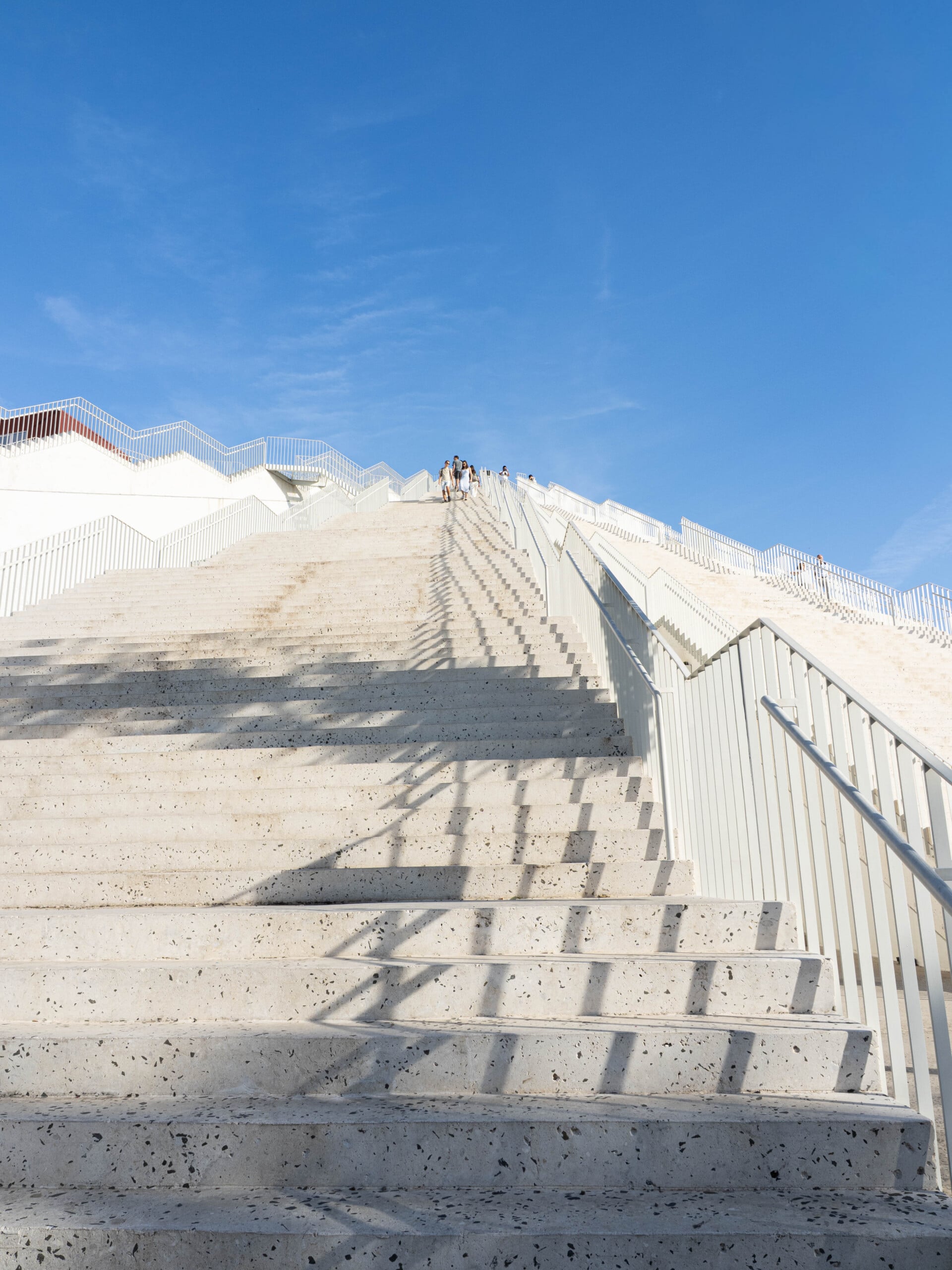
Wide stone staircase with metal railings ascending steeply under a clear blue sky. Several people are visible at the top, with shadows cast by the railings onto the steps.

From low down, the angle at which parallel lines seem to converge is obtuse, and the horizon seems much closer than it would if I raised the camera.
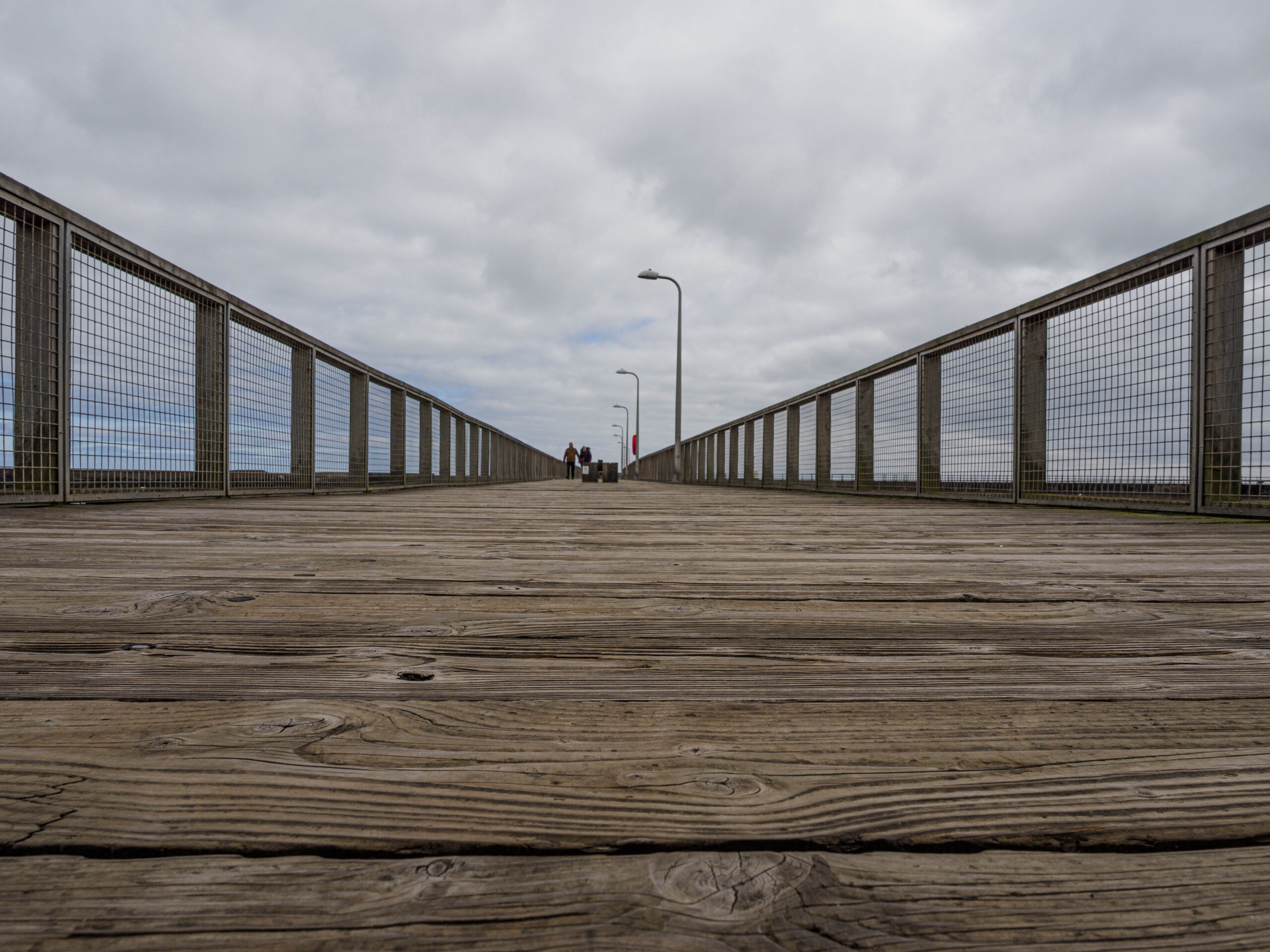
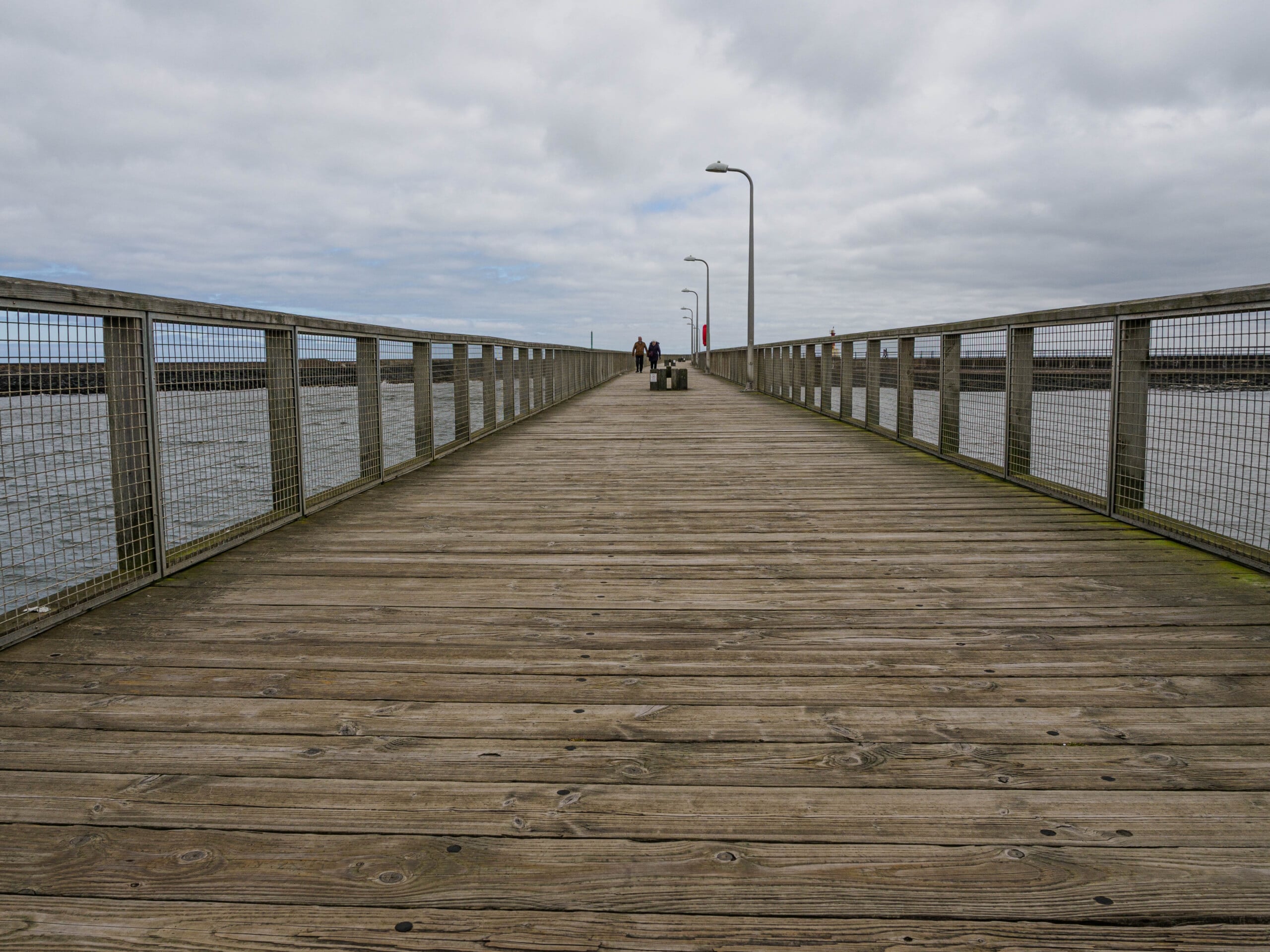
A low-angle view of a wooden pier with metal railings on both sides, stretching into the distance under a cloudy sky. A few people are visible far away near the end of the pier.

A wooden pier with metal railings extends over the water under a cloudy sky. Two people walk in the distance near a lamp post at the end of the pier.
Compare these photos with the worm’s-eye view above and one taken at knee level. Note the changing angles of the lines that lead one’s eye into the frame.

High-angled cameras and those looking down create feelings of vulnerability. But they also make the horizon more distant. Parallel lines that disappear to a vanishing point converge at a more acute angle. When a drone looks straight down from above, it loses the vanishing point altogether, and parallel lines no longer converge.

Focal Length and Illusory Perspective

Focal length does not, on its own, alter perspective. True perspective is determined solely by the camera’s position. However, focal length influences perspective indirectly because photographers adjust their position based on the lens they are using. A closer camera position creates a deeper perspective, while a more distant position creates a flatter one.

Waves splash against rocks in the foreground as the sun sets over the ocean, casting a warm orange and yellow glow across the sky and water.
The camera’s proximity to the splash adds depth to the photo.

But there’s more to it than the camera’s physical position.

The choice of focal length appears to alter perspective in another way. If you fit a wide-angle lens to the camera and walk closer to the subject, it will fill more of the frame. At the same time, that wide lens makes background objects appear much smaller and distant. It seems to be adding depth to the photo. In reality, the distance between the foreground and the background is the same, but we have created the illusion that the background is farther away. That’s one reason foreground interest works well in landscape photography.

An illusory perspective is where our brains interpret depth in a photograph based on the elements within it.

As we have seen, a wide-angle lens strengthens the illusion of depth. It does that by separating the foreground from the background. I am sure you have seen online close-up photos of cute calves, kittens, and puppies with huge noses. The wide-angle lens’s proximity to the animal’s nose causes that effect, exaggerating the nose’s size relative to the back of its face. (It’s not a good look when used on humans.)
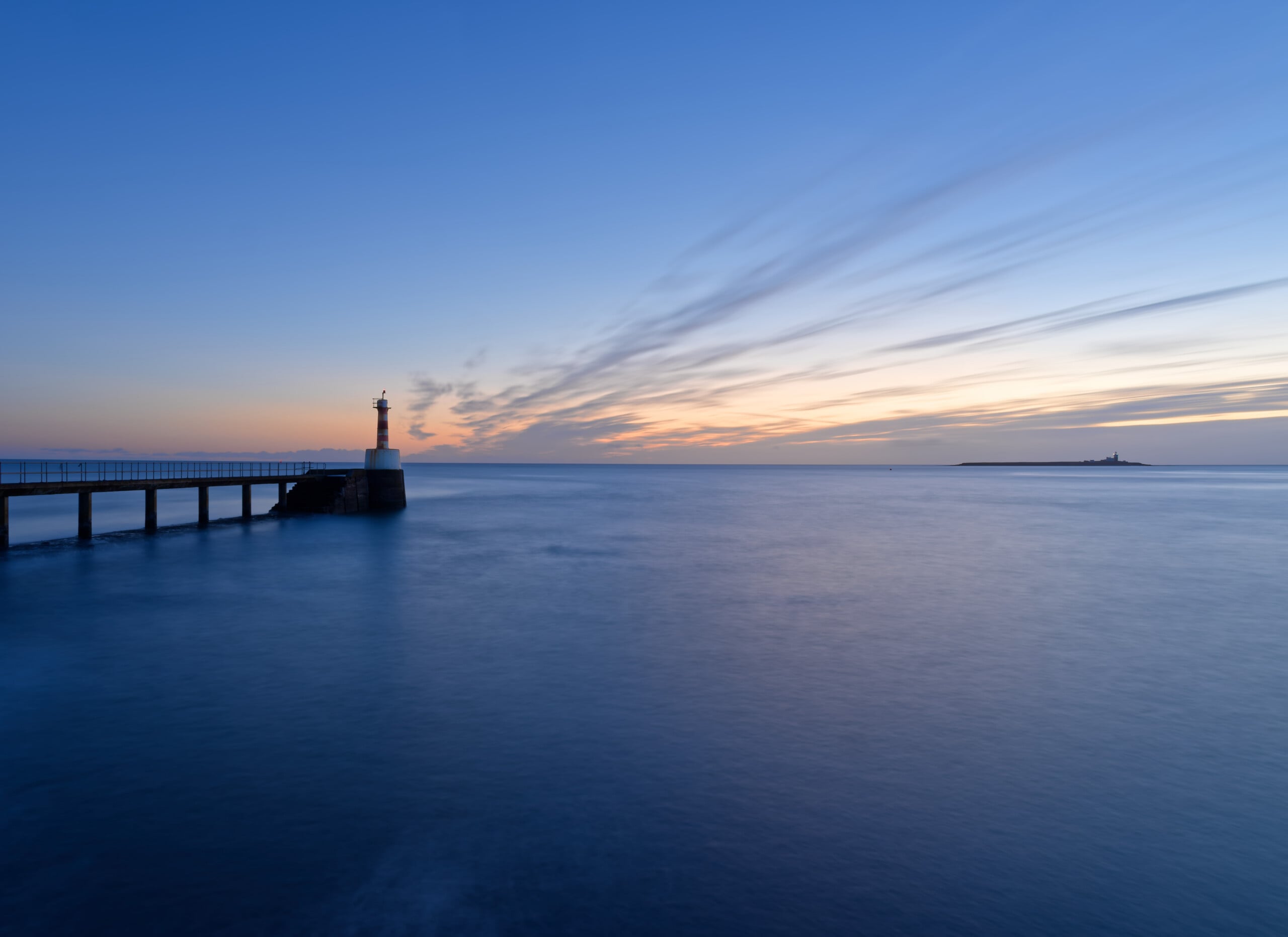
A tranquil seascape at sunset with a lighthouse on a pier extending into calm blue water. The sky is streaked with clouds, and an island is visible on the horizon under soft, fading light.
Shot at 12mm, the island seems distant.

Alternatively, if you use a long telephoto lens to photograph a subject, the background will appear much closer. Subjects can even look like cardboard cutouts because of the long lens’s flattening-out effect.

Two children stand on a seaside pier, talking, as a large wave splashes behind them. In the background, a lighthouse and building are visible across the water under a clear blue sky.
I shot the above photo with a 400mm telephoto lens from even further away from the island than the previous image. Yes, this long lens appears to reduce the depth in the photo, and the lighthouse appears much closer.

Therefore, telephoto lenses seem to weaken the illusion of depth by compressing the scene and flattening the apparent distance between foreground and background elements. That compression can emphasize patterns and textures that might otherwise become lost in a wider view. Alternatively, it can add context by making the background object seem closer to the subject.

Understanding those lens characteristics gives photographers another way to influence the viewer’s sense of space and scale in the picture.

Other Ways of Increasing Illusory Perspective

Other elements can change the feeling of depth in a photo, too. For example, distant objects appear hazier and less saturated due to atmospheric interference, as does reducing color saturation in the background and increasing it in the foreground. Additionally, our brains perceive brighter objects as closer to us. Also, if we place warm (red, orange, yellow) colored objects against a cool (green, blue, violet) background, our brains will interpret the image as having greater depth.

Direct light also strengthens illusory perspective. Similarly, strong tonal contrasts, a shallow depth of field, and converging lines will be present.
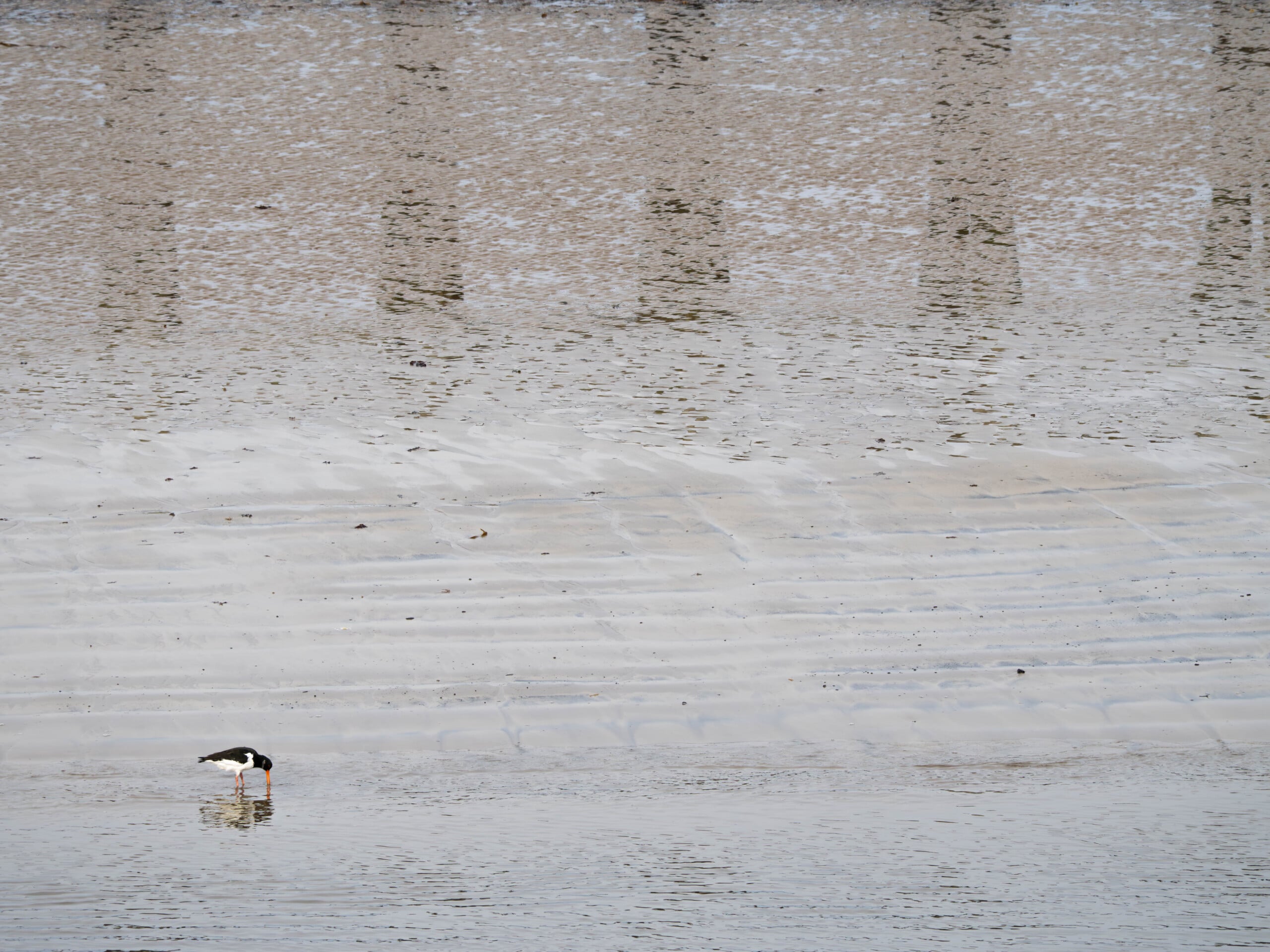
A lone bird stands in shallow water on a gently sloped, sandy and concrete surface, with subtle reflections and patterns created by the wet ground and water.
A long lens, the high vantage point, and the lack of features in this photo make it appear flatter. The ground looks almost vertical, yet it was a flat area of sand.

The opposite of all those cues that strengthen the illusion of depth is, of course, true for a weakening perspective.

Although we may think of a strong perspective as good and a weak one as bad, in photography, that is not necessarily the case. We can use several of those tools together to boost the effect we want, whether that is a photo with lots of depth or one with very little.

Emotional and Psychological Perspectives

As well as a branch of physics, photography is an art. Because of that, photography’s power is far more than just documentation. It allows emotional expression and psychological exploration.

A photograph conveys feelings, moods, and psychological states. For instance, while a close-up portrait can reveal intimate details of human emotion, a vast landscape might evoke feelings of solitude, freedom, or even insignificance because of its sublime grandeur. Therefore, weakening or strengthening the perspective is paramount to creating the story we want to tell.

A white seabird with a yellowish head and black-tipped wings stands on a rocky surface near the sea, raising its wings as if stretching or preparing to take flight. The background is softly blurred blue water.

Conclusion

Perspective in photography extends beyond geometry and optical physics. It involves the nature of shapes, colors, and tones that influence every aspect of the photograph.

Understanding perspective, both true and illusory, helps us move beyond simple record-making and toward expression. The tools I mentioned above that alter the viewer’s perspective help guide attention, evoking ideas and feelings.