



惯性聚合 高效追踪和阅读你感兴趣的博客、新闻、科技资讯
阅读原文 在惯性聚合中打开

推荐订阅源

让小产品的独立变现更简单 - ezindie.com
V
V2EX
小众软件
小众软件
MongoDB | Blog
MongoDB | Blog
Jina AI
Jina AI
G
Google Developers Blog
H
Help Net Security
Microsoft Azure Blog
月光博客
月光博客
The GitHub Blog
The GitHub Blog
Y
Y Combinator Blog
爱范儿
爱范儿
B
Blog
云风的 BLOG
云风的 BLOG
H
Hackread – Cybersecurity News, Data Breaches, AI and More
GbyAI
GbyAI
博客园 - 叶小钗
aimingoo的专栏
aimingoo的专栏
Blog — PlanetScale
Blog — PlanetScale
奇客Solidot–传递最新科技情报
奇客Solidot–传递最新科技情报
有赞技术团队
有赞技术团队
博客园_首页
Google DeepMind News
M
MIT News - Artificial intelligence

PetaPixel

The Camp Snap 2 Has More Photo Accessories and is Smaller Than Ever Polaroid Go Generation 3 Is the World’s Smallest Instant Analog Camera China Lucky’s New Color C200 Film Has Arrived in the US and Looks Great Chinese Private Equity Firm HSG Emerges as Leading Bidder to Buy Stake in Leica Camera Leica Cine Compact 1 Projector Promises a Plug-and-Play Home Theater Experience There Are No Photos Allowed at the Studio Ghibli Amusement Park Xiaomi 17T Pro Review: High-End Photography Without the Flagship Price Photographer Builds the iPhone Camera App He Always Wanted New $50 Y2K-Inspired Compact Camera Looks Thin In Form and Function Save Big on Macro Photography Essentials Nvidia’s New Chip Aims to Upend the Creative Laptop Market Japanese Zoo Considering Photo Ban After US Tourists Invade Punch the Monkey’s Enclosure Years in the Making, Glass Imaging Is Delivering on its Promise to Transform Smartphone Photography Gen Z are Five Times More Likely to Have a Plan for Photos After Death Long Island Beach Where Marilyn Monroe Posed for Iconic Photos Honored With Plaque Camera Trap Captures One-Armed Gorilla Raising Newborn in the Wild Photographer’s Camera Gear Gets Jet Washed by 20-Foot Wave in Tahiti Photojournalists Say ICE Agents Targeted Them and Their Cameras at Delaney Hall Protests Model Sues Fashion Brand After it AI-Generated Pictures of Her Easy Macro Photography Tips for Incredible Close-Up Photos The Myth of Intent in Photography Samsung’s Competitors Have a Better Samsung Camera Than Samsung Does Thypoch Simera 50mm f/1.4 Review: Crisp and Clean The AI Film ‘Dreams of Violets’ Is How You Get Me to Hate Movies Photographer Documents the Vanishing Wildlife of the ‘American Amazon’ Press Photographer Releases 30-Year Archive of Iconic Celebrity Images Photographer Granted Rare Access to Cambridge’s May Balls for 40 Years A Feature-Length AI-Generated ‘Live Action’ Movie Is Premiering at Tribeca for Some Reason Despite Being a Member, YoloLiv Isn’t Complying with the Micro Four Thirds Standard ArcBlue C42 Is the World’s First Smart Full-Frame Astrophotography System
Atmos Is a Weather App By Photographers, for Photographers
Jeremy Gray · 2026-05-30 · via PetaPixel

Four smartphone screens display an astronomy app showing forecasts for the Milky Way, aurora, golden hour, and moonrise, each with vivid background images and forecast ratings at the bottom.

As photographers know, light is extremely important. And for outdoor photographers, nothing affects the quality of light quite like the weather. Photographer Matthew Raifman wanted to build a weather app for people like him, photographers who want to know not just what the weather forecast is, but whether or not the conditions will be any good for photography. Enter Atmos for Weather & Photo, also known as Atmos.

Raifman’s new iPhone weather app was “born out of a frustration most outdoor photographers know intimately: the pre-shoot ritual of bouncing between four or five different apps trying to piece together a complete picture of conditions.”

This includes figuring out where the Sun will be when conditions are best, what the wind is doing, tidal conditions, types and their altitudes, the phase of the Moon, and so on. For different types of outdoor photography, all of this matters, and Raifman wanted all of that info in one place.

A weather app screen for Berkeley, CA shows photography recommendations: Wildlife (93 Epic), Portraits (84 Great), Long Exposure (76 Great), and Macro (72 Great), with ideal times, conditions, and a daylight timeline.

A vibrant sunrise over a city skyline with orange, pink, and purple clouds; a weather app rates the sunrise “93 Epic” and displays details about sky conditions and suggested alarm times.

But Atmos goes even further, including genre-based scores for different conditions.

“The core idea is simple. Rather than reporting raw conditions, Atmos Weather interprets them,” Raifman says. “Cloud cover, atmospheric humidity, visibility, wind, precipitation, sun angle, and terrain are all fed into a scoring model that produces a single shootability number for sunrise, sunset, and night sky windows.”

As the photographer explains, Atmos is less about telling the user what the weather is or what it is likely to be, but rather, what the sky will look like and whether it is worth going out to take photos.
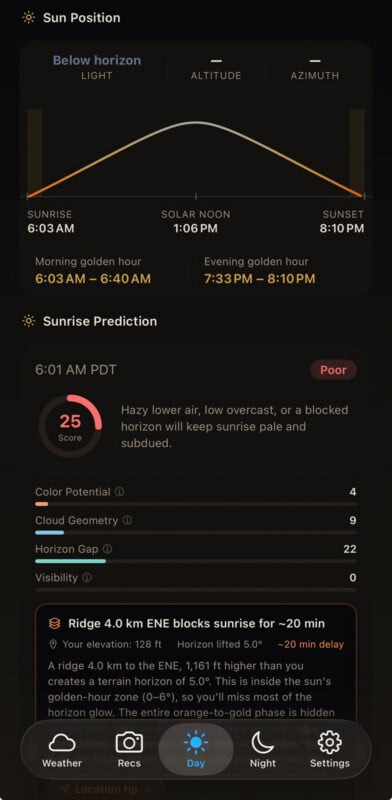
Screenshot of a weather app showing sunrise prediction. The sunrise score is poor (25), with a hazy sky and a horizon gap of 22%. Graphs and details on golden hour times, sun altitude, and position are displayed.

A mobile app screen shows stargazing data: “Milky Way arch” is not visible, with poor visibility predicted. Moon phase, times for moonrise and sunset, and aurora forecast (Kp index 0.3) are also displayed.

A weather app screen shows cloud layer data: visible sky coverage is 30% low, 20% mid, 33% high. Fog is reported, with a cloud floor of ~100 ft, ceiling of ~7,100 ft, and zero visibility. A satellite image is shown below.

To that end, the app promises sophisticated analysis, including treating clouds across three altitude layers, each impacting a final score differently. High cirrus clouds scatter light and make sunsets warmer, while low stratus clouds can totally ruin a shot. 65% cloud cover, for example, doesn’t really give a photographer useful information. Photographers need to know what kinds of clouds are in the sky and where they will be.

Similarly, photographers also care about the “horizon gap,” the open sky between the lowest layer of clouds and the land.

“This is the condition photographers are hunting for. When the sun dips below a cloud layer in the final minutes before it hits the horizon and illuminates the clouds, that’s what turns a decent sunset into something unforgettable,” Raifman says. “Atmos specifically identifies and scores for that window based on where the sun is setting, topography, and where the photographer is located. It’s a level of atmospheric analysis that goes well beyond anything in a standard forecast.”

For night photography, Atmos also tracks temperature spreads, changes, dew point, atmospheric transparency, Moon phase, and more to predict astrophotography conditions. It also pulls live space weather data from NOAA, including the Kp index, solar wind speed, and orientation of the interplanetary magnetic field, to offer insight for aurora chasers.

“Atmos filters everything against your exact latitude and tells you what it means where you’re standing. Will the aurora be visible for your eyes and your camera,” Raifman says.

In total, Atmos scores 12 photography genres independently, including wildlife, macro, long exposure, Milky Way, and even infrared. These scores are weighted by what matters most to those types of photographers.

Atmos is available now on iOS with a two-week free trial. Afterward, it is $3.99 per month. Raifman says this cost covers his development costs and access to the premium weather API data feeds the app requires.


PetaPixel Members receive 33% off an Atmos subscription indefinitely. Join today!


Image credits: Atmos, Matthew Raifman