






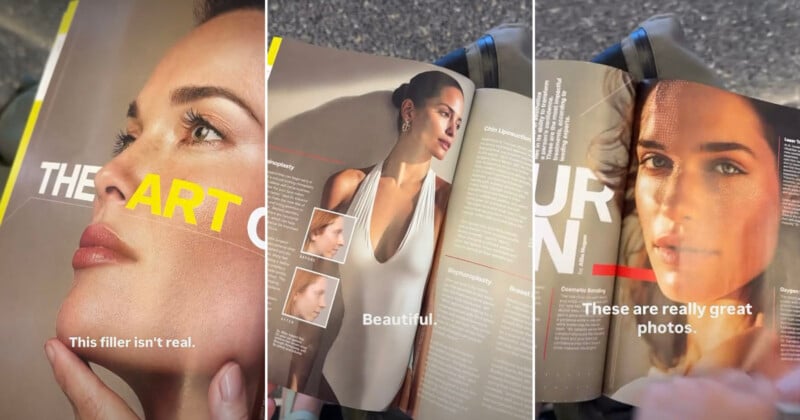
Generative AI is rapidly spreading, and as Austin-based photographer and DP Cassandra Klepac recently discovered, AI is coming for beauty and fashion in a big way.
As The Mary Sue reports, Klepac picked up a magazine, Beauty Authority, at the airport and found herself impressed with many of the apparent photos. When searching for photographer credits, what Klepac found instead were the AI prompts that someone associated with the magazine had used to generate the imagery. Not photos of real women, but AI-generated content.
What made the matter more disturbing to Klepac is that the article the images were illustrating were about cosmetic procedures and how they impact real women.
“This article is about beauty procedures. So, why are we using fake women to talk about real women’s bodies? Why are we using AI-generated faces for this?” Klepac asked in a viral Instagram Reel with nearly 150,000 likes.
“Do you trust this information when paired with a fake face?” Klepac continued.
“As a photographer who has photographed so many real people, mostly women, women who feel like they’re not photogenic, I love being able to get the trust of someone and get a photography that they really love, that they feel great in,” Klepac continued. “And this just feels off to me.”
Although a professional photographer, Klepac seems less concerned about the impact this has on working photographers and more worried about the idea that publications are using AI-generated, fake people to illustrate real stories that affect real individuals.
In a very different approach, beauty and cosmetic brand Dove pledged in 2024 to never use AI to “create or distort” a woman’s appearance. Dove cited studies that showed the damaging effects of AI-generated beauty content on the mental health and well-being of girls and women.
“It says here in the article, ‘Confidence is a feeling.’ Confidence is not an AI-generated image that says ’emphasizing elegant proportions’ and just writing, ‘Full body portrait of a confident woman in her 30s wearing a sleek white bathing suit.’ That’s not confidence. This woman has never looked in a mirror. I have.”
“Am I overthinking this, or are we trusting health advice from AI-generated faces?” Klepac concluded.
The reaction to Klepac’s Reel overwhelmingly corroborates her concerns.
“The audacity of this magazine’s editors is disgusting,” writes Instagram user bellabellabellabee. “How dare they… Our kids need clean water, not AI-generated human experiences. Humans make art. AI makes death.”
“Imagine if they didn’t have list the AI prompt. You wouldn’t have known if the photos were real or not. AI governance and policies need to happen. But your larger question still needs answering? Why?” adds rynellealara.
“Agree 100%. It’s bad enough to retouch photos so models look even more beautiful, plus it feels lazy to use AI when I’m pretty sure there’s at least 5 models out there looking for work,” writes kellyphdca.
Speaking of actual fashion models, just two weeks ago, PetaPixel reported that fashion model Francheska Pujols filed a lawsuit against a clothing retailer for putting images of her, which were shot against a plain background, in front of AI-generated backdrops and using AI to change her poses. The model alleged that the AI images, which were significantly different from the real photos modeled for, harmed her professional reputation and misappropriated her likeness.
It isn’t just relatively unknown fashion brands that are guilty of using AI in ways people dislike. Last summer, Swedish clothing company H&M rolled out AI-generated clones of models, which the company called “digital twins.” As expected, it proved polarizing.
It’s one thing to use AI to sell clothes, and photographers understandably don’t care for that very much. It’s another to use AI to generate fake people as part of a story about how cosmetic procedures affect real people.
Image credits: Cassandra Klepac (@cassandra.klepac)
此内容由惯性聚合(RSS阅读器)自动聚合整理,仅供阅读参考。 原文来自 — 版权归原作者所有。