
惯性聚合 高效追踪和阅读你感兴趣的博客、新闻、科技资讯
阅读原文 在惯性聚合中打开

推荐订阅源

S
Securelist
SecWiki News
SecWiki News
Help Net Security
Help Net Security
Attack and Defense Labs
L
LINUX DO - 最新话题
H
Heimdal Security Blog
cs.AI updates on arXiv.org
H
Hacker News: Front Page
Hacker News - Newest:
Hacker News - Newest: "LLM"
Google DeepMind News
V2EX - 技术
V2EX - 技术
Hacker News: Ask HN
Hacker News: Ask HN
O
OpenAI News
Threat Intelligence Blog | Flashpoint
T
Threat Research - Cisco Blogs
A
Arctic Wolf
Simon Willison's Weblog
P
Privacy & Cybersecurity Law Blog
T
Threatpost
cs.CL updates on arXiv.org
C
Cyber Attacks, Cyber Crime and Cyber Security
T
Tor Project blog
C
CXSECURITY Database RSS Feed - CXSecurity.com
Spread Privacy
Spread Privacy
奇客Solidot–传递最新科技情报
奇客Solidot–传递最新科技情报
人人都是产品经理
人人都是产品经理
S
SegmentFault 最新的问题
www.infosecurity-magazine.com
P
Palo Alto Networks Blog
C
CERT Recently Published Vulnerability Notes
PCI Perspectives
PCI Perspectives
AWS News Blog
AWS News Blog
IT之家
IT之家
美团技术团队
OSCHINA 社区最新新闻
OSCHINA 社区最新新闻
freeCodeCamp Programming Tutorials: Python, JavaScript, Git & More
T
Tailwind CSS Blog
M
MIT News - Artificial intelligence
V
Visual Studio Blog
Schneier on Security
T
The Exploit Database - CXSecurity.com
有赞技术团队
有赞技术团队
小众软件
小众软件
Google Online Security Blog
N
News | PayPal Newsroom
博客园_首页
T
Tenable Blog
酷 壳 – CoolShell
酷 壳 – CoolShell
S
Secure Thoughts
I
Intezer

PetaPixel

The Camp Snap 2 Has More Photo Accessories and is Smaller Than Ever Polaroid Go Generation 3 Is the World’s Smallest Instant Analog Camera China Lucky’s New Color C200 Film Has Arrived in the US and Looks Great Chinese Private Equity Firm HSG Emerges as Leading Bidder to Buy Stake in Leica Camera Leica Cine Compact 1 Projector Promises a Plug-and-Play Home Theater Experience There Are No Photos Allowed at the Studio Ghibli Amusement Park Xiaomi 17T Pro Review: High-End Photography Without the Flagship Price Photographer Builds the iPhone Camera App He Always Wanted New $50 Y2K-Inspired Compact Camera Looks Thin In Form and Function Save Big on Macro Photography Essentials Nvidia’s New Chip Aims to Upend the Creative Laptop Market Japanese Zoo Considering Photo Ban After US Tourists Invade Punch the Monkey’s Enclosure Gen Z are Five Times More Likely to Have a Plan for Photos After Death Long Island Beach Where Marilyn Monroe Posed for Iconic Photos Honored With Plaque Camera Trap Captures One-Armed Gorilla Raising Newborn in the Wild Photographer’s Camera Gear Gets Jet Washed by 20-Foot Wave in Tahiti Photojournalists Say ICE Agents Targeted Them and Their Cameras at Delaney Hall Protests Model Sues Fashion Brand After it AI-Generated Pictures of Her Easy Macro Photography Tips for Incredible Close-Up Photos The Myth of Intent in Photography Samsung’s Competitors Have a Better Samsung Camera Than Samsung Does Thypoch Simera 50mm f/1.4 Review: Crisp and Clean The AI Film ‘Dreams of Violets’ Is How You Get Me to Hate Movies Photographer Documents the Vanishing Wildlife of the ‘American Amazon’ Press Photographer Releases 30-Year Archive of Iconic Celebrity Images Photographer Granted Rare Access to Cambridge’s May Balls for 40 Years Atmos Is a Weather App By Photographers, for Photographers A Feature-Length AI-Generated ‘Live Action’ Movie Is Premiering at Tribeca for Some Reason Despite Being a Member, YoloLiv Isn’t Complying with the Micro Four Thirds Standard ArcBlue C42 Is the World’s First Smart Full-Frame Astrophotography System Film Friday: Kodak TMax 400 Is Far From a One-Trick Pony Sihoo Doro C300 Pro V2 Ergonomic Chair with Full-Body Adaptive Support Keeps You Comfortable and Creative Unknown Photographer Who Took First Royal Portrait Honored With Blue Plaque 15 of the Best Photos Smithsonian Just Added to Unsplash for Free The Challenge of Photographing Mountain Gorillas in the Mist of an Impenetrable Forest This Javelin Thrower Looks Like He is Impaling Himself in Crazy Optical Illusion Photo Capture One’s Private Equity Owner Is Trying to Sell It: Report Thypoch’s New Simera-C 16mm T1.9 Is its Widest Cinema Lens Yet Employee vs Contractor: What Photographers Need to Know Nat Geo’s New Documentary, ‘Time and Water,’ Tells a Story You’re Still Writing Massive Sample Gallery Update: Lumix L10, Sony a7R VI, and More Crafty Lens Cap for Leica M Hides AirTags Polaroid’s Limited Edition Purple Film Gives ‘Waste a Second Life’ Thypoch Voyager 24-50mm f/2.8 Review: Autofocus Zoom for a Bargain Xiaomi’s 17T Series Phones Feature Leica Tech and a New 5x Camera People Don’t Believe This Smartphone Wildlife Photographer’s Images are Real Leica’s Brand-New Metal Gray Paint Finish Looks Very Stylish Independent Audit Finds No Security Basis for Restricting DJI in the USA Witnesses in Nick Ut’s Defamation Trial Against Netflix Include ‘Napalm Girl’ Herself 70mm Film Festival to Show in Palm Springs This Weeekend Google’s New Gemini Omni AI Video Model Can Do Crazy Things Photographers Are Livid About a Photo Festival’s Camera-Busting Rage Room Capture One to Increase All Product Prices By 6% One-of-a-Kind Leica Rifle Camera Used by the Luftwaffe Could Fetch $160,000 The Ultimate ‘First Camera Purchase’ Accessory Tier List | The PetaPixel Podcast 8 Editing Problems Nik Collection 9 Actually Solves Halide Mark III Promises ‘Most Beautiful Photos Possible’ on iPhone New Film Will Chronicle the Life and Work of Brazilian Photographer Claudia Andujar Virginia Museum of Fine Arts Receives Major Gift of Nearly 2,000 Important Photographs Ilford and Expired Film Club Get Into the World Cup Spirit Photographer Arrested for Allegedly Failing to Deliver Quinceañera Photos Acer’s Three New Monitors Are Made for Photographers and Videographers A Streaming Service Made Up Entirely of AI-Generated Shows is About to Launch The Incredible Photography of ‘Obsession’ Spectacular Moment Meteor Explodes Behind Erupting Volcano Caught on Camera VSCO Terms of Use Explained: Why It Says It Isn’t Stealing Your Photos Calibrite Colorimeter Is the First That Hardware Calibrates Apple Displays How a Photographer Became a Writer to Tell an Even More Powerful Story Imagen Is Offering Full AI Editing Access for $10, Just In Time for Peak Season Misunderstanding of Fujifilm Film Announcement Causes Panic on Social Media Viltrox Vintage Z1 Pro Flash Offers Retro Style and Modern Performance for Under $60 Pope Leo Warns AI Images Are a ‘Powerful Amplifier’ of Disinformation Footage Reveals Newly Discovered Blue Octopus No Bigger Than a Golf Ball Wedding Photographer Seriously Injured After Being Stabbed by Guest Photographer Takes One in 1.7 Million Photo of Airplane Transiting the Sun Photographer Bitten by ‘Shark or Sea Lion’ During Surf Competition NYC Gallery Says it Has ‘Every Right’ to Create AI Version of Iconic Ansel Adams Photo Sony 100-400mm f/4.5 GM OSS Review: Zoom Zoom NYC Gallery Sold an AI-Generated Ansel Adams Photo Without Permission The Story Behind The Last Photograph of Oscar Wilde on His Death Bed I Fundamentally Disagree With Canon Building a Wall Between its V and C Series Cameras Underwater Cameras Capture Seals Resting in Secret ‘Bubble Caves’ Student Captures Cosmic Radiation on Film by Sending Negative to Space The Enduring Mystery Behind Iconic American Photograph ‘Lunch on a Beam’ The Hidden World of Insect Wings Revealed by Macro Photographer These Earbuds Have Tiny Cameras That Take Photos and Let Users Talk to AI About What They See Yashica Brings Beloved Characters to the Cheap Keychain Camera Segment Fujifilm Has Over 40 New Lens Ideas: ‘It’s Difficult to Convey How Much We Care About Our Lenses’ Why So Many Watch Enthusiasts Love One Specific Camera The 25 Best Memorial Day Deals for Photographers Thypoch’s Stylish Ksana 35mm f/2 Prime Promises 1980s-Inspired Flare Lyft Driver Tries to Scam Customer with AI-Generated Photo of ‘Damage’ to Vehicle What Does It Look to Take a Photo With Half a Lens? First Ever Photograph of ‘Rusty Lark’ Bird Thought to be Extinct for 94 Years Cannes Photographer Reveals His Trick of Getting Hollywood Stars to Look at His Camera IMAX Stock Soars as Takeover Talks Revealed Before the Frame: A Filmmaker’s Approach to Street Photography Scientists Are Building a Camera System to Monitor Zoo Animals’ Health MLS Game To Be First Pro Sports Broadcast Shot Entirely With iPhone Photographers Can Build Their Very Own Keychain Camera at Home
Years in the Making, Glass Imaging Is Delivering on its Promise to Transform Smartphone Photography
Jeremy Gray · 2026-06-01 · via PetaPixel

A bunch of blue and light blue balloons is tied to a stick outdoors amid greenery. Nearby are chairs, a baby-themed block, and a wine glass, suggesting a party or celebration in a garden setting.

Glass Imaging’s impressive GlassAI Neural image signal processing (ISP) technology is heavily featured in the brand-new Honor 600 smartphone, promising to improve the zoom photography experience on the fancy new phone.

What Does Glass Imaging Do?

PetaPixel has covered Glass Imaging’s AI technology numerous times in the last few years, including a trip to Glass Imaging’s California headquarters in 2024. The company’s primary focus is using AI technology and more intelligent image signal processing to dramatically improve image quality from small image sensors and mobile camera systems.
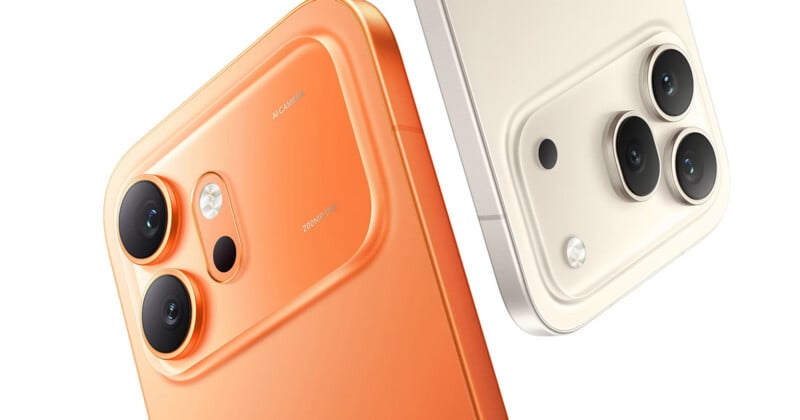
Close-up of the backs of two smartphones, one orange and one white, each featuring two or three rear cameras and an LED flash within raised rectangular camera modules.
Honor 600 | Credit: Honor

By leveraging its sophisticated algorithmic technology, a specific imaging pipeline, and on-device processing power, GlassAI can help smartphones overcome the physical limitations of small sensors and lenses.

In the case of the Honor 600, GlassAI applies its neural network processing to the phone’s zoom imaging, “helping to recover fine detail, reduce noise, and preserve natural color and texture across the zoom range.”
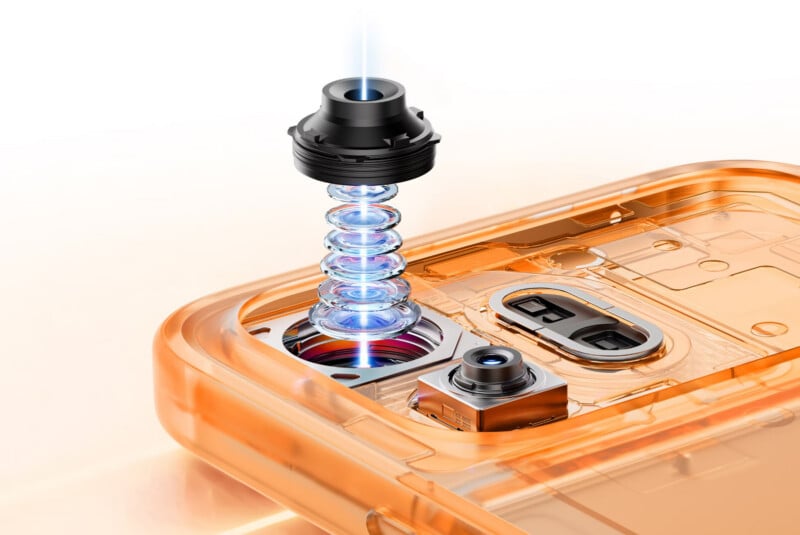
A close-up illustration shows an exploded view of a smartphone camera module, with lens components and sensors separated above an orange transparent phone casing. A blue beam of light travels through the lens elements.
Instead of a dedicated telephoto camera, the Honor 600 uses a crop of its 200-megapixel main camera to deliver ‘zoom’ photography. | Image credit: Honor

GlassAI Inside the Honor 600 Smartphone


”We’re honored to partner with Honor and to have our Neural ISP technology featured in the 600 series,” says Ziv Attar, CEO of Glass Imaging. “Honor continues to set a high bar for mobile imaging, and we’re proud to contribute to that experience and showcase our product in the market.”

As Glass Imaging tells PetaPixel, its neural ISP technology is particularly helpful when dealing with small pixels.

A flowchart shows: devices with cameras, capturing data, training neural networks, and converting RAW to RGB images using a neural-based ISP, ending with a mobile device labeled “Ready to ship” and “Glass AI.
Glass Imaging’s typical neural ISP training pipeline.

“In general, one advantage we offer is in dealing with small pixels. Sub-micron pixels encode high-frequency data in complex ways that traditional ISPs fail to decode — that information isn’t lost, just hard to recover. By modeling the specific point spread function (PSF), sensor, and noise profile of each module, GlassAI corrects optical degradations at their source instead of relying on generic approximations,” Shivansh Rao from Glass Imaging’s machine learning team tells PetaPixel.


A densely packed cluster of multi-story residential buildings with flat roofs and varied facades, seen under bright daylight with blue sky in the background.
Honor 600 AI zoom example
A dense cluster of multi-story apartment buildings and houses with flat roofs and balconies, closely packed together in an urban neighborhood, under a clear blue sky.
iPhone 17 Telephoto — The iPhone 17, like the Honor 600, lacks a dedicated telephoto camera. It uses a crop from its 48-megapixel Fusion camera to deliver ‘optical-quality’ zoom.
Two side-by-side images show colorful apartment buildings with yellow, blue, and brown facades. The left image is clear and sharp, while the right image appears blurry and out of focus.
Crops: Honor 600 with GlassAI (left) versus iPhone 17 (right)

“Specifically, smartphone cameras run into a hard trade-off as pixels shrink: to keep diffraction in check at tiny pixel sizes, designers tend to widen the aperture, but a wider aperture pulls in steeper rays at the edge of the lens that introduce more geometric aberration. A conventional ISP does not model the optics, so it can’t undo that blur; it generally only smooths or sharpens around it. Because we model the actual optics and sensor physics per module, we correct those degradations directly instead of masking them,” Rao continues.

As Glass Imaging has explained before, the company performs extensive end-to-end training for demosaicing, denoising, deblurring, and multi-frame fusion simultaneously, so that all these critical image processing steps are performed in parallel rather than one after another.

“A traditional ISP runs [these] as a chain of discrete steps, and each step discards information the later steps can never recover,” Rao says. “By training the whole pipeline end-to-end on the RAW, we avoid that compounding loss.”

Understandably, given the occasionally jarring, unrealistic, and unpleasant-looking results from many traditional computational photography models and modes, photographers are a little bit skeptical of anything AI-related in their phones. Glass Imaging hopes to avoid the pitfalls of more traditional computational photography by relying on a real RAW image data signal at every step of the process. The company’s model is not creating new detail from thin air, but rather recovering “genuine detail” from real data captured by the actual image sensor.


A picnic setup in a grassy area with a white umbrella, blue balloons, a low table with place settings, cushions, and a decorated white teepee surrounded by trees and greenery. A person stands in the background among the trees.
Honor 600 AI zoom
A picnic setup in a grassy park features a white umbrella, a low table with place settings, blue balloons, a small play tent decorated with colorful flags, and blankets laid out, surrounded by trees and greenery.
iPhone 17
A bunch of blue and light blue balloons tied to wooden poles outdoors, surrounded by greenery and plants. There are also some decorated boxes and a white chair beneath the balloons.
Crops: Honor 600 with GlassAI (left) versus iPhone 17 (right)

“GlassAI Neural ISP is trained to recover genuine detail the optics actually captured but a standard pipeline would lose, so the output stays realistic to what was in front of the lens. That avoids the over-sharpened, artificial, or ‘AI-cleaned’ look you get when computational steps are guessing at detail,” Rao says.

In the case of the Honor 600, Glass Imaging’s technology takes the place of a dedicated telephoto lens. While many class-leading smartphones these days feature three rear cameras, main, ultra-wide, and telephoto, more mid-range models designed for customers on a tighter budget often eschew a dedicated telephoto camera. This is also the case for many very expensive folding or ultra-thin phones, where space is at a premium and a dedicated telephoto camera comes with too many other trade-offs.

So instead of using a longer lens with a dedicated sensor, the Honor 600’s zoom function crops from its 200-megapixel main camera.

“On the Honor 600, zoom isn’t handled by a dedicated telephoto lens — the phone reaches into a scene by cropping its high-resolution main camera. That puts the load on the sensor and main lens: the 200 MP main camera uses a 16-in-1 ‘Hex Bayer’ pattern, so its native pixels are tiny (around 0.56 μm) and normally binned into 2.24 μm super-pixels,” Rao says.


A vibrant yellow rose in full bloom surrounded by green leaves and rosebuds in a sunlit garden.
Honor 600 AI zoom
A bright yellow rose in full bloom surrounded by rosebuds and green leaves, with sunlight highlighting the vibrant colors. Brick pathway and more foliage are visible in the background.
iPhone 17
Side-by-side close-up photos of a blooming yellow rose surrounded by green leaves. The left image is slightly brighter and sharper, while the right image appears softer with more saturated yellow tones.
Crops: Honor 600 with GlassAI (left) versus iPhone 17 (right)

Overcoming the Physical Limitations of Small Pixels

“When you zoom, you’re effectively shooting at those native sub-micron pixels, which is exactly where image quality hits a real physics problem.”

While zooming in on a 200-megapixel sensor may provide the data for a decent simulated telephoto shot, cropping like this also reveals sensor-level issues, such as diffraction and aberrations that can otherwise harm image quality. A blur spot can even cover multiple pixels, since the pixels themselves are so small.

“The result is that simply adding more pixels stops helping, at least with naive sharpening in a traditional ISP, which can’t recover the lost detail,” Rao tells PetaPixel.

“GlassAI addresses this in two ways. First, we incorporate lens aberration correction into the pipeline and train on the actual point spread function (PSF), sensor, and noise of that specific module, which matters more and more as pixels shrink. In our own controlled study, neural restoration improved resolution (MTF50) by over 50% as pixels shrank from 0.75 to 0.35 μm (covering the range of the Honor 600’s sensor), while a traditional ISP largely stalled: since it has no model of the optics, the residual blur stays in the image and the extra detail from denser sampling is lost,” Rao explains.

“That gap is very hard to close with a stepwise pipeline — by the time it sharpens, the real detail has already been discarded. Second, as mentioned, we train an end-to-end network on the RAW data, avoiding the information losses of a traditional multi-stage (demosaic, denoise, sharpen) ISP pipeline,” Rao continues.

A stone arch bridge stands over a calm pond, surrounded by lush green trees and vegetation, with the scene reflected in the water below.
Honor 600 AI zoom
A stone bridge arches over a calm, reflective pond surrounded by lush green trees and foliage on a sunny day.
iPhone 17
A stone arch bridge covered in moss and greenery spans a calm body of water, surrounded by dense trees and lush vegetation under daylight. The image is split into two nearly identical halves.
Crops: Honor 600 with GlassAI (left) versus iPhone 17 (right)


Put another way, by precisely modeling the entire imaging pipeline, including the specific sensor and lens used in the Honor 600’s 200-megapixel main camera, Glass Imaging can recover details that would typically be lost.

“We’re approaching what we call the ‘telephoto physics wall’: the point where silicon scaling outpaces what conventional optics and traditional ISP can cleanly deliver, and further resolution gain is limited,” the Glass Imaging Deep Optics team explained earlier this year in an extremely detailed technology article.

As the company shows through extensive testing, its neural ISP significantly outperforms traditional image signal processing, delivering sharper, cleaner photos. The performance gap widens as pixel size decreases, opening new possibilities for smartphone manufacturers.

A comparison of image processing results: the top row shows ground truth and raw images; middle rows display traditional and mathematical ISP outputs, and the bottom row shows neural ISP results, all across six different incident fluences.
‘On a mixed-script text chart (Latin and CJK characters), the traditional ISP output is essentially unreadable across all configurations due to severe artifacts from Hex CFA demosaicing and uncorrected chromatic aberrations. The neural ISP recovers legible text across the full pitch range, with progressively sharper rendering at smaller pitches,’ Glass Imaging explains.
A comparison grid showing image quality at different apertures and resolutions. Rows include Ground Truth, Traditional Demosaicked, Traditional ISP, and Neural ISP Restored. Metrics SSIM and LPIPS are shown below each image.
‘On converging line patterns, higher pixel density helps resolve finer lines in both cases. However, the traditional ISP still shows moiré effects at smaller pixel sizes. The Neural ISP cleanly resolves the line patterns due to PSF aware deconvolution, with visibly finer detail preserved at 0.35 µm than at 0.75 µm,’ says Glass Imaging.

Glass Imaging Can Improve Image Quality From Any Sensor

Speaking of smartphone makers, while Glass Imaging cannot discuss any particular future, unannounced products, Rao says the team is working hard to develop new technologies for many devices across the smartphone industry and beyond. Glass Imaging’s technology offers promising benefits for any camera, especially those with smaller sensors and lenses, such as wearables, drones, automotive, medical, and more.

“You should expect to see Glass Imaging in more places over time,” Rao concludes.


Image credits: Honor 600 product photos by Honor. Real-world sample photos by Cyrus Tabar.