











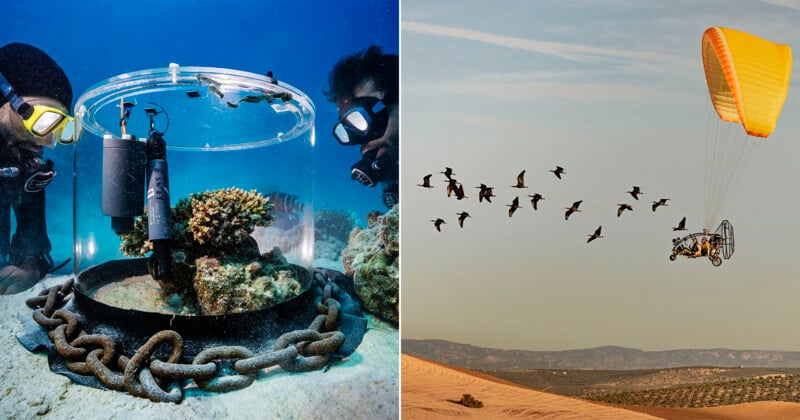
Nature‘s 2026 Scientist At Work photography competition features five of the best photos that scientists captured around the world, showcasing the important work scientists do and the incredible places they go.
Student Gunnar Hartmann is the overall winner of this year’s Scientist At Work photo competition. Hartmann is the photographer for Waldrappteam, an Austrian conservation and research group that is working on the reintroduction of ibises, known in the area as Waldrapp, in Europe.
Ibises were once plentiful in the region, living in the northern foothills of the Alps. However, increased poaching and changing climate conditions forced the birds out about 400 years ago.
As Nature explains, Hartmann joined the group in 2024 as a science undergraduate student at the University of Koblenz in Germany. Every year, the Waldrappteam travels 2,800 kilometers over 50 days from southeast Germany to southwest Spain, leading a flock of hand-raised ibises to their new home.
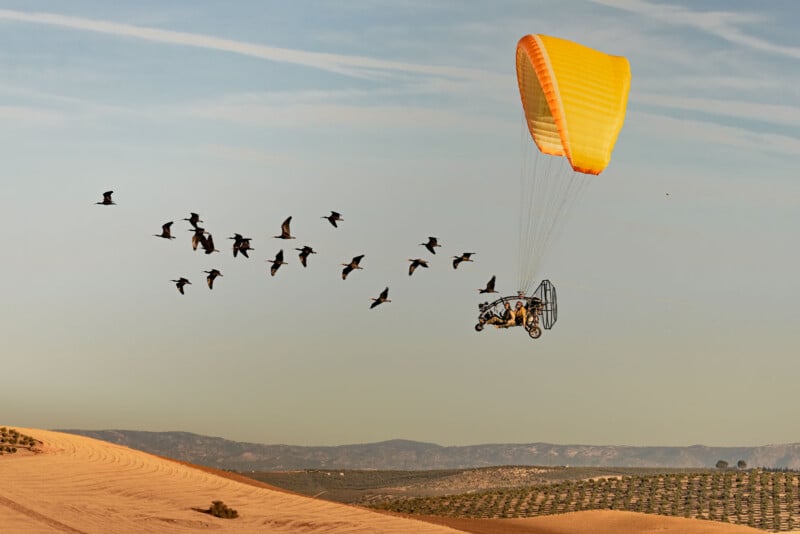
These ibises, raised and bonded to their human foster parents, follow along as the scientists travel in an ultralight aircraft, photogenic with its vibrant yellow parachute. The project was founded in 2004, and it has attracted many fans and followers over the years, as communities gather to watch the aircraft-assisted migration along its route.
Hartmann bested over 220 other submissions to win the grand prize, which includes a £500 cash prize and a feature in Nature.
Alongside Hartmann, four other photographers were named winners, each receiving the same cash prize and Nature feature.
Photographer and freelance marine biologist Uli Kunz captured a powerful portrait of scientists Nauras Daraghmeh and Yusuf El-Khaled installing an incubation chamber over a precious coral-reef underwater ecosystem.
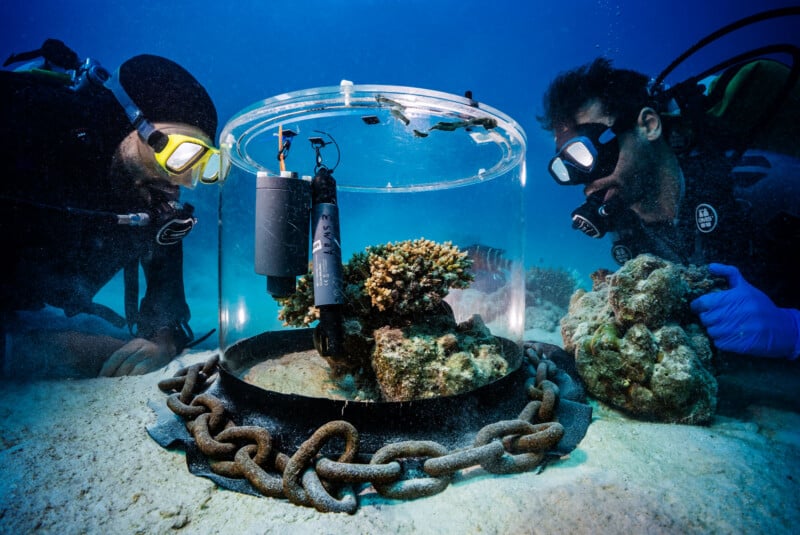
The project is nicknamed the “coral probiotics village,” and it’s based at King Abdullah University of Science and Technology in Thuwal, Saudi Arabia. The project investigates different types of coral and measures how they are affected by changing water temperatures caused by climate change.
“In this photo, I wanted not only to capture the research divers in the midst of their often hectic work, but also to show a moment of quiet contemplation,” explains the photographer, Kunz.
Another underwater photo won this year’s competition. Marine ecologist Robert Harcourt from Australia’s Macquarie University captured an incredible shot of marine biologist Michael Doane collecting a sample from the skin of a whale shark (Rhincodon typus. While Doane carefully and safely collects the sample from the whale shark, a silvertip shark (< em> Carcharhinus albimarginatus) curiously sees what’s happening in the background.
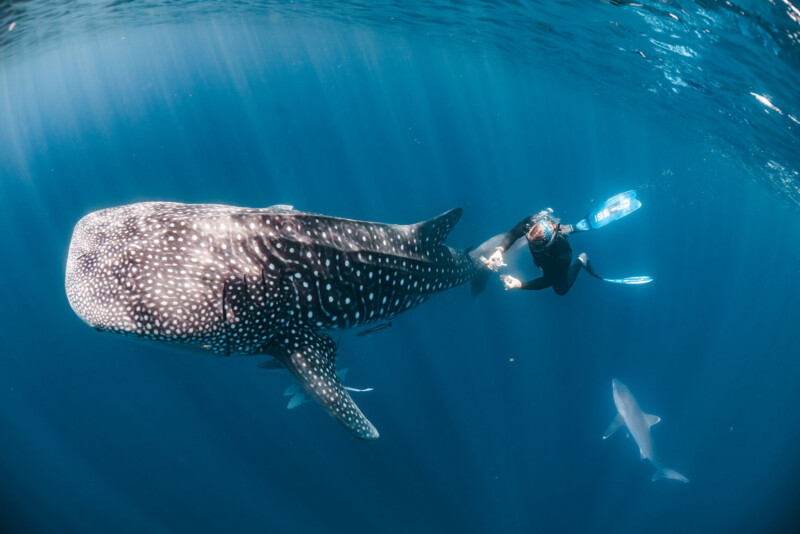
“Swimming next to a 12-meter whale shark as it cruises through the blue, gulping away and seemingly non-plussed by our presence is both humbling and exhilarating,” Harcourt says. “The silvertip shark sneaking up on Mike got all our hearts racing — except Mike, who was focused on microbes.”
Haolun (Allen) Tian’s excellent aerial photo shows vibrant green algal blooms on Dog Lake in Ontario, Canada, as scientists collected samples from a contrasting pink boat.
As Tian, project lead and PhD student at Queen’s University in Kingston, Canada, explains, two common algal species, Microcystis aeruginosa and Dolichospermum flos-aquae, create a “toxic, viole smelling layer of rot” on the surface of Dog Lake each summer. This thick green bloom, while it looks beautiful from above, is horrible at the surface. It kills fish and clogs local water supplies.
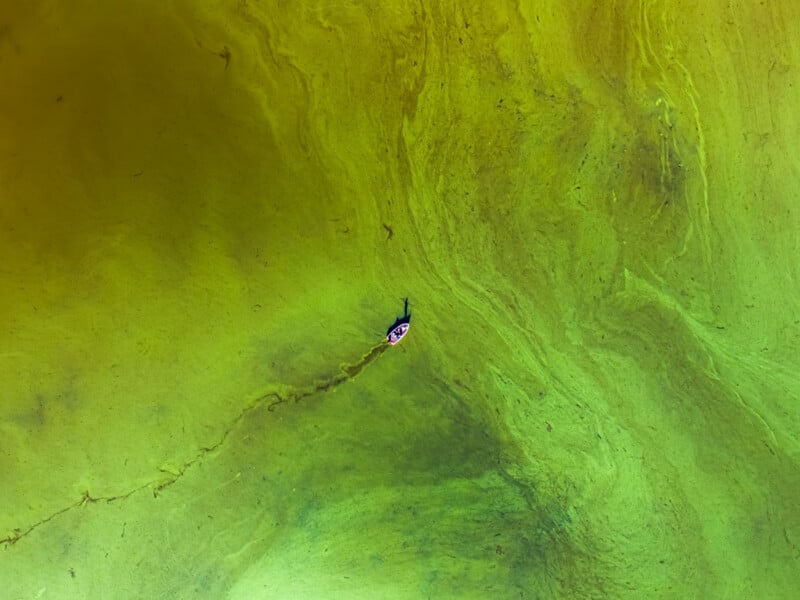
“During the fall, they actually rot and die,” Tian says. “Basically, there’s very few species that can eat them, so they don’t enter the food web.”
Tian and the rest of the team, including Kelly Estrada Piedrahita and Shirley French, study algal DNA to understand better how they interact with and affect other lake species.
Rounding out the winning photos in this year’s Scientists at Work photo competition is Shayanta Chowdhury’s photo of entomologist Lee Haines studying a yellow fever mosquito (Aedes aegypti) under ultraviolet light. It’s a very colorful portrait that captures both the scientist and her subject in a single frame.
“The UV illumination created striking colors from both the tiny mosquito and the condensation that formed beneath the cold Petri dish,” says the photographer, who is a chemistry student at Notre Dame in Indiana.

Haines is part of a team that studies how the drug nitisinone can kill blood-feeding insects.
Chowdhury uses lasers and spectrometers in his own studies, but adds that he doesn’t directly work with biological samples.
“I am always fascinated by their beauty under the microscope,” he says.
Nature‘s annual Scientist At Work photo competition is a beautiful reminder that the important scientific work happening at universities and research institutes every single day, all over the world, can be visually stunning, too. Photos like these are a powerful way for scientists to connect with everyone and share what they are doing in an accessible, approachable way.
Image credits: Nature, Springer Nature. All photographers are credited in the image captions.
此内容由惯性聚合(RSS阅读器)自动聚合整理,仅供阅读参考。 原文来自 — 版权归原作者所有。