


惯性聚合 高效追踪和阅读你感兴趣的博客、新闻、科技资讯
阅读原文 在惯性聚合中打开

推荐订阅源

Blog — PlanetScale
Blog — PlanetScale
博客园_首页
WordPress大学
WordPress大学
博客园 - 聂微东
P
Privacy International News Feed
Forbes - Security
Forbes - Security
Threat Intelligence Blog | Flashpoint
Last Week in AI
Last Week in AI
C
CERT Recently Published Vulnerability Notes
月光博客
月光博客
NISL@THU
NISL@THU
美团技术团队
T
Tailwind CSS Blog
Jina AI
Jina AI
Cyber Security Advisories - MS-ISAC
Apple Machine Learning Research
C
Cisco Blogs
freeCodeCamp Programming Tutorials: Python, JavaScript, Git & More
The Hacker News
The Hacker News
B
Blog
P
Palo Alto Networks Blog
L
Lohrmann on Cybersecurity
有赞技术团队
有赞技术团队
The Register - Security
S
Securelist
A
Arctic Wolf
MyScale Blog
MyScale Blog
H
Help Net Security
N
Netflix TechBlog - Medium
CTFtime.org: upcoming CTF events
T
Threatpost
Recent Commits to openclaw:main
Security Latest
Security Latest
T
Tor Project blog
V
Vulnerabilities – Threatpost
V
V2EX
AI
AI
Hugging Face - Blog
Hugging Face - Blog
大猫的无限游戏
大猫的无限游戏
博客园 - Franky
Simon Willison's Weblog
小众软件
小众软件
OSCHINA 社区最新新闻
OSCHINA 社区最新新闻
H
Hackread – Cybersecurity News, Data Breaches, AI and More
T
Troy Hunt's Blog
Schneier on Security
cs.AI updates on arXiv.org
H
Heimdal Security Blog
Google Online Security Blog
Know Your Adversary
Know Your Adversary

PetaPixel

The Camp Snap 2 Has More Photo Accessories and is Smaller Than Ever Polaroid Go Generation 3 Is the World’s Smallest Instant Analog Camera China Lucky’s New Color C200 Film Has Arrived in the US and Looks Great Chinese Private Equity Firm HSG Emerges as Leading Bidder to Buy Stake in Leica Camera Leica Cine Compact 1 Projector Promises a Plug-and-Play Home Theater Experience There Are No Photos Allowed at the Studio Ghibli Amusement Park Xiaomi 17T Pro Review: High-End Photography Without the Flagship Price Photographer Builds the iPhone Camera App He Always Wanted New $50 Y2K-Inspired Compact Camera Looks Thin In Form and Function Save Big on Macro Photography Essentials Nvidia’s New Chip Aims to Upend the Creative Laptop Market Japanese Zoo Considering Photo Ban After US Tourists Invade Punch the Monkey’s Enclosure Years in the Making, Glass Imaging Is Delivering on its Promise to Transform Smartphone Photography Gen Z are Five Times More Likely to Have a Plan for Photos After Death Long Island Beach Where Marilyn Monroe Posed for Iconic Photos Honored With Plaque Camera Trap Captures One-Armed Gorilla Raising Newborn in the Wild Photographer’s Camera Gear Gets Jet Washed by 20-Foot Wave in Tahiti Photojournalists Say ICE Agents Targeted Them and Their Cameras at Delaney Hall Protests Model Sues Fashion Brand After it AI-Generated Pictures of Her Easy Macro Photography Tips for Incredible Close-Up Photos The Myth of Intent in Photography Samsung’s Competitors Have a Better Samsung Camera Than Samsung Does Thypoch Simera 50mm f/1.4 Review: Crisp and Clean The AI Film ‘Dreams of Violets’ Is How You Get Me to Hate Movies Photographer Documents the Vanishing Wildlife of the ‘American Amazon’ Press Photographer Releases 30-Year Archive of Iconic Celebrity Images Photographer Granted Rare Access to Cambridge’s May Balls for 40 Years Atmos Is a Weather App By Photographers, for Photographers A Feature-Length AI-Generated ‘Live Action’ Movie Is Premiering at Tribeca for Some Reason Despite Being a Member, YoloLiv Isn’t Complying with the Micro Four Thirds Standard ArcBlue C42 Is the World’s First Smart Full-Frame Astrophotography System Film Friday: Kodak TMax 400 Is Far From a One-Trick Pony Sihoo Doro C300 Pro V2 Ergonomic Chair with Full-Body Adaptive Support Keeps You Comfortable and Creative Unknown Photographer Who Took First Royal Portrait Honored With Blue Plaque 15 of the Best Photos Smithsonian Just Added to Unsplash for Free The Challenge of Photographing Mountain Gorillas in the Mist of an Impenetrable Forest This Javelin Thrower Looks Like He is Impaling Himself in Crazy Optical Illusion Photo Capture One’s Private Equity Owner Is Trying to Sell It: Report Thypoch’s New Simera-C 16mm T1.9 Is its Widest Cinema Lens Yet Employee vs Contractor: What Photographers Need to Know Nat Geo’s New Documentary, ‘Time and Water,’ Tells a Story You’re Still Writing Massive Sample Gallery Update: Lumix L10, Sony a7R VI, and More Crafty Lens Cap for Leica M Hides AirTags Polaroid’s Limited Edition Purple Film Gives ‘Waste a Second Life’ Thypoch Voyager 24-50mm f/2.8 Review: Autofocus Zoom for a Bargain Xiaomi’s 17T Series Phones Feature Leica Tech and a New 5x Camera People Don’t Believe This Smartphone Wildlife Photographer’s Images are Real Leica’s Brand-New Metal Gray Paint Finish Looks Very Stylish Independent Audit Finds No Security Basis for Restricting DJI in the USA Witnesses in Nick Ut’s Defamation Trial Against Netflix Include ‘Napalm Girl’ Herself 70mm Film Festival to Show in Palm Springs This Weeekend Google’s New Gemini Omni AI Video Model Can Do Crazy Things Photographers Are Livid About a Photo Festival’s Camera-Busting Rage Room Capture One to Increase All Product Prices By 6% One-of-a-Kind Leica Rifle Camera Used by the Luftwaffe Could Fetch $160,000 The Ultimate ‘First Camera Purchase’ Accessory Tier List | The PetaPixel Podcast 8 Editing Problems Nik Collection 9 Actually Solves Halide Mark III Promises ‘Most Beautiful Photos Possible’ on iPhone New Film Will Chronicle the Life and Work of Brazilian Photographer Claudia Andujar Virginia Museum of Fine Arts Receives Major Gift of Nearly 2,000 Important Photographs Ilford and Expired Film Club Get Into the World Cup Spirit Photographer Arrested for Allegedly Failing to Deliver Quinceañera Photos Acer’s Three New Monitors Are Made for Photographers and Videographers A Streaming Service Made Up Entirely of AI-Generated Shows is About to Launch The Incredible Photography of ‘Obsession’ Spectacular Moment Meteor Explodes Behind Erupting Volcano Caught on Camera Calibrite Colorimeter Is the First That Hardware Calibrates Apple Displays How a Photographer Became a Writer to Tell an Even More Powerful Story Imagen Is Offering Full AI Editing Access for $10, Just In Time for Peak Season Misunderstanding of Fujifilm Film Announcement Causes Panic on Social Media Viltrox Vintage Z1 Pro Flash Offers Retro Style and Modern Performance for Under $60 Pope Leo Warns AI Images Are a ‘Powerful Amplifier’ of Disinformation Footage Reveals Newly Discovered Blue Octopus No Bigger Than a Golf Ball Wedding Photographer Seriously Injured After Being Stabbed by Guest Photographer Takes One in 1.7 Million Photo of Airplane Transiting the Sun Photographer Bitten by ‘Shark or Sea Lion’ During Surf Competition NYC Gallery Says it Has ‘Every Right’ to Create AI Version of Iconic Ansel Adams Photo Sony 100-400mm f/4.5 GM OSS Review: Zoom Zoom NYC Gallery Sold an AI-Generated Ansel Adams Photo Without Permission The Story Behind The Last Photograph of Oscar Wilde on His Death Bed I Fundamentally Disagree With Canon Building a Wall Between its V and C Series Cameras Underwater Cameras Capture Seals Resting in Secret ‘Bubble Caves’ Student Captures Cosmic Radiation on Film by Sending Negative to Space The Enduring Mystery Behind Iconic American Photograph ‘Lunch on a Beam’ The Hidden World of Insect Wings Revealed by Macro Photographer These Earbuds Have Tiny Cameras That Take Photos and Let Users Talk to AI About What They See Yashica Brings Beloved Characters to the Cheap Keychain Camera Segment Fujifilm Has Over 40 New Lens Ideas: ‘It’s Difficult to Convey How Much We Care About Our Lenses’ Why So Many Watch Enthusiasts Love One Specific Camera The 25 Best Memorial Day Deals for Photographers Thypoch’s Stylish Ksana 35mm f/2 Prime Promises 1980s-Inspired Flare Lyft Driver Tries to Scam Customer with AI-Generated Photo of ‘Damage’ to Vehicle What Does It Look to Take a Photo With Half a Lens? First Ever Photograph of ‘Rusty Lark’ Bird Thought to be Extinct for 94 Years Cannes Photographer Reveals His Trick of Getting Hollywood Stars to Look at His Camera IMAX Stock Soars as Takeover Talks Revealed Before the Frame: A Filmmaker’s Approach to Street Photography Scientists Are Building a Camera System to Monitor Zoo Animals’ Health MLS Game To Be First Pro Sports Broadcast Shot Entirely With iPhone Photographers Can Build Their Very Own Keychain Camera at Home
VSCO Terms of Use Explained: Why It Says It Isn’t Stealing Your Photos
Jeremy Gray · 2026-05-27 · via PetaPixel

Black and white circular geometric logo with grid lines next to the bold text "VSCO" on a plain white background.

Many photographers will remember the massive controversy Adobe found itself embroiled in nearly two years ago when photographers noticed just how invasive and overreaching the company’s updated Terms of Use were. The company quickly reacted. VSCO is now finding itself in a similar position, as users are taking notice of some concerning language in the platform’s Terms of Use.

Photographer Simon Migaj was reading VSCO’s Terms of Use over the weekend, and observed that users grant VSCO the right to use the “name, image, voice, or likeness of any individual in your Content, in whole or in part, and in any form, media, or technology, whether now known or developed in the future.”

Further, the license also includes “the right” for VSCO to “use certain Content for Creator Promotion and to develop, train, and improve AI or machine learning models as further described in our Creator Content Standards.”

It is worth noting here that VSCO has already published new Terms of Use that will be going into effect on June 22, 2026, but these are not materially different in the relevant “License You Grant to Us” section. In fact, the language Migaj noticed isn’t new at all.

Terms of Use Look Scary

For those who actually read Terms of Use for software will know all too well that the agreements always look onerous. For example, consider the very beginning of the “License You Grant to Us” section in VSCO’s Terms of Use, either current or upcoming.

“By using our Services, you grant us a royalty-free, sublicensable, non-exclusive, perpetual, irrevocable, worldwide license to use, reproduce, distribute, publicly perform, publicly display, and make derivative works of your Creator Content and AI Content (collectively, “Content”)… ”

This is common language. That doesn’t necessarily make it any less scary, but it does allow VSCO to actually do anything with the content its users upload to the platform. Even displaying an image in an app requires a license, especially when it may be shown as a thumbnail, sent to servers, displayed in connected apps, etc.

As Adobe explained following its Terms of Use fallout in June 2024, software companies require a license to user content to provide essential services and software functions. It also needs to be sublicensable so that companies can utilize technologies and services developed by third parties, even if it’s backend software architecture.
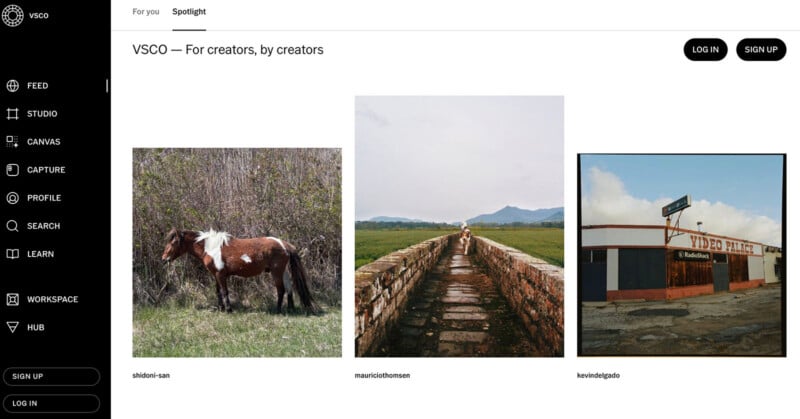
Screenshot of a VSCO webpage displaying three photos: a brown-and-white horse in a grassy field, a person standing on a stone path, and a building with a "VIDEO PLACE" sign. The left sidebar shows navigation options.
Even displaying user photos on VSCO’s platform requires image licenses. If users do not agree to these, VSCO would be entirely useless.

The issue is that companies, by and large, neglect to include plain-language explanations of their Terms of Use, especially the sections that sound bad. What photographer would immediately feel comfortable handing over an irrevocable, lifetime royalty-free license to their content without understanding what that actually means? No photographer, that’s who.

“On the “royalty-free, sublicensable, perpetual” language: this is functionally required for any platform that displays user-uploaded content,” VSCO’s CEO Eric Wittman tells PetaPixel. “Without it, we couldn’t legally render your photos on different devices, let you share your profile publicly, or build the discovery features photographers rely on. This language protects our ability to operate, not to exploit.”

The Right to Likeness

However, the larger concern is that VSCO’s Terms of Use go beyond just the standard licensing question. While the company, and any company, should explain Terms of Use in a way that makes sense to the average user who surely isn’t a lawyer or technology expert, there is more concerning language in VSCO’s Terms of Use than the general license language above.

VSCO’s Terms of Use grant the company the right to use, reproduce, distribute, and make derivative works of more than just an uploaded photo. The company also claims the right to the “name, image, voice, or likeness of any individual included in your Content, in whole or in part, and in any form, media, or technology, whether now known or developed in the future.”

“This language provides a fairly standard license related to the right of publicity. Your ‘right of publicity’ provides you control over how your name, face, or voice is used,” Sara Lee, VSCO General Counsel tells PetaPixel.

“We ask for permission to use these aspects of creators’ content so we can display and feature content and improve our platform, including in search, feeds, featured content, and in future new ways to provide a rich experience on VSCO. To be clear, this doesn’t mean VSCO owns your work or publicity rights or can do anything we want with them. The content posted by you as a creator still belongs to you.

“We always respect creators’ privacy settings and also give attribution (typically by referencing creator usernames) where applicable.”

As photographers have painfully learned firsthand, it is nearly impossible to predict what a company might do with images it has the license to use, especially when considering technology that doesn’t yet exist. VSCO is covering its bases here, keeping things extremely open-ended in a way that rightly concerns some photographers. That doesn’t necessarily mean anything nefarious is happening, of course, but it’s important for people to keep an eye on how companies say they may use their content and data.

VSCO and AI Training

VSCO has historically been transparent about its relationship with AI, including a new campaign dedicated to empowering real, human creativity.

The company’s relationship to AI and transparency has not changed. The language in VSCO’s Terms of Use that outlines how the company can use user content to “develop, train, and improve AI or machine learning models… ” has a fairly significant caveat worth considering.

Side-by-side images of outdoor stairs next to a wall. The left side shows three yellow traffic cones on the ground and steps; the right side shows the same area with the cones digitally removed.
VSCO has been regularly releasing new AI photo editing features, which the company insists are not trained using data from paying members. However, images uploaded by non-premium members are fair game.

“VSCO does not use content from paying subscribers for AI training, nor is their content licensed to third parties. Full stop,” Wittman tells PetaPixel. It is worth noting here that, as VSCO has said before, the company does train AI using content uploaded by non-paying VSCO subscribers.

“For non-paying members whose content is publicly posted, we may use that content to develop and improve AI-powered features on the platform. This is consistent with how most creative platforms operate, and it’s the reason the license language exists. We want to be honest about that rather than obscure about it.”


‘For non-paying members whose content is publicly posted, we may use that content to develop and improve AI-powered features on the platform.’


Wittman says that while much of the language in VSCO’s Terms of Use is purposefully broad, it is designed to cover the company’s bases for rather standard functionality.

“The legal framing is broad by necessity, but what it actually covers is operating the platform, enabling discovery, personalizing experiences, and improving AI features,” Wittman explains. “It does not mean VSCO owns your photos or can sell them.”

Wittman offers a practical example. When a photographer looks at a photo on VSCO, the app displays a set of visually similar images as recommendations. This recommendation engine is powered by machine learning, which requires licensed images to develop, including those uploaded to VSCO by free members.

Wittman knows not every photographer is okay with any level of AI training done with their content.

“We respect that perspective,” Wittman says. “What we can commit to is transparency about what we’re actually doing, rather than hiding behind vague policy language.”

If VSCO users don’t want their content used for AI training, they must either be a paying member or, if they are a free user, not upload content publicly. Those are their only options as of now.


‘What we can commit to is transparency about what we’re actually doing, rather than hiding behind vague policy language.’


Trust Is An Important Part of the Equation

Legalese rarely reads well. It almost always sounds terrifying, like the user is signing their life away to a company to use an app or website. It’s certainly true that people are signing away significant rights whenever they use a platform. A photography platform cannot exist without licensing rights to display people’s images.

With the specific exception of marketing materials, which VSCO explains here, the company is not displaying photos that users have uploaded in any unusual way. VSCO is not selling users’ photos to the highest bidder or preventing photographers from going about their business as usual with any images uploaded to VSCO.

However, companies should still consider ways they can directly engage with the community, including explaining Terms of Use in plain language that outlines exactly what they mean. Photographers care deeply about their work, as they should, so they must know what a company commits to doing, or more importantly, not doing, with their photos. This is an area where VSCO’s current and upcoming Terms of Use come up short.

The company has done plenty of things right in recent years and worked hard to deliver useful tools and services to photographers, but that doesn’t mean there isn’t room for improvement.

At the risk of sounding glib, photographers who do not wish to transfer any rights or license to their photos cannot use social media or most photo editing apps. VSCO’s Terms of Use are not unique, not by a long shot. Those who read the Terms of Use on platforms like Instagram or Reddit will find considerable overlap, for example. The same is true nearly universally.

That said, it remains important to understand what companies may do with photos, especially as nearly every company pursues some form of AI development. It’s also essential that people know what companies do with their data. It’s also important for people to decide to what extent they trust a company. That is a significant component when dealing with any company.

Photographers should read Terms of Use, research companies, and determine what they are willing to give up to use the platforms and services they like. It’s a perfectly reasonable response to dislike a company’s approach to licensing or data and stop using their products and services. There is nothing wrong with that.

However, it’s important too for photographers to realize what any line in the sand they draw may mean for how they can actually share their work online.