


惯性聚合 高效追踪和阅读你感兴趣的博客、新闻、科技资讯
阅读原文 在惯性聚合中打开

推荐订阅源

D
DataBreaches.Net
Latest news
Latest news
aimingoo的专栏
aimingoo的专栏
GbyAI
GbyAI
D
Docker
让小产品的独立变现更简单 - ezindie.com
F
Fortinet All Blogs
量子位
IT之家
IT之家
博客园 - 司徒正美
博客园 - Franky
大猫的无限游戏
大猫的无限游戏
CTFtime.org: upcoming CTF events
The Cloudflare Blog
Last Week in AI
Last Week in AI
美团技术团队
freeCodeCamp Programming Tutorials: Python, JavaScript, Git & More
腾讯CDC
WordPress大学
WordPress大学
Google DeepMind News
Martin Fowler
Martin Fowler
MongoDB | Blog
MongoDB | Blog
博客园 - 叶小钗
阮一峰的网络日志
阮一峰的网络日志
月光博客
月光博客
F
Full Disclosure
Stack Overflow Blog
Stack Overflow Blog
OSCHINA 社区最新新闻
OSCHINA 社区最新新闻
B
Blog
I
InfoQ
A
About on SuperTechFans
爱范儿
爱范儿
Jina AI
Jina AI
博客园 - 三生石上(FineUI控件)
Y
Y Combinator Blog
博客园 - 【当耐特】
The Register - Security
Microsoft Security Blog
S
SegmentFault 最新的问题
钛媒体:引领未来商业与生活新知
钛媒体:引领未来商业与生活新知
L
LangChain Blog
Recorded Future
Recorded Future
雷峰网
雷峰网
小众软件
小众软件
H
Hackread – Cybersecurity News, Data Breaches, AI and More
T
Tailwind CSS Blog
MyScale Blog
MyScale Blog
博客园 - 聂微东
V
V2EX
Vercel News
Vercel News

PetaPixel

Polaroid Go Generation 3 Is the World’s Smallest Instant Analog Camera China Lucky’s New Color C200 Film Has Arrived in the US and Looks Great Chinese Private Equity Firm HSG Emerges as Leading Bidder to Buy Stake in Leica Camera Leica Cine Compact 1 Projector Promises a Plug-and-Play Home Theater Experience There Are No Photos Allowed at the Studio Ghibli Amusement Park Xiaomi 17T Pro Review: High-End Photography Without the Flagship Price Photographer Builds the iPhone Camera App He Always Wanted New $50 Y2K-Inspired Compact Camera Looks Thin In Form and Function Save Big on Macro Photography Essentials Nvidia’s New Chip Aims to Upend the Creative Laptop Market Japanese Zoo Considering Photo Ban After US Tourists Invade Punch the Monkey’s Enclosure Years in the Making, Glass Imaging Is Delivering on its Promise to Transform Smartphone Photography Gen Z are Five Times More Likely to Have a Plan for Photos After Death Long Island Beach Where Marilyn Monroe Posed for Iconic Photos Honored With Plaque Camera Trap Captures One-Armed Gorilla Raising Newborn in the Wild Photographer’s Camera Gear Gets Jet Washed by 20-Foot Wave in Tahiti Photojournalists Say ICE Agents Targeted Them and Their Cameras at Delaney Hall Protests Model Sues Fashion Brand After it AI-Generated Pictures of Her Easy Macro Photography Tips for Incredible Close-Up Photos The Myth of Intent in Photography Samsung’s Competitors Have a Better Samsung Camera Than Samsung Does Thypoch Simera 50mm f/1.4 Review: Crisp and Clean The AI Film ‘Dreams of Violets’ Is How You Get Me to Hate Movies Photographer Documents the Vanishing Wildlife of the ‘American Amazon’ Press Photographer Releases 30-Year Archive of Iconic Celebrity Images Photographer Granted Rare Access to Cambridge’s May Balls for 40 Years Atmos Is a Weather App By Photographers, for Photographers A Feature-Length AI-Generated ‘Live Action’ Movie Is Premiering at Tribeca for Some Reason Despite Being a Member, YoloLiv Isn’t Complying with the Micro Four Thirds Standard ArcBlue C42 Is the World’s First Smart Full-Frame Astrophotography System Film Friday: Kodak TMax 400 Is Far From a One-Trick Pony Sihoo Doro C300 Pro V2 Ergonomic Chair with Full-Body Adaptive Support Keeps You Comfortable and Creative Unknown Photographer Who Took First Royal Portrait Honored With Blue Plaque 15 of the Best Photos Smithsonian Just Added to Unsplash for Free The Challenge of Photographing Mountain Gorillas in the Mist of an Impenetrable Forest This Javelin Thrower Looks Like He is Impaling Himself in Crazy Optical Illusion Photo Capture One’s Private Equity Owner Is Trying to Sell It: Report Thypoch’s New Simera-C 16mm T1.9 Is its Widest Cinema Lens Yet Employee vs Contractor: What Photographers Need to Know Nat Geo’s New Documentary, ‘Time and Water,’ Tells a Story You’re Still Writing Massive Sample Gallery Update: Lumix L10, Sony a7R VI, and More Crafty Lens Cap for Leica M Hides AirTags Polaroid’s Limited Edition Purple Film Gives ‘Waste a Second Life’ Thypoch Voyager 24-50mm f/2.8 Review: Autofocus Zoom for a Bargain Xiaomi’s 17T Series Phones Feature Leica Tech and a New 5x Camera People Don’t Believe This Smartphone Wildlife Photographer’s Images are Real Leica’s Brand-New Metal Gray Paint Finish Looks Very Stylish Independent Audit Finds No Security Basis for Restricting DJI in the USA Witnesses in Nick Ut’s Defamation Trial Against Netflix Include ‘Napalm Girl’ Herself 70mm Film Festival to Show in Palm Springs This Weeekend Google’s New Gemini Omni AI Video Model Can Do Crazy Things Photographers Are Livid About a Photo Festival’s Camera-Busting Rage Room Capture One to Increase All Product Prices By 6% One-of-a-Kind Leica Rifle Camera Used by the Luftwaffe Could Fetch $160,000 The Ultimate ‘First Camera Purchase’ Accessory Tier List | The PetaPixel Podcast 8 Editing Problems Nik Collection 9 Actually Solves Halide Mark III Promises ‘Most Beautiful Photos Possible’ on iPhone New Film Will Chronicle the Life and Work of Brazilian Photographer Claudia Andujar Virginia Museum of Fine Arts Receives Major Gift of Nearly 2,000 Important Photographs Ilford and Expired Film Club Get Into the World Cup Spirit Photographer Arrested for Allegedly Failing to Deliver Quinceañera Photos Acer’s Three New Monitors Are Made for Photographers and Videographers A Streaming Service Made Up Entirely of AI-Generated Shows is About to Launch The Incredible Photography of ‘Obsession’ Spectacular Moment Meteor Explodes Behind Erupting Volcano Caught on Camera VSCO Terms of Use Explained: Why It Says It Isn’t Stealing Your Photos Calibrite Colorimeter Is the First That Hardware Calibrates Apple Displays How a Photographer Became a Writer to Tell an Even More Powerful Story Imagen Is Offering Full AI Editing Access for $10, Just In Time for Peak Season Misunderstanding of Fujifilm Film Announcement Causes Panic on Social Media Viltrox Vintage Z1 Pro Flash Offers Retro Style and Modern Performance for Under $60 Pope Leo Warns AI Images Are a ‘Powerful Amplifier’ of Disinformation Footage Reveals Newly Discovered Blue Octopus No Bigger Than a Golf Ball Wedding Photographer Seriously Injured After Being Stabbed by Guest Photographer Takes One in 1.7 Million Photo of Airplane Transiting the Sun Photographer Bitten by ‘Shark or Sea Lion’ During Surf Competition NYC Gallery Says it Has ‘Every Right’ to Create AI Version of Iconic Ansel Adams Photo Sony 100-400mm f/4.5 GM OSS Review: Zoom Zoom NYC Gallery Sold an AI-Generated Ansel Adams Photo Without Permission The Story Behind The Last Photograph of Oscar Wilde on His Death Bed I Fundamentally Disagree With Canon Building a Wall Between its V and C Series Cameras Underwater Cameras Capture Seals Resting in Secret ‘Bubble Caves’ Student Captures Cosmic Radiation on Film by Sending Negative to Space The Enduring Mystery Behind Iconic American Photograph ‘Lunch on a Beam’ The Hidden World of Insect Wings Revealed by Macro Photographer These Earbuds Have Tiny Cameras That Take Photos and Let Users Talk to AI About What They See Yashica Brings Beloved Characters to the Cheap Keychain Camera Segment Fujifilm Has Over 40 New Lens Ideas: ‘It’s Difficult to Convey How Much We Care About Our Lenses’ Why So Many Watch Enthusiasts Love One Specific Camera The 25 Best Memorial Day Deals for Photographers Thypoch’s Stylish Ksana 35mm f/2 Prime Promises 1980s-Inspired Flare Lyft Driver Tries to Scam Customer with AI-Generated Photo of ‘Damage’ to Vehicle What Does It Look to Take a Photo With Half a Lens? First Ever Photograph of ‘Rusty Lark’ Bird Thought to be Extinct for 94 Years Cannes Photographer Reveals His Trick of Getting Hollywood Stars to Look at His Camera IMAX Stock Soars as Takeover Talks Revealed Before the Frame: A Filmmaker’s Approach to Street Photography Scientists Are Building a Camera System to Monitor Zoo Animals’ Health MLS Game To Be First Pro Sports Broadcast Shot Entirely With iPhone Photographers Can Build Their Very Own Keychain Camera at Home
What Is Longitudinal Chromatic Aberration and Why Is it So Hard to Correct?
Jeremy Gray · 2026-06-14 · via PetaPixel

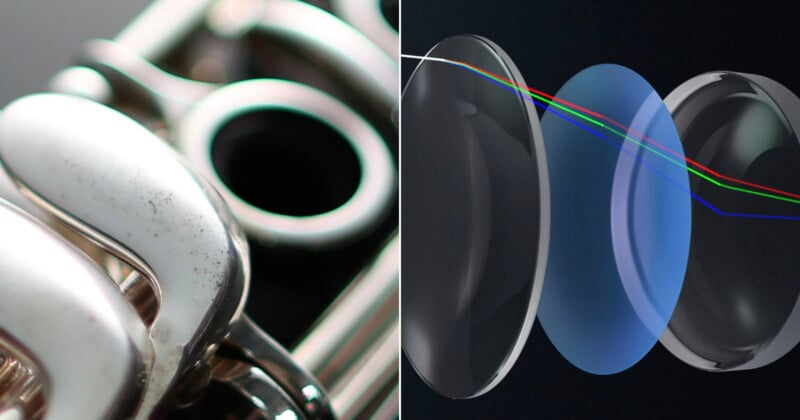
Close-up of a shiny metal flute on the left, and a digital illustration of curved camera lens elements with colored light paths on the right.

Have you ever looked at a photo and wondered, “What’s with all the green and pink colors around high-contrast edges?” That’s longitudinal, or axial, chromatic aberration. LoCA. It’s common, very difficult to prevent optically and nearly as hard to remove during post-processing.

What Is Longitudinal Chromatic Aberration?

LoCA isn’t the only type of chromatic aberration out there, and both it and lateral, or transverse, chromatic aberration happen for similar reasons. Broadly speaking, chromatic aberrations occur when different wavelengths of light focus at different points.

In the case of LoCA, the issue is that red, green, and blue wavelengths travel through elements inside a lens and focus at different points on the focal plane, whether that is film with an analog camera or the image sensor in a digital one.
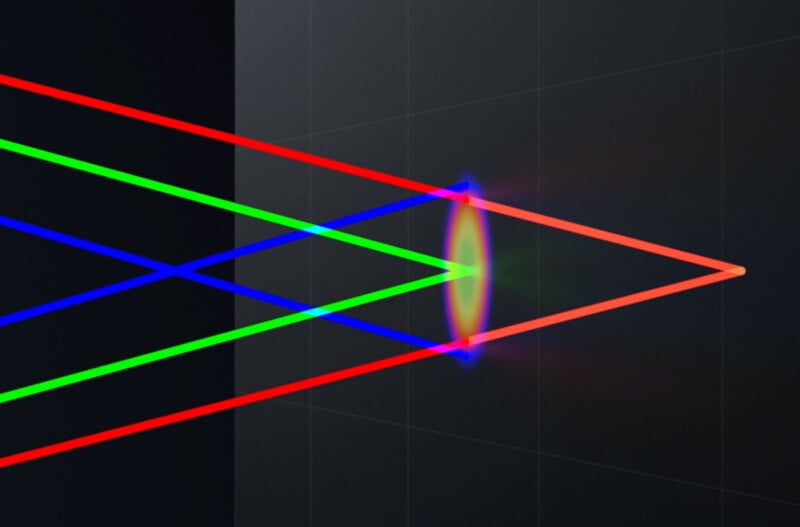
Three colored light beams—red, green, and blue—converge and cross at a central focal point, creating a bright, multicolored area against a dark background with faint grid lines.
Credit: Canon

As Canon explains in a video it shared with PetaPixel for this story, “Ideally, all wavelengths of light passing through a lens should converge at a single point on the image plane.” In the event this occurs, there is no chromatic aberration.

The problem is that different colors of light refract differently through glass, meaning that “slight misalignments are inevitable.”

When misalignments are very minor, it may not be a major issue for most photographers. However, when they are significant, which is more often the case with extremely fast-aperture ones with very large glass elements inside, it can be very distracting. Many photographers don’t like noticeable color fringing in their photos, after all. Since LoCA primarily affects bokeh, bad LoCA control can prove especially distracting.

Close-up of tangled silver chains hanging on a white surface, with the foreground in sharp focus and the background blurred. The intricate links create a textured, shiny pattern.
Even extremely good lenses, like the Sony FE 135mm f/1.8 G Master, can exhibit LoCA. | Test shot by Chris Niccolls

“The wavelengths of red, green, and blue light are different, causing them to focus at different positions,” Fujifilm tells PetaPixel.

When you are photographing something, such as a person, you have a focal plane, typically near the eyes. Anything in front of or behind that plane of focus is, of course, out of focus. Imagine a perfectly corrected lens, which is practically impossible. In this case, all wavelengths of light travel through the lens and converge at a single, perfect point. This means that out-of-focus elements will be perfectly neutral, with no color fringing.

A narrow white light beam enters a transparent prism, splitting into three colored beams—red, green, and blue—on a dark background, illustrating light dispersion.

In reality, some light is misaligned in one direction, and other light misses the mark in another direction. A fairly common situation is green misalignment behind the focal plane and red or pink misalignment in front of it. So out-of-focus areas closer to the camera may show magenta fringing, while out-of-focus elements in the background may show green edges.

Sunlight filters through the branches of a tree with sparse leaves and berries, against a blue sky. Some branches are covered with a light dusting of frost, creating a wintery atmosphere.
The Zeiss Otus ML 50mm f/1.4 exhibits strong LoCA. High-contrast edges in front of and behind the subject exhibit significant color fringing. | Test shot by Chris Niccolls

When these misalignments occur off-axis, lateral chromatic aberration can occur. This appears outside the central portion of the image and is typically a single color, such as blue or purple. Because it is not different colors, it is easier to selectively remove during post-processing. It’s more common with wide-angle lenses or those without advanced optical elements.

How do Lens Manufacturers Reduce LoCA?

So Canon and Fujifilm both explained what longitudinal chromatic aberration is and what causes it, but what do Canon, Fujifilm, and Nikon say about correcting chromatic aberrations?

“Some new optical technologies that have been implemented to counter the effects of LoCA is Nikon’s ‘multi-focus’ systems on select lenses (especially macro lenses, which have high susceptibility to LoCA),” Nikon’s Mark Cruz, Sr. Manager, Product DCIL, Nikon Inc., tells PetaPixel. “This new system achieves extremely high focusing accuracy at close distances by simultaneously controlling two AF drive units. This results in a high-level of compensation for aberrations at close distances.”

Two birds perch on a dark rocky outcrop by the water, with sunlight reflecting off the rippling waves in the background.
Lens designers want to avoid THIS. | Credit: Canon

Cruz continues, explaining that advancements in glass processing and manufacturing techniques have enabled Nikon to shape its glass more precisely. By combining different convex and concave lens shapes and with significantly more precise glass elements, Nikon’s engineers have been able to reduce chromatic aberrations and ensure that different wavelengths of light are better aligned on the image sensor.

This is especially important with large-diameter aspherical lenses, which have historically been challenging to machine and grind with the required level of accuracy.

“Another contributing factor to the reduction of LoCA has been Nikon’s advancements in high-refractive-index (HRI) glass, while improved manufacturing processes has led to higher surface accuracy. The latest generation of this molded glass material effectively compensate for various lens aberrations. Additionally, we continue to utilize spherical and aspherical elements which deliver outstanding surface accuracy with improved corrective capability,” Cruz adds.
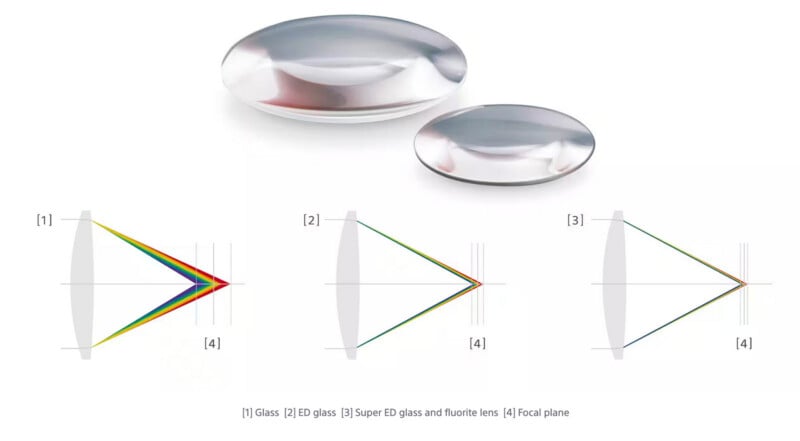
Two types of camera lenses are shown above three diagrams comparing how glass, ED glass, and Super ED glass focus colored light onto a single focal plane. Colored lines illustrate reduced chromatic aberration.
This excellent graphic from Sony illustrates the differences between ED and Super ED glass as it relates to chromatic aberrations. | Credit: Sony

As for Fujifilm, it minimizes longitudinal chromatic aberrations by using ED and Super ED lenses. ED glass, used by all the major manufacturers, significantly reduces chromatic aberration. “ED” stands for Extra-low Dispersion, which means light scatters less as it travels through the lens.

Super ED glass, as its name suggests, is even better.

“We minimize the longitudinal chromatic aberration by using ED lenses and Super ED lenses that reduce light dispersion, as well as by designing lens systems that combine concave and convex elements to counteract the aberration,” Fujifilm tells PetaPixel.

While it may seem like a great idea for companies to jam as much ED and Super ED glass as possible into their lenses, it is, unfortunately, not that simple. Correcting for chromatic aberrations is but one focus for lens designers. They must also ensure the lens is sharp, offers good contrast, and resists flare. Lenses also must be affordable, have fast focusing, and not weigh a ton. There are many objectives in lens design, and some of them work directly against each other, forcing engineers into a challenging give-and-take process.

“We optimally design the lens configuration while considering the best balance of size, weight, and cost,” Fujifilm says. “For example, in large-aperture lenses like the XF500mm F5.6, the lens group consists of 21 elements, including 5 ED lenses and 2 Super ED lenses. The XF500mm F5.6 effectively suppresses longitudinal chromatic aberration using five ED lenses and two Super ED lenses, allowing the focus lens to consist of just one element. Since increasing the number of lenses in the focus group also increases its weight, we carefully consider this aspect during the design process.”
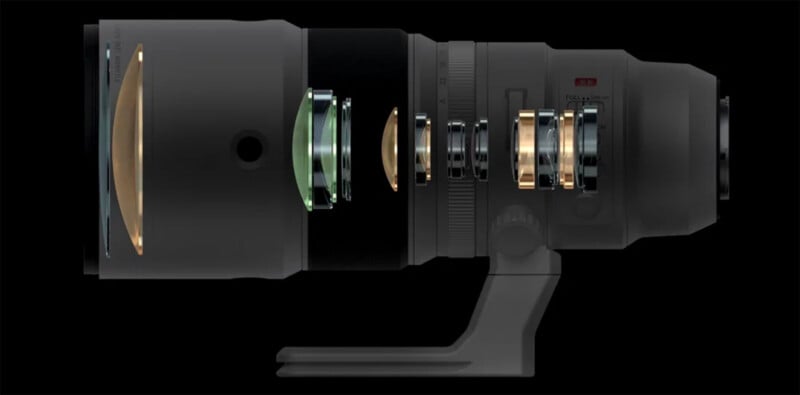
A digital rendering showing an exploded view of a camera telephoto lens, revealing its internal elements and glass components against a black background.
Fujifilm XF 500mm f/5.6 R LM OIS WR optical design | Credit: Fujifilm

In Canon’s case, its approach depends on the lens. For lenses targeting a more accessible price point, a good way to reduce chromatic aberrations is to use convex and concave lenses carefully. This is a basic approach, but it can be effective. It basically bends different wavelengths of light in opposite directions, trying to cancel out refractive errors. It’s a delicate balance.

Canon has “ED” lenses, too, although they are called UD (Ultra-low Dispersion). Canon even grows its own synthetic fluorite crystals to create these specialized optics with significantly reduced refractive indices.

Several rough green and white crystals, a large clear synthetic crystal, and three polished optical lenses are displayed on a dark surface, illustrating the process of transforming raw minerals into finished lenses.
Image credit: Canon

As Canon explains, this approach is not always the best one. For lenses with large apertures (fast lenses) and those with shorter barrels, it is not always feasible to use optical layout to adequately bend light so that it converges. It requires many lens elements, and there is not always space for them.

In cases like this, where Canon wants compact lenses with high image quality and minimal chromatic aberration, it developed an all-new type of glass, Blue Spectrum Refractive (BR) elements.
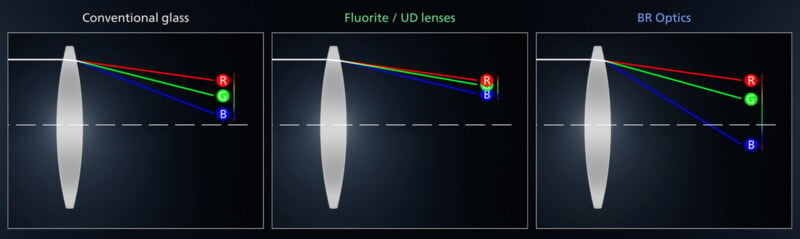
A diagram comparing how red, green, and blue light focus through conventional glass, fluorite/UD lenses, and BR optics, showing improved alignment of light rays with advanced lens types.
Credit: Canon

“Blue (short wavelength) light is particularly troublesome for lens engineers because it’s hard to correct its path through a lens element in the same way as longer-wavelength green and red light, which means it can cause blue fringing,” Canon explains. “However, in August 2015, Canon introduced the EF 35mm f/1.4L II USM, the first lens to feature a Blue Spectrum Refractive (BR) element. The BR element uses a new organic optical element that has different dispersion characteristics from standard elements. It is sandwiched between concave and convex glass lenses, to control the path of blue light and minimize chromatic aberration.”


I’ve seen this BR element firsthand in Japan, and it’s very impressive. A decade in the making, BR optical elements use anomalous dispersion to alter how blue light refracts within the lens.
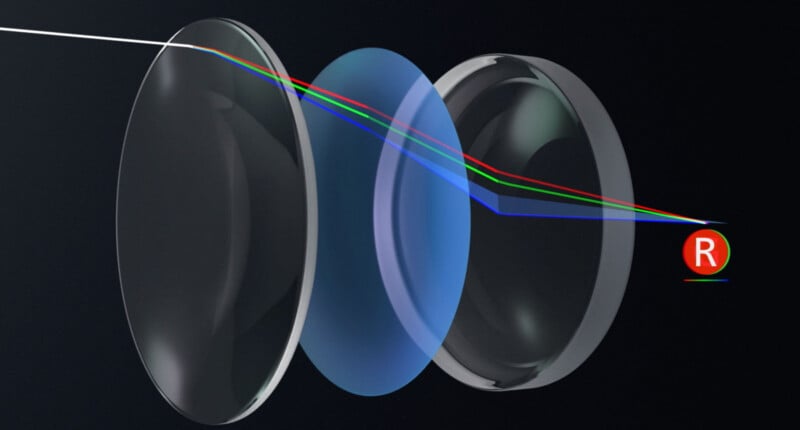
Diagram showing three transparent lens elements with colored lines (red, green, blue) passing through them, illustrating how light is refracted and converged toward an "R" symbol on a dark background.
Credit: Canon

The BR element itself is very thin and makes it much easier to focus blue wavelengths of light on the image sensor. Basically, it keeps blue light from straying off the desired optical path and, alongside other optical approaches, keeps red, green, and blue light focused on a single point on the focal plane.

Two red dice with white dots rest on a dark textured surface next to two parallel silver chains. The dice are translucent and one is in sharp focus, while the other is blurred in the background.
Canon’s advanced optical technology helps keep images clean, like this sample image from the RF 85mm f/1.4L VCM, which Chris shot at Canon’s Utsunomiya lens factory. | Photo by Chris Niccolls
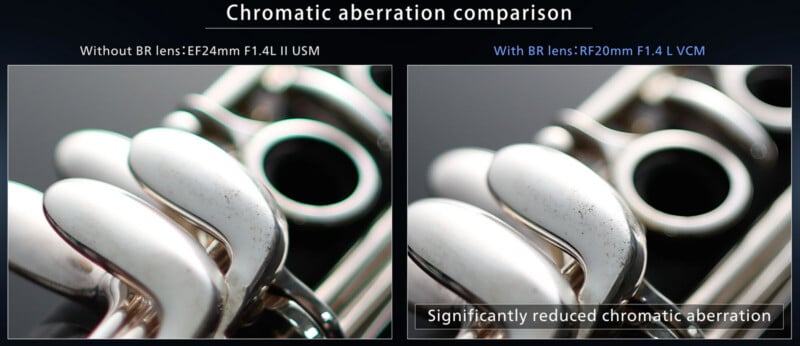
Side-by-side comparison of two images showing chromatic aberration in a close-up of a silver instrument; the left image is blurry with color fringing, while the right image is much sharper and clearer.
Credit: Canon

The Software Side


It is also worth considering how manufacturers combine optical technology with software to further improve image quality. Nikon, for example, recognizes that in some situations, LoCA remains visible even with lenses featuring advanced optical technologies. In these cases, its NX Studio software has specialized LoCA corrective measures that can be applied to both RAW and JPEG images.


Canon uses its Neural Network technology to achieve similar results inside its own software, Digital Photo Professional.

Third-party image editing apps, like Adobe Lightroom, DxO PhotoLab, and more, include chromatic aberration corrective tools.

However, as mentioned at the top, given the causes of LoCA and how it appears in images, it can be very challenging to correct it using software. It can be reduced, yes, but the most effective way to eliminate LoCA is to do so physically at the time of capture.

Removing LoCA Is Very Difficult

There is no question that modern lenses are significantly better at dealing with longitudinal chromatic aberration than their vintage counterparts. New lenses deliver cleaner images than ever and much more effective aberration control for many reasons, including more precise glass elements, advanced glass materials, and often a little extra help on the digital correction side.

A person in a striped shirt sits at a desk in an office, working on a computer displaying colorful technical diagrams or schematics.
Credit: Canon

Photography is all about light, and lenses are as good as they have ever been at bending different wavelengths of light in the perfect way so that they converge on a single point. As camera manufacturers explained to us, bending light is a very delicate dance, and eliminating those pesky chromatic aberrations is remarkably difficult. An awful lot of time, money, and engineering have gone into making your photos just that little bit cleaner.