


If your platform team publishes standardized pipeline components, you've probably encountered this: once they're out in the wild, you lose visibility. You can't see if anyone’s actually using it, who's on which version, or which projects are still running outdated versions that open your organization up to security risks.
Now with GitLab 19.0's new Components Analytics view in the CI/CD Catalog, your team gets visibility and important adoption data about how CI/CD components are being utilized across the organization. Usage counts and adoption data is available across all tiers; with Ultimate, drill into any component to see exactly which projects are using which versions.
As AI generates more of the pipelines hitting production, this visibility matters more than ever.
The GitLab CI/CD Catalog gives DevSecOps and platform engineering teams a central place to publish versioned, reusable pipeline components that any project can pull in with a single include reference. No copy-pasting, no manual updates across hundreds of repos, no guesswork about which template is the source of truth. Distribution: solved.
But once a component is out in the wild, visibility disappears, and the consequences aren't only operational. Security fixes in shared components don't automatically propagate, so outdated, vulnerable versions linger in production pipelines, with a blast radius no one can measure until something breaks. The next time a vulnerability is disclosed in a widely used component, the question "how exposed are we?" shouldn't take a week of manual auditing to answer.
Components Analytics closes that gap with two views: a high-level usage view available across all tiers, and a per-component drill-down on Ultimate.
The high-level adoption view shows component maintainers how widely each of their components is being used across the organization. For each catalog resource you maintain, you can see:
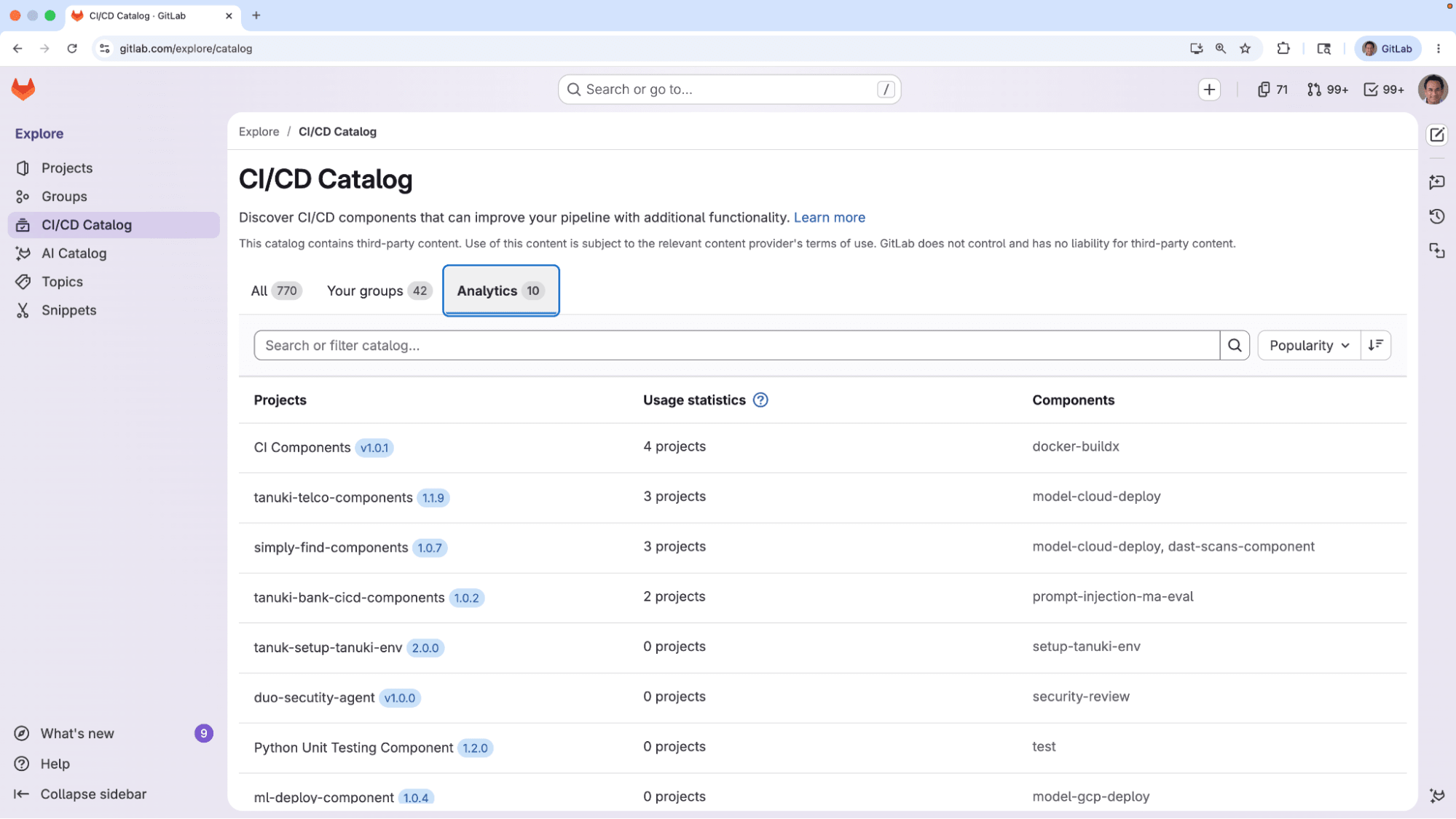
At a glance, you can see which of your components are widely adopted and which have been quietly abandoned. This is useful for prioritizing maintenance, planning deprecations, and making the case for continued investment in shared CI infrastructure.
This high-level view shipped in GitLab 18.9 and is available across all tiers, including Free. If you maintain components in the CI/CD Catalog, it's ready for use today. You can access it through Explore > CI/CD Catalog > Analytics.
For teams that need evidence of what's running where, whether for security response, compliance audits, or major refactors, GitLab Ultimate adds the per-component drill-down.
If the high-level view answers "how widely is my component being used?", the drill-down answers "which projects are running which versions, and where do I need to act?"
With the new Component Analytics on GitLab Ultimate, you can open any catalog resource you maintain and see exactly which projects included one of its components in a pipeline in the last 30 days, which version each project is on, and which versions are outdated. Each project is clearly marked as up-to-date or outdated, so you know at a glance where to focus.
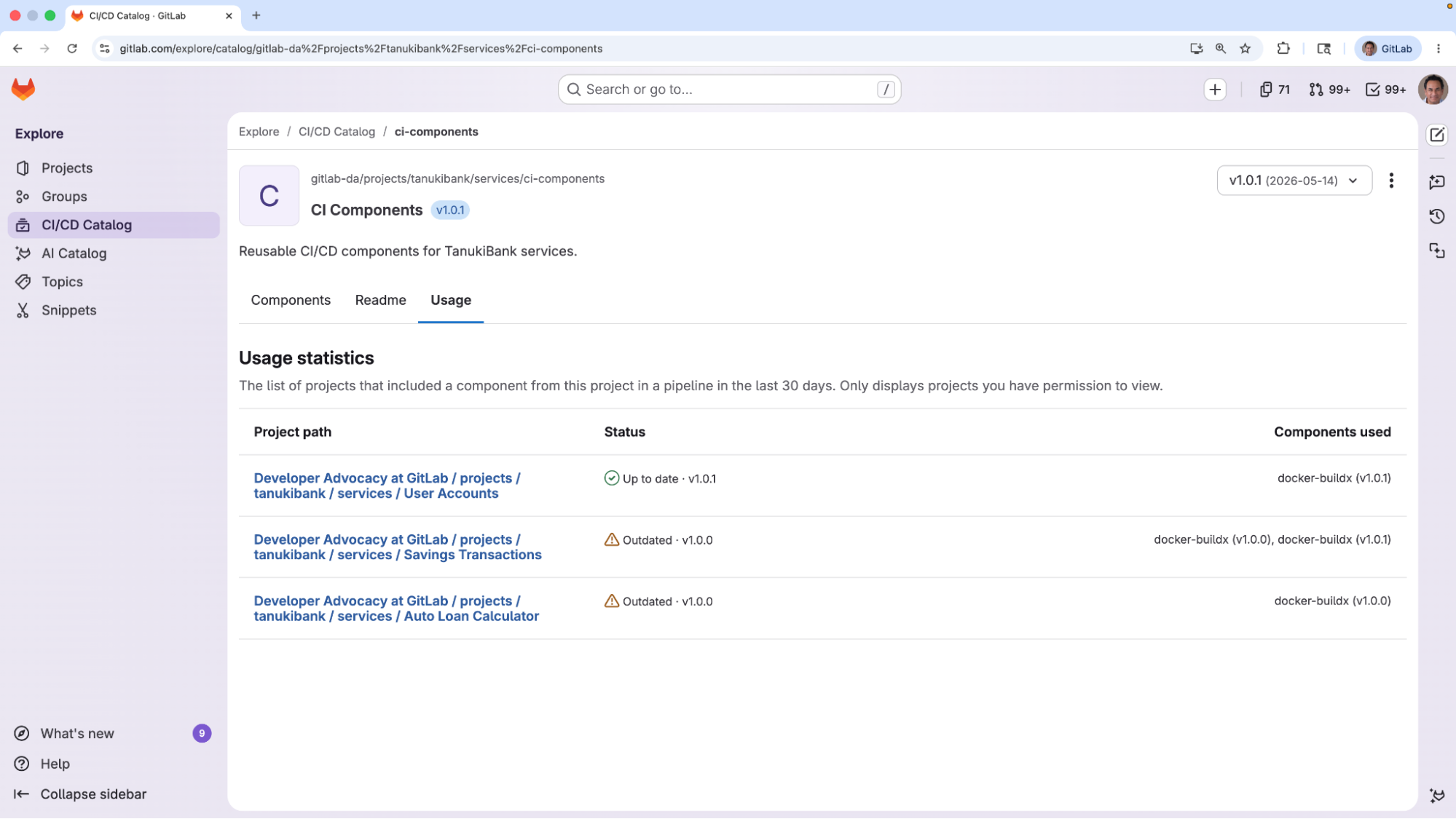
If you shipped a fix in v2.1 of a component, the drill-down shows you exactly which projects are still pinned to v1.x, so you can open MRs, notify the maintainers directly, or escalate. The next time a vulnerability is disclosed in a widely used component, "how exposed are we?" becomes a one-tab answer instead of a week of manual auditing.
The drill-down also shapes the bigger decisions: whether a refactor will ripple across hundreds of pipelines, whether it's safe to deprecate an older version, or whether the security fix you shipped last week has actually been adopted in the projects that matter.
GitHub Actions, CircleCI Orbs, and Jenkins Shared Libraries all offer pipeline reusability, but none of them offers the native usage visibility that Components Analytics adds.
Reusability without visibility means you can't prove your standards are running or measure the return on the platform investment. GitLab is the only platform that pairs a governed CI component catalog with native analytics that show where your standards are running and surface where they aren't.
The CI/CD Catalog gave platform teams a way to reduce drift and enforce standards. Components Analytics is the visibility layer that turns shared CI from a set of YAML templates you publish and forget into infrastructure you can audit, act on, and trust.
As AI generates more code across your org, the CI/CD Catalog and Components Analytics together help your organization scale its automated workflows. Tools like the CI Expert Agent can generate pipelines built to GitLab standards from the start, but only Components Analytics tells you whether those standards are actually running in production.
Self-Managed and Dedicated customers can build that approved set of standards with components mirrored from GitLab.com alongside components built in-house, giving regulated and air-gapped environments the same curated baseline.
If you maintain components in the CI/CD Catalog, adoption metrics are available now across all tiers by clicking on Explore > CI/CD Catalog > Analytics.
The component usage detail view that answers the question, “which projects are running which versions, and where do I need to act?” is available on GitLab Ultimate. Start a free Ultimate trial or talk to our team about enabling it for your organization.
此内容由惯性聚合(RSS阅读器)自动聚合整理,仅供阅读参考。 原文来自 — 版权归原作者所有。