惯性聚合 高效追踪和阅读你感兴趣的博客、新闻、科技资讯
阅读原文 在惯性聚合中打开

推荐订阅源

Know Your Adversary
Know Your Adversary
小众软件
小众软件
L
LangChain Blog
月光博客
月光博客
博客园 - Franky
Microsoft Azure Blog
Y
Y Combinator Blog
有赞技术团队
有赞技术团队
奇客Solidot–传递最新科技情报
奇客Solidot–传递最新科技情报
MongoDB | Blog
MongoDB | Blog
Recorded Future
Recorded Future
V
Visual Studio Blog
TaoSecurity Blog
TaoSecurity Blog
S
Schneier on Security
C
Cybersecurity and Infrastructure Security Agency CISA
P
Privacy & Cybersecurity Law Blog
T
Threat Research - Cisco Blogs
D
DataBreaches.Net
L
LINUX DO - 热门话题
C
Check Point Blog
F
Fortinet All Blogs
Hugging Face - Blog
Hugging Face - Blog
The Hacker News
The Hacker News
钛媒体:引领未来商业与生活新知
钛媒体:引领未来商业与生活新知
Microsoft Security Blog
酷 壳 – CoolShell
酷 壳 – CoolShell
V
V2EX
让小产品的独立变现更简单 - ezindie.com
The GitHub Blog
The GitHub Blog
P
Proofpoint News Feed
L
Lohrmann on Cybersecurity
博客园 - 司徒正美
T
Threatpost
P
Palo Alto Networks Blog
A
About on SuperTechFans
Spread Privacy
Spread Privacy
Engineering at Meta
Engineering at Meta
N
News | PayPal Newsroom
T
Tailwind CSS Blog
The Last Watchdog
The Last Watchdog
Blog — PlanetScale
Blog — PlanetScale
A
Arctic Wolf
量子位
Exploit-DB.com RSS Feed
博客园 - 聂微东
Google Online Security Blog
Google DeepMind News
www.infosecurity-magazine.com
V
Vulnerabilities – Threatpost
H
Hacker News: Front Page

Deno

Deno 2.8 | Deno Claw Patrol: an open-source security firewall for agents | Deno Fresh 2.3: Zero JS by default, View Transitions, and Temporal support | Deno Deno 2.7: Temporal API, Windows ARM, and npm overrides | Deno Build a dinosaur runner game with Deno, pt. 6 | Deno Build a dinosaur runner game with Deno, pt. 5 | Deno Deno Deploy is Generally Available | Deno Introducing Deno Sandbox | Deno Build a dinosaur runner game with Deno, pt. 4 | Deno Build a dinosaur runner game with Deno, pt. 3 | Deno Build a dinosaur runner game with Deno, pt. 2 | Deno React / Next.js Denial-of-Service Vulnerability: Deno Deploy users protected | Deno Deno 2.6: dx is the new npx | Deno Build a dinosaur runner game with Deno, pt. 1 | Deno React Server Functions / Next.js Vulnerability: Deno Deploy users protected | Deno My highlights from the new Deno Deploy | Deno Deno's Other Open Source Projects | Deno How Deno protects against npm exploits | Deno Help Us Raise $200k to Free JavaScript from Oracle | Deno Deno 2.5: Permissions in the config file | Deno Fresh 2.0 Graduates to Beta, Adds Vite Support | Deno Deno 2.4: deno bundle is back | Deno JavaScript™ Trademark Update | Deno What's coming to JavaScript | Deno A brief history of JavaScript | Deno Reports of Deno's Demise Have Been Greatly Exaggerated | Deno An Update on Fresh | Deno How Plaid migrated 100 services to a new database platform 5x faster with Deno | Deno Deno 2.3: Improved deno compile, local npm packages, and more | Deno Add JSR packages with pnpm and Yarn | Deno Zero-config Debugging with Deno and OpenTelemetry | Deno Exploring Art with TypeScript, Jupyter, Polars, and Observable Plot | Deno Deno v Oracle Update 3: Fighting the JavaScript Trademark | Deno Build a custom RAG AI agent in TypeScript and Jupyter | Deno How to get deep traces in your Node.js backend with OTel and Deno | Deno toranoana.deno #20 登録受付中(2025年3月14日) | Deno Node just added TypeScript support. What does that mean for Deno? | Deno The Dino 🦕, the Llama 🦙, and the Whale 🐋 | Deno Publish a lint rule, get a prize | Deno Deno 2.2: OpenTelemetry, Lint Plugins, node:sqlite | Deno If you're not using npm specifiers, you're doing it wrong | Deno How Deno's documentation is evolving | Deno Oracle justified its JavaScript trademark with Node.js—now it wants that ignored | Deno Introducing the JSR open governance board | Deno Intro to Wasm in Deno | Deno Announcing OpenAI on JSR | Deno Deno in 2024 | Deno Goodbye WinterCG, welcome WinterTC | Deno Build a SolidJS app with Deno | Deno Run your Next.js SSR app on Deno Deploy | Deno Solve Advent of Code 2024 with Deno and Win Prizes! | Deno Deno v. Oracle: Canceling the JavaScript Trademark | Deno Deno 2.1: Wasm Imports and other enhancements | Deno Build a Typesafe API with tRPC and Deno | Deno Self-contained Executable Programs with Deno Compile | Deno Build a Database App with Drizzle ORM and Deno | Deno Introducing your new JavaScript package manager: Deno | Deno Announcing Growthbook on JSR | Deno Build an Astro site with Deno | Deno How to convert CommonJS to ESM | Deno Announcing Deno 2 | Deno The Final Touches: What’s New In v2.0.0-rc.10 | Deno Announcing Stable V8 Bindings for Rust | Deno Deno 2.0 Release Candidate | Deno Secure, efficient private npm registries with Cloudsmith and Deno | Deno Painting the Plane as We Fly It: Designing JSR | Deno Introducing Web Cache API support on Deno Deploy | Deno Deno 1.46: The Last 1.x Release | Deno Protect your cloud spend with new Deno Deploy spend limits | Deno What we got wrong about HTTP imports | Deno Benchmarking AWS Lambda Cold Starts Across JavaScript Runtimes | Deno Announcing Supabase on JSR | Deno Deno 1.45: Workspace and Monorepo Support | Deno Introducing KV Backup for Deno Subhosting | Deno A Gentle Intro to TypeScript | Deno Announcing Hono on JSR | Deno How We Made the Deno Language Server Ten Times Faster | Deno How the Guardian uses Deno to audit accessibility and performance across their 2.7 million articles | Deno Introducing More Flexible Domain Association for Deno Subhosting | Deno The stabilization process of the Standard Library has begun | Deno Deno 1.44: Private npm registries, improved Node.js compat, and performance boosts | Deno How we built a secure, performant, multi-tenant cloud platform to run untrusted code | Deno The Deno Standard Library is now available on JSR | Deno How to document your JavaScript package | Deno Your Low Code Solution Needs an Escape Hatch | Deno Deno 1.43: Improved Language Server performance | Deno How Slack used Deno to save months of engineering effort in launching their new platform | Deno Announcing the Hookdeck SDK on JSR | Deno Announcing the Neon Serverless Driver on JSR | Deno An intro to TSConfig for JavaScript Developers | Deno How we built JSR | Deno How Netlify used Deno Subhosting to build a successful edge functions product | Deno Introducing Simpler Project Creation in Deno Deploy | Deno Deno 1.42: Better dependency management with JSR | Deno Introducing deployctl, the command line interface for Deno Deploy | Deno Introducing JSR - the JavaScript Registry | Deno How to add Monaco to a Next.js app and securely run untrusted user code | Deno Survey Results and Roadmap | Deno Deno 1.41: smaller deno compile binaries | Deno Webhooks suck, but here are alternatives | Deno
JSR Is Not Another Package Manager | Deno
Ryan Dahl · 2024-04-24 · via Deno

Over the past years, new package managers like yarn and pnpm have emerged, enhancing how packages are downloaded. However, the npm package registry, a cornerstone of the JavaScript ecosystem, has barely evolved. Its last notable update was a “files” tab added years ago. The JavaScript language, known for its vibrant evolution, seems paradoxically mired in a distribution model that hasn’t kept pace.

Back when I created Node, there was no standard module system for JavaScript. As a result, the npm registry and Node defaulted to CommonJS (require), a system with fundamental flaws that made it unworkable in browsers. So, almost a decade ago, in 2015, the language adopted syntax for ES modules (import). Today, most JavaScript is written using ES modules, yet the pathways for distributing these modules remain convoluted, especially when TypeScript is involved. This clear gap in the ecosystem prompted the creation of JSR, not as another package manager but as a transformative registry designed to revolutionize how JavaScript and TypeScript are shared across server-side runtimes, browsers, and various tools.

JSR fundamentally improves the code distribution process by streamlining complexities that have long plagued developers. By being ESM-only and TypeScript-first, JSR eradicates the frustrating juggling of package.json configurations and the labyrinthine tsconfig compiler options. Through a package scoring system, JSR motivates best practices in code distribution—higher scores are awarded to packages that include comprehensive JSDoc documentation on each exported symbol, akin to what the Dart community has in pub.dev. As seen in other modern programming ecosystems like Go and Rust, JSR provides automatic documentation generation right out of the box.

JSR is a registry, not another client for the npm registry. But that doesn’t mean you need to give up everything from npm, or make a hard switch to a disjoint ecosystem of JavaScript modules. JSR is designed to complement the npm registry, not replace it. JSR packages are allowed to depend on npm packages - see, for example, this package. Moreover, JSR packages can be used in existing npm-first software because JSR itself acts as an npm registry (accessible at npm.jsr.io) that distributes npm-compatible tarballs. This allows JSR packages to be included in any software using npm, yarn, or pnpm, as well as to integrate with private registries. The npm tarballs that JSR distributes are optimal.

At Deno, we prioritize security as a paramount concern in JavaScript development. While no registry can comprehensively police all published code, JSR provides transparency about its publishers and secures the publishing process. By integrating OIDC tokens with GitHub Actions, JSR creates advanced, verifiable provenance attestations using the Supply Chain Levels for Software Artifacts and stores them in Sigstore. This not only ensures the authenticity of the code but also establishes trust and accountability in what developers are implementing.

JavaScript is the common language of many programmers, making it both universal and accessible. The language merits a central hub—a town square—where developers can share their work without undue complexity. We believe JavaScript will remain central to software development for many years, and JSR aims to support this enduring relevance. While JSR is not a package manager, it offers a new approach to how we manage and secure code, aspiring to be a stable, forward-looking platform that enhances and safeguards JavaScript development. In this way, JSR represents not just another tool in the ecosystem but a fundamental shift in how we think about distributing JavaScript and TypeScript.
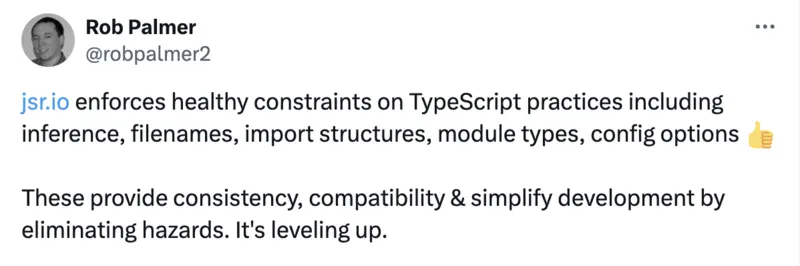
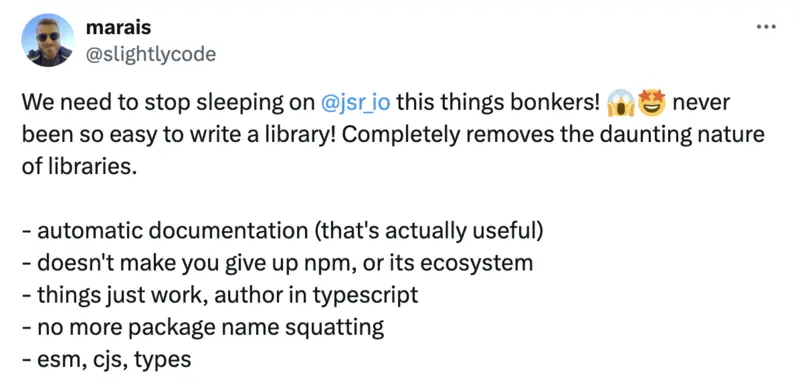
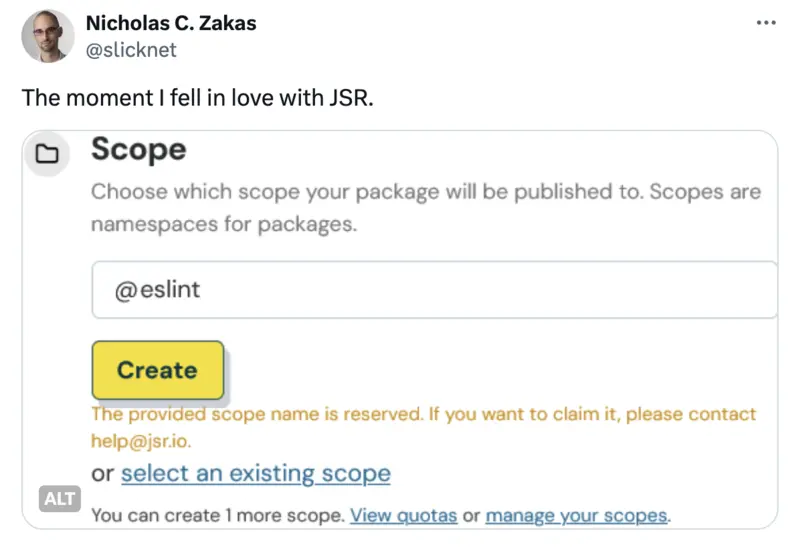
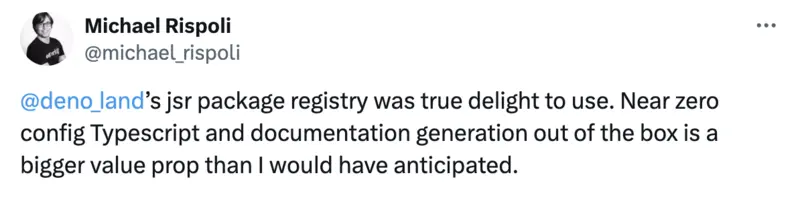
Tweet from @robpalmer2 Tweet from @slightlycode Tweet from @slicknet Tweet from @michael_rispoli

🚨️ Read more about JSR 🚨️