

惯性聚合 高效追踪和阅读你感兴趣的博客、新闻、科技资讯
阅读原文 在惯性聚合中打开

推荐订阅源

PCI Perspectives
PCI Perspectives
Microsoft Security Blog
MongoDB | Blog
MongoDB | Blog
T
The Blog of Author Tim Ferriss
罗磊的独立博客
人人都是产品经理
人人都是产品经理
The Cloudflare Blog
Engineering at Meta
Engineering at Meta
Y
Y Combinator Blog
宝玉的分享
宝玉的分享
Recorded Future
Recorded Future
钛媒体:引领未来商业与生活新知
钛媒体:引领未来商业与生活新知
月光博客
月光博客
Recent Announcements
Threat Intelligence Blog | Flashpoint
D
Darknet – Hacking Tools, Hacker News & Cyber Security
Apple Machine Learning Research
T
Threatpost
The GitHub Blog
The GitHub Blog
M
MIT News - Artificial intelligence
Scott Helme
Scott Helme
P
Palo Alto Networks Blog
T
Tenable Blog
P
Privacy International News Feed
V
Visual Studio Blog
F
Fortinet All Blogs
酷 壳 – CoolShell
酷 壳 – CoolShell
I
Intezer
cs.CL updates on arXiv.org
AI
AI
cs.CV updates on arXiv.org
S
Security Affairs
S
SegmentFault 最新的问题
C
Cisco Blogs
博客园 - 聂微东
MyScale Blog
MyScale Blog
V
Vulnerabilities – Threatpost
量子位
T
The Exploit Database - CXSecurity.com
奇客Solidot–传递最新科技情报
奇客Solidot–传递最新科技情报
Security Latest
Security Latest
P
Proofpoint News Feed
阮一峰的网络日志
阮一峰的网络日志
K
KPMG report finds enterprise disconnect between AI and its ROI | CIO
T
Troy Hunt's Blog
T
Tailwind CSS Blog
Stack Overflow Blog
Stack Overflow Blog
云风的 BLOG
云风的 BLOG
A
About on SuperTechFans
The Last Watchdog
The Last Watchdog

Deno

Deno 2.8 | Deno Claw Patrol: an open-source security firewall for agents | Deno Fresh 2.3: Zero JS by default, View Transitions, and Temporal support | Deno Deno 2.7: Temporal API, Windows ARM, and npm overrides | Deno Build a dinosaur runner game with Deno, pt. 6 | Deno Build a dinosaur runner game with Deno, pt. 5 | Deno Deno Deploy is Generally Available | Deno Introducing Deno Sandbox | Deno Build a dinosaur runner game with Deno, pt. 4 | Deno Build a dinosaur runner game with Deno, pt. 3 | Deno Build a dinosaur runner game with Deno, pt. 2 | Deno React / Next.js Denial-of-Service Vulnerability: Deno Deploy users protected | Deno Deno 2.6: dx is the new npx | Deno Build a dinosaur runner game with Deno, pt. 1 | Deno React Server Functions / Next.js Vulnerability: Deno Deploy users protected | Deno My highlights from the new Deno Deploy | Deno Deno's Other Open Source Projects | Deno How Deno protects against npm exploits | Deno Help Us Raise $200k to Free JavaScript from Oracle | Deno Deno 2.5: Permissions in the config file | Deno Fresh 2.0 Graduates to Beta, Adds Vite Support | Deno Deno 2.4: deno bundle is back | Deno JavaScript™ Trademark Update | Deno What's coming to JavaScript | Deno A brief history of JavaScript | Deno Reports of Deno's Demise Have Been Greatly Exaggerated | Deno An Update on Fresh | Deno How Plaid migrated 100 services to a new database platform 5x faster with Deno | Deno Deno 2.3: Improved deno compile, local npm packages, and more | Deno Add JSR packages with pnpm and Yarn | Deno Zero-config Debugging with Deno and OpenTelemetry | Deno Exploring Art with TypeScript, Jupyter, Polars, and Observable Plot | Deno Deno v Oracle Update 3: Fighting the JavaScript Trademark | Deno Build a custom RAG AI agent in TypeScript and Jupyter | Deno How to get deep traces in your Node.js backend with OTel and Deno | Deno toranoana.deno #20 登録受付中(2025年3月14日) | Deno Node just added TypeScript support. What does that mean for Deno? | Deno The Dino 🦕, the Llama 🦙, and the Whale 🐋 | Deno Publish a lint rule, get a prize | Deno Deno 2.2: OpenTelemetry, Lint Plugins, node:sqlite | Deno If you're not using npm specifiers, you're doing it wrong | Deno How Deno's documentation is evolving | Deno Oracle justified its JavaScript trademark with Node.js—now it wants that ignored | Deno Introducing the JSR open governance board | Deno Intro to Wasm in Deno | Deno Announcing OpenAI on JSR | Deno Deno in 2024 | Deno Goodbye WinterCG, welcome WinterTC | Deno Build a SolidJS app with Deno | Deno Run your Next.js SSR app on Deno Deploy | Deno Solve Advent of Code 2024 with Deno and Win Prizes! | Deno Deno v. Oracle: Canceling the JavaScript Trademark | Deno Deno 2.1: Wasm Imports and other enhancements | Deno Build a Typesafe API with tRPC and Deno | Deno Self-contained Executable Programs with Deno Compile | Deno Build a Database App with Drizzle ORM and Deno | Deno Introducing your new JavaScript package manager: Deno | Deno Announcing Growthbook on JSR | Deno Build an Astro site with Deno | Deno How to convert CommonJS to ESM | Deno Announcing Deno 2 | Deno The Final Touches: What’s New In v2.0.0-rc.10 | Deno Announcing Stable V8 Bindings for Rust | Deno Deno 2.0 Release Candidate | Deno Secure, efficient private npm registries with Cloudsmith and Deno | Deno Painting the Plane as We Fly It: Designing JSR | Deno Introducing Web Cache API support on Deno Deploy | Deno Deno 1.46: The Last 1.x Release | Deno Protect your cloud spend with new Deno Deploy spend limits | Deno What we got wrong about HTTP imports | Deno Benchmarking AWS Lambda Cold Starts Across JavaScript Runtimes | Deno Announcing Supabase on JSR | Deno Deno 1.45: Workspace and Monorepo Support | Deno Introducing KV Backup for Deno Subhosting | Deno A Gentle Intro to TypeScript | Deno Announcing Hono on JSR | Deno How We Made the Deno Language Server Ten Times Faster | Deno How the Guardian uses Deno to audit accessibility and performance across their 2.7 million articles | Deno Introducing More Flexible Domain Association for Deno Subhosting | Deno The stabilization process of the Standard Library has begun | Deno Deno 1.44: Private npm registries, improved Node.js compat, and performance boosts | Deno How we built a secure, performant, multi-tenant cloud platform to run untrusted code | Deno The Deno Standard Library is now available on JSR | Deno How to document your JavaScript package | Deno Your Low Code Solution Needs an Escape Hatch | Deno Deno 1.43: Improved Language Server performance | Deno How Slack used Deno to save months of engineering effort in launching their new platform | Deno JSR Is Not Another Package Manager | Deno Announcing the Hookdeck SDK on JSR | Deno Announcing the Neon Serverless Driver on JSR | Deno An intro to TSConfig for JavaScript Developers | Deno How we built JSR | Deno How Netlify used Deno Subhosting to build a successful edge functions product | Deno Introducing Simpler Project Creation in Deno Deploy | Deno Deno 1.42: Better dependency management with JSR | Deno Introducing deployctl, the command line interface for Deno Deploy | Deno Introducing JSR - the JavaScript Registry | Deno How to add Monaco to a Next.js app and securely run untrusted user code | Deno Survey Results and Roadmap | Deno Deno 1.41: smaller deno compile binaries | Deno
Roll your own JavaScript runtime, pt. 3 | Deno
2023-05-04 · via Deno

This post is a continuation of Roll your own JavaScript runtime and Roll your own JavaScript runtime, pt. 2.

Update 2024-09-26: updated the code samples to the latest version of deno_core

We’ve been delighted by the positive response to this series on rolling your own custom JavaScript runtime. One area that some expressed interest in is how to use snapshots to get faster startup times. Snapshots can provide improved performance at a (typically) negligible increase in filesize.

In this blog post, we’ll build on the first and second part by creating a snapshot of runtime.js in a build script, then loading that snapshot in main.rs to speed up start time for our custom runtime.
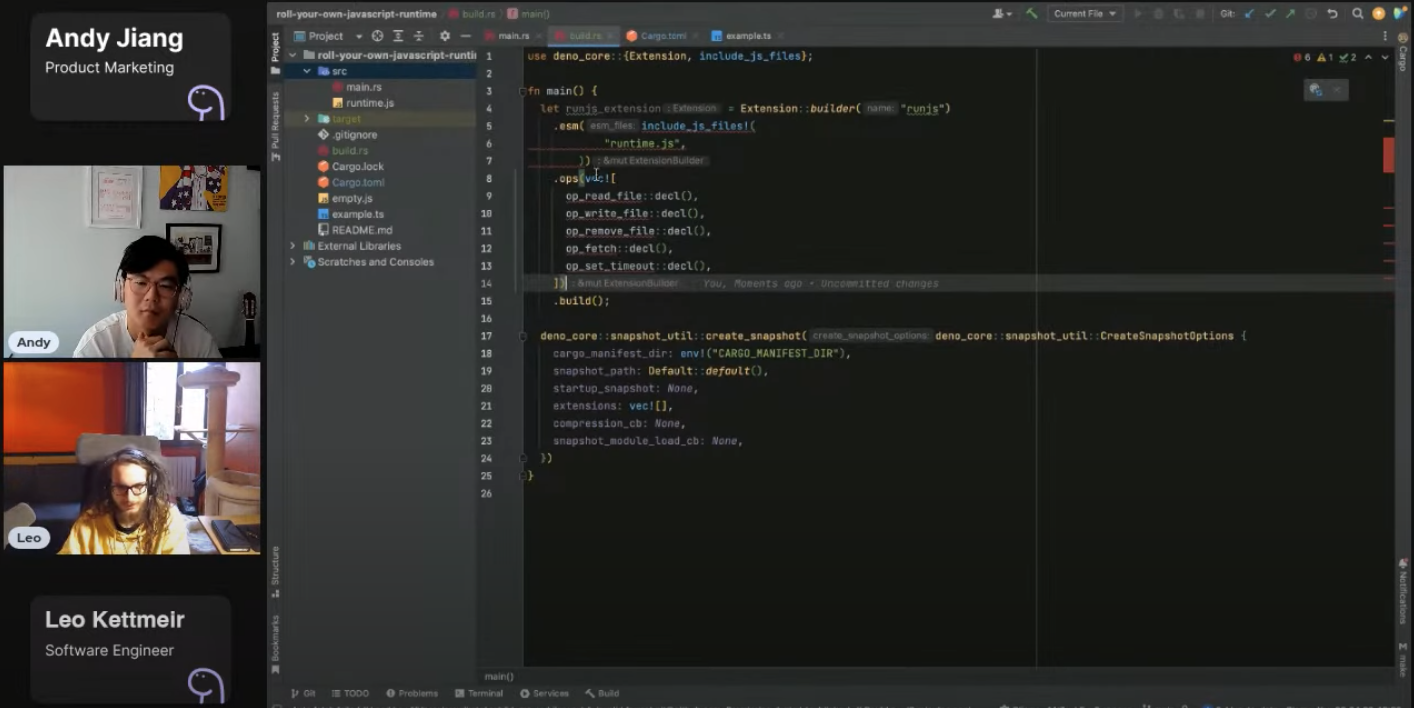
Screenshot of the video walkthrough from Andy and Leo

Watch the video demo or view source code here.

Getting setup

If you followed the first and second blog post, your project should have three files:

  • example.ts: the JavaScript file we intend to execute with the custom runtime
  • src/main.rs: the asynchronous Rust function that creates an instance of JsRuntime, which is responsible for JavaScript execution
  • src/runtime.js: the runtime interface that defines and provides the API that will interop with the JsRuntime from main.rs

Let’s write a build.rs file that will create a snapshot of the custom runtime, runjs.

Creating a snapshot in build.rs

Before create a build.rs file, let’s first add deno_core as a build dependency in Cargo.toml:

[package]
name = "runjs"
version = "0.1.0"
edition = "2021"

# See more keys and their definitions at https://doc.rust-lang.org/cargo/reference/manifest.html

[dependencies]
deno_ast = { version = "0.42", features = ["transpiling"] }
deno_core = "0.311"
reqwest = "0.12"
tokio = { version = "1.40", features = ["full"] }

+ [build-dependencies]
+ deno_core = "0.311"

Next, let’s create a build.rs file in the root of your project. In this file, we’ll have to do the following steps:

  • Create a small extension of src/runtime.js
  • Build a file path to the snapshot
  • Create the snapshot

Putting the above steps into code, your build.rs script should look like:

use deno_core::extension;
use std::env;
use std::path::PathBuf;

fn main() {
  extension!(
    
    runjs,
    
    esm_entry_point = "ext:runjs/src/runtime.js",
    
    esm = ["src/runtime.js"]
  );

  let out_dir = PathBuf::from(env::var_os("OUT_DIR").unwrap());
  let snapshot_path = out_dir.join("RUNJS_SNAPSHOT.bin");

  let snapshot = deno_core::snapshot::create_snapshot(
    deno_core::snapshot::CreateSnapshotOptions {
      cargo_manifest_dir: env!("CARGO_MANIFEST_DIR"),
      startup_snapshot: None,
      skip_op_registration: false,
      extensions: vec![runjs::init_ops_and_esm()],
      with_runtime_cb: None,
      extension_transpiler: None,
    },
    None,
  )
    .unwrap();

  std::fs::write(snapshot_path, snapshot.output).unwrap();
}

The main function is create_snapshot, which accepts several options. Let’s go over them in the next section.

Diving into CreateSnapshotOptions

The create_snapshot function is a nice abstraction layer that uses an options struct to determine how the snapshot is created. We will use the following options to configure it:

  • cargo_manifest_dir: the directory in which Cargo will be compiling everything into. We define the snapshot path by resolving OUT_DIR and RUNJS_SNAPSHOT.bin.
  • extensions: extensions to include within the generated snapshot. we pass the runjs extension, which is built from src/runtime.js.

Loading the snapshot in main.rs

Currently, the main.rs file’s run_js function loads the runjs extension. We’ll modify this function to instead load the snapshot we created in build.rs:

+ use deno_core::Snapshot;

// Other stuff…

+ static RUNTIME_SNAPSHOT: &[u8] = include_bytes!(concat!(env!("OUT_DIR"), "/RUNJS_SNAPSHOT.bin"));

extension!(
  runjs,
  ops = [
    op_read_file,
    op_write_file,
    op_remove_file,
    op_fetch,
  ],
-  esm_entry_point = "ext:runjs/runtime.js",
-  esm = [dir "src", "runtime.js"],
)

async fn run_js(file_path: &str) -> Result<(), AnyError> {
  let main_module = deno_core::resolve_path(file_path)?;
  let mut js_runtime = deno_core::JsRuntime::new(deno_core::RuntimeOptions {
    module_loader: Some(Rc::new(TsModuleLoader)),
+    startup_snapshot: Some(Snapshot::Static(RUNTIME_SNAPSHOT)),
-    extensions: vec![runjs::init_ops_and_esm()],
+    extensions: vec![runjs::init_ops()],
    ..Default::default()
  });

  let mod_id = js_runtime.load_main_module(&main_module, None).await?;
  let result = js_runtime.mod_evaluate(mod_id);
  js_runtime
    .run_event_loop(Default::default())
    .await?;
  result.await
}

We’ll remove the esm and esm_entry_point declarations, since that was moved to build.rs script. Then, we’ll add a line to load the snapshot.

Finally, to load the snapshot, we’ll add startup_snapshot in RuntimeOptions that points to the RUNTIME_SNAPSHOT, which is defined above run_js as a static slice of bytes of the snapshot we created in build.rs.

And that’s it! Let’s try running with:

cargo run -- example.ts

It should work!

What’s next?

Snapshotting is an excellent tool to help improve startup speeds for a custom runtime. This is an extremely simple example, but we hope that it sheds some light into how Deno uses snapshots to optimize performance.

Through this series, we’ve shown how to build your own custom JavaScript runtime, add APIs like fetch, and now speed up startup times via snapshotting. We love hearing from you so if there’s anything you want us to cover, please let us know on Twitter, YouTube, or Discord.

Don’t miss any updates — follow us on Twitter.