







Programming should be simple. That’s why we made Deno a zero-config, batteries-included JavaScript runtime with native TypeScript support, enabling immediate productivity.
In version 1.43, we have enhanced the performance of Deno in IDEs by reducing auto-completion times from 6-8 seconds to under one second in large codebases and significantly decreasing memory usage. We have also achieved more complete npm compatibility by reworking our node:vm and node:worker_threads implementations, widely used in JavaScript CLI tools like test runners.
To upgrade to Deno 1.43, run the following in your terminal:
If Deno is not yet installed, learn how to install it here.
What’s New in Deno 1.43
deno.json tasksjsxImportSourceTypesdeno serve subcommandDeno.serve() updatesURL.parse() Web APIrusty_v8DENO_FUTURE=1A few Deno users reached out to tell us that our Language Server struggled with bigger projects that had a large number of files. The Language Server (commonly referred to as Deno LSP) provides autocompletion, among other things, in your editor. When they shared what the editor experience was like in those projects, we realized that we could improve the responsiveness and memory consumption substantially.
This cycle, we spent most of our time reworking many aspects of the LSP, making it faster and more efficient. In larger projects, where auto-completion previously took about 6-8 seconds, we have reduced it to under one second. Similarly, memory consumption has improved significantly, allowing projects that previously caused out-of-memory errors in our LSP to operate without issue.
Before:
After:
This release includes many key improvements around the node:worker_threads and
node:vm modules. Both modules are used frequently in test runners, like Jest
and Vitest, as well as tools like Docusaurus. In fact, we’re now running
Docusarus to power some of
our documentation sites with Deno.
process.kill in Rust to avoid run permission prompt. This makes
ora, a popular CLI spinner library, work in Deno.http.maxHeaderSize value to make undici work.fs.cpSync: Always ensure the parent directory exists for SolidStart.env option in node:worker_threads. This enables calling
sveltekit build to complete successfully.AsyncResource borrow panic which broke ng serve and vitest.Promise rejection in node:vm contexts which is used in
docusaurus build.MessagePort.unref() used for @angular/cli serve.fs.createWriteStream which occured in koa-body.hostname in node:http is a valid IPv4 address which fixes
docusaurus serve.module to builtinsModule for docusaurus build.node:worker_thread worker exiting prematurely.node:domain module to fix configuration discovery in web-ext.MessagePort not having an .on handler which is needed for
piscina used in Angular.parseArgs from node:util not supporting the default option.fs.readv, fs.readvSync functions.Other frameworks, like SolidStart, are inching closer to full support as well.
We’ve got the basics down, but some work remains to be done to fully support
their https server and auth-js:
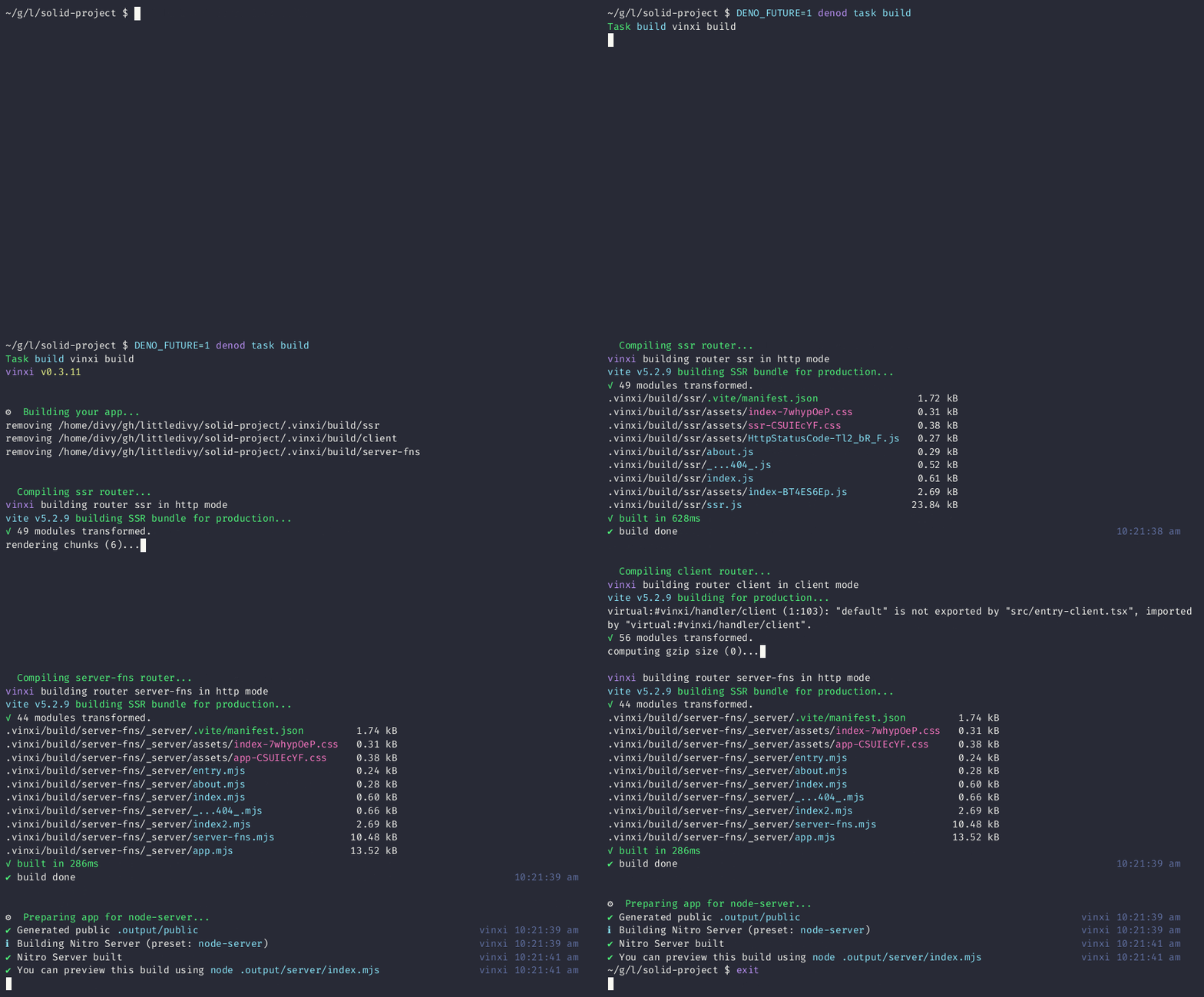
SolidStart and other framework compatibility improvements are being done behind
the new DENO_FUTURE=1 environment variable, which you can read about
below.
Another area we tackled was improvements to AsyncResource which is necessary
to make vitest work as it depends on the tinypool package, which in turn
makes heavy use of Node’s AsyncResource under the hood.
And of course, we’re working on supporting Next.js too. We got the
initialization wizard fully working thanks to some improvements around our
handling of the layout in the node_modules directory.
~/my-app $ DENO_FUTURE=1 deno task dev
Task dev next dev
   ▲ Next.js 14.1.3
   - Local:        http://localhost:3000

 ✓ Ready in 2.2s
 ○ Compiling / ...
 ✓ Compiled / in 5.5s (511 modules)
 ✓ Compiled in 381ms (241 modules)
Running Next.js currently requires enabling some unstable flags in Deno, and we’re well underway in the process of stabilizing them.
Executable npm commands like vite, typically managed through package.json scripts, can now be directly referenced in tasks defined in deno.json as well.
// deno.json
{
  "tasks": {
    "start": "vite"
  }
}This release adds support for V8 code caching (also known as bytecode caching), which can significantly improve the time your application spends on parsing and compiling JavaScript modules. The compiled bytecode is automatically cached on local disk when a module is loaded for the first time, and then reused on subsequent loads.
In our testing, we’ve observed startup time improvements between 5% and 240% depending on the application.
Since version v1.38 Deno comes out of the box
with a precompile JSX transform that is optimized for server side rendering
performance. In certain scenarios a framework might want to prevent an element
to be precompiled to allow passing additional properties to it. Our transform
learned a new trick to make this possible with the jsxPrecompileSkipElements
compiler option.
// deno.json
{
  "compilerOptions": {
    "jsx": "precompile",
    "jsxImportSource": "preact",
    // Don't precompile <a>, <body>, and <img> elements
    "jsxPrecompileSkipElements": ["a", "body", "img"]
  }
}
You can pass an array of elements to that option to exempt them from being precompiled.
const a = <a href="#">click me</a>;


const $$_tpl_1 = ['<a href="#">click me</a>'];
const a = jsxTemplate($$_tpl_1);


const a = jsx("a", {
  href: "#",
  children: "click me",
});
jsxImportSourceTypesA new jsxImportSourceTypes pragma and compiler option allows specifying the
types for the automatic JSX transform. This is useful to use with libraries that
don’t provide their types.
export function Hello() {
  return <div>Hello!</div>;
}
Alternatively, this can instead be specified in a deno.json file:
{
  "compilerOptions": {
    "jsx": "react-jsx",
    "jsxImportSource": "npm:react@^18.3",
    "jsxImportSourceTypes": "npm:@types/react@^18.3"
  }
}
deno serve subcommandIn this release we’ve added deno serve subcommand, that allows you to write
servers in a declarative way:
export default {
  fetch(request) {
    return new Response("Hello world");
  },
};
$ deno serve server.ts
deno serve: Listening on http://localhost:8000/
$ curl http://localhost:8000/
Hello world
Notice that you don’t have to pass any permission flags - deno serve applies
appropriate --allow-net permission automatically that allows it to listen for
incoming HTTP connections. Still, you can pass extra permission flags as needed.
Additionally, you can use --host and --port flag to configure which
interface the server binds to:
$ deno serve --host 0.0.0.0 --port 3000 server.ts
deno serve: Listening on http://0.0.0.0:3000/
$ curl http://0.0.0.0:3000/
Hello world
Our plan is to introduce automatic load-balancing in the future, that will run the server on multiple CPU cores allowing for better utilization of your system resources.
Deno.serve() updatesYou can now get information if the response was sent successfuly or there was a
failure using the Deno.ServeHandlerInfo.completed promise:
Deno.serve((req, info) => {
  info.completed.then(() => {
    console.log("Response sent successfuly!");
  }).catch(() => {
    console.error("Failed sending the response.");
  });
  return new Response("Hello world");
});
Additionally, the AbortSignal attached to the Request argument will always
be aborted when a transaction finishes - whether by client closing the
connection or server sending the response.
Deno.serve((req, info) => {
  req.signal.addEventListener("abort", () => {
    console.log("Response finished");
  });
  return new Response("Hello world");
});
We added a minor quality of life improvement that makes it easier to get the
server address from Deno.serve. Previously, you had to write something like
this:
let listenPort: number | null = null;

Deno.serve(
  {
    onListen: ({ port }) => (listenPort = port),
  },
  () => new Response("hello world"),
);
By adding a new addr property directly on the server instance this becomes
much simpler:
const server = Deno.serve(() => new Response("hello world"));
const port = server.addr.port;
URL.parse() Web APIThe new Web API URL.parse() provides a simpler control flow when you need to
parse URLs.
Before this addition, the way to parse was to construct a new URL instance.
The crux is that new URL(input, base) throws an error if the url you’re
parsing is not valid; while URL.parse(input, base) will just return null for
invalid urls.
So if you’re parsing a URL and need to provide a fallback in case parsing fails, you can replace this code:
let url;
try {
  url = new URL(userProvidedValue, "http://deno.land");
} catch {
  url = new URL("http://deno.land");
}
With this code:
const url = URL.parse(userProvidedValue, "http://deno.land") ??
  new URL("https://deno.land");
Thank you to Kenta Moriuchi for implementing this API.
The Deno Standard Library (deno_std)
offers a set of high quality packages that are audited by the core team and
guaranteed to work with Deno.
We’ll have a full blog post on this in the coming days, but starting in Deno
1.43, the Standard Library will be published exclusively to
JSR under the @std scope. Existing
versions of the Standard Library will continue to live at https://deno.land/std.
This move, alongside Deno’s new workspaces functionality, is part of the changes
coming in Deno 2. For more details, check out
the Standard Library’s roadmap
for stabilization.
rusty_v8Whilst we don’t provide Android builds ourselves, we received a great patch that
makes it easier to build rusty_v8 for Android.
Thanks to @Taknok for contributing this.
Deno 1.43 ships with V8 12.4, which adds support for a new TypedArray kind:
Float16Array.
This API proves useful in several GPU related applications.
DENO_FUTURE=1In anticipation of the upcoming Deno 2 release, we’ve put breaking changes for
Deno 2 behind the DENO_FUTURE=1 environment variable. Enabling it allows you
to test compatibility of your project with Deno 2.
This includes the following:
nodeModulesDir settingDeno.* APIs in Web Workerspackage.json is presentDeno.ConnectTlsOptions.certFileDeno.ConnectTlsOptions.certChainDeno.ConnectTlsOptions.privateKeyDeno.ListenTlsOptions.keyFileDeno.ListenTlsOptions.certFileDeno.customInspectDeno.Conn.prototype.ridDeno.TlsConn.prototype.ridDeno.Listener.prototype.ridDeno.TlsListener.prototype.ridDeno.UnixConn.prototype.ridDeno.FsWatcher.prototype.ridDeno.FsFile constructor illegalWe couldn’t build Deno without the help of our community! Whether by answering questions in our community Discord server or reporting bugs, we are incredibly grateful for your support. In particular, we’d like to thank the following people for their contributions to Deno 1.43: Alex Yang, Carlos Precioso, JOTSR, Javier Viola, Kenta Moriuchi, MAKS11060, nokazn, welfuture, youngwendy, 林炳权, chirsz-ever.
Would you like to join the ranks of Deno contributors? Check out our contribution docs here, and we’ll see you on the list next time.
Believe it or not, the changes listed above still don’t tell you everything that got better in 1.43. You can view the full list of pull requests merged in Deno 1.43 on GitHub here.
Thank you for catching up with our 1.43 release, and we hope you love building with Deno!
🍋 Fresh 2.0 is right around the corner.
Our next major Fresh release will be simpler with a more composable, routing API. Read more here.
此内容由惯性聚合(RSS阅读器)自动聚合整理,仅供阅读参考。 原文来自 — 版权归原作者所有。