


惯性聚合 高效追踪和阅读你感兴趣的博客、新闻、科技资讯
阅读原文 在惯性聚合中打开

推荐订阅源

The Hacker News
The Hacker News
月光博客
月光博客
Last Week in AI
Last Week in AI
D
DataBreaches.Net
MyScale Blog
MyScale Blog
The Register - Security
D
Docker
酷 壳 – CoolShell
酷 壳 – CoolShell
Y
Y Combinator Blog
WordPress大学
WordPress大学
Microsoft Security Blog
I
InfoQ
cs.AI updates on arXiv.org
P
Privacy International News Feed
云风的 BLOG
云风的 BLOG
OSCHINA 社区最新新闻
OSCHINA 社区最新新闻
L
LangChain Blog
钛媒体:引领未来商业与生活新知
钛媒体:引领未来商业与生活新知
C
Check Point Blog
V
V2EX
P
Palo Alto Networks Blog
Threat Intelligence Blog | Flashpoint
小众软件
小众软件
博客园 - 叶小钗
A
Arctic Wolf
The GitHub Blog
The GitHub Blog
V
Visual Studio Blog
Martin Fowler
Martin Fowler
Simon Willison's Weblog
Security Latest
Security Latest
阮一峰的网络日志
阮一峰的网络日志
博客园 - 【当耐特】
Know Your Adversary
Know Your Adversary
N
Netflix TechBlog - Medium
Recorded Future
Recorded Future
B
Blog RSS Feed
T
Tenable Blog
S
Secure Thoughts
Vercel News
Vercel News
Hugging Face - Blog
Hugging Face - Blog
C
CXSECURITY Database RSS Feed - CXSecurity.com
PCI Perspectives
PCI Perspectives
T
Tor Project blog
MongoDB | Blog
MongoDB | Blog
A
About on SuperTechFans
罗磊的独立博客
Cyber Security Advisories - MS-ISAC
F
Fortinet All Blogs
Webroot Blog
Webroot Blog
T
Threat Research - Cisco Blogs

Deno

Deno 2.8 | Deno Claw Patrol: an open-source security firewall for agents | Deno Fresh 2.3: Zero JS by default, View Transitions, and Temporal support | Deno Deno 2.7: Temporal API, Windows ARM, and npm overrides | Deno Build a dinosaur runner game with Deno, pt. 6 | Deno Build a dinosaur runner game with Deno, pt. 5 | Deno Deno Deploy is Generally Available | Deno Introducing Deno Sandbox | Deno Build a dinosaur runner game with Deno, pt. 4 | Deno Build a dinosaur runner game with Deno, pt. 3 | Deno Build a dinosaur runner game with Deno, pt. 2 | Deno React / Next.js Denial-of-Service Vulnerability: Deno Deploy users protected | Deno Deno 2.6: dx is the new npx | Deno Build a dinosaur runner game with Deno, pt. 1 | Deno React Server Functions / Next.js Vulnerability: Deno Deploy users protected | Deno My highlights from the new Deno Deploy | Deno Deno's Other Open Source Projects | Deno How Deno protects against npm exploits | Deno Help Us Raise $200k to Free JavaScript from Oracle | Deno Deno 2.5: Permissions in the config file | Deno Fresh 2.0 Graduates to Beta, Adds Vite Support | Deno Deno 2.4: deno bundle is back | Deno JavaScript™ Trademark Update | Deno What's coming to JavaScript | Deno A brief history of JavaScript | Deno Reports of Deno's Demise Have Been Greatly Exaggerated | Deno An Update on Fresh | Deno How Plaid migrated 100 services to a new database platform 5x faster with Deno | Deno Deno 2.3: Improved deno compile, local npm packages, and more | Deno Add JSR packages with pnpm and Yarn | Deno Zero-config Debugging with Deno and OpenTelemetry | Deno Exploring Art with TypeScript, Jupyter, Polars, and Observable Plot | Deno Deno v Oracle Update 3: Fighting the JavaScript Trademark | Deno Build a custom RAG AI agent in TypeScript and Jupyter | Deno How to get deep traces in your Node.js backend with OTel and Deno | Deno toranoana.deno #20 登録受付中(2025年3月14日) | Deno Node just added TypeScript support. What does that mean for Deno? | Deno The Dino 🦕, the Llama 🦙, and the Whale 🐋 | Deno Publish a lint rule, get a prize | Deno Deno 2.2: OpenTelemetry, Lint Plugins, node:sqlite | Deno If you're not using npm specifiers, you're doing it wrong | Deno How Deno's documentation is evolving | Deno Oracle justified its JavaScript trademark with Node.js—now it wants that ignored | Deno Introducing the JSR open governance board | Deno Intro to Wasm in Deno | Deno Announcing OpenAI on JSR | Deno Deno in 2024 | Deno Goodbye WinterCG, welcome WinterTC | Deno Build a SolidJS app with Deno | Deno Run your Next.js SSR app on Deno Deploy | Deno Solve Advent of Code 2024 with Deno and Win Prizes! | Deno Deno v. Oracle: Canceling the JavaScript Trademark | Deno Deno 2.1: Wasm Imports and other enhancements | Deno Build a Typesafe API with tRPC and Deno | Deno Self-contained Executable Programs with Deno Compile | Deno Build a Database App with Drizzle ORM and Deno | Deno Introducing your new JavaScript package manager: Deno | Deno Announcing Growthbook on JSR | Deno Build an Astro site with Deno | Deno How to convert CommonJS to ESM | Deno Announcing Deno 2 | Deno The Final Touches: What’s New In v2.0.0-rc.10 | Deno Announcing Stable V8 Bindings for Rust | Deno Deno 2.0 Release Candidate | Deno Secure, efficient private npm registries with Cloudsmith and Deno | Deno Painting the Plane as We Fly It: Designing JSR | Deno Introducing Web Cache API support on Deno Deploy | Deno Deno 1.46: The Last 1.x Release | Deno Protect your cloud spend with new Deno Deploy spend limits | Deno What we got wrong about HTTP imports | Deno Benchmarking AWS Lambda Cold Starts Across JavaScript Runtimes | Deno Announcing Supabase on JSR | Deno Deno 1.45: Workspace and Monorepo Support | Deno Introducing KV Backup for Deno Subhosting | Deno A Gentle Intro to TypeScript | Deno Announcing Hono on JSR | Deno How We Made the Deno Language Server Ten Times Faster | Deno How the Guardian uses Deno to audit accessibility and performance across their 2.7 million articles | Deno Introducing More Flexible Domain Association for Deno Subhosting | Deno The stabilization process of the Standard Library has begun | Deno Deno 1.44: Private npm registries, improved Node.js compat, and performance boosts | Deno How we built a secure, performant, multi-tenant cloud platform to run untrusted code | Deno The Deno Standard Library is now available on JSR | Deno How to document your JavaScript package | Deno Your Low Code Solution Needs an Escape Hatch | Deno Deno 1.43: Improved Language Server performance | Deno How Slack used Deno to save months of engineering effort in launching their new platform | Deno JSR Is Not Another Package Manager | Deno Announcing the Hookdeck SDK on JSR | Deno Announcing the Neon Serverless Driver on JSR | Deno An intro to TSConfig for JavaScript Developers | Deno How we built JSR | Deno How Netlify used Deno Subhosting to build a successful edge functions product | Deno Introducing Simpler Project Creation in Deno Deploy | Deno Deno 1.42: Better dependency management with JSR | Deno Introducing deployctl, the command line interface for Deno Deploy | Deno Introducing JSR - the JavaScript Registry | Deno How to add Monaco to a Next.js app and securely run untrusted user code | Deno Survey Results and Roadmap | Deno Deno 1.41: smaller deno compile binaries | Deno
Build a REST API with Express, TypeScript, and Deno, pt. 2 | Deno
Tim Post · 2023-04-06 · via Deno

In the first part of this tutorial, we were up and running with Deno + Express with no config necessary and a couple of working routes in just a few minutes. If you happened upon this part of the tutorial first, we suggest going back and reading the first one and cloning the companion code repo.

In this episode, we’ll add some tests and benchmarks to measure the impact code changes will have on our API service operates. Then, we’ll build and launch a Docker image.

From this point, you can pick-and-choose what you want from the companion repository, and then deploy your own API via GitOps on your own cluster or use the Docker image to run it on any host that works with Docker.
Video Thumbnail Feel free to watch the video walkthrough of this post.

If you want to skip to the code, you can do so here.

Getting Tests In Place For Our Express Routes

We want to make sure our routes return what we expect, so we’ll use Deno’s built-in testing facility to make sure we’re covered.

We create a file called main_tests.ts (see the documentation for more on how Deno searches for tests and benchmarks to run) with the following code:

import { assertEquals } from "https://deno.land/std@0.182.0/testing/asserts.ts";
const stagingUrl = Deno.env.get("STAGING_URL") || "http://localhost:3000";

Deno.test("Plural Users Route", async () => {
  const res = await fetch(`${stagingUrl}/users`);
  const response = await res.json();
  console.log(response);
  assertEquals(res.status, 200);
});

Deno.test("Single User Route & User Data", async () => {
  const res = await fetch(`${stagingUrl}/users/2`);
  const response = await res.json();
  assertEquals(res.status, 200);
  assertEquals(response.name, "Funmi");
});

Learn more about Deno’s built-in testing.

Our tests make requests, wait for the response code, and in the case of the single-user call, verify that the correct data is returned for a specific call. A very simple way to do this is just using fetch(), which is why we use async functions.

Now, We Can Add Benchmarks!

Tests verify what the response contains, but how much time does it take to get a response? For this, we use benchmarks, which are also a very convenient part of Deno’s built-in toolchain.

Much like tests, Deno will automatically discover benchmarks to run based on the _bench suffix. We create main_bench.ts so Deno knows these are the benchmarks that correspond with the main module:

const stagingUrl = Deno.env.get("STAGING_URL") || "http://localhost:3000";

Deno.bench("Single User", async () => {
  await fetch(`${stagingUrl}/users/2`);
});

Deno.bench("All Users", async () => {
  await fetch(`${stagingUrl}/users`);
});

That’s all we have to do! Deno will handle running the tests, recording the times, and reporting the stats.

Note that we’re concerned with how long the requests take from start to finish only, not how long it takes the client to parse the response, so the benchmarks are deliberately leaky.

Deploying via Docker / GitOps

If you’ve got existing infrastructure that deploys from your repo / CI server to a container, then everything needed is included in the repo. The first file, docker-compose.yml specifies the details:

version: "3.9"

services:
  deno-express-api:
    container_name: deno-express-api
    image: deno
    restart: always
    build:
      context: .
      dockerfile: Dockerfile
      target: base
    ports:
      - "${PORT}:${PORT}"

And, for the build, we also have our Dockerfile:

FROM denoland/deno:latest as base

WORKDIR /app

COPY . ./

RUN deno cache main.ts

CMD ["task", "start"]

This file sets the work directory and copies everything in /app to root. The command deno cache caches all dependencies with main.ts as the entrypoint. Finally, it runs task start when the Docker container starts.

Note that we need only define task start on the command line, as we’ve already defined this task in deno.jsonc:

{
  "tasks": {
    "dev": "deno run --allow-read --allow-net --allow-env --watch main.ts",
    "start": "deno run --allow-read --allow-net --allow-env main.ts"
  }
}

If your fork of the project requires additional permissions, remember to update them there. Now, we launch the container so we can run our tests and benchmarks against it:

$ docker compose up --build
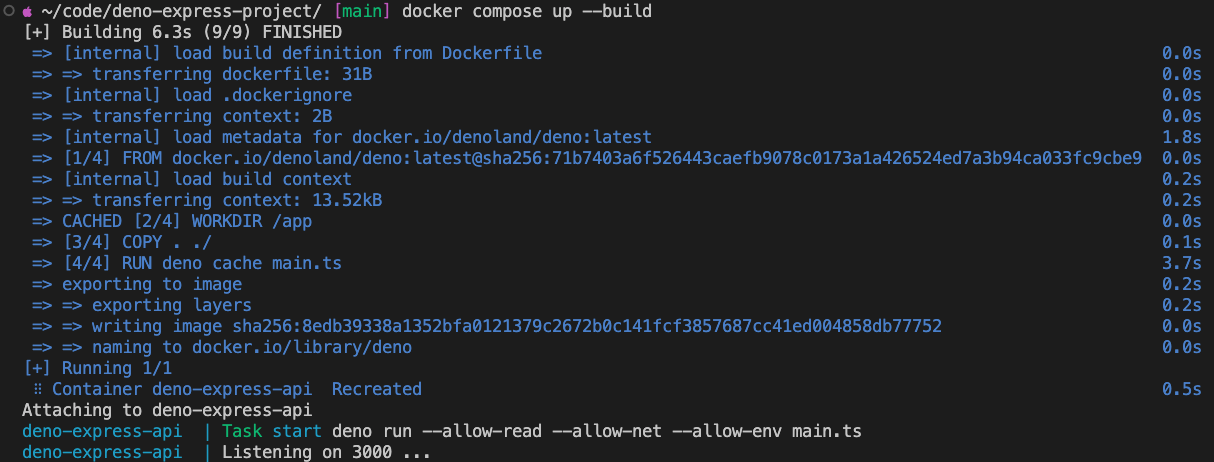
Docker Compose, "docker compose up --build output"

You can find the built container wherever you’ve configured Docker to store them; see the Docker desktop application if you’re not sure.

Running the Tests

Now that it’s up and running, we can run our tests via deno test -A, and see that they pass:
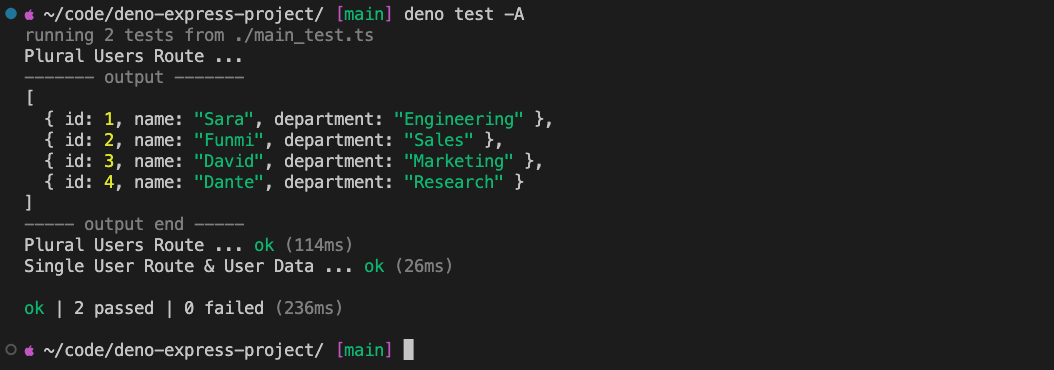
Deno test, "deno test -A output"

Great! We know the results come as expected, but how about when expected? We run our benchmarks via deno bench -A:
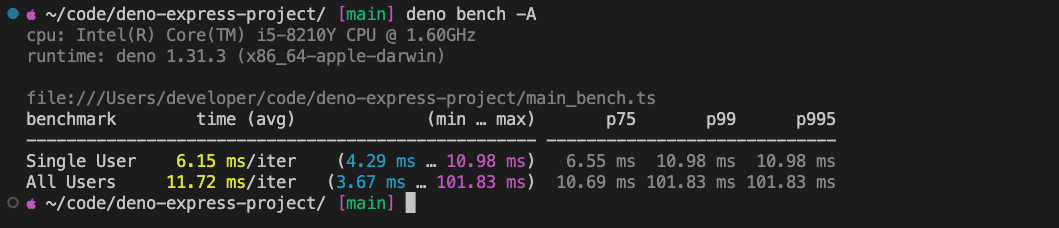
Deno bench, "deno bench -A output"

Iterating

So, what can we do with that? Well, we left a lot of verbose logging on in the middleware, so an exercise we do in the video is disabling the console output and re-running the benchmarks, which does show a notable improvement.

If you want to follow along, open main.ts and look for the middleware function that logs requests, reqLogger() and comment out the line as shown below:

const reqLogger = function (req: Request, _res: Response, next: NextFunction) {
  
  
  next();
};

Then, start the development service with deno task dev, test your changes, and either rebuild your image or push to your CI server.

It’s also worth mentioning that the numbers themselves will vary based on your local setup; I was recording on a MacBook Air while running them in the video.

You can also export the benchmark data in JSON using deno bench -A --json for automated benchmarks and graphing.

What’s Next?

At this point you’re ready to connect a real data store, implement real routes, real tests, and real benchmarks.

To help structure your project, check out express.Router.

Building production APIs also requires consideration of compression, authentication, and rate limiting options, so do take some time to thoroughly read the Express documentation.

We hope you found this useful and wish you luck with your project!

Stuck? Get help in our Discord!