


惯性聚合 高效追踪和阅读你感兴趣的博客、新闻、科技资讯
阅读原文 在惯性聚合中打开

推荐订阅源

Microsoft Azure Blog
C
Cisco Blogs
WordPress大学
WordPress大学
H
Hackread – Cybersecurity News, Data Breaches, AI and More
The Cloudflare Blog
小众软件
小众软件
Recent Commits to openclaw:main
I
Intezer
Cyberwarzone
Cyberwarzone
T
The Blog of Author Tim Ferriss
博客园 - Franky
F
Fortinet All Blogs
C
Cyber Attacks, Cyber Crime and Cyber Security
G
Google Developers Blog
Recent Announcements
I
InfoQ
T
Threat Research - Cisco Blogs
V
V2EX
T
Tenable Blog
H
Help Net Security
Cisco Talos Blog
Cisco Talos Blog
T
Tailwind CSS Blog
cs.CL updates on arXiv.org
The GitHub Blog
The GitHub Blog
P
Privacy & Cybersecurity Law Blog
A
Arctic Wolf
OSCHINA 社区最新新闻
OSCHINA 社区最新新闻
D
DataBreaches.Net
罗磊的独立博客
钛媒体:引领未来商业与生活新知
钛媒体:引领未来商业与生活新知
D
Docker
T
Tor Project blog
Attack and Defense Labs
P
Proofpoint News Feed
H
Heimdal Security Blog
Engineering at Meta
Engineering at Meta
雷峰网
雷峰网
Martin Fowler
Martin Fowler
AWS News Blog
AWS News Blog
IT之家
IT之家
Google DeepMind News
NISL@THU
NISL@THU
Google Online Security Blog
Vercel News
Vercel News
K
KPMG report finds enterprise disconnect between AI and its ROI | CIO
SecWiki News
SecWiki News
GbyAI
GbyAI
P
Proofpoint News Feed
月光博客
月光博客
Schneier on Security

Vercel News

Vercel Open Source Program: Winter 2026 cohort How Notion Workers run untrusted code at scale with Vercel Sandbox How we run Vercel's CDN in front of Discourse From idea to secure checkout in minutes with Stripe Building Slack agents can be easy Scaling redirects to infinity on Vercel Advancing Python typing Gamma builds design-first agents with Vercel How Avalara turns pipe dreams into patent-pending with v0 Keeping community human while scaling with agents How OpenEvidence built a healthcare AI that physicians actually trust Security boundaries in agentic architectures Skills Night: 69,000+ ways agents are getting smarter Video Generation with AI Gateway We Ralph Wiggumed WebStreams to make them 10x faster How Stably ships AI testing agents in hours, not weeks How we built AEO tracking for coding agents Anyone can build agents, but it takes a platform to run them Introducing Geist Pixel The Vercel AI Accelerator is back with $6m in credits Making agent-friendly pages with content negotiation The Vercel OSS Bug Bounty program is now available Introducing the new v0 Run untrusted code with Vercel Sandbox, now generally available How Stripe built a game-changing app in a single flight with v0 How Sensay went from zero to product in six weeks AGENTS.md outperforms skills in our agent evals Agent skills explained: An FAQ Testing if "bash is all you need" AWS databases are now live on the Vercel Marketplace and v0 Use Perplexity Web Search with Vercel AI Gateway Introducing: React Best Practices Nick Bogaty joins Vercel as Chief Revenue Officer How Mux shipped durable video workflows with their @mux/ai SDK How to build agents with filesystems and bash Stopping the slow death of internal tools Building AI-Generated Pixel Trading Cards with Vercel AI Gateway We removed 80% of our agent’s tools AI SDK 6 Our $1 million hacker challenge for React2Shell Cline now runs on Vercel AI Gateway How to prompt v0 Build smarter workflows with Notion and v0 Vercel launches partner certification Inside Workflow DevKit: How framework integrations work React2Shell Security Bulletin | Vercel Knowledge Base Billions of requests: Black Friday-Cyber Monday 2025 Investing in the Python ecosystem AWS Databases coming to the Vercel Marketplace How we built the v0 iOS app Workflow Builder: Build your own workflow automation platform Vercel Open Source Program: Fall 2025 cohort Self-driving infrastructure Vercel collaborates with Google for Gemini 3 Pro Preview launch Vercel: The anti-vendor-lock-in cloud How Nous Research used BotID to block automated abuse at scale How AI Gateway runs on Fluid compute What we learned building agents at Vercel Build and deploy data applications on Snowflake with v0 BotID Deep Analysis catches a sophisticated bot network in real-time Vercel achieves TISAX AL2 compliance to serve automotive partners Bun runtime on Vercel Functions David Totten Joins Vercel to Lead Global Field Engineering Vercel Ship AI 2025 recap You can just ship agents AI agents and services on the Vercel Marketplace Built-in durability: Introducing Workflow Development Kit Zero-config backends on Vercel AI Cloud Introducing Vercel Agent: Your new Vercel teammate Update regarding Vercel service disruption on October 20, 2025 Agents at work, a partnership with Salesforce and Slack Running Next.js in ChatGPT: How to Build ChatGPT Apps Talha Tariq joins Vercel as CTO of Security Just another (Black) Friday Server rendering benchmarks: Fluid Compute and Cloudflare Workers Towards the AI Cloud: Our Series F Collaborating with Anthropic on Claude Sonnet 4.5 to power intelligent coding agents Preventing the stampede: Request collapsing in the Vercel CDN BotID uncovers hidden SEO poisoning How we made global routing faster with Bloom filters What you need to know about vibe coding Scale to one: How Fluid solves cold starts Addressing security & quality issues with MCP tools - Vercel AI agents at scale: Rox’s Vercel-powered revenue operating system Helly Hansen migrated to Vercel and drove 80% Black Friday growth Agentic Infrastructure Zero Data Retention on AI Gateway Optimizing Vercel Sandbox snapshots How Waldium made a blog platform work for humans and AI alike How FLORA shipped a creative agent on Vercel's AI stack Agent responsibly Making Turborepo 96% faster with agents, sandboxes, and humans Unified reporting for all AI Gateway usage new.website joins forces with v0 SERHANT.'s playbook for rapid AI iteration Two startups at global scale without DevOps Chat SDK brings agents to your users 360 billion tokens, 3 million customers, 6 engineers Meet the 2026 Vercel AI Accelerator Cohort Build knowledge agents without embeddings
How we made v0 an effective coding agent
Max LeiterSoftware Engineer · 2026-01-07 · via Vercel News

Last year we introduced the v0 Composite Model Family, and described how the v0 models operate inside a multi-step agentic pipeline. Three parts of that pipeline have had the greatest impact on reliability. These are the dynamic system prompt, a streaming manipulation layer that we call “LLM Suspense”, and a set of deterministic and model-driven autofixers that run after (or while!) the model finishes streaming its response.

What we optimize for

The primary metric we optimize for is the percentage of successful generations. A successful generation is one that produces a working website in v0’s preview instead of an error or blank screen. But the problem is that LLMs running in isolation encounter various issues when generating code at scale.

In our experience, code generated by LLMs can have errors as often as 10% of the time. Our composite pipeline is able to detect and fix many of these errors in real time as the LLM streams the output. This can lead to a double-digit increase in success rates.
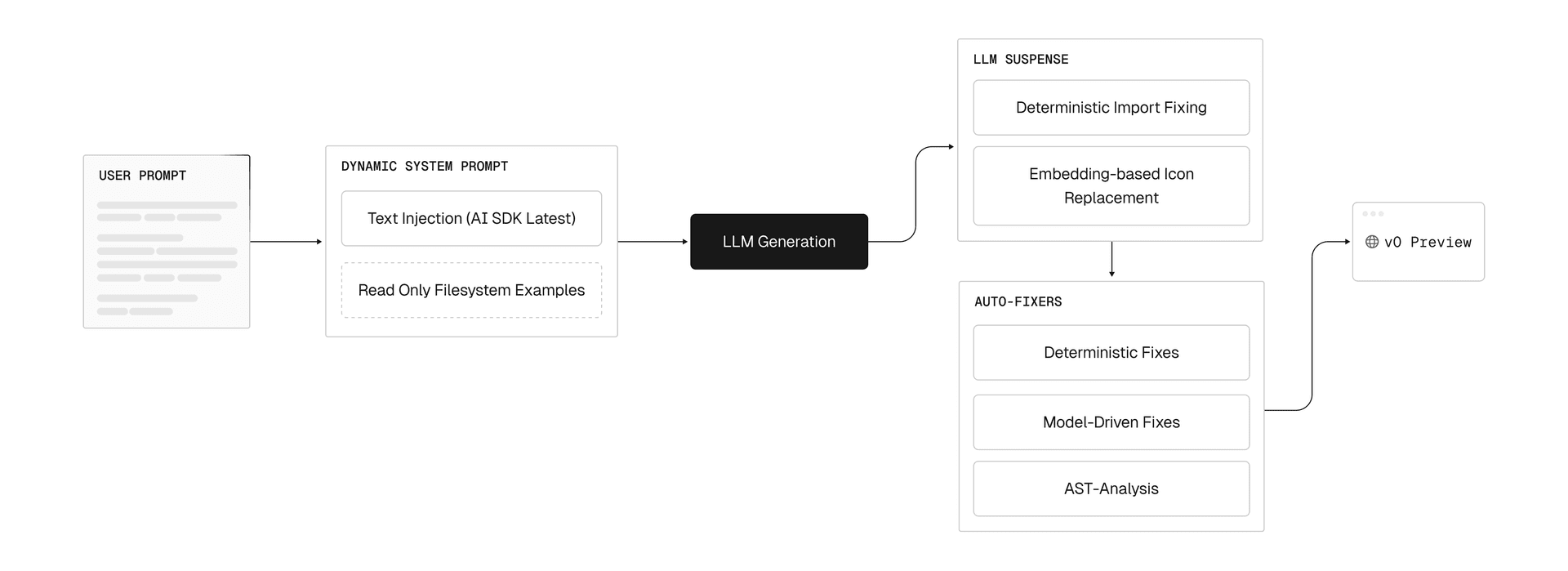
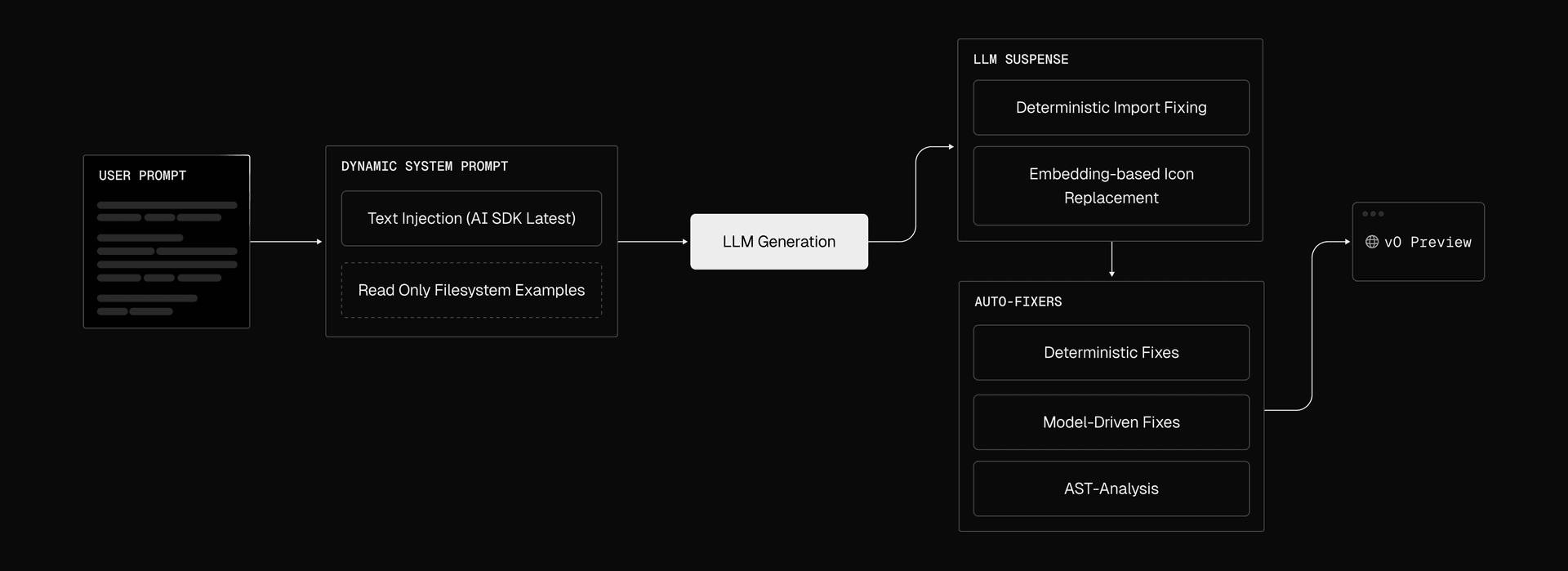
Link to headingDynamic system prompt

Your product’s moat cannot be your system prompt. However, that does not change the fact that the system prompt is your most powerful tool for steering the model.

For example, take AI SDK usage. AI SDK ships major and minor releases regularly. Models often rely on outdated internal knowledge (their “training cutoff”), but we want v0 to use the latest version. This can lead to errors like using APIs from an older version of the SDK. These errors directly reduce our success rate.

Many agents rely on web search tools for ingesting new information. Web search is great (v0 uses it too), but it has its faults. You may get back old search results, like outdated blog posts and documentation. Further, many agents have a smaller model summarize the results of web search, which in turn becomes a bad game of telephone between the small model and parent model. The small model may hallucinate, misquote something, or omit important information.

Instead of relying on web search, we detect AI-related intent using embeddings and keyword matching. When a message is tagged as AI-related and relevant to the AI SDK, we inject knowledge into the prompt describing the targeted version of the SDK. We keep this injection consistent to maximize prompt-cache hits and keep token usage low.

In addition to text injection, we worked with the AI SDK team to provide examples in the v0 agent’s read-only filesystem. These are hand-curated directories with code samples designed for LLM consumption. When v0 decides to use the SDK, it can search these directories for relevant patterns such as image generation, routing, or integrating web search tools.

These dynamic system prompts are used for a variety of topics, including frontend frameworks and integrations.

Link to headingLLM Suspense

LLM Suspense is a framework that manipulates text as it streams to the user. This includes actions like find-and-replace for cleaning up incorrect imports, but can become much more sophisticated.

Two examples show the flexibility it provides:

A simple example is substituting long strings the LLM often refers to. For example, when a user uploads an attachment, we give v0 a blob storage URL. That URL can be very long (hundreds of characters), which can cost 10s of tokens and impact performance.

Before we invoke the LLM, we replace the long URLs with shorter versions that get transformed into the proper URL after the LLM finishes its response. This means the LLM reads and writes fewer tokens, saving our users money and time.

In production, these simple rules handle variations in quoting, formatting, and mixed import blocks. Because this happens during streaming, the user never sees an intermediate incorrect state.
Suspense can also handle more complex cases. By default, v0 uses the lucide-react icon library. It updates weekly, adding and removing icons. This means the LLM will often reference icons that no longer exist or never existed.

To correct this deterministically, we:

  1. Embed every icon name in a vector database.

  2. Analyze actual exports from lucide-react at runtime.

  3. Pass through the correct icon when available.

  4. When the icon does not exist, run an embedding search to find the closest match.

  5. Rewrite the import during streaming.

For example, a request for a "Vercel logo icon" might produce:

import { VercelLogo } from ‘lucide-react’

LLM Suspense will replace this with:

import { Triangle as VercelLogo } from ‘lucide-react’

This process completes within 100 milliseconds and requires no further model calls.

Link to headingAutofixers

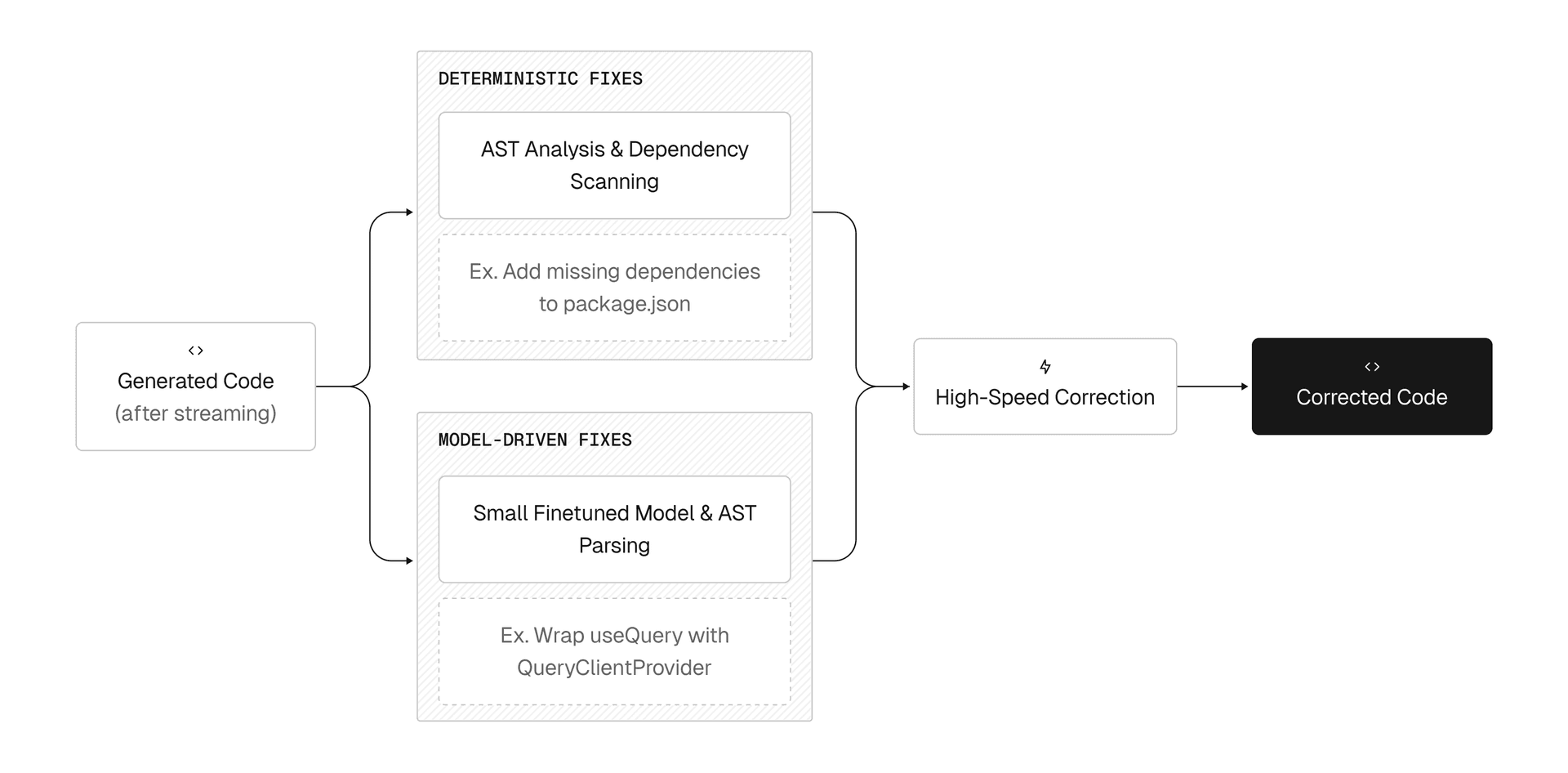
Sometimes, there are issues that our system prompt and LLM Suspense cannot fix. These often involve changes across multiple files or require analyzing the abstract syntax tree (AST).

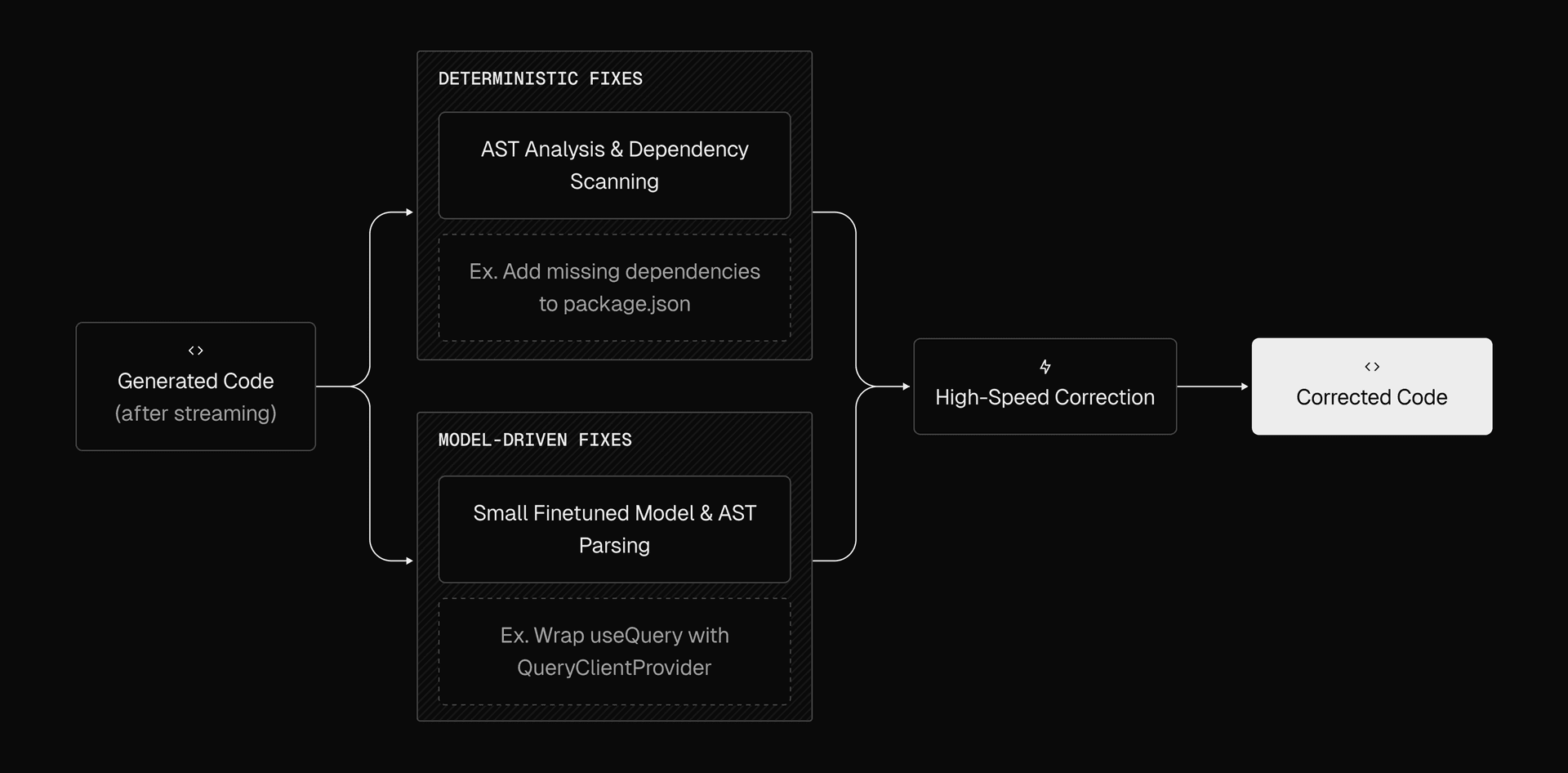
For these cases, we collect errors after streaming and pass them through our autofixers. These include deterministic fixes and a small, fast, fine tuned model trained on data from a large volume of real generations.

Some autofix examples include:

  • useQuery and useMutation from @tanstack/react-query require being wrapped in a QueryClientProvider. We parse the AST to check whether they're wrapped, but the autofix model determines where to add it.

  • Completing missing dependencies in package.json by scanning the generated code and deterministically updating the file.

  • Repairing common JSX or TypeScript errors that slip through Suspense transformations.

These fixes run in under 250 milliseconds and only when needed, allowing us to maintain low latency while increasing reliability.
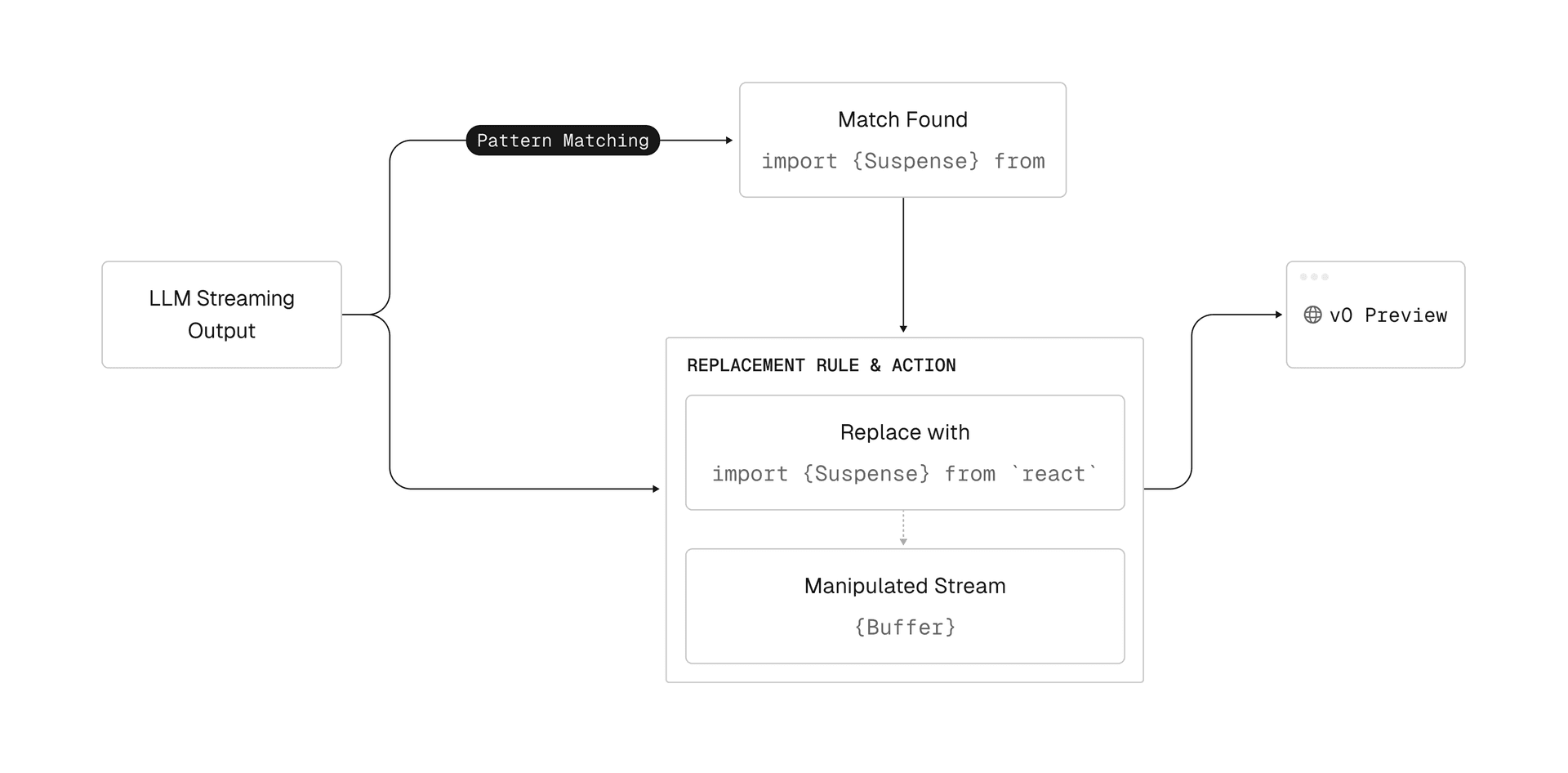
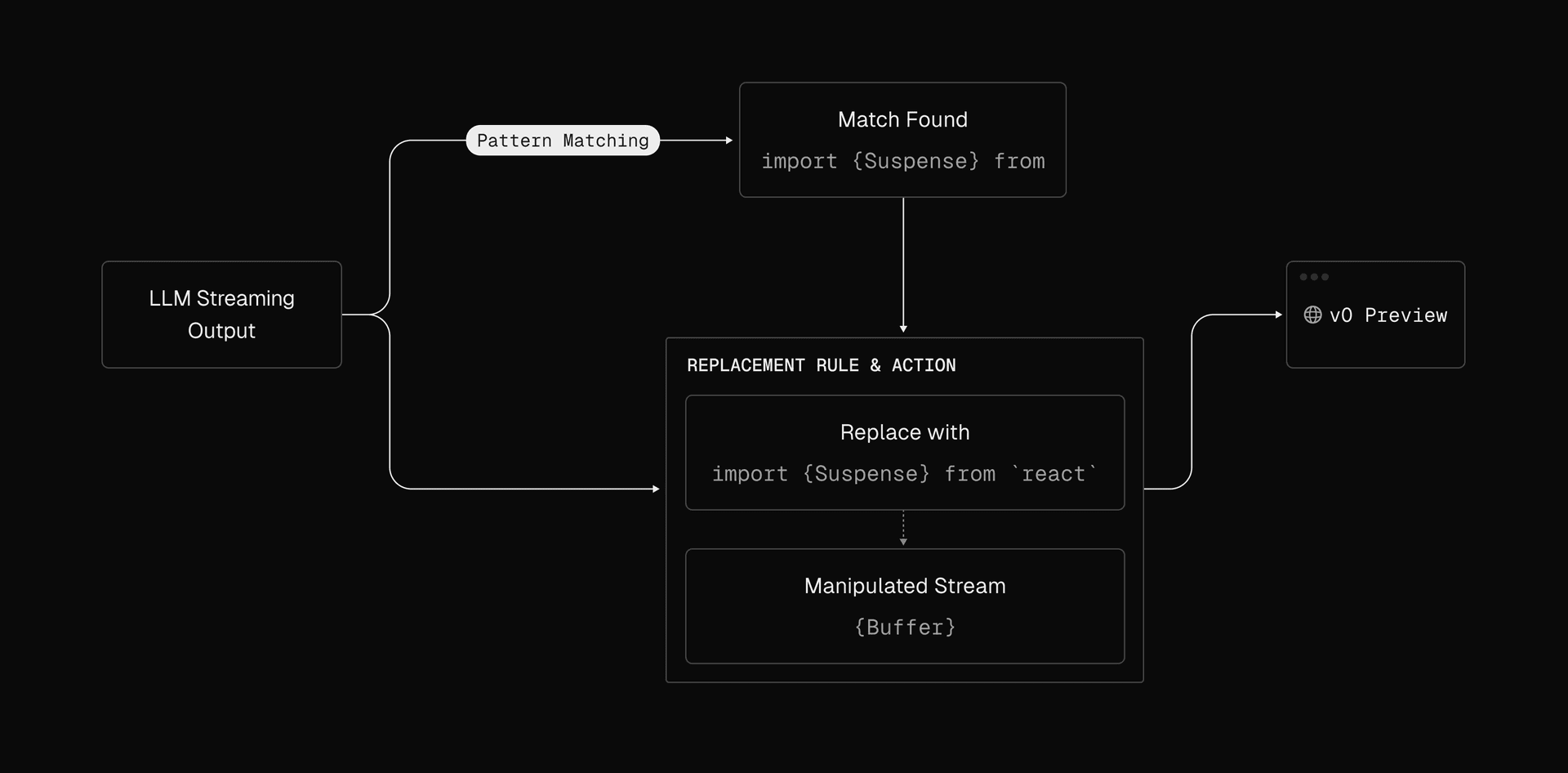
Link to headingPutting it together

Combining the dynamic system prompt, LLM Suspense, and autofixers gives us a pipeline that produces stable, functioning generations at higher rates than a standalone model. Each part of the pipeline addresses a specific failure mode, and together they significantly increase the likelihood that users see a rendered website in v0 on the first attempt.