





The Supreme Court is not saying people don’t have certain rights, just that no courts can help them when those rights are violated.
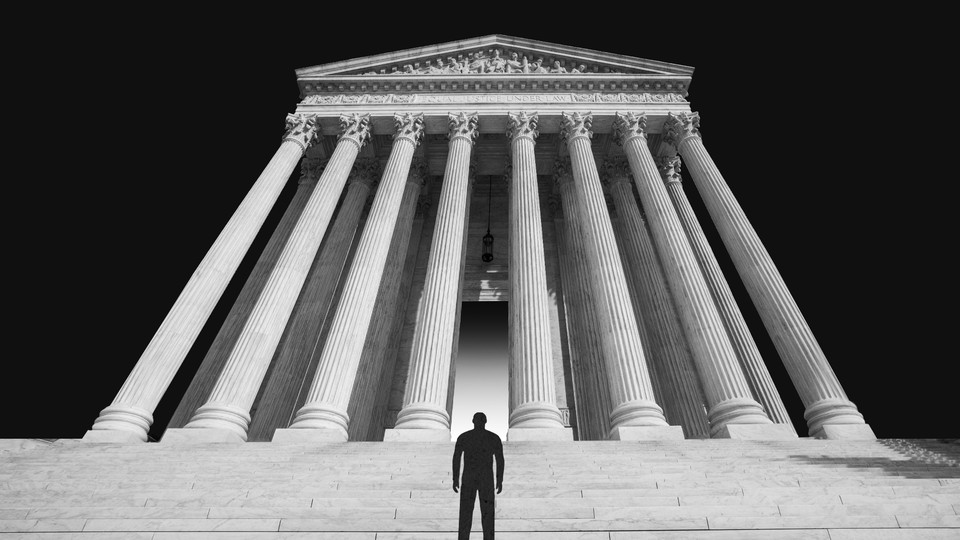
The six Republican appointees on the Supreme Court have made one thing clear: People may have rights, but in many cases they have no way to enforce them. Four decisions released this week have that paradox at their core.
Two of them, both issued Tuesday, held that the plaintiffs lacked “causes of action”—the legal authorization to sue to vindicate their federal rights. In Cisco v. DOE, practitioners of the Falun Gong religion claimed that they were persecuted by the Chinese government and that Cisco’s surveillance technology helped China identify and torture them. The six Republican appointees said the victims could not sue Cisco under the Alien Tort Statute, a law enacted in 1789 that allows “any civil action by an alien for a tort” that is “committed in violation of the law of nations or a treaty of the United States.” In another case, Landor v. Louisiana Department of Corrections, a Rastafarian prisoner had attempted to sue the correctional officers who had forcibly held him down and shaved his dreadlocks—in violation of his religious practices—after he had handed them a judicial decision telling them they could not do so. Here the six Republican appointees said that the Religious Land Use and Institutionalized Persons Act does not allow people to bring claims for money damages against the individual correctional officers who are subject to the act’s obligations.
In both of these cases, the majority ruled expansively, issuing sweeping legal proclamations that will have serious consequences for people whose rights are violated. In Cisco, the justices didn’t just say that Falun Gong practitioners couldn’t sue a corporation for enabling their torture. They said that courts could not recognize any causes of action under the Alien Tort Statute for violations of the law of nations that did not exist when the statute was enacted in 1789. It is up to Congress to authorize causes of action for newly recognized features of the law of nations, even though Congress had already created a cause of action for violations of the law of nations—the Alien Tort Statute itself. The Court’s decision will bar suits by victims of any human-rights abuses, because human-rights protections became part of international law in the 20th century.
Listen: How to save the Supreme Court from itself
Landor did to another set of legal protections—spending-clause statutes—what Cisco did to international law. Spending-clause statutes are the set of laws in which Congress has offered states money, provided that the states adhere to various conditions. In Landor, the condition was that states would agree to respect the religious-freedom rights of incarcerated people. The majority in Landor said that the conditions in those spending programs generally couldn’t be enforced against the state officers who are supposedly bound by those conditions. The Court said Congress didn’t have the power to impose liability on the individual government employees who didn’t personally agree to comply with the conditions that are part of the spending programs—and that state and local governments agree to when they accept federal funds.
That rule will undermine protections in the many public-benefits programs that are structured as spending-clause statutes, such as Medicaid and the Individuals With Disabilities Education Act. If people can’t sue for damages when officials violate the rules that Congress has established for those programs, then those rules aren’t really rules at all.
Two other decisions—one also issued Tuesday, the other yesterday—transformed a swath of federal immigration protections into unenforceable guidelines that the Trump administration need not comply with.
In Blanche v. Lau, the legal protections at issue were for lawful permanent residents—green-card holders—who are entitled to the greatest legal protections of all noncitizens. The six Republican appointees said those protections were effectively useless and not binding. Although federal law has long said that a legal permanent resident can be denied reentry into the United States if clear and convincing evidence exists that the resident committed a crime of moral turpitude, Lau says that border officials can deny admission even without such evidence. This allows officers to strip green-card holders’ lawful immigration status without the degree of proof required by federal law—and, perhaps, without any meaningful proof at all. The Republican appointees said the legal protections apply only in formal immigration proceedings, and would be too impracticable and burdensome to apply at the border.
Adam Serwer: The Supreme Court has invented a right to discriminate
Then yesterday, the Republican appointees declared that the laws requiring a presidential administration to undergo certain procedures before revoking so-called temporary protected immigration status can’t be enforced at all. Temporary protected status is a kind of immigration relief that allows people who pass a rigorous vetting process to remain and work in the United States because conditions in their home countries make return dangerous. To end TPS, the executive branch is required, by law, to consult with executive-branch agencies before determining that the conditions in a country have changed enough to warrant ending TPS. There is almost no question that the Trump administration failed to engage in that consultation when it ended TPS for Haitian citizens in the fall of 2025. Last week, The New York Times reported that emails conclusively show that the Department of Homeland Security decided to end TPS for Haitians before DHS heard from the State Department about whether conditions in Haiti had changed sufficiently.
The Supreme Court’s opinion in the TPS cases says that doesn’t matter. Federal courts cannot review whether the executive branch complied with the procedures required by statute.
One exception exists to this overall pattern. In Exxon Mobil Corp. v. Corporación Cimex, the six Republican appointees said that individuals and entities could sue the Cuban government, notwithstanding that foreign states are typically immune from suit in federal court. Here though, the plaintiff was not a human, but a corporation—Exxon Mobil.
The combined force of these decisions is clear: It’s good to be a corporation. If you’re anyone else, your rights may not be very useful to you at all.
此内容由惯性聚合(RSS阅读器)自动聚合整理,仅供阅读参考。 原文来自 — 版权归原作者所有。