








Ed ThomasUK editor
 BBC
BBC
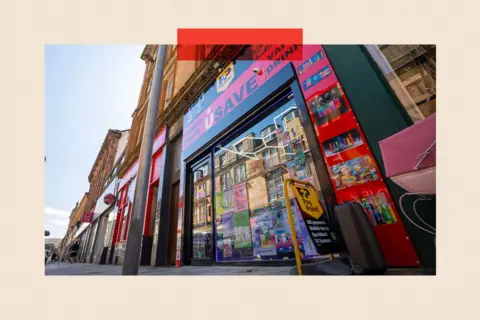
For a number of years, people around Britain have spoken of what they perceived to be "dodgy shops" on their High Street. To many, it seemed new businesses were popping up that had little obvious purpose or, in many cases, a huge number of direct competitors already in situ. Rumours spread between neighbours about money-laundering mini-marts and gang-owned vape stores.
There was a vague feeling of unease about all of this - but it was difficult for ordinary people living nearby to prove there was anything amiss.
And so when we started looking into the topic last February, I didn't truly appreciate the scale of what was really going on on our High Streets.
Our BBC team has travelled across the UK - including to Plymouth, Rochdale, Shrewsbury, Newport and Bradford - exposing what we have found to be brazen criminality on the High Street.
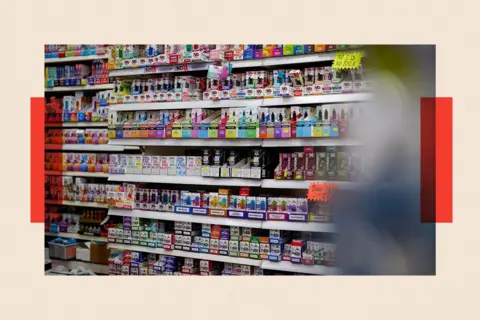
In Hull, we unearthed underground tunnels supplying sacks of illegal cigarettes to High Street mini-marts. In Swansea, we watched as officers smashed in windows of "stash cars" that were used to hide illegal cigarettes during the day, and deal drugs at night. And we exposed a network of high street shops selling illegal tobacco fronted by "ghost directors" masking the real owners.
Freedom of Information requests revealed for the first time that more than 3,600 shops across the UK had illegal goods - such as counterfeit cigarettes, tobaccos, and vapes - seized over 2024-25. The then-Home Secretary Yvette Cooper described some of our findings as a "disgrace". Throughout our reporting we were repeatedly attacked and threatened.
In lots of places, it seems, High Streets have become a front for organised crime. The National Crime Agency (NCA) estimates that at least £1bn of criminal cash is laundered through UK High Street stores each year.
 Getty Images
"People want to feel safe… [going] down the local High Street," says John Herriman, chief executive of the Chartered Trading Standards Institute. "The concern is that they don't feel as safe as they used to."
Every episode of High Street criminality causes local angst. But when you look at the national picture - as we have done over the last year - another broader lesson emerges. High Streets seem to offer insight into Britain's troubles. Like a cracked mirror, they reflect other trends in British society, including lacklustre income growth, inequality and the boom in online shopping.
And some analysts tell us that obvious criminality on the High Street is shaping politics too, turning voters away from long-established parties and towards political newcomers.
So how did it get to this? And is there a solution for the decline of Britain's High Streets?
The psychological effect
Organised crime has always existed on the High Street, says Elijah Glantz, a research fellow into organised crime at the Royal United Services Institute (Rusi), a security think tank.
"Nail bars, pubs, certain restaurants - anything that's cash-intensive has always been vulnerable to organised crime exploiting it," he says. Criminals like cash because unlike card transactions or bank transfers, it is largely untraceable, which makes it useful for both transactions and money laundering.
But in the last decade, he says, both the police and Trading Standards - a body enforcing consumer protection laws - have been squeezed. In 2002, there were 4,260 staff employed by Trading Standards, but in 2025 there were 2,378. Since then, crime has seemingly become more visible.
"There does seem to be an increase in the visibility of it. We're looking at organised crime that has manifested because nobody has put it away, nobody has forced it underground," says Glantz.
And that brazenness has a sharp psychological effect, analysts say - particularly on politics.
 EPA/Shutterstock
Nick Plumb, a director at the Power to Change think tank, says that the sight of open criminality on the High Street fuels feelings of "powerlessness" - a force that's proving potent in UK politics.
"The sense of a lack of control… has been a key feature of our politics over the last decade," he says. "High Streets are incredibly important [to] how people feel about the country… and politics."
And it's not just criminality that people care about. There is the issue of empty shops too.
In particular, Plumb's analysis showed that in the 2024 general election, support for Reform UK was higher in the 100 places in England with the biggest increases in persistent High Street vacancy relative to the rest of the country. This is based on parliamentary seats they won, or came second in. It built on previous research - from academics at the universities of Warwick and Oxford, and Imperial College London - that linked visible High Street decline to support for the United Kingdom Independence Party, an earlier political outfit of Nigel Farage, between 2009 and 2019.
Plumb says that "High Street decline is only partially explained by deprivation," and points to the "rise of online shopping and out-of-town retail, distant and uninterested ownership [and] changing working habits" as a factors behind the decline.
This decline often starts with those vacant units.
 Morgan Spence / BBC News
Glantz from Rusi thinks that as legitimate businesses close, crime moves in. "Rents are down, there's a lot of empty spaces, so landlords are willing to pretty much take just about anybody," he says.
Plumb came up with a new name for these areas: the "shuttered front", a string of constituencies with struggling High Streets that Power to Change think could play a pivotal role in future elections.
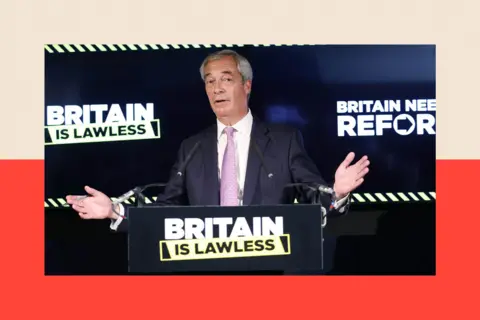
Indeed, Reform's Nigel Farage and Richard Tice were among the first mainstream politicians to regularly talk about visible signs of High Street criminality.
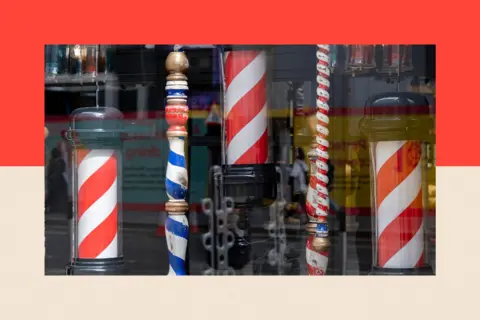
In 2024, Farage said at an event: "You can see High Streets with five, six, seven barber shops in them." Tice added: "Seriously, how come lots of these new barber shops have got no customers in them? How come they all want cash only? These are fronts for money laundering and drug money, and someone has to talk about it."
And in a social media video he made last year - one that quickly set parts of the internet alight - Robert Jenrick, who was then the shadow justice minister, listed "weird Turkish barber shops" as a visible sign of decline, alongside bike theft, phone theft, and drugs in town centres. "It's all chipping away at society," he said. He later clarified that he was "obviously not talking about all Turkish-style barber shops". Jenrick defected to Reform earlier this year.
Some politicians argue the language around High Street decline is in danger of becoming racially coded. In January, Miatta Fahnbulleh, then the devolution, faith and communities minister, agreed when asked by the Guardian if she thought the focus on Turkish barbers had racist overtones. "Yes, I do. The fundamentals aren't to do with the colour of the skin of people running our High Streets. It's to do with long-term decline and neglect."
At the time a Reform spokesman was quoted as saying: "This is not a matter of ethnicity.
"The National Crime Agency itself has said many of these establishments are used as fronts for money laundering as well as a whole range of criminality which is why they carried out hundreds of raids on them last year."
Meanwhile, immigration - the issue that voters consistently highlight as among the most pressing, and that Reform campaigns heavily on - came up in our investigation too. We exposed a Kurdish gang that was enabling migrants to work illegally in mini-marts the length of Britain, by offering to put their own names to official paperwork. Trading Standards told us they find a constant supply of staff from asylum hotels, who are vulnerable to abuse by employers, working in those shops.
Josh Nicholson, a researcher at the Centre for Social Justice think tank, says, "Chaos and flux in Westminster are reflected in our High Streets.
"People feel powerlessness, they look at Westminster and see an inability of politicians to grapple with the basics and that feeds down to a local level."
This feeling of helplessness came up again and again in our travels.
"Nothing is going to change," Daniel, in Swansea, told us about the criminality on his High Street, which has become a hub for counterfeit rolling tobacco. He has seen violence on the High Street and an increase in raids on High Street shops. He's a dual British and Chinese national and was considering moving to Hong Kong.
"It doesn't make me feel safe. I've got kids."
Economic hardship
Oscar Selby, who researches troubled High Streets at the Centre for Cities think tank, sees them as a "bellwether" for the wider economy.
"High streets are ultimately… downstream of the broader economy's performance," he says. "The reason why people are so frustrated about High Streets is that people are also just annoyed that incomes have stagnated for the last 15 years. I think it all comes together in one package."
He thinks troubled High Streets are a "visual manifestation of the economic hardship that a lot of places feel".
High Street criminality sheds light on how bricks-and-mortar stores have been hammered by the boom in online shopping, with footfall 15-20% lower after the Covid lockdowns, according to a study from 2024. Amazon's net sales in the UK, however, have doubled since 2020. This has been exacerbated by the woes in the commercial property market, which was hit by the shift to working from home since lockdowns were introduced, and rising interest rates.
Of course, it's an uneven picture across the country. Some town centres appear to be thriving, and in those places you won't notice much visible sign of criminality - though the NCA did find organised High Street crime gangs in every part of the UK during an operation last year. Research from the Centre for Cities points to Cambridge, York, Edinburgh and Manchester as relative success stories. But this reflects another problem: inequality, because it tends to be places that are already wealthier that have less High Street crime. Towns that are already struggling, meanwhile, are the ones that attract money-laundering gangs.
Now, amid calls for Sir Keir Starmer's resignation, Westminster is paying more attention. Housing Secretary Steve Reed directly linked the state of High Streets to people's faith in politics.
"Each of the last four prime ministers have been the most unpopular ever and the reason for that is the public are very angry about the state of the economy, very angry about the state of our public services and very angry about what they see around them when they look at their High Streets and their hometown," Reed told the BBC.
So, what can be done about it?
The government has announced a new High Street organised crime unit, which will cost £30m over three years. About two-thirds of that will go towards the NCA, funding 75 officers. The rest will go to Trading Standards, with a small amount given to tax and immigration authorities.
The promise is that rogue barber shops, vape stores, mini-marts and sweet shops will face thousands of raids.
 Morgan Spence/BBC News
Glantz from Rusi thinks the extra cash will make some difference, and hopes the new officers hired at the NCA will spend time looking in detail through company documents and help to "peel back the layers of ownership structures, which is very difficult to do".
He adds: "If you get specialist investigators at the NCA to look, you will get a better threat picture and start to understand who is at the end of it."
But he doesn't think £30m over three years is enough to make up for long-term cuts to police and Trading Standards budgets - though he does say that a small number of flashy, highly visible raids on shops, if shared widely on social media, could have a deterrent effect.
"There hasn't been that visible community policing that might have in the past deterred these very obvious shops from springing up."
Strategic direction
To take truly tough action, Glantz says, authorities need extra powers.
Currently, if Trading Standards want to shut a business, they usually have to use anti-social behaviour powers. But it requires lots of paperwork, and it's a tough bar to meet: it must be proved that a business is a serious nuisance, or that disorderly, offensive or criminal behaviour is likely to occur.
On the few occasions when Trading Standards can shut a business permanently, it's generally by working with landlords, who evict tenants.
Instead, Trading Standards wants stronger, direct powers to close illegal shops quickly, and to shut down crime networks operating in multiple premises across High Streets (to end the whack-a-mole strategy where criminals simply shift their illegal goods to another shop they own next door).
Partly in response to the BBC's journalism, the government has now ordered a "rapid review" of local responders' powers; in particular, it will look at whether Trading Standards should be able to close a potentially criminal shop for longer than the initial three months.
Herriman, from the Chartered Trading Standards Institute, thinks that for too long High Street organised crime was seen as a local problem rather than a national one, in part because Trading Standards activities are devolved to councils.
"Actually what it needs is some strategic direction from [national] government… because then you can start to coordinate across the country," he says.
The newly announced cash, Herriman says "is not job done, it is just job started".
Perhaps the biggest lesson from our year-long investigation was this: people still fundamentally care about their High Streets.
In the 1990s, it was out-of-town shopping centres that were predicted to kill off High Streets; then it was online shopping, then working from home.
But travelling the country, we found that High Streets still occupy a special place in our psyche. That's why the sight of brazen criminality causes such distress.
One pensioner in Oldham urged us to keep going, because "nobody cared". Richard, in north-west London, asked us in desperation for tips to investigate gangs himself. And I'll never forget Errol, a Kurd from Turkey who had spent decades building his grocer's shop in Pill, south Wales. He said he could no longer compete with gangs, and was tempted to give up and leave. He stayed mostly for his children and grandchildren, who were born in Britain.
Now, it's the task of the government and police to fix it.
Additional reporting: Patrick Clahane and Rebecca Wearn

BBC InDepth is the home on the website and app for the best analysis, with fresh perspectives that challenge assumptions and deep reporting on the biggest issues of the day. Emma Barnett and John Simpson bring their pick of the most thought-provoking deep reads and analysis, every Saturday. Sign up for the newsletter here