





Marie-Louise Connolly,health correspondent, BBC News NIand
Erica Witherington,disability reporter

 Getty Images
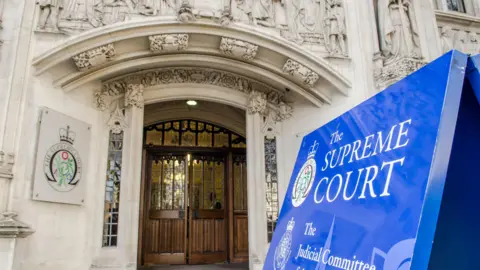
Severely disabled people aged 16 and over will now be able to give consent to their care arrangements despite not having the capacity to do so, the Supreme Court has ruled.
The judgment, which was triggered by a case brought by the attorney general for Northern Ireland, will apply across the UK.
Northern Ireland Health Minister Mike Nesbitt had sought to change the code of practice on how people are deprived of their liberty if they lack the capacity to consent to care arrangements.
Charities including Mencap, Mind and the National Autistic Society have warned that the ruling "strips fundamental human rights protections from potentially hundreds of thousands of severely disabled people".
It is thought more than 9,000 people in Northern Ireland will be affected by the ruling, and any potential action by the health minister.
It also means other health departments across the UK could change their legal frameworks on care arrangements for those who are severely disabled.
Official figures show there were 364,900 Deprivation of Liberty Safeguards applications in England in 2024-25, with 118,850 still not completed at the end of the year. Only 21.1% of applications were completed within the statutory time frame of 21 days.
A Department of Health spokesperson said it "welcomes" the judgement, describing it as an "important judgement" which clarifies how the law on deprivation of liberty should be interpreted going forward.
They said they were carefully considering the implications for practice across Health and Social Care services in Northern Ireland.
What rules were in place before the judgment?
The ruling overrules a previous Supreme Court judgment ruling known as Cheshire West.
This usually applies to people with a severe learning disability or dementia, living in locked rehabilitation units or placements such as supported living or care homes.
However, Northern Ireland's health minister sought to change the code of practice so that a person can give valid consent, through the expression of their wishes and feelings, even if they lack relevant capacity.
These legal safeguards ensure an independent person checks that such arrangements are justified, lawful, and in the person's best interests.
However, the Supreme Court heard arguments that Cheshire West was wrongly decided and creates an unsustainable administrative burden on health and social care systems.
In written submissions on behalf of Northern Ireland's attorney general, Tony McGleenan KC said a wider definition for the code of practice would "mean that fewer people aged 16 and above with impaired decision-making capacity would be regarded as deprived of their liberty".
"Safeguards would still be required... but those safeguards would focus on identification of the person's known wishes and feelings," he added.
What does the Supreme Court ruling mean?
The court ruled that lack of legal capacity is not the same as lack of "valid consent" for the purposes of Article 5 of the Human Rights Act.
It said some people who cannot make a legally recognised decision about where they live may still be able to consent, in convention terms, if they have enough awareness to understand their arrangements and express whether they are content with them.
The ruling, which will also be applied in England, Wales, and Scotland, as well as Northern Ireland, has said that a multifactorial approach will now be used in determining whether someone is deprived of their liberty.
Significantly a person's own wishes and preferences will be taken into consideration, however, unless they indicate an objection, it's unlikely that their living arrangements will be considered a deprivation of liberty.
It could potentially prove challenging for those in charge of providing care, as the court has acknowledged that people's ability to express their attitude towards their care arrangement will vary from case to case.
Northern Ireland's health minister now has the legal power to revise the Deprivation of Liberty Safeguards code of practice, which oversees care arrangements for people without sufficient mental capacity.
In simple terms, campaigners say the ruling means the law will now class fewer people as being deprived of their liberty and if fewer people fall into that category, fewer people will automatically get the legal checks and protections that used to follow.
That could ease pressure on an overstretched Deprivation of Liberty Safeguards (DoLS) system, but campaigners say it does so by narrowing who gets protected in the first place.
They warn that disabled people in locked or highly restrictive care settings may now find it harder to get independent oversight or challenge what is happening to them.
The next big question is how quickly ministers respond.
The government had already said it planned to consult on replacing DoLS with Liberty Protection Safeguards, and campaigners now say interim guidance is needed urgently to stop confusion and protect people affected by the judgment.
 Getty Images
Ruling 'sets us back decades'
The judgment has been met with alarm by some charities.
In a joint statement, Mencap, Mind and National Autistic Society said it "sets us back decades", adding that it could make it "easier for abuse and neglect to go unnoticed behind closed doors".
"By removing independent checks, advocacy, and automatic access to legal aid, the Court has closed the gateway to justice and support for many who need it most.
"A litany of previous wrongdoings demonstrate how closed cultures, lack of independent oversight and restrictive care can lead to abuse scandals and decisions like this fly in the face of everything we've learnt."
Calling on the UK government to urgently issue interim guidance to health care providers, the charities said it should "urgently bring in new laws and guidance that strengthens protections for some of the people who are most at risk".
"This should include clearly explaining how disabled people and their families can challenge breaches of their rights and get the advocacy and support they need."
What does it mean to be mentally incapacitated?
Mental capacity refers to whether a person is able to make their own decisions.
It can cover everything from what clothes to wear to significant decisions such as whether to move into a care home. Some people may be able to make decisions on some things, but not others.
Determining that someone is mentally incapacitated is not a simple process, but people over 16 who fall into this category are protected under the Mental Capacity Act 2005.
According to the NHS, a person's mental capacity can change over time depending on their condition and what decisions need to be made.