James GallagherHealth and science correspondent

 Getty Images
Only "a few thousand" men who have a dangerous genetic variant and a family history of cancer should be screened for prostate cancer with a blood test, according to the final recommendations of scientific advisers.
The UK's National Screening Committee says the harms of screening outweigh the benefits in all other groups.
Testing healthy men for prostate cancer does save lives, but also leads to treatment that can leave men unable to control their bladder or have an erection.
The final decision though rests with health ministers in England, Wales, Scotland and Northern Ireland.
The prostate sits just below the bladder and has a vital role in male anatomy as it helps make part of the seminal fluid and can affect the flow of urine.
Prostate cancer is the most common cancer in men and kills 12,000 people across the UK each year.
Prostate screening – which is when healthy people are checked for disease – involves a blood test called prostate specific antigen or PSA and, depending on the results, a follow up MRI scan of the prostate.
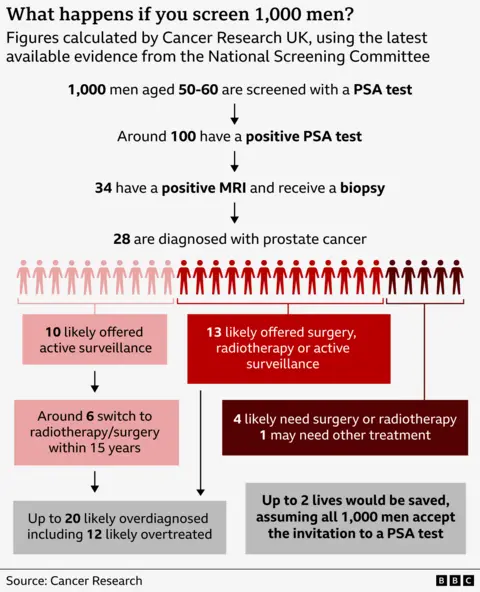
A major review by the National Screening Committee said for every 1,000 men screened in their 50s, it would save two lives from prostate cancer over the next 15 years.
But it would also lead to 20 men being told they have a cancer that would never need treatment.
Some prostate cancers grow so slowly you would have to reach 120 to 150 years old before they were a threat. However, they would have to live with that psychological burden of a cancer diagnosis for the rest of their lives.
Out of those 20 men, 12 would end up having treatment they don't need, but that damages the prostate – potentially damaging their sex lives and causing some incontinence, meaning they would need a pad to catch leaking urine.
"Once a prostate cancer is found, we still can't reliably tell which cancers need treatment or which do not – and the treatments available for prostate cancer can cause long-lasting harm," said Prof Sir Mike Richards, who chairs the screening committee and has prostate cancer himself.
The final advice says screening should not be offered to:
- All men
- Black men, who are at double the risk of prostate cancer
- Men with a family history of cancer - as the disease is so common that it doesn't narrow down the risk
The only group where the benefits were greater than the harms is men with a BRCA2 gene variant and a family history of breast, ovarian, pancreatic, or prostate cancer.
BRCA2 is involved in repairing DNA and some mutations lead to cancers being both more common and more deadly.
The screening committee said eligible men should be invited for a PSA blood test every two years between the ages of 45 and 61.
This will apply to a "few thousand" men a year, some are already getting informal screening as their families are known to NHS genetics clinics.
The evidence could still shift
The committee said it would continuously evaluate new evidence as it comes in, which could yet lead to wider screening programmes.
This includes new tests for prostate cancer that may do a better job of spotting those that need treatment, artificial intelligence tools and the results of the Transform trial which is underway in the UK and should soon answer a key area of uncertainty for black men.
While it is clear that black men are at much higher risk of getting prostate cancer, it is still uncertain whether those cancers are more dangerous - which would affect the decision on whether the NHS should offer screening.
Sir Mike said he hoped "new evidence and new tests and a better understanding of prostate cancer will support wider prostate cancer screening in future" but they "do need the evidence first".
The review comes after an intense period of campaigning involving charities, Olympian Sir Chris Hoy, who has terminal prostate cancer, as well as former Prime Ministers David Cameron and Rishi Sunak. Many famous faces including actor Stephen Fry and footballer Les Ferdinand have been vocal on an issue that affects many men.
 Jeff J Mitchell/Getty Images
The final advice suggests screening for even fewer people than was originally suggested in November when people with both BRCA1 and BRCA2 mutations would have been eligible.
Chiara De Biase, from Prostate Cancer UK, said she was "deeply disappointed" with the final recommendations.
"We know that a mass screening programme could save thousands of men's lives, and while we recognise the current evidence does not yet show that screening all men at risk would do more good than harm, today's decision is a step backwards, narrowing the recommendation to a smaller pool of eligible men."
What actually changes with prostate screening will be decided by ministers in the devolved governments in the UK.
Sir Mike is due to discuss their recommendations with the new health secretary James Murray on Monday.
Dr Ian Walker, executive director of policy at Cancer Research UK, said: "Screening decisions must be guided by the current evidence, with programmes only introduced when the benefits are shown to outweigh the harms, including unnecessary and invasive overtreatment.
"We urge the UK Government to accept the recommendation."