






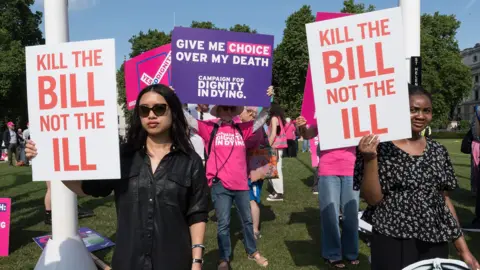
 Getty Images
A fresh attempt to legalise assisted dying in England and Wales has been launched, with the MP behind the plan telling the BBC she wanted to "finish the job".
Lauren Edwards, the Labour MP for Rochester and Strood, said she would bring an identical bill to the one passed by the Commons last year.
That bill, brought by Labour MP Kim Leadbeater, was not passed by the House of Lords in April after an unprecedented number of suggested amendments delayed its progress until it ran out of time.
Its opponents argued it had substantial flaws that risked vulnerable people being pressured into ending their lives early.
The proposed law - known as the Terminally Ill Adults (End of Life) Bill - would have allowed people over the age of 18 who were expected to die within six months to be given help to end their own life, subject to certain safeguards.
By bringing exactly the same legislation, Edwards is threatening to trigger rarely used powers to override peers' objections should they refuse to pass it again.
Bills usually only become law if both Houses of Parliament agree on its final wording.
But the powers under the Parliament Act, which have only been used seven times in the last century, mean that if MPs pass an identical bill in two consecutive parliamentary sessions, peers cannot block it a second time.
The Lords can suggest amendments which, if agreed by the Commons, would be added to the bill. But if they do not pass the bill as a whole before the end of the next session - usually in around a year's time - the unamended bill could become law even without their approval.
Opponents have previously warned that using the Parliament Act would risk creating a law out of a bill about which the Royal College of Psychiatrists, as well as a range of disability charities and hospices, have major concerns.
Edwards told the BBC she was "playing by the rules" and asking the House of Lords to do the same.
"Laws passed in the House of Commons are then refined by the House of Lords but they don't have the opportunity to block them," she said.
"It's perfectly reasonable for us to ask the House of Lords to finish the job."
The government was officially neutral, although several cabinet ministers including the then health secretary Wes Streeting voiced their opposition.
Sir Keir Starmer voted in favour and before the general election promised the broadcaster Dame Esther Rantzen, who had been calling for legalisation, to provide parliamentary time for a debate and vote.
Some MPs have questioned whether Andy Burnham, were he to replace Starmer as prime minister, would be as supportive.
As an MP in 2015, Burnham abstained on another effort to legalise assisted dying. But he told BBC Radio Manchester in 2024 he had since had family experience that had changed his mind and would "probably vote in favour" of the principle of assisted dying.
But he added: "In terms of the implementation of it, I would say there should be a requirement that the hospices of this country get properly funded and sorted out before that law change comes in."
He said palliative care was "not in the strong position it should be".
"Consequently, you can't have this law change with an underfunded hospice movement."