



 Greenpeace India
For several weeks now, the Indian capital, Delhi, has been battling a severe heatwave, with temperatures routinely rising above 40C. The real feel, the weather apps helpfully tell us, is always a few degrees higher. But how hot do you feel when you hit the streets?
On Tuesday, the Indian Meteorological Department (IMD) recorded the maximum day temperature at 43.5C in the capital.
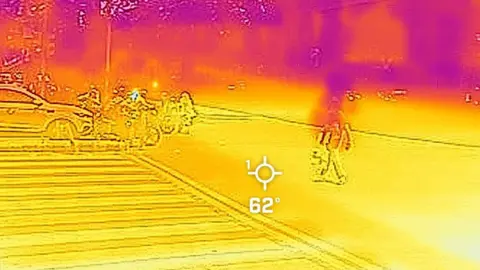
But we spent the day out on the city streets with a thermal camera deployed by Greenpeace India which recorded surface temperatures of up to 64C in some places.
The comparison is not like-for-like. The IMD's official data reflects the temperature of the city air measured under standard conditions, while thermal cameras record the temperature of surfaces.
On hot days, roads, concrete, vehicles and other exposed surfaces can become substantially hotter than the air around them.
High surface temperatures increase the heat absorbed by the human body through radiation and can make urban areas feel considerably hotter than the official temperature, particularly where there is little shade or vegetation.
Our first stop was just after mid-day at the IIT flyover in south Delhi, one of the busiest traffic junctions in the city. Hundreds of thousands of vehicles pass this crossing daily and, in peak traffic, wait time can sometimes stretch up to 10 minutes.
As Greenpeace researcher Nibedita Saha moved her camera from the shaded areas under the flyover (where the reading was 42C) to the bikers idling at stop signals under the direct sunlight, the reading went up to 64C. The surface temperature of the spot where we stood was 61C - it fell to 39.8C when we moved less than 10ft away to stand under a tree.
"Consistent exposure to such high temperatures can cause major health issues," says Nibedita, adding that sometimes, moving just a few feet can help. "We got instant relief. That's the difference just one tree can make."
Dr A Fathahudeen, a pulmonologist, says that the core human body temperature is 37C and prolonged exposure to high heat can make it rise.
"When it exceeds 40C, the body ceases to work normally. The most common symptom is heat exhaustion. People become extremely sweaty, complain of headaches and fatigue," he said, adding that in more serious cases, people can become confused and dazed and even have seizures.
"If not treated urgently, they can have multiple organ failures, leading to death," he said.
To stay safe during a heatwave, Dr Fathahudeen's advice to people is to keep drinking water even when not thirsty, wear loose, light-coloured clothing and use an umbrella.
The government, he said, must also issue an advisory for labourers to not work outdoors between 10:30am and 3pm.
But that's not a luxury Delhi's poor have.
We expected few people to be out and about when we headed to city landmark Red Fort in Old Delhi to meet street vendors.
The heat was unrelenting, but there were some shoppers, pilgrims and tourists around - and the vendors said they'd set up shops in the hope of finding some customers.
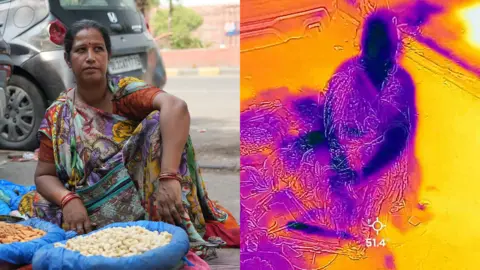
"What choice do poor people like us have?" asked Sanjana Ben who sells dry fruits from the pavement. She sat on the ground on a thin cushion fashioned from some clothes, with small sacks of cashews, almonds, raisins, walnuts and dried figs placed in front.
The thermal camera recorded temperatures just about 40C on her face - but as it moved closer to the ground, it read 51.4C, climbing to 57C just a few inches away.
"At times my head spins and my vision blurs. When the ground feels very hot, I stand up for a bit. But how long can I do that, so I sit down again," Sanjana Ben told the BBC.
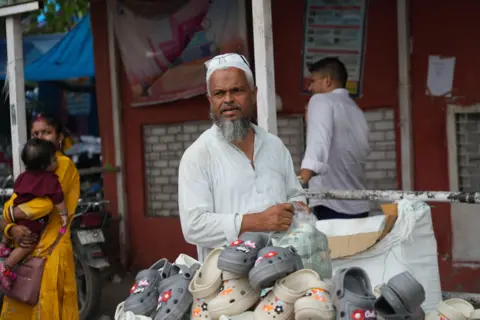
Mohammad Mahfouz Alam, who sells footwear from a stall nearby, said on hot days like these, there's little respite as the heat rises from the ground up and the sun beats down mercilessly from above.
"There's no relief day or night. I feel listless, my legs hurt. I reach home exhausted. Even after I take a bath, I cannot sleep. The fan blows hot air and I keep tossing and turning in bed."
The city weather, he said, has changed over the years. "The seasons have become more erratic. Summer, winter and rains have all become unpredictable and they affect us - those who live and work on the street - more."
He pointed to the tree behind him. "If this tree wasn't there, it'll be impossible for me to be here. The day this tree is gone, everything will be over."
As Nibedita's camera panned Mahfouz Alam and moved to focus on his surroundings, the readings moved from 40C to 58.65C. It stopped on his shoulder to record 44.8C.
 Antriksha Pathania/BBC
A couple of minutes walk from these stalls is Chandni Chowk which stretches from the Red Fort to Fatehpuri Mosque and has a maze of narrow alleyways and side streets leading to tens of thousands of shops and food stalls.
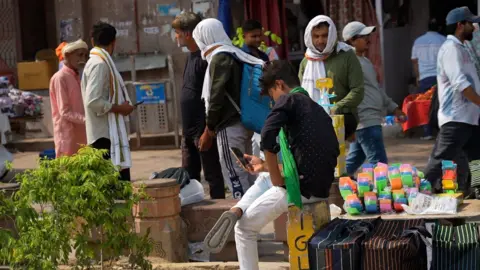
The main boulevard here was developed as a pedestrian zone a few years ago and short stone pillars were erected on both sides to allow visitors to catch a breath. But with no shade here, there are no takers for them.
We caught a young plastic toy vendor, engrossed on his phone, sitting on a concrete pillar that recorded 56.9C.
 Antriksha Pathania/BBC
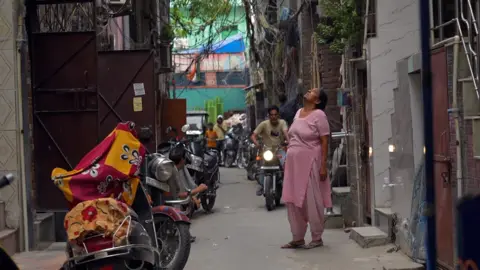
By the time we arrived in Sundar Nagri, a lower middle-class neighbourhood in east Delhi's Seelampur area, it was past 5pm and the sun was beginning to lose some of its sting.
But anything under direct sunlight was still baking - a concrete bench at the mouth of the colony recorded 51.6C.
 Antriksha Pathania/BBC
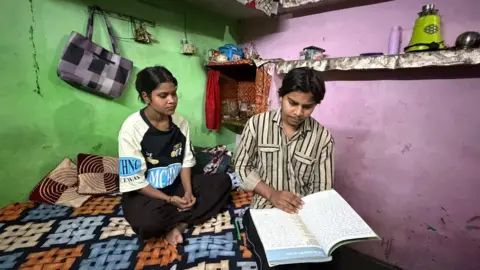
As we walked past bustling street markets selling mangoes, clothes, footwear and vegetables to meet siblings Abhishek and Kajal, a dust storm appeared on the horizon.
The small concrete homes here sit cheek by jowl, hugging both sides of lanes sometimes so narrow that only one person can pass at a time.
For the past two weeks, Abhishek has been maintaining a "Garmi khata" (a heat register) documenting how extreme heat is affecting their bodies, sleep, incomes and daily lives for a Greenpeace project.
 Antriksha Pathania/BBC
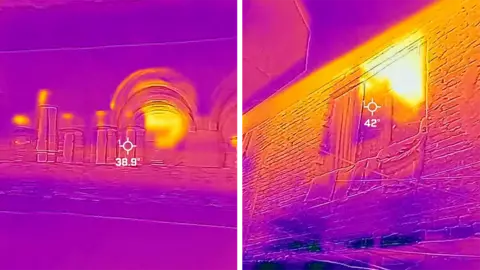
Outside his home, the camera recorded 42C. We walked up a flight of narrow stairs to their two-room home to find out if it's any cooler indoors.
The difference was barely discernible - when Nibedita pointed her camera to the plates, glasses and bowls on a shelf near the wall, the indoor temperatures hovered around 40C.
 Greenpeace India/BBC
There was no window or outlet for the heat to escape, a small ceiling fan whirred overhead recycling hot air. "When it's very hot, I feel nauseous," Kajal said. "You can't go out, you can't stay in."
Abhishek read out a recent entry from his register: "This week's heat has changed our daily routines. Everyone returns home late and no-one is sleeping well," he wrote.
"In the mornings, the fan is switched off during cooking and the heat becomes unbearable. My sister finds it hard to do her chores. My mother looks more tired than ever."
The days, he said, passed somehow, but the nights were most difficult. "I've cut my hair short, I get up several times to wash my face, I take off my t-shirt, but I still can't sleep at night.
"Outside, there's at least a breeze, inside it feels like I'm standing next to an oven."