











 Getty Images
The Met Office has issued a rare red warning for extreme heat covering parts of England and Wales later this week.
Temperatures will increase significantly in the next few days and could hit 40C in places by Wednesday and Thursday.
The warning comes into place at 09:00 on Wednesday and will last until 21:00 on Thursday for central, southern and south-east England, and parts of south Wales.
Will schools close if it gets too hot?
There is no legal maximum temperature for classrooms - and the government does not normally advise schools to close. Instead, it says schools can usually be managed safely and that keeping children in school is important.
Teaching unions have recommended that schools should aim to keep indoor temperatures at a maximum of 26C.
School leaders will keep a close eye on temperatures and will refer to their risk assessments. They will also watch for pupils becoming tired more quickly, especially those who are vulnerable.
If a head teacher does decide to close a school, they will need to talk to the chair of governors and their academy trust or employer first.
What can schools do to help combat the heat?
Some parents may already have had a message from their schools saying uniform rules are being relaxed and children can instead wear PE kits.
Schools can also look at changing start and finish times to avoid the worst of the heat.
Lessons may be moved to cooler areas of the school and the Department of Health and Social Care (DHSC) recommends children should not take part in vigorous physical activity when it is very hot, so PE lessons maybe be a bit more sedentary than normal.
CO2 monitors can also be used to keep a check on ventilation.
 Getty Images/SolStock
Advice from the UK Health Security Agency (UKHSA) says schools may have to close windows later in the day if it becomes hotter outside than inside, and fans shouldn't be used if temperatures go above 35C.
Teaching unions say schools will always be as creative as possible in taking all possible measures to keep children and staff comfortable, but this will be more difficult in some schools.
They called on the government to invest in making all school buildings more resilient to extreme weather.
How can I help my child keep cool at school?
If school uniform rules are relaxed, children should wear loose, light-coloured clothing where possible and sunhats with wide brims.
Sunscreen with high sun protection factors should be used – and some schools will ask students to bring in their own so they can re-apply it when needed during the day.
Schools will also encourage children to drink lots of water – but it's worth reminding them at home why this is important.
Can I keep my child off school because of the heat?
If your school is open, the advice is to send your child in as normal.
The government says school attendance is the best way for pupils to learn and reach their potential.
Do I have to go to work if it gets too hot?
There's no law in the UK that says a given temperature is too hot or too cold to work.
Workplace advice group Acas says that "except in extreme circumstances, workers usually need to follow their contracts and work with their employer to find a suitable and safe way to work".
Acas chief executive Niall Mackenzie says it is usually "a last resort in extreme circumstances" if a workplace has to be closed, or a worker is unable to travel or work because of the heat.
"Any such decision should only be taken where there are no alternative options and should be communicated clearly and in good time," he says, adding employers should be flexible and consider relaxing rules where possible.
In cold weather, the HSE says the minimum temperature for an indoor workplace should normally be at least 16C - or 13C if the work involves "rigorous physical effort".
What can employers do to keep the workplace cool?
The HSE says employers should let staff work flexibly where possible and move workers to cooler parts of the building.
Relaxing formal dress codes and allowing enough breaks to allow workers to get cold drinks or cool down can also help.
Employers can provide fans or air conditioning and, where possible, windows should be opened to keep air circulating.
If you are working from home, close curtains to block out the sun. In the morning and evening, open windows on opposite sides of your home to let hot air out and cold air in. Use a fan to encourage airflow.
What about people who work outside?
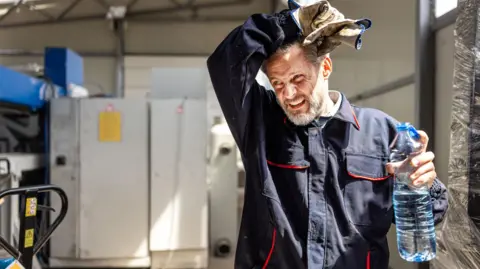
The HSE suggests that work should be rescheduled to cooler times of the day, and that employers introduce more frequent rest breaks, introduce shading to rest areas and provide free access to cool drinking water.
 Getty Images
It also says workers should be encouraged to remove personal protective equipment when resting to help them cool down.
Acas says staff working outside should wear appropriate clothes and use sunscreen to help protect them from sunburn.
What about travelling to work?
Acas notes that if public transport is affected, it could impact staff attendance and their ability to get into work on time.
It says people should check timetables in advance, and employers should be flexible.
National Highways says drivers should take plenty of drinking water on journeys, including enough for passengers.
If possible, it also advises changing travel times to avoid the hottest days and times of day.
Motoring group the RAC has said drivers whose cars don't have effective air conditioning should "strongly consider" postponing non-essential journeys until the weather warnings are lifted.