







'Six eggs used to be £1' - why everyday essentials cost so much more now
Phil Leake,Data journalist, Jennifer Meierhans,Business reporterand Rachel Clun,Business reporter

 Getty Images
Many of us have been buying the same supermarket staples every week for years.
And we've all noticed when we get to the checkout the total is higher now than it used to be - even when we've left luxuries like wine or biscuits on the shelf.
But you might be surprised to know exactly how much everyday essentials like milk, bread and eggs used to cost just a few years ago compared to what you're paying today.
We reveal how much they've gone up, what's behind the rise and whether anyone is profiting.
What's happening to the price of eggs?
Back in 2022 you only had to shell out £1 for the average box of six supermarket own brand free-range eggs. But today the same box costs £1.80, according to market researchers Assosia which compared average prices across Tesco, Sainsbury's, Asda and Morrisons for the BBC.
The price of eggs shot up after millions of hens were culled following the UK's worst outbreak of avian flu between 2021 and 2023.
The sudden drop in the number of laying hens and the added energy cost of keeping birds indoors due to restrictions caused shortages.
This led to supermarkets putting limits on how many eggs each customer could buy and both producers and retailers put prices up to offset their losses.
A big chunk of the cost of producing eggs comes from buying the grain the hens eat, heating their sheds and transporting the eggs.
Ukraine is a major supplier of grain and the cost rose sharply after Russia's full scale invasion in 2022. The conflict also pushed up energy prices, something we are seeing once again due to the war in the Middle East.
While these price pressures continue, demand for eggs remains high due to the popularity of high protein diets.
Milk uses a lot of energy
 Getty Images
Milk is another everyday essential that's gone up, from £1.29 for four pints of semi-skimmed in 2022 to £1.65 today, according to Assosia's data on supermarket budget ranges.
Dairy production uses a lot of energy in milking, processing and transportation so the energy price hikes following the war in Ukraine hit the industry hard and pushed up prices.
After an initial spike, milk price rises have eased in the last few years because of global oversupply. Dairy farmers are being paid 25% less for each litre of milk with many making a loss, according to agricultural analysts The Andersons Centre.
Farmers and producers keep supermarket shelves stocked with eggs, milk and bread - but their costs have risen well above the rate of inflation over the last year.
Prices that producers pay for materials and goods went up by 7.7% in the year to April, according to the ONS. This is the biggest increase in more than three years.
What's more over the same period, factory gate prices - the amount producers charge retailers or other wholesalers - only rose by 4%.
AJ Bell head of financial analysis Danni Hewson says contracts between producers and supermarkets are signed in advance.
"Without a crystal ball nobody can know what is going to happen" to producers' and farmers' costs at the moment these contracts are signed.
While that means farmers can ask for more money when a contract is up for renewal, that can't usually occur mid-contract when energy or fuel prices skyrocket.
"So there will be a degree of some of these price increases, obviously, having to be swallowed by some of these producers," she says.
Bread prices level out after Ukraine war
A loaf of basic medium slice white bread cost 65p in 2022 but that's now risen to 74p on average in the big supermarkets. Assosia does not have data for discounters like Aldi and Lidl but the other supermarkets tend to price match as competition for customers is so fierce.
The increase in the cost of wheat after Russia's invasion of Ukraine which led to rising bread prices has levelled out. However conflict in the Middle East has sparked global supply fears, according to The Andersons Centre.
Hewson said there has been a "perfect storm" of increased costs for raw materials, energy, labour costs and even changes to packaging regulation that has made these essentials more expensive.
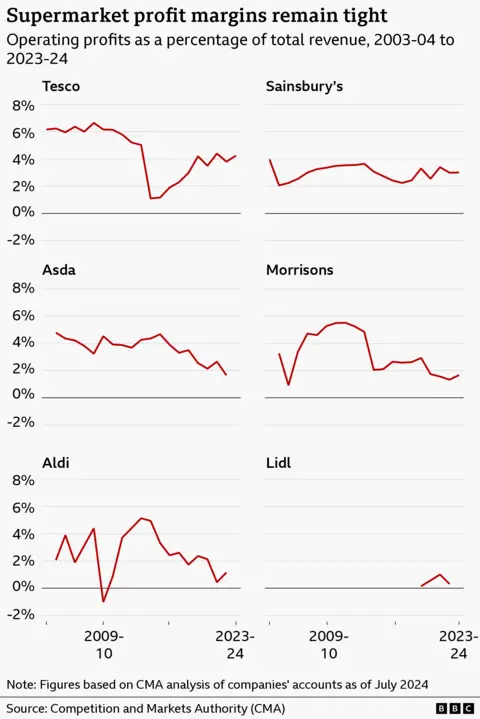
It can be galling that while the total at the checkout continues to rise, supermarkets are seemingly profiting.
Sales at the UK's main supermarkets rose from about £130bn to about £160bn between 2020 and 2024.
But when we take their sales and operating expenses into account, none of the main retailers' profit margins have increased over the last 20 years.
While these figures don't drill down into how much of those sales were for food, and they can't reveal how much profit was made on fresh fruit, meat or dairy products, experts say they do illustrate how competitive the supermarket industry is in the UK.
The Competition and Markets Authority's July 2024 investigation into the groceries sector found no evidence that supermarkets were artificially inflating prices.
There was no spike in 2022 and 2023 when food prices soared as a result of the global energy crisis following Russia's invasion of Ukraine.
Hewson says the UK supermarket sector is "massively competitive", and most will sell some staple products at a loss to get people through the door.
"In most of those cases, what happens is the supermarket swallows those losses. And that impacts their margins," she says.
"These are not businesses that are making huge amounts for every pound that they sell. They have to work hard to make their money."
Andrew Opie, director of food and sustainability at the British Retail Consortium, which represents supermarkets says the UK was "one of the most affordable places in Western Europe for grocery shopping".
"As food inflation has risen in recent years, supermarkets have ramped up their focus on offering value on everyday staples - in some cases selling products below cost and absorbing the impact through their own margins to deliver savings for customers," he added.
