
惯性聚合 高效追踪和阅读你感兴趣的博客、新闻、科技资讯
阅读原文 在惯性聚合中打开

推荐订阅源

OSCHINA 社区最新新闻
OSCHINA 社区最新新闻
cs.CV updates on arXiv.org
Security Archives - TechRepublic
N
News and Events Feed by Topic
Last Week in AI
Last Week in AI
博客园 - 司徒正美
The GitHub Blog
The GitHub Blog
O
OpenAI News
The Last Watchdog
The Last Watchdog
T
The Blog of Author Tim Ferriss
M
MIT News - Artificial intelligence
P
Proofpoint News Feed
Forbes - Security
Forbes - Security
cs.AI updates on arXiv.org
有赞技术团队
有赞技术团队
Jina AI
Jina AI
GbyAI
GbyAI
V
Vulnerabilities – Threatpost
L
LangChain Blog
Vercel News
Vercel News
CTFtime.org: upcoming CTF events
AI
AI
博客园 - 聂微东
W
WeLiveSecurity
Threat Intelligence Blog | Flashpoint
Scott Helme
Scott Helme
罗磊的独立博客
Martin Fowler
Martin Fowler
S
Security Affairs
T
Tor Project blog
Recent Announcements
F
Fortinet All Blogs
美团技术团队
C
Cisco Blogs
PCI Perspectives
PCI Perspectives
Recent Commits to openclaw:main
S
Security @ Cisco Blogs
T
Threat Research - Cisco Blogs
A
About on SuperTechFans
Cisco Talos Blog
Cisco Talos Blog
K
KPMG report finds enterprise disconnect between AI and its ROI | CIO
I
Intezer
B
Blog
WordPress大学
WordPress大学
I
InfoQ
G
Google Developers Blog
www.infosecurity-magazine.com
V
V2EX
P
Privacy & Cybersecurity Law Blog
雷峰网
雷峰网

Lobsters

CIFSwitch: a non-universal Linux local root vulnerability RIPE NCC session fixation: poaching logins with an Atlas probe GNOME 2.20 but its Web Components Agentic Search for Context Engineering – Leonie Monigatti Garnix is shutting down [not OC] akashina.tngl.sh/jjc Concerning Emacs (and Jazz) Nitpicking the shell history scene in ‘Tron: Legacy’ What's cooking on SourceHut? Q2 2026 The tenth OpenPGP email summit Package managers that package package managers Clojure on Fennel part three: parsing WordPress at 23 Finding Miscompiles for Fun, Not Profit GitHub - creusot-rs/creusot: Creusot helps you prove your Rust code is correct. Announcing Rust 1.96.0 | Rust Blog A Love Letter to Neovim sqlite AGENTS.md Am I a Bad Friend? CSS vs. JavaScript • Josh W. Comeau Erlang Ecosystem Foundation - Supporting the BEAM community A brief note about slot access cost in Common Lisp Keyboard latency probe Rethinking the GNOME clipboard issues Back to the Building Blocks’ Building Blocks Tech Notes: Theseus: translating win32 to wasm Fast is better than slow Content-addressed Rust builds (or, what kache actually caches) Intent to Prototype: Embedding API Canada’s Bill C-22 and the security cost of collecting more data 5 PostgreSQL locking behaviors that trip people up okmij.org Stop advertising in your commits! | AksDev GitHub - mplsllc/macsurf: A modern web browser for Classic Mac OS 9 PowerPC. Real CSS3, ES5 JavaScript, native HTTPS — built with CodeWarrior on the Carbon API. Introducing DoomBench - Can Your Data Stack Run DOOM? What are some of your favourite developer tools? Building a Scalable Ingestion Pipeline with Temporal (Part 1) Converting shallow Git bundles into normal repositories Are you a member of any professional associations? What is a harmonic? An interactive comic about additive synthesis How Virtual Tables Work in the Itanium C++ ABI Using SwiftUI to Build a Mac-assed App in 2026 Rust (and Slint) on a jailbroken Kindle. ~jack/lambda-on-lambda - Serverless Haskell on AWS - sourcehut git Human proof for FOSS contributions Extremely simple internet radio controlled via IRC Announcing BABLR Splitting Konsole views from Helix to run tools | AksDev GitHub - yugr/rust-slides Serving files over HTTP three ways: synchronous, epoll, and io_uring update docs with information about building with build.py (#979) · astral-sh/python-build-standalone@c9c40c5 A Simple Makefile Tutorial On C extensions, portability, and alternative compilers Switching to Colemak | Pedro Alves Just How Bad Was The Intel IAPX432? Nix's Substituter List Is Not a Routing Table Accelerating copy_if using SIMD Lambda on Lambda: Serverless Haskell on AWS | Blog Announcing feed-repeat v1.0 Scaling Akvorado BMP RIB with sharding EYG news: A host of CLI improvements, new guides and new effects The social contract of writing JS Crossword C array types are weird; and related topics Flatpak will depend on systemd – OSnews Migrating from Go to Rust | corrode Rust Consulting A portentous reunion Vivado Licensing Options How my minimal, memory-safe Go rsync steers clear of vulnerabilities the entropy layer of a wavelet codec, on its own GitHub - nferhat/fht-compositor: A dynamic tiling Wayland compositor. Debian SE Linux and PinTheft Does bulk memmove speed up std::remove_if? (No.) 声明式部分更新 | Blog | Chrome for Developers Fully in-browser container builds Dianne Skoll's Web Site - Remind The Architecture of Open Source Applications (Volume 1)Berkeley DB Pardon MIE? - ironPeak Blog “Long-Term Support” doesn’t mean what you think Jira IS Turing-Complete May I recommend thinking of Emacs as your Fortress of Solitude hershey Floodgap Gopher-HTTP gateway gopher://thelambdalab.xyz/1cuneiforth/ HP QuickWeb, Singular And Pointless That one time I used Go panics for flow control A new suite of modern tools coming for editing and publishing RFCs From the Tabletop… The Digital Antiquarian Building a Host-Tuned GCC to Make GCC Compile Faster Are we self-sovereign PKI yet? Claw Patrol: an open-source security firewall for agents | Deno Revised^7 Report on Scheme, Large: Procedural Fascicle Draft is now public A Network Allow-List Won't Stop Exfiltration — André Graf From AFSK to Goertzel – µArt.cz Software For My New Home Server Introducing Neptune: Direct3D virtualization for QEMU AI Agent Bankrupted Their Operator While Trying to Scan DN42 - Lan Tian @ Blog mimalloc: A new, high-performance, scalable memory allocator for the modern era Making wl_shm fast The Soul of Maintaining a New Machine - Third Draft | Books in Progress What is Git made of?
How much do amd64 microarchitecture levels help in Go?
Published by · 2026-06-07 · via Lobsters

Our 64-bit Intel and AMD processors have evolved over decades. When you compile a Go program for a 64-bit Intel or AMD processor, the compiler targets, by default, a nearly 20-year-old instruction set. The binary that comes out runs on essentially any x64 chip, but it also leaves on the table every instruction that was added since 2003.

We often refer to microarchitecture levels. Each level bundles a set of instruction-set extensions that you can assume are present:

Level Adds (roughly)
v1 the original AMD64 baseline (SSE2)
v2 popcnt, SSE4.2
v3 AVX2
v4 AVX-512 (F/BW/DQ/VL)

In my view, this ladder is already slightly obsolete. It was frozen around 2020, and the hardware has moved on. We would need to add the latest AVX-512 sub-extensions (VBMI, VBMI2, VNNI, BF16, FP16, VPOPCNTDQ, and so on), which recent server and consumer chips support but which v4 does not require. While v1 through v4 are a useful common language, a realistic “use everything this CPU offers” target today would need at least a v5, and arguably the whole scheme should be replaced by finer-grained feature detection.

In any case, the Go toolchain exposes this v1 through v4 ladder via the GOAMD64 environment variable. Setting GOAMD64=v3 tells the compiler it may use everything up to and including AVX2. The default is v1, the lowest common denominator.

This raises an obvious question. If I take a real, performance-sensitive library and recompile it at each level, how much do I actually gain? I picked Roaring Bitmaps, a compressed bitset data structure used in databases and search engines.

A Roaring Bitmap stores a set of 32-bit integers. It splits the 32-bit space into chunks of 65,536 values, keyed by the high 16 bits, and stores each chunk in a container that holds only the low 16 bits. A container comes in one of three shapes, and the library always keeps whichever is smallest:

  • an array container: a sorted list of 16-bit values, used when the chunk is sparse (a few thousand elements at most);
  • a bitmap container: a flat 8 KB bit vector (65,536 bits, one per possible value), used when the chunk is dense;
  • a run container: a list of [start, length] intervals, used when the set bits cluster into consecutive runs.

I fetched the latest release of the library, then ran its own benchmark suite four times, once per level, collecting eight samples each. I did this on a single Intel Xeon Gold 6548N (Emerald Rapids, which supports all four levels, including AVX-512) under Go 1.26.2 and Roaring v2.18.2.

A population count (or popcount, also called the Hamming weight) is simply the number of bits set to 1 in a machine word. Roaring leans on it constantly: the cardinality of a bitmap container, how many values it holds, is the sum of the population counts of its 1024 64-bit words. Modern x86 chips have a dedicated popcnt instruction that does this in a single operation, but it only became available at the v2 level (SSE4.2, 2008). Without it, the compiler has to fall back to a multi-instruction bit-twiddling sequence.

The clearest single result is population count: counting the number of set bits in a bitmap container. The v1 baseline cannot use the popcnt instruction, so Go emits a software fallback. The moment we move to v2, popcnt becomes available and the time is cut almost in half:
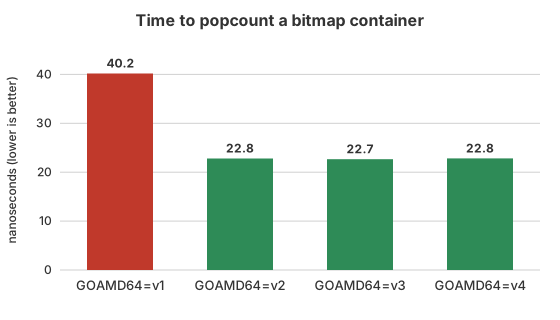
That is a 43% reduction, and it is free: no source change, just a compiler flag. Notice, though, that v3 and v4 do nothing more. A single popcnt instruction is already optimal; as far as the Go compiler is concerned, AVX2 and AVX-512 have nothing to add.

Population count is the easy win. What about the rest of the library?

Another clear win is building a container from a dense bitmap. The FromDense array benchmark takes a raw 8 KB bit vector and constructs the most compact container for it: it popcounts every word to learn the cardinality, then scans out the positions of the set bits. That word-at-a-time popcount-and-scan loop is exactly what the compiler can auto-vectorize once 256-bit registers are available, so the gains keep coming past v2:

v2 already cuts 21% by using scalar popcnt/tzcnt instructions, and v3 (AVX2) nearly doubles that to a 38% reduction. As with popcount, v4 adds nothing.

Set operations show the same pattern. The IntersectionCardinality benchmark counts how many values two bitmaps have in common: for bitmap containers, it ANDs the words pairwise and population-counts the result, without ever materializing the intersection. Here v2 does essentially nothing (the scalar popcnt is already in the inner loop), but v3 lets the compiler widen the AND-and-count loop to 256-bit registers, cutting the time by 22%:

Takeaways:

  1. On modern hardware, everyone should be using v2 or better. The resulting binary will run in any data center and on any non-ancient laptop.
  2. The v3 level might be worth investigating.
  3. The v4 level should have helped in some of my benchmarks, but it did not. I suspect that the Go compiler is just not great at it.

(Obviously: run your own benchmarks.)