
惯性聚合 高效追踪和阅读你感兴趣的博客、新闻、科技资讯
阅读原文 在惯性聚合中打开

推荐订阅源

GbyAI
GbyAI
freeCodeCamp Programming Tutorials: Python, JavaScript, Git & More
IT之家
IT之家
K
KPMG report finds enterprise disconnect between AI and its ROI | CIO
N
News | PayPal Newsroom
Cloudbric
Cloudbric
Webroot Blog
Webroot Blog
www.infosecurity-magazine.com
Simon Willison's Weblog
Spread Privacy
Spread Privacy
Threat Intelligence Blog | Flashpoint
V
Vulnerabilities – Threatpost
Attack and Defense Labs
C
Cyber Attacks, Cyber Crime and Cyber Security
Cisco Talos Blog
Cisco Talos Blog
C
Cybersecurity and Infrastructure Security Agency CISA
H
Hackread – Cybersecurity News, Data Breaches, AI and More
P
Proofpoint News Feed
阮一峰的网络日志
阮一峰的网络日志
S
Secure Thoughts
T
Tor Project blog
Latest news
Latest news
aimingoo的专栏
aimingoo的专栏
V2EX - 技术
V2EX - 技术
Exploit-DB.com RSS Feed
OSCHINA 社区最新新闻
OSCHINA 社区最新新闻
钛媒体:引领未来商业与生活新知
钛媒体:引领未来商业与生活新知
S
Securelist
T
Tenable Blog
N
Netflix TechBlog - Medium
Google Online Security Blog
博客园 - Franky
T
Troy Hunt's Blog
量子位
大猫的无限游戏
大猫的无限游戏
T
Threat Research - Cisco Blogs
T
The Exploit Database - CXSecurity.com
MongoDB | Blog
MongoDB | Blog
H
Heimdal Security Blog
D
Docker
W
WeLiveSecurity
Stack Overflow Blog
Stack Overflow Blog
G
Google Developers Blog
博客园 - 叶小钗
腾讯CDC
The Hacker News
The Hacker News
WordPress大学
WordPress大学
人人都是产品经理
人人都是产品经理
Project Zero
Project Zero
Martin Fowler
Martin Fowler

Lobsters

CIFSwitch: a non-universal Linux local root vulnerability RIPE NCC session fixation: poaching logins with an Atlas probe GNOME 2.20 but its Web Components Agentic Search for Context Engineering – Leonie Monigatti Garnix is shutting down [not OC] akashina.tngl.sh/jjc Concerning Emacs (and Jazz) Nitpicking the shell history scene in ‘Tron: Legacy’ What's cooking on SourceHut? Q2 2026 The tenth OpenPGP email summit Package managers that package package managers Clojure on Fennel part three: parsing WordPress at 23 Finding Miscompiles for Fun, Not Profit GitHub - creusot-rs/creusot: Creusot helps you prove your Rust code is correct. Announcing Rust 1.96.0 | Rust Blog A Love Letter to Neovim sqlite AGENTS.md Am I a Bad Friend? CSS vs. JavaScript • Josh W. Comeau Erlang Ecosystem Foundation - Supporting the BEAM community A brief note about slot access cost in Common Lisp Keyboard latency probe Rethinking the GNOME clipboard issues Back to the Building Blocks’ Building Blocks Tech Notes: Theseus: translating win32 to wasm Fast is better than slow Content-addressed Rust builds (or, what kache actually caches) Intent to Prototype: Embedding API Canada’s Bill C-22 and the security cost of collecting more data 5 PostgreSQL locking behaviors that trip people up okmij.org Stop advertising in your commits! | AksDev GitHub - mplsllc/macsurf: A modern web browser for Classic Mac OS 9 PowerPC. Real CSS3, ES5 JavaScript, native HTTPS — built with CodeWarrior on the Carbon API. Introducing DoomBench - Can Your Data Stack Run DOOM? What are some of your favourite developer tools? Building a Scalable Ingestion Pipeline with Temporal (Part 1) Converting shallow Git bundles into normal repositories Are you a member of any professional associations? What is a harmonic? An interactive comic about additive synthesis How Virtual Tables Work in the Itanium C++ ABI Using SwiftUI to Build a Mac-assed App in 2026 Rust (and Slint) on a jailbroken Kindle. ~jack/lambda-on-lambda - Serverless Haskell on AWS - sourcehut git Human proof for FOSS contributions Extremely simple internet radio controlled via IRC Announcing BABLR Splitting Konsole views from Helix to run tools | AksDev GitHub - yugr/rust-slides Serving files over HTTP three ways: synchronous, epoll, and io_uring update docs with information about building with build.py (#979) · astral-sh/python-build-standalone@c9c40c5 A Simple Makefile Tutorial On C extensions, portability, and alternative compilers Switching to Colemak | Pedro Alves Just How Bad Was The Intel IAPX432? Nix's Substituter List Is Not a Routing Table Accelerating copy_if using SIMD Lambda on Lambda: Serverless Haskell on AWS | Blog Announcing feed-repeat v1.0 Scaling Akvorado BMP RIB with sharding EYG news: A host of CLI improvements, new guides and new effects The social contract of writing JS Crossword C array types are weird; and related topics Flatpak will depend on systemd – OSnews Migrating from Go to Rust | corrode Rust Consulting A portentous reunion Vivado Licensing Options How my minimal, memory-safe Go rsync steers clear of vulnerabilities the entropy layer of a wavelet codec, on its own GitHub - nferhat/fht-compositor: A dynamic tiling Wayland compositor. Debian SE Linux and PinTheft Does bulk memmove speed up std::remove_if? (No.) 声明式部分更新 | Blog | Chrome for Developers Fully in-browser container builds Dianne Skoll's Web Site - Remind The Architecture of Open Source Applications (Volume 1)Berkeley DB Pardon MIE? - ironPeak Blog “Long-Term Support” doesn’t mean what you think Jira IS Turing-Complete May I recommend thinking of Emacs as your Fortress of Solitude hershey Floodgap Gopher-HTTP gateway gopher://thelambdalab.xyz/1cuneiforth/ HP QuickWeb, Singular And Pointless That one time I used Go panics for flow control A new suite of modern tools coming for editing and publishing RFCs From the Tabletop… The Digital Antiquarian Building a Host-Tuned GCC to Make GCC Compile Faster Are we self-sovereign PKI yet? Claw Patrol: an open-source security firewall for agents | Deno Revised^7 Report on Scheme, Large: Procedural Fascicle Draft is now public A Network Allow-List Won't Stop Exfiltration — André Graf From AFSK to Goertzel – µArt.cz Software For My New Home Server Introducing Neptune: Direct3D virtualization for QEMU AI Agent Bankrupted Their Operator While Trying to Scan DN42 - Lan Tian @ Blog mimalloc: A new, high-performance, scalable memory allocator for the modern era Making wl_shm fast The Soul of Maintaining a New Machine - Third Draft | Books in Progress What is Git made of?
The Xteink X4 E-Ink Reader — Max Glenister
Max Glenister · 2026-06-25 · via Lobsters

I’ve had the Xteink X4 for a couple of months now, a £40 e-ink reader small enough to stick to the back of a phone. I’d seen a few posts about it (Khairul Selamat, Neil Brown, joelchrono, and moddedbear among them), so I got curious and ordered one.

First impressions

Out of the box, the X4 is lightweight, properly light, the kind where I’d forget it’s in my pocket. The display is crisp for its size, and the device ships with a branded 16GB microSD card (cute touch) plus a card reader and adhesive metal ring for MagSafe mounting.

The microSD slot is awkward (I needed a stylus to push the card out, felt like I was doing something wrong). The stock OS defaults to Chinese, but the UI is navigable enough that I had it switched to English within a minute of blind fumbling.

Marketing pushes the “stick it to your phone” angle hard. I’ve got a MagSafe-compatible case on my Pixel 7a, but that spot’s already taken by my card holder. Even if it wasn’t, the X4 mounts inverted for some reason (polarity issue with third-party MagSafe cases, presumably).

The real portability win is the size and weight, not the phone mount. This thing actually fits in a trouser pocket and disappears.

Software

Stock firmware is usable but minimal (three fonts, basic line-height and paragraph spacing controls, EPUB support). Page turns are instant with no noticeable ghosting. The hardware’s good, the firmware just doesn’t do it justice.
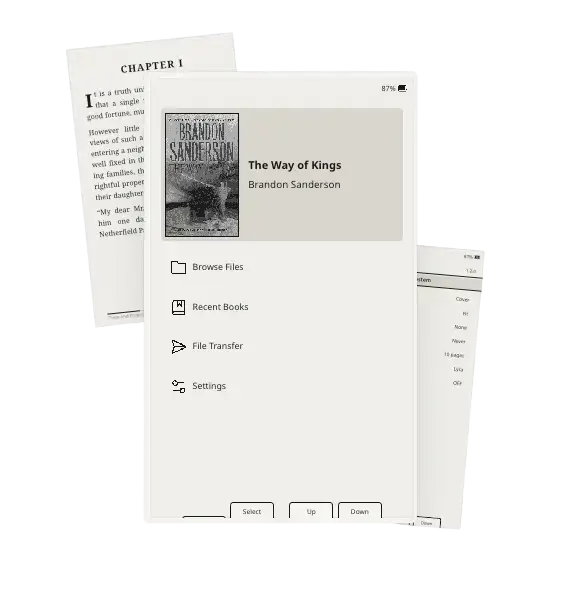
Rather than live with stock, there’s a small crop of custom firmwares, all forked from CrossPoint. CrossPoint itself has come a long way since I first started poking at this (it’s now on v1.3.0 with OTA updates, 24 UI languages, and SD-card font installation without needing to reflash). Flashing takes about two minutes and one terminal command, no button combos or debug modes needed. If the terminal’s off-putting, CrossPoint has a web-based flasher that does it in the browser instead.

Units bought from AliExpress or elsewhere outside China ship with USB flashing disabled. CrossPoint’s docs point to the SD card flashing method instead, which works fine for getting custom firmware on, it just doesn’t unlock USB flashing itself.

I tried Papyrix first, which keeps things minimal and focused on the reading experience. The typography engine punches well above what I’d expect from a £40 device, a Knuth-Plass line breaking algorithm for proper TeX-quality justified text, soft hyphen support, and language-aware hyphenation across six languages. It’ll even handle Vietnamese, Thai, Greek, and Arabic scripts, with right-to-left layout and proper contextual shaping for Arabic. Beyond EPUB it reads FictionBook, HTML, Markdown, and plain text. Custom themes and fonts load straight from the SD card, button remapping is supported, and there’s Calibre Wireless Device support for sending books over WiFi without touching a cable.

It’s good, but I ended up settling on Inx, which goes wider and feels the most polished of the lot. A tab bar across the top (Recent, Library, Settings, Sync, Statistics) gives it a proper app feel, with per-book settings rather than global-only, Wi-Fi with Calibre wireless sync, OPDS catalogue browsing, and more format support beyond EPUB. The reading statistics page is the bit I keep going back to (reading time, pages, chapters, and average time per page, all broken down per book). It syncs with KOReader for anyone already using that for annotations, plus highlighting and footnote navigation baked into the in-book menu. It’s even got a little corgi as its mascot on the sleep and wake screens, and it’s still being actively worked on.

The firmware rabbit hole goes deeper. MicroSlate turns the X4 into a dedicated writing device when paired with a Bluetooth keyboard (scrolling, typewriter, and paginated writing modes), with auto-save and WiFi sync for getting notes off the device. TernOS is a different beast entirely, a PalmOS-inspired OS that runs native Rust apps and classic Palm apps. PlusPoint is a CrossPoint fork with experimental JavaScript app support.

Then there’s the weird stuff (a Tamagotchi app that uses MQTT to switch between moods and display messages, intended as a little companion display for an AI assistant, and a browser-based wallpaper maker that converts any image into the 480x800 BMP format the device needs for custom sleep screens, all processed locally).
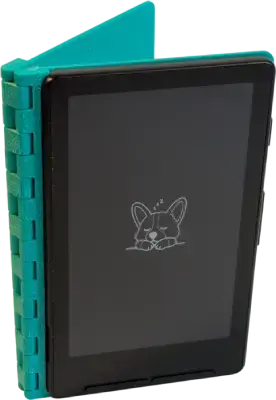
I 3D printed this flip cover case for it, about an hour on my FlashForge AD5X. It uses one of the adhesive MagSafe rings that ships with the X4, so the device sits in the case securely rather than just resting against a magnet.

Compared to other full-size e-ink readers

I reviewed the Bigme B6 in January, a £125 colour e-ink tablet running Android 14. My conclusion there was that colour e-ink isn’t quite ready, muted colours, halved resolution, ghosting when switching between colour and black-and-white. Android brought flexibility (any reading app I wanted) but also the baggage of a phone OS bolted onto a slow screen, stuttering animations, traces left behind by menus, and a load of bloat to strip out before it felt usable.

The X4 sidesteps all of that by being smaller and dumber in the best way. No stylus lag, no waiting on slow colour screens, no Android complexity to debloat. Devices like the Kobo Clara Colour and InkBook Solaris Color have since brought Kaleido 3 colour e-ink to mainstream readers without needing to tinker with Android, which is probably the better way in for colour. But none of them get close to the X4 on portability. The Clara and Paperwhite need a big pocket, the X4 disappears into any pocket. For pure reading, that size difference matters more than colour ever will.

For £40, the X4 with Crosspoint or Inx is a better reading device than it has any right to be. Paging’s instant, the display’s crisp, and it’s small enough to actually carry everywhere. Stock firmware is bare minimum, but custom firmware makes it actually good.