


惯性聚合 高效追踪和阅读你感兴趣的博客、新闻、科技资讯
阅读原文 在惯性聚合中打开

推荐订阅源

Microsoft Azure Blog
博客园_首页
Forbes - Security
Forbes - Security
WordPress大学
WordPress大学
P
Proofpoint News Feed
T
Threat Research - Cisco Blogs
L
LINUX DO - 热门话题
L
Lohrmann on Cybersecurity
Spread Privacy
Spread Privacy
D
Darknet – Hacking Tools, Hacker News & Cyber Security
大猫的无限游戏
大猫的无限游戏
博客园 - 三生石上(FineUI控件)
P
Privacy International News Feed
A
About on SuperTechFans
T
Tailwind CSS Blog
I
InfoQ
S
Securelist
云风的 BLOG
云风的 BLOG
罗磊的独立博客
Recent Announcements
T
The Exploit Database - CXSecurity.com
B
Blog RSS Feed
V
Visual Studio Blog
Know Your Adversary
Know Your Adversary
The GitHub Blog
The GitHub Blog
Jina AI
Jina AI
腾讯CDC
Cyberwarzone
Cyberwarzone
有赞技术团队
有赞技术团队
AWS News Blog
AWS News Blog
博客园 - 【当耐特】
cs.AI updates on arXiv.org
F
Full Disclosure
S
Secure Thoughts
博客园 - 司徒正美
J
Java Code Geeks
Y
Y Combinator Blog
Google Online Security Blog
GbyAI
GbyAI
N
News and Events Feed by Topic
Help Net Security
Help Net Security
freeCodeCamp Programming Tutorials: Python, JavaScript, Git & More
Project Zero
Project Zero
T
Tenable Blog
cs.CV updates on arXiv.org
T
Tor Project blog
MyScale Blog
MyScale Blog
Scott Helme
Scott Helme
小众软件
小众软件
K
Kaspersky official blog

Lobsters

CIFSwitch: a non-universal Linux local root vulnerability RIPE NCC session fixation: poaching logins with an Atlas probe GNOME 2.20 but its Web Components Agentic Search for Context Engineering – Leonie Monigatti Garnix is shutting down [not OC] akashina.tngl.sh/jjc Concerning Emacs (and Jazz) Nitpicking the shell history scene in ‘Tron: Legacy’ What's cooking on SourceHut? Q2 2026 The tenth OpenPGP email summit Package managers that package package managers Clojure on Fennel part three: parsing WordPress at 23 Finding Miscompiles for Fun, Not Profit GitHub - creusot-rs/creusot: Creusot helps you prove your Rust code is correct. Announcing Rust 1.96.0 | Rust Blog A Love Letter to Neovim sqlite AGENTS.md Am I a Bad Friend? CSS vs. JavaScript • Josh W. Comeau Erlang Ecosystem Foundation - Supporting the BEAM community A brief note about slot access cost in Common Lisp Keyboard latency probe Rethinking the GNOME clipboard issues Back to the Building Blocks’ Building Blocks Tech Notes: Theseus: translating win32 to wasm Fast is better than slow Content-addressed Rust builds (or, what kache actually caches) Intent to Prototype: Embedding API Canada’s Bill C-22 and the security cost of collecting more data 5 PostgreSQL locking behaviors that trip people up okmij.org Stop advertising in your commits! | AksDev GitHub - mplsllc/macsurf: A modern web browser for Classic Mac OS 9 PowerPC. Real CSS3, ES5 JavaScript, native HTTPS — built with CodeWarrior on the Carbon API. Introducing DoomBench - Can Your Data Stack Run DOOM? What are some of your favourite developer tools? Building a Scalable Ingestion Pipeline with Temporal (Part 1) Converting shallow Git bundles into normal repositories Are you a member of any professional associations? What is a harmonic? An interactive comic about additive synthesis How Virtual Tables Work in the Itanium C++ ABI Using SwiftUI to Build a Mac-assed App in 2026 Rust (and Slint) on a jailbroken Kindle. ~jack/lambda-on-lambda - Serverless Haskell on AWS - sourcehut git Human proof for FOSS contributions Extremely simple internet radio controlled via IRC Announcing BABLR Splitting Konsole views from Helix to run tools | AksDev GitHub - yugr/rust-slides Serving files over HTTP three ways: synchronous, epoll, and io_uring update docs with information about building with build.py (#979) · astral-sh/python-build-standalone@c9c40c5 A Simple Makefile Tutorial On C extensions, portability, and alternative compilers Switching to Colemak | Pedro Alves Just How Bad Was The Intel IAPX432? Nix's Substituter List Is Not a Routing Table Accelerating copy_if using SIMD Lambda on Lambda: Serverless Haskell on AWS | Blog Announcing feed-repeat v1.0 Scaling Akvorado BMP RIB with sharding EYG news: A host of CLI improvements, new guides and new effects The social contract of writing JS Crossword C array types are weird; and related topics Flatpak will depend on systemd – OSnews Migrating from Go to Rust | corrode Rust Consulting A portentous reunion Vivado Licensing Options How my minimal, memory-safe Go rsync steers clear of vulnerabilities the entropy layer of a wavelet codec, on its own GitHub - nferhat/fht-compositor: A dynamic tiling Wayland compositor. Debian SE Linux and PinTheft Does bulk memmove speed up std::remove_if? (No.) 声明式部分更新 | Blog | Chrome for Developers Fully in-browser container builds Dianne Skoll's Web Site - Remind The Architecture of Open Source Applications (Volume 1)Berkeley DB Pardon MIE? - ironPeak Blog “Long-Term Support” doesn’t mean what you think Jira IS Turing-Complete May I recommend thinking of Emacs as your Fortress of Solitude hershey Floodgap Gopher-HTTP gateway gopher://thelambdalab.xyz/1cuneiforth/ HP QuickWeb, Singular And Pointless That one time I used Go panics for flow control A new suite of modern tools coming for editing and publishing RFCs From the Tabletop… The Digital Antiquarian Building a Host-Tuned GCC to Make GCC Compile Faster Are we self-sovereign PKI yet? Claw Patrol: an open-source security firewall for agents | Deno Revised^7 Report on Scheme, Large: Procedural Fascicle Draft is now public A Network Allow-List Won't Stop Exfiltration — André Graf From AFSK to Goertzel – µArt.cz Software For My New Home Server Introducing Neptune: Direct3D virtualization for QEMU AI Agent Bankrupted Their Operator While Trying to Scan DN42 - Lan Tian @ Blog mimalloc: A new, high-performance, scalable memory allocator for the modern era Making wl_shm fast The Soul of Maintaining a New Machine - Third Draft | Books in Progress What is Git made of?
Deno Desktop — Ankur Sethi
Ankur Sethi · 2026-06-25 · via Lobsters

From the Desktop apps section of the Deno documentation:

deno desktop turns a Deno project (anything from a single TypeScript file to a Next.js app) into a self-contained desktop application. The output is a redistributable binary that bundles your code, the Deno runtime, and a web rendering engine into one bundle per platform.

I'm happy to see another attempt at solving the biggest issues with Electron apps (other notable attempts being Tauri, Electrobun, and Neutralinojs).

According to the docs, Deno Desktop is only available in Deno's canary channel at the moment. So I obviously installed it (version 2.8.3+893d85b) and tried running a Hello World example app.

On first run, Deno spent a few minutes downloading laufey-cef-aarch64-apple-darwin.tar.gz, then packaged the example into an app bundle weighing 308.8MB.

I was curious about that download. A quick Kagi search led me to the homepage for a Rust/C library called laufey, which appears to be the tech underpinning Deno Desktop.

Running the app bundle popped open a window that looked like this:
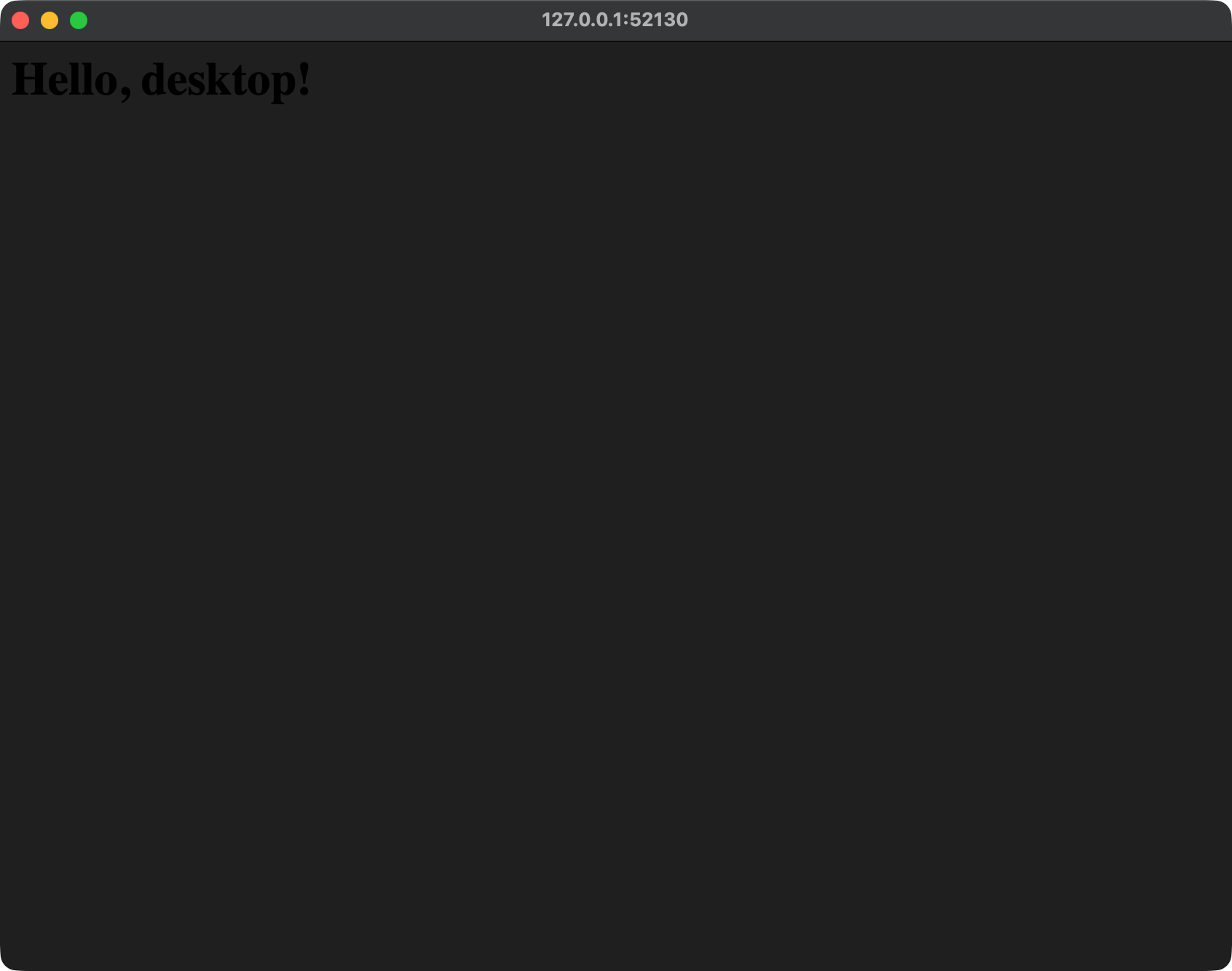
Deno Desktop CEF

This is clearly a work in progress. If somebody who works on Deno is reading this, here's a list of bugs I noticed:

  • The app window had a dark background by default, even though the demo app didn't contain any styles. Browsers don't default to a dark background unless you explicitly opt in using <meta name="color-scheme" content="light dark">. Even so, opting into dark mode inverts all the default colors, not just the page background. Something is off here.
  • Running the bundle triggered a macOS permissions dialog for laufey Helper (Alerts) and hello-deno-desktop, both of them asking for notification permissions. The demo app didn't use the notifications API (it didn't even contain any JavaScript), so seeing two permission dialogs felt aggressive.
  • Hitting Cmd + Q didn't quit the app.
  • The app always opened on the top left of the screen.

Deno uses Chromium as the default webview (via Chromium Embedded Framework). But you can also use the system webview instead:

$ deno desktop --backend webview main.ts

When I ran that command, it downloaded laufey-webview-aarch64-apple-darwin.tar.gz and produced a much slimmer app bundle at 68.5MB. This is what the window looked like:
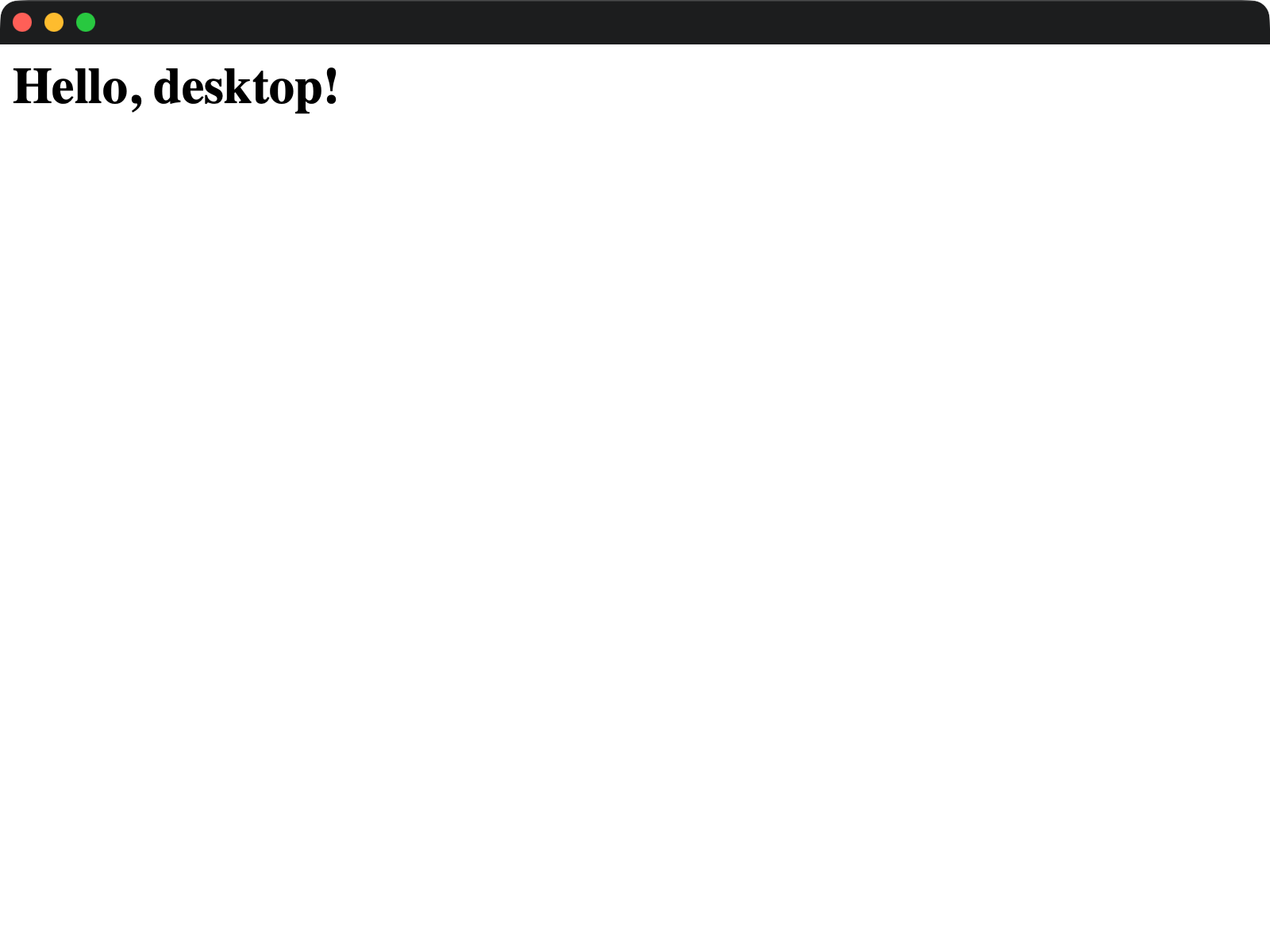
Deno Desktop native webview

This version of the app exhibited none of the bugs I noticed in the CEF version, except it doesn't have a title.

Deno Desktop also has a raw backend that skips bundling the webview altogether. I didn't try it, but here's what the docs say:

No web engine. Provides window management, input events, clipboard, and the native API surface, but no webview, no Deno.serve() auto-binding, and no bindings.<name>() proxy.

Useful for apps that draw their own UI (WebGPU, Skia, custom rendering) or as a foundation for non-web desktop programs. The raw backend is selected through the desktop.backend field in deno.json; the --backend flag accepts only cef and webview.

A major difference between Deno Desktop and its competition is how it communicates between the code running in the webview and the code running in the Deno runtime:

Bindings are not IPC. The Deno runtime and the rendering backend run as threads / processes inside the same address space (CEF) or coordinated process group (WebView). Calls go through in-process channels, and the backend dispatches them from its run loop.

This avoids the cross-process round-trip that socket-based IPC frameworks (Electron's ipcMain / ipcRenderer, Tauri's invoke) impose. Arguments and results are still encoded as they cross the realm boundary, but the transport is in-process: no socket, no cross-process scheduling.

In practical terms: bindings are fast enough that you do not need to worry about call frequency for typical app workloads.

The docs are light on how they pull this off. I'd love to read more about this.

There's a built-in auto-update mechanism, including rollbacks if updates fail:

Deno.autoUpdate() polls a release server for new versions, downloads binary-diff patches, applies them to the runtime dylib, and stages the result for the next launch. If the next launch fails, the runtime rolls back to the previous version automatically. Updates ship as small bsdiff patches instead of full binary downloads, with rollback baked into the launcher.

The comparison page has this bullet-point under the section titled "What deno desktop doesn't have yet":

Shared CEF runtime across apps. Every app currently bundles its own CEF copy. A managed shared runtime would drop binary sizes to a few MB per app. On the roadmap.

Does this mean all Deno apps on my computer could potentially share a single CEF runtime? If yes, that would mean massive disk space savings. But it's unclear if the developers intend to ship this feature in a future release or if it's just a wishlist item that may or may not see the light of day.

Deno Desktop is, of course, heavily under development. Some important features are still missing (platform native file dialogs), and it's not clear if others are on the roadmap or not (mobile support). I'm sure many of the missing features will make their way into the final release, and we'll get a clearer idea of future plans in a release announcement.

I have a personal interest in anything that aims to replace Electron, so I'll be keeping an eye out for Deno 2.9.