


To associate routing information—like AS paths or BGP communities—to flows, Akvorado can import routes through the BGP Monitoring Protocol (BMP). As the Internet routing table contains more than 1 million routes, Akvorado needs to scale to tens of millions of routes.1 This has been a long-standing challenge,2 but I expect this issue is now fixed by using RIB sharding, a method that splits the routing database into several parts to enable concurrent updates.
Akvorado connects 2 elements to build its RIB:

In the diagram above, the RIB stores five IPv4 prefixes and two IPv6 prefixes.
One of them, 2001:db8:1::/48, contains three routes:
2001:db8::3:1, AS 65402, AS path 65402, community
65402:31,2001:db8::4:1, same ASN, AS path, and community,2001:db8::5:1, AS 65402, AS path 65401 65402,
community 65402:31.The rib structure is defined in Go as follows:
type rib struct {
    tree          *bart.Table[prefixIndex]
    routes        map[routeKey]route
    nlris         *intern.Pool[nlri]
    nextHops      *intern.Pool[nextHop]
    rtas          *intern.Pool[routeAttributes]
    nextPrefixID  prefixIndex
    freePrefixIDs []prefixIndex
}
The prefix tree uses the bart package, an adaptation of Donald Knuth’s ART algorithm. The benchmarks demonstrate it outperforms other packages for lookups, insertions, and memory usage.3 Plus, the author is quite helpful.
The list of routes for each prefix is not stored directly in the prefix tree: it would put too much pressure on the garbage collector by allocating per-prefix arrays.
Instead, the RIB assigns a unique 32-bit prefix identifier for each prefix,
either by picking the last available prefix identifier from the freePrefixIDs
array if any, or using the nextPrefixID value before incrementing it. Then,
the routes are stored in the routes map, leveraging the optimized Swiss
table in Go. To retrieve routes attached to a prefix, we look them up
one by one in the routes map with a 64-bit key combining the 32-bit prefix
index with a 32-bit route index matching the position of the route in the list.
Akvorado scans routes from the first to the last to find the best one.4 It
knows there is no more route if the route key returns no result.
type prefixIndex uint32
type routeIndex uint32
type routeKey uint64
A route contains a BGP peer identifier, a partial NLRI5, the next hop, and the attributes.
type route struct {
    peer       uint32
    nlri       intern.Reference[nlri]
    nextHop    intern.Reference[nextHop]
    attributes intern.Reference[routeAttributes]
    prefixLen  uint8
}

type nlri struct {
    family bgp.Family
    path   uint32
    rd     RD
}
type nextHop netip.Addr
type routeAttributes struct {
    asn              uint32
    asPath           []uint32
    communities      []uint32
    largeCommunities []bgp.LargeCommunity
}
To save memory and allocations, NLRI, next hops, and route attributes are
“interned:” a 32-bit integer replaces the real value. The mechanism predates the
unique package introduced in Go 1.23. We keep it because it has
different trade-offs:
Hash() and Equal()
methods.6The global read/write lock is a bottleneck in this implementation. But how? There are several users of the RIB, each with its own set of constraints:
The Kafka workers look up the RIB to enrich flows with routing information. They are bound by the number of Kafka partitions.8 Akvorado also adjusts their number to ensure efficient batching to ClickHouse. On our setup, the number of workers oscillates between 8 and 16. As we want to observe the latest data, we cannot afford for the Kafka workers to lag too much.
The monitored routers send route updates through the BMP protocol. When connecting, they can send millions of routes.9 After the initial synchronization, updates are sent continuously and may spike from time to time. The router detects a stuck BMP station when its TCP window is full and resets the session in this case. While Akvorado implements a large incoming buffer, it still needs to update the received routes with the write lock held fast enough to avoid being detected as stuck.
When a remote BGP peer goes down, Akvorado flushes the associated routes by walking the RIB with the write lock held. When a monitored router goes down, Akvorado waits a bit but eventually flushes all the associated routes.
In short: on a busy setup, lock contention is high for both readers and writers, and neither can lag too much behind.
To remove the global lock, the RIB is split into several “shards,” each one handling a subset of the prefixes:

The prefix tree stays global and is protected by a single lock. Each shard gets
its read/write lock, its route map, and its intern pools to store NLRIs, next
hops, and route attributes, which would not have been possible with Go’s
unique package. The prefix indexes are also sharded: the 8 most
significant bits are the shard index and the 24 remaining bits are the local
prefix index.
Gerhard confirmed that after this blind change, the BMP receiver chugged steadily. 🎉
Later, I wrote a concurrent benchmark over half a million synthetic but plausible routes10 partitioned over 0 to 8 writers, churning routes as fast as possible, while 1 to 16 readers continuously look up a set of 10,000 routes. I don’t know if this benchmark is realistic, but it confirms the improvements for both read and write latencies:
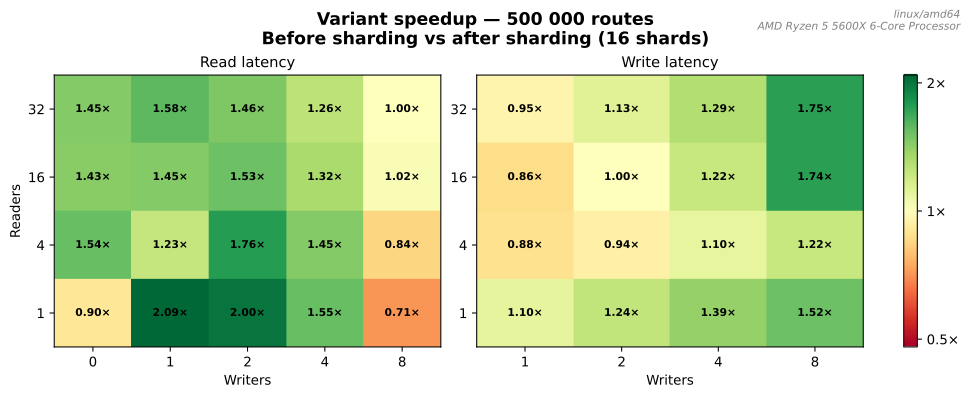
It also shows that a high number of writers degrades read latency.
The single read/write lock protecting the prefix tree is the next target. The bart package provides alternative mutation methods returning an updated tree using copy-on-write. Readers don’t need the global lock any more, leaving it only to synchronize writers. The prefix tree is boxed in an atomic pointer.

Without a lock, readers can now fetch a stale prefix index when walking their copy of the tree if a concurrent writer removes the last route attached to this prefix index and recycles it for another prefix. To avoid this issue, we combine the prefix index with a generation number and store them in the tree:
type generation uint32
type prefixRef struct {
    idx prefixIndex
    gen generation
}
type rib struct {
    mu     sync.Mutex
    tree   atomic.Pointer[bart.Table[prefixRef]]
    shards []*ribShard
}
Each shard stores the generation number for each local prefix index. The
generation number increases by one if the associated prefix index is freed. When
looking up the routes attached to a prefix index, the reader checks if the
generation number matches. Otherwise, it assumes the index was recycled and the
list of routes is empty.11 You can see this case in the diagram above for
prefix index 5, stored with a generation index of 3, while the current value in
the []generations array is 4. The generation number could overflow, but it is
not a problem as lookups are quick.
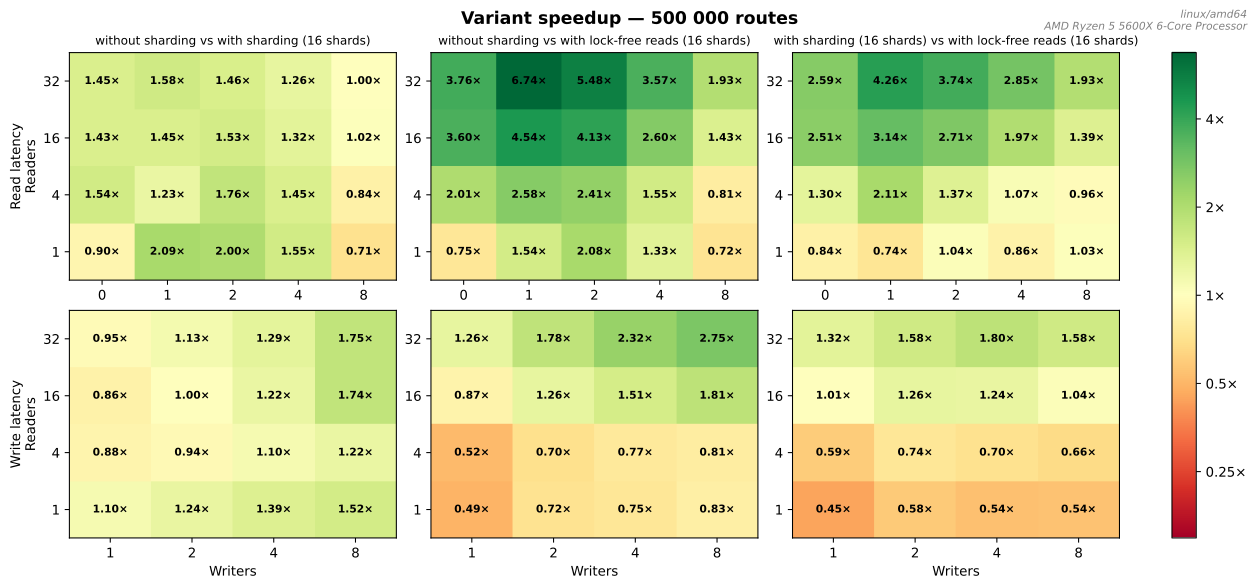
Running the concurrent benchmark against this new implementation shows the improvements for the read latency as soon as the cost of the copy-on-write prefix tree is amortized.
Among the multiple attempts to optimize the BMP component, RIB sharding is one of the more satisfying. Akvorado 2.2 implements the first step. PR #2433, drafted while writing this blog post, implements the second step and will be released with Akvorado 2.4. 🪓
此内容由惯性聚合(RSS阅读器)自动聚合整理,仅供阅读参考。 原文来自 — 版权归原作者所有。