



惯性聚合 高效追踪和阅读你感兴趣的博客、新闻、科技资讯
阅读原文 在惯性聚合中打开

推荐订阅源

雷峰网
雷峰网
S
Securelist
Y
Y Combinator Blog
云风的 BLOG
云风的 BLOG
A
About on SuperTechFans
Martin Fowler
Martin Fowler
量子位
D
Docker
G
Google Developers Blog
Threat Intelligence Blog | Flashpoint
U
Unit 42
S
Secure Thoughts
CTFtime.org: upcoming CTF events
K
Kaspersky official blog
NISL@THU
NISL@THU
T
Tailwind CSS Blog
I
Intezer
T
Threat Research - Cisco Blogs
P
Privacy & Cybersecurity Law Blog
D
DataBreaches.Net
Engineering at Meta
Engineering at Meta
C
Cyber Attacks, Cyber Crime and Cyber Security
F
Full Disclosure
Microsoft Security Blog
Cisco Talos Blog
Cisco Talos Blog
Cyber Security Advisories - MS-ISAC
Simon Willison's Weblog
Vercel News
Vercel News
cs.CL updates on arXiv.org
F
Fortinet All Blogs
W
WeLiveSecurity
C
Cisco Blogs
Security Latest
Security Latest
PCI Perspectives
PCI Perspectives
L
LangChain Blog
P
Palo Alto Networks Blog
IT之家
IT之家
aimingoo的专栏
aimingoo的专栏
Apple Machine Learning Research
宝玉的分享
宝玉的分享
Blog — PlanetScale
Blog — PlanetScale
Help Net Security
Help Net Security
Microsoft Azure Blog
Project Zero
Project Zero
G
GRAHAM CLULEY
Recent Commits to openclaw:main
让小产品的独立变现更简单 - ezindie.com
L
Lohrmann on Cybersecurity
Cloudbric
Cloudbric
D
Darknet – Hacking Tools, Hacker News & Cyber Security

Lobsters

CIFSwitch: a non-universal Linux local root vulnerability RIPE NCC session fixation: poaching logins with an Atlas probe GNOME 2.20 but its Web Components Agentic Search for Context Engineering – Leonie Monigatti Garnix is shutting down [not OC] akashina.tngl.sh/jjc Concerning Emacs (and Jazz) Nitpicking the shell history scene in ‘Tron: Legacy’ What's cooking on SourceHut? Q2 2026 The tenth OpenPGP email summit Package managers that package package managers Clojure on Fennel part three: parsing WordPress at 23 Finding Miscompiles for Fun, Not Profit GitHub - creusot-rs/creusot: Creusot helps you prove your Rust code is correct. Announcing Rust 1.96.0 | Rust Blog A Love Letter to Neovim sqlite AGENTS.md Am I a Bad Friend? CSS vs. JavaScript • Josh W. Comeau Erlang Ecosystem Foundation - Supporting the BEAM community A brief note about slot access cost in Common Lisp Keyboard latency probe Rethinking the GNOME clipboard issues Back to the Building Blocks’ Building Blocks Tech Notes: Theseus: translating win32 to wasm Fast is better than slow Content-addressed Rust builds (or, what kache actually caches) Intent to Prototype: Embedding API Canada’s Bill C-22 and the security cost of collecting more data 5 PostgreSQL locking behaviors that trip people up okmij.org Stop advertising in your commits! | AksDev GitHub - mplsllc/macsurf: A modern web browser for Classic Mac OS 9 PowerPC. Real CSS3, ES5 JavaScript, native HTTPS — built with CodeWarrior on the Carbon API. Introducing DoomBench - Can Your Data Stack Run DOOM? What are some of your favourite developer tools? Building a Scalable Ingestion Pipeline with Temporal (Part 1) Converting shallow Git bundles into normal repositories Are you a member of any professional associations? What is a harmonic? An interactive comic about additive synthesis How Virtual Tables Work in the Itanium C++ ABI Using SwiftUI to Build a Mac-assed App in 2026 Rust (and Slint) on a jailbroken Kindle. ~jack/lambda-on-lambda - Serverless Haskell on AWS - sourcehut git Human proof for FOSS contributions Extremely simple internet radio controlled via IRC Announcing BABLR Splitting Konsole views from Helix to run tools | AksDev GitHub - yugr/rust-slides Serving files over HTTP three ways: synchronous, epoll, and io_uring update docs with information about building with build.py (#979) · astral-sh/python-build-standalone@c9c40c5 A Simple Makefile Tutorial On C extensions, portability, and alternative compilers Switching to Colemak | Pedro Alves Just How Bad Was The Intel IAPX432? Nix's Substituter List Is Not a Routing Table Accelerating copy_if using SIMD Lambda on Lambda: Serverless Haskell on AWS | Blog Announcing feed-repeat v1.0 Scaling Akvorado BMP RIB with sharding EYG news: A host of CLI improvements, new guides and new effects The social contract of writing JS Crossword C array types are weird; and related topics Flatpak will depend on systemd – OSnews Migrating from Go to Rust | corrode Rust Consulting A portentous reunion Vivado Licensing Options How my minimal, memory-safe Go rsync steers clear of vulnerabilities the entropy layer of a wavelet codec, on its own GitHub - nferhat/fht-compositor: A dynamic tiling Wayland compositor. Debian SE Linux and PinTheft Does bulk memmove speed up std::remove_if? (No.) 声明式部分更新 | Blog | Chrome for Developers Fully in-browser container builds Dianne Skoll's Web Site - Remind The Architecture of Open Source Applications (Volume 1)Berkeley DB Pardon MIE? - ironPeak Blog “Long-Term Support” doesn’t mean what you think Jira IS Turing-Complete May I recommend thinking of Emacs as your Fortress of Solitude hershey Floodgap Gopher-HTTP gateway gopher://thelambdalab.xyz/1cuneiforth/ HP QuickWeb, Singular And Pointless That one time I used Go panics for flow control A new suite of modern tools coming for editing and publishing RFCs From the Tabletop… The Digital Antiquarian Building a Host-Tuned GCC to Make GCC Compile Faster Are we self-sovereign PKI yet? Claw Patrol: an open-source security firewall for agents | Deno Revised^7 Report on Scheme, Large: Procedural Fascicle Draft is now public A Network Allow-List Won't Stop Exfiltration — André Graf From AFSK to Goertzel – µArt.cz Software For My New Home Server Introducing Neptune: Direct3D virtualization for QEMU AI Agent Bankrupted Their Operator While Trying to Scan DN42 - Lan Tian @ Blog mimalloc: A new, high-performance, scalable memory allocator for the modern era Making wl_shm fast The Soul of Maintaining a New Machine - Third Draft | Books in Progress What is Git made of?
I am dreading our LLM-written incident report future
Lorin Hochstein · 2026-06-20 · via Lobsters

incidents 2 Minutes

The other day, Reginald Braithwaite posted the following toot. For posterity, I’ve also included my own response to it:
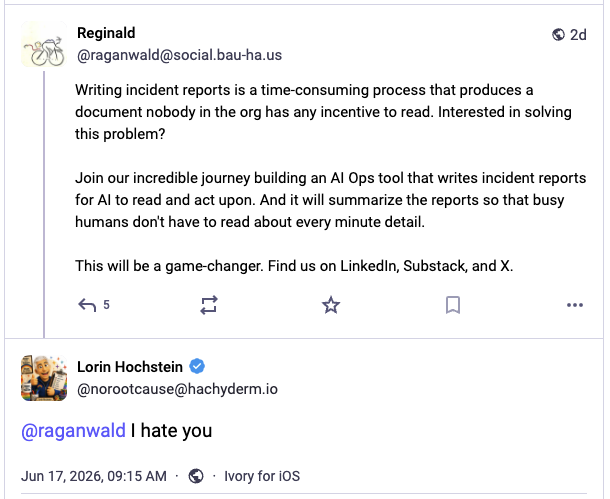
Screenshot of a Mastodon toot by Reginald Braithwaite (@raganwald) and a response by Lorin Hochstein (@norootcause).

Reginald: Writing incident reports is a time-consuming process that produces a document nobody in the org has any incentive to read. Interested in solving this problem?

Join our incredibly journey building an AI Ops tool that writes incident reports for AI to read and act upon. And it will summarize the reports so that busy humans don't have to read about every minute detail.

This will be a game-changer. Find us on LinkedIn, Substack, and X.

Lorin: I hate you

Braithwaite’s post is dripping with sarcasm, but make no mistake, incident reports written entirely by LLMs is coming. And I am not looking forward to this future.

Before I dive in here, I want to note that there is a lot of toil you need to do in order to gather the data you need to write a good incident report, and LLMs can help significantly reduce that toil. I’ve got no issues there. But there’s a world of difference between using LLMs to help you assemble the ingredients involved in writing an incident report, and using an LLM to actually write the report itself.

Braithwaite’s post is horrifying to me precisely because of the seduction of the LLM as a tool for generating an incident report. After all, you can just ask it to write the report, and it’ll do it. And that’s exactly what scares me.

There’s a famous quote by the cartoonist Dick Guindon: “Writing is Nature’s way of showing you how sloppy your thinking is“. You might think you understand a concept, but it’s only when you put metaphorical pen to paper, when you actually try to explain the concept in written words to a potential reader, that you realize how fuzzy your understanding actually is. Writing in your own words forces you to confront how much you actually understand what it is that you’re writing about. Or, as Leslie Lamport put it, “If you’re thinking without writing, you only think you’re thinking.”

Having an LLM generate the text of an incident write-up bypasses this thinking step. Now there’s no human in the loop of the writing process that has to confront whether the explanation is actually consistent with the evidence that they’ve gathered. Instead, what you get is a plausible explanation of what happened to someone who is not intimately familiar with the details. They might read, nod along, and think, “yes, that makes sense.” But the LLM may have invented couplings between systems that aren’t there, and may miss critical interactions that were actually part of the incident, and because nobody did the hard work of actually synthesizing the data to do the write-up, nobody will notice. Because if you’re trying to reduce the writing effort, how much effort are you really going to put into checking the LLMs work.

In my view, LLM-generated incident write-ups are more dangerous than using LLM for coding or for AI SRE style tasks. For coding tasks, there’s always a testing step to check that the code exhibits the desired behavior, even if nobody looks at the code itself for meaningful details. For AI SRE tasks, either the LLM output helps you resolve the incident, or it doesn’t. In both cases, Nature is the ultimate arbiter of the LLM output.

But incident write-ups aren’t like that. The consequences of a poor report aren’t immediately apparent the way incorrect code or an incorrect operational diagnosis are in the moment. Instead, we get incident reports that have the superficially correct form, but are actually incorrect, with no obvious test for correctness.

And, because incident reports are time-consuming to write, the temptation to use AI tools to generate them will be overwhelming. But these LLMs will not go around talking to people that were involved in the incident. These reports will be simulacra; they will have the right form, but they will not provide readers with genuine insights into the nature of the system. The amount of learning will be significantly curtailed.

And, yes, people will probably use AI to summarize them as well.

It’s not a future I’m looking forward to.

Published