




Nix and Guix look like rival ecosystems, but under the hood they’re the same “Input Output Machine”.
Need proof? 🕵 How about we build a Guix derivation with Nix.
First let’s create a super basic derivation in Guix: Hello world.
❯ guix repl -- /dev/stdin <<'EOF'
  (use-modules (guix derivations) (guix store))
  (with-store %store
    (let ((drv (derivation %store "simple" "/bin/sh"
                           '("-c" "echo Hello World > $out")
                           #:env-vars '(("PATH" . "/bin"))
                           #:system "x86_64-linux")))
      (format #t "~a\n" (derivation-file-name drv))))
EOF
/gnu/store/zr0q11srv4yir8a6wrz582js7zsi17ij-simple.drv
We then ask Nix to build it. 🪄
We ask to use /gnu/store as the Nix store and have it write its state, database and log files in alternate directories, so it does not collide or mess with Guix.
Note It’s slightly more complicated. Nix happens to check its SQLite database for the derivation, so we need to register it first. The version of Guix (v1.5.0) I’m using leverages a
guix-daemonuser that runs inside a private mount namespace where/gnu/storeis writable, but everyone else (including me) sees it as read-only. Theunshare --mountcreates a new private mount namespace so I can mount it as read-write and run the Nix command against it.
❯ cat > /tmp/register.txt <<'EOF'
/gnu/store/zr0q11srv4yir8a6wrz582js7zsi17ij-simple.drv
822a79886102e5ca392cd14358aef0866c36ca526ff1b156f1ded2808a2095df
336

0
EOF

❯ NIX_STORE=/nix/store/fla7gi1dvkw4hvwxar8m7z25p2yv7r40-nix-2.34.7/bin/nix-store

❯ NIX_STORE_DIR=/gnu/store NIX_STATE_DIR=/tmp/nix-gnu/var/nix \
   $NIX_STORE --load-db < /tmp/register.txt

❯ sudo unshare --mount bash -c '
mount -o remount,rw /gnu/store
su -s /bin/bash guix-daemon -c \
    "NIX_STORE_DIR=/gnu/store NIX_STATE_DIR=/tmp/nix-gnu/var/nix \
    NIX_LOG_DIR=/tmp/nix-gnu/var/log/nix \
    /nix/store/fla7gi1dvkw4hvwxar8m7z25p2yv7r40-nix-2.34.7/bin/nix-store \
    --realise /gnu/store/zr0q11srv4yir8a6wrz582js7zsi17ij-simple.drv"
'
warning: creating directory "/var/empty/.cache/nix": Permission denied
this derivation will be built:
  /gnu/store/zr0q11srv4yir8a6wrz582js7zsi17ij-simple.drv
building '/gnu/store/zr0q11srv4yir8a6wrz582js7zsi17ij-simple.drv'...
warning: you did not specify '--add-root'; the result might be removed by the garbage collector
/gnu/store/kd5szqbl9asz5hravhnxgd9plm4a9gzh-simple

❯ cat /gnu/store/kd5szqbl9asz5hravhnxgd9plm4a9gzh-simple
Hello World
We just built a Guix derivation using Nix. 🔥
How is that possible?
Both take a language frontend, Nix or Guile (Scheme), that compiles to a derivation (recipe) and pass that onto a builder (daemon) that executes it to produce an output.
What makes them both special is they both promise the same thing: hermetic builds. Everything needed to build the output is declared in the recipe: sources, environment variables, dependencies, etc.
“Under Nix, a build process will only find resources that have been declared explicitly as dependencies. There’s no way it can build until everything it needs has been correctly declared. If it builds, you will know you’ve provided a complete declaration.” – Nix OS Website
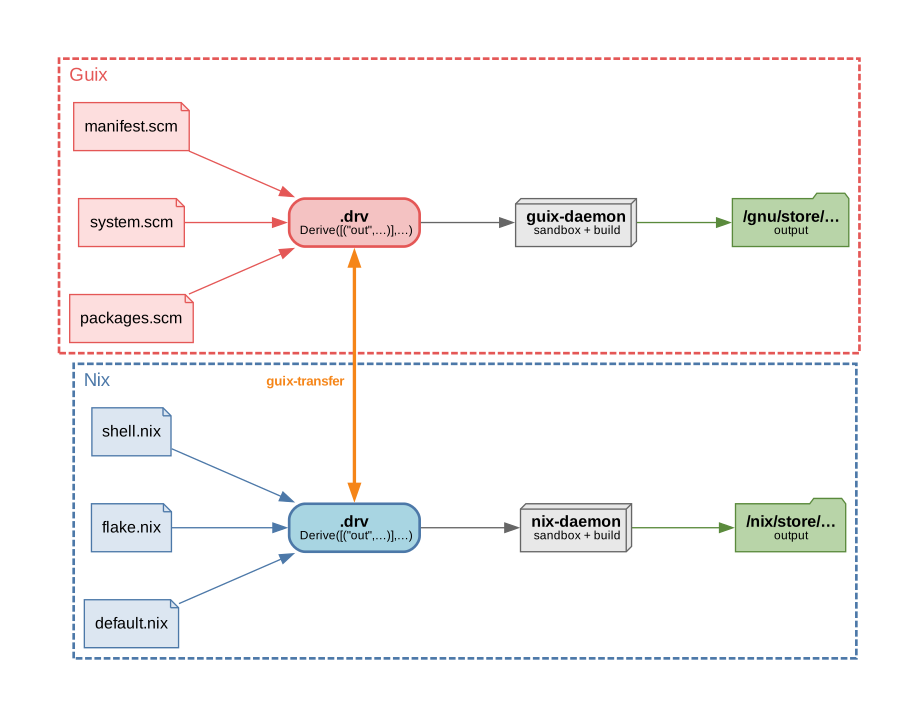
Guix, specifically the daemon, was forked from Nix early on, and as a result the two are very similar; they both share the same derivation format, ATerm, for instance.
Guix is based on the Nix package manager – Guix Website
That’s why our earlier example of building the Guix derivation with Nix was possible without much translation.
What if we could leverage an existing recipe from Guix in Nix in its traditional /nix/store?
If we could convert from one recipe file to the other, we could use the existing recipes from Guix in Nix and vice versa.
Turns out this is far more feasible than you would think, because Guix is Nix or at least a superset of it.
I, with the help of Claude, built a tool to do just that: guix-transfer 🤯.
guix-transfer is a CLI tool for performing bottom-up translation of GNU Guix derivations into Nix.
Confused? Let us see it in action:
# generate a Guix derivation
❯ guix build hello --derivations
/gnu/store/2nfg943asrl9dv64zrr1a4kpb25mfafd-hello-2.12.2.drv

# translate it
❯ /guix-transfer /gnu/store/2nfg943asrl9dv64zrr1a4kpb25mfafd-hello-2.12.2.drv
Loading Guix derivation graph from /gnu/store/2nfg943asrl9dv64zrr1a4kpb25mfafd-hello-2.12.2.drv ...
Loaded 228 derivations.
Translating bottom-up ...
[228/228] done
Done. Final Nix derivation:
/nix/store/brdd8zw3j9hhq8zf27ixqyi3l61nwppn-hello-2.12.2.drv
Realise it with: nix-store --realise --option filter-syscalls false /nix/store/brdd8zw3j9hhq8zf27ixqyi3l61nwppn-hello-2.12.2.drv

# build it with Nix
# this is a LONG multi-hour build since we build everything from source
❯ nix-store --option filter-syscalls false --realise \
/nix/store/brdd8zw3j9hhq8zf27ixqyi3l61nwppn-hello-2.12.2.drv

❯ /nix/store/j3940mdzr6qmw4ydhyla663s501vb8ns-hello-2.12.2/bin/hello
Hello, world!
Note When you unpack a tarball, tar restores each file’s original permissions, including setuid/setgid bits. Nix’s sandbox installs a seccomp filter that blocks any
chmodcall that sets these bits, returning “Operation not permitted”. Guix’s early bootstrap uses a Scheme-basedtar(gash-utils) that treats this error as fatal, unlike GNU tar which silently skips it. The fix is--option filter-syscalls false, which disables the filter.
If it’s not clear what we just did: we took a Guix derivation and all of its dependencies (down to the bootstrap seeds), translated it to a Nix derivation, and built it with Nix. 😲
What is this abomination and how was this possible!?
It’s important to revisit what a derivation is, and how it’s used in Nix and Guix to better understand how this is possible. Let’s look at the same basic derivation from earlier, Hello World.
You might want to check out my other post on Nix derivations by hand if this interests you 🤓.
derivation {
  name = "simple";
  builder = "/bin/sh";
  system = builtins.currentSystem;
  args = ["-c" ''
    echo "Hello World" > $out
  ''];
}
When we evaluate (nix-instantiate) this derivation, we get a path to a file that contains the derivation in the ATerm format:
❯ nix-instantiate - << 'EOF'
derivation {
  name = "simple";
  builder = "/bin/sh";
  system = builtins.currentSystem;
  args = ["-c" ''
    echo "Hello World" > $out
  ''];
}
EOF
/nix/store/w4mcfbibhjgri1nm627gb9whxxd65gmi-simple.drv
If we look at the contents of the file, we can see the ATerm representation of the derivation:
Derive(
  [("out", "/nix/store/r4c710xzfqrqw2wd6cinxwgmh44l4cy2-simple", "", "")],
  [],
  [],
  "x86_64-linux",
  "/bin/sh",
  ["-c", "echo \"Hello World\" > $out\n"],
  [
    ("builder", "/bin/sh"),
    ("name", "simple"),
    ("out", "/nix/store/r4c710xzfqrqw2wd6cinxwgmh44l4cy2-simple"),
    ("system", "x86_64-linux")
  ]
)
This has all the information we need to build the output by the builder. At this point, it’s really not Nix specific anymore. The same applies for the Guix derivations.
The derivations do not “know” whether they came from Scheme or Nix. It’s a recipe. The insight then is if we rewrite the store paths from /gnu/store to /nix/store, and swap some builtins (i.e. builtin:download for builtin:fetchurl), we can get nix-daemon to build it identically. 💡
The only difference in more complex derivations is that they have dependencies, which are also derivations, and the builder references them so it forms a graph of derivations, each built by the builder in topological order.
The leaves of this tree for any non-trivial derivation are the bootstrap seeds: gcc, awk, bash, tar etc. Guix is famous for bootstrapping itself from a 357-byte binary as source [ref]. Since at no point do the bootstrap seeds depend on /gnu/store being the prefix, the translated chain builds identically under Nix.
guix-transfer walks a Guix .drv graph in post-order and for each
derivation:
-
Guix’s
builtin:downloadis replaced with Nix’sbuiltin:fetchurl. Same idea, different name. -
Source files are added to the Nix store, with embedded
/gnu/storepaths rewritten to their/nix/storeequivalents. -
Every
/gnu/storereference: input drvs, builder path, args, env vars are rewritten to the mapped/nix/storepath. -
Output paths are blanked as Nix recomputes them via
hashDerivationModulo. -
The result is serialised as JSON and registered with
nix derivation add.
That’s it. No Nix expressions are generated. No stdenv. No mapping
of Guix packages to nixpkgs equivalents. The Guix derivation graph is
translated faithfully, and nix-daemon builds it.
Note Interestingly,
builtin:fetchurltakes exactly one URL and cannot fall back. Guix derivations carry lists of mirrors, many of which are flaky or dead. Similar to Nix, Guix operates a content-addressed mirror atbordeaux.guix.gnu.orgthat serves any source its CI has ever seen. We leverage this for thefetchurlinstead of the original source URL.
Now that we have a way to slurp Guix packages into Nix, we can start to do some diabolical combinations by combining native Nix and Guix packages together!
We can take our hello package we built in Nix and leverage it in a Nix derivation.
let
guixHello = /nix/store/...-hello-2.12.2;
in
derivation {
  name = "nix-hello-world";
  system = "x86_64-linux";
  builder = "/bin/sh";
  args = [ "-c" "echo \"$(${guixHello}/bin/hello) from Nix\" > $out" ];
}
Nix automatically scans your derivations for anything prefixed with /nix/store and tracks it as an input dependency. This is similar to how store paths are interpolated when you do something like ${pkgs.hello}/bin/hello.
❯ nix-build --no-out-link hello-from-nix.nix

❯ cat /nix/store/...-run-guix-hello
Hello, world! from Nix
If writing the /nix/store paths raw in the Nix expression is a little too raw for you, we can build something more ergonic pretty easily as well.
guix-transfer has an --emit-nix mode that instead will emit the Nix expression for the translated .drv.
Let’s look at a slightly more complex example that uses Guix’s guile to build a derivation with dependencies:
❯ guix repl -- /dev/stdin <<'EOF'
  (use-modules (guix derivations) (guix store) (guix packages)
               (gnu packages bootstrap))
  (with-store store
    (let* ((guile-drv (package-derivation store %bootstrap-guile))
           (guile-out (derivation->output-path guile-drv))
           (drv (derivation store "demo" (string-append guile-out "/bin/guile")
                            `("--no-auto-compile" "-c"
                              ,(string-append
                                 "(call-with-output-file (getenv \"out\") "
                                 "  (lambda (p) (display \"Hello from Guix!\\n\" p)))"))
                            #:inputs (list (derivation-input guile-drv))
                            #:system "x86_64-linux")))
      (format #t "~a\n" (derivation-file-name drv))))
EOF

❯ guix build /gnu/store/fln2d17fyqka3gafcdqyhfyl1nzml5jn-demo.drv
successfully built /gnu/store/fln2d17fyqka3gafcdqyhfyl1nzml5jn-demo.drv
/gnu/store/l66zvywi60ljhk3kwwaay156cgsc2ahg-demo

❯ cat /gnu/store/l66zvywi60ljhk3kwwaay156cgsc2ahg-demo
Hello from Guix!
We can now convert this to a Nix expression with guix-transfer.
❯ guix-transfer /gnu/store/fln2d17fyqka3gafcdqyhfyl1nzml5jn-demo.drv --emit-nix /tmp/demo.nix
...
Realise it with: nix-store --realise --option filter-syscalls false /nix/store/fkj4vz6vs85s2x3dwhg5ysfwyr8rv4a5-demo.drv
Emitted Nix expression: /tmp/demo.nix
We realise the derivation with nix-store --realise or we can nix-build the Nix expression. Please notice that both produce the exact same hash: /nix/store/rq5bc9crsg1hrr7afllzjgi7z8bl21zy-demo.
❯ nix-build /tmp/demo.nix
/nix/store/rq5bc9crsg1hrr7afllzjgi7z8bl21zy-demo

❯ nix-store --realise --option filter-syscalls false /nix/store/zgwdbfpigl8cwy5d85p0rdcl21x3bszm-demo.drv
/nix/store/rq5bc9crsg1hrr7afllzjgi7z8bl21zy-demo

❯ cat /nix/store/rq5bc9crsg1hrr7afllzjgi7z8bl21zy-demo
Hello from Guix!
We can now use this Guix derivation like any normal Nix expression, such as the ones you might encounter in Nixpkgs.
let
  guixDemo = import /tmp/demo.nix;
in
derivation {
  name = "use-guix-demo";
  system = "x86_64-linux";
  builder = "/bin/sh";
  args = [ "-c" "echo \"Nix says: $(cat ${guixDemo})\" > $out" ];
}
That means we could even build a flake that is all of Guix packages available for use.
{
  outputs = { self }: {
    packages.x86_64-linux.demo = import ./demo.nix;
  };
}
My mind is blown. 🤯
Nixpkgs is known as the world’s largest package repository, and now we have made a way for it suddenly to become even larger by borrowing any derivation from Guix!
The real power behind Nix are the derivations and that they are hermetic, declaring any dependency needed. We’ve seen that we can transfer these recipes to any store-based system that has similar qualities and preserve the reproducibility.