惯性聚合 高效追踪和阅读你感兴趣的博客、新闻、科技资讯
阅读原文 在惯性聚合中打开

推荐订阅源

GbyAI
GbyAI
量子位
L
LINUX DO - 最新话题
T
Tailwind CSS Blog
Cyber Security Advisories - MS-ISAC
Jina AI
Jina AI
freeCodeCamp Programming Tutorials: Python, JavaScript, Git & More
Recorded Future
Recorded Future
D
DataBreaches.Net
博客园 - 三生石上(FineUI控件)
J
Java Code Geeks
博客园 - 聂微东
B
Blog
让小产品的独立变现更简单 - ezindie.com
博客园 - 叶小钗
Hugging Face - Blog
Hugging Face - Blog
博客园_首页
G
Google Developers Blog
MyScale Blog
MyScale Blog
罗磊的独立博客
Martin Fowler
Martin Fowler
V
Visual Studio Blog
aimingoo的专栏
aimingoo的专栏
H
Help Net Security
H
Hacker News: Front Page
博客园 - Franky
Exploit-DB.com RSS Feed
AI
AI
N
News and Events Feed by Topic
Hacker News - Newest:
Hacker News - Newest: "LLM"
K
KPMG report finds enterprise disconnect between AI and its ROI | CIO
Recent Commits to openclaw:main
TaoSecurity Blog
TaoSecurity Blog
O
OpenAI News
Latest news
Latest news
T
Threat Research - Cisco Blogs
cs.CV updates on arXiv.org
L
LINUX DO - 热门话题
Spread Privacy
Spread Privacy
I
Intezer
Scott Helme
Scott Helme
MongoDB | Blog
MongoDB | Blog
C
Cybersecurity and Infrastructure Security Agency CISA
P
Palo Alto Networks Blog
A
Arctic Wolf
AWS News Blog
AWS News Blog
S
Schneier on Security
Y
Y Combinator Blog
月光博客
月光博客
H
Hackread – Cybersecurity News, Data Breaches, AI and More

Crazyrouter Blog (English)

Ideogram AI Guide 2026: Product Mockups, Text Rendering, and API Automation Akool AI Voice Generator Review 2026: API Alternatives for Developers GLM 4.6 API Guide 2026: Build Chinese-English Agents with Tool Calling Google Veo3 API Guide 2026: Batch Video Generation, QA, and Fallbacks AI Lip Sync Tools Comparison 2026: Developer Guide for Localization Pipelines Claude Opus 4.8 vs Opus 4.7: Real API Benchmark Results for Developers Opus 4.8 vs Opus 4.7 Coding Test: What Changed for Developers? Opus 4.8 vs Opus 4.7 for Agents: JSON, Tool Use, and Structured Output Gemini 2.5 Flash-Lite for RAG, Agent Routing, and Cost per Successful Task Gemini 2.5 Flash-Lite for Support Automation and Ticket Triage Gemini 2.5 Flash-Lite Use Cases: The Practical Automation Tier for Developers Claude Jupiter v1-p vs GPT-5.5 Benchmark: Real API Test on Reasoning and Coding Claude Jupiter v1-p vs Claude Opus 4.7 vs Sonnet 4.6: Live API Test Claude Code Pricing 2026: Pro vs Max vs Team vs API Costs Claude Opus 4.7 vs DeepSeek V4 Pro: Real API Compatibility and Coding Benchmark Gemini CLI Complete Guide 2026: Repo Automation, CI Agents, and Multi-Model Routing Ideogram AI Guide 2026: Brand Design Automation, API Workflows, and Alternatives GLM 4.6 API Guide 2026: Agents, RAG, Tool Calling, and Bilingual Apps WAN 2.2 Animate Tutorial 2026: Character Consistency, Shot Control, and API Workflows Google Veo3 API Guide 2026: Production Video Pipelines, Prompts, Pricing, and Fallbacks AI API Pricing Comparison 2026: Text, Image, Video, Caching, and Router Costs Codex CLI Installation Guide 2026: Windows, macOS, Linux, Proxies, and CI Setup How to Get a Claude API Key in 2026: Secure Setup for Teams, CI, and Alternatives Gemini Advanced Review 2026: Is It Worth It for Coding, Research, and API Teams? Claude Code Pricing Guide 2026: Team Agent Budgets, API Fallbacks, and Cost Control Seedance 2.0 Pricing: Convert 46 CNY per Million Tokens to Cost per Second Qwen2.5-Omni Guide 2026: Real-Time Voice, Vision, and Multimodal Agents Kimi K2 Thinking Guide 2026: Reasoning Workflows, Evals, and Cost Control Google Veo3 API Guide 2026: Batch Video Pipelines, Pricing, and Fallbacks Codex CLI Installation Guide 2026: macOS, Linux, WSL, Proxies, and Dev Containers How to Get a Claude API Key in 2026: Safe Production Setup and Alternatives AI API Pricing Comparison 2026: GPT, Claude, Gemini, Video, and Agent Workloads Gemini Advanced Review 2026: Is It Worth It for Developer Teams? Claude Code Pricing Guide 2026: API Fallbacks, Team Seats, and Budget Control Seedream 4.0 API Tutorial 2026: Batch Image Generation, Product Creative, and Pricing Qwen2.5-Omni Guide 2026: Real-Time Voice, Vision, Text Agents, and API Integration Kimi K2 Thinking Guide 2026: Reasoning Agents, Evaluation Workflows, and API Cost Control WAN 2.2 Animate Tutorial 2026: Character Motion, Shot Control, API Pipelines, and Pricing Google Veo3 API Guide 2026: Production Video Workflows, Prompts, Pricing, and Fallbacks AI API Pricing Comparison 2026: OpenAI, Claude, Gemini, DeepSeek, and Router Costs How to Get a Claude API Key in 2026: Setup, Security, Rotation, and Alternatives Codex CLI Installation Guide 2026: macOS, Linux, WSL, Proxies, and Devcontainers Gemini Advanced Review 2026: Is It Worth It for Developers and API Builders? Claude Code Pricing Guide 2026: CI Agents, Team Seats, and API Budget Planning AI API Gateway for Singapore and Malaysia Developers: One Endpoint for GPT, Claude and Gemini AI API Gateway for Thai Developers: Use GPT, Claude and Gemini with One Key One API Key for GPT, Claude and Gemini: A Practical Setup for Central Asia Developers Gemini 3.5 Flash vs Claude Response-Tier Models: Which One Should Developers Use? Gemini 3.5 Flash vs Gemini 3 Flash vs Gemini 2.5 Flash: Real API Benchmark "How to Test Multiple AI Image Models with One API Key" Codex CLI Installation Guide: Setup on macOS, Linux, Windows WSL and CI/CD Seedream 4.0 API Tutorial: ByteDance Image Generation for Production Pipelines Kimi K2 Thinking Model: Complete Developer Guide for Reasoning Workflows Luma Ray 2 Review: AI Video Generation Quality, Speed, and API Guide Pika 2.2 New Features Review: Scene Director, Sound Design, and API Updates Google Veo 3 API Guide: Video Generation with Audio for Developers AI Lip Sync Tools Comparison 2026: Best APIs for Talking Avatars and Video Dubbing Gemini Advanced Review May 2026: Is It Worth $20/Month for AI Power Users? Claude Code Pricing in May 2026: Max Plan, Opus 4, and Real Cost Breakdown Hermes Agent + Crazyrouter: One-Click Setup for 627+ AI Models Text-Embedding-3-Small: Complete Guide to OpenAI's Most Popular Embedding Model (2026) AI Meme Generator & Coloring Book Creator with GPT-image-2 — Fun Projects That Actually Make Money AI Future Baby Prediction with GPT-image-2 — See What Your Child Might Look Like Ghibli Style Photo Transformation with GPT-image-2 — Turn Any Photo Into Anime Art AI Action Figure Generator with GPT-image-2 — Turn Anyone Into a Boxed Toy AI Face Reading & Personal Color Analysis with GPT-image-2 — Two Viral Use Cases in One Guide AI Palm Reading with GPT-image-2 — Generate Professional Palmistry Analysis from a Single Photo Gemini 2.5 Flash-Lite Pricing Explained — The Cheapest Gemini Model for High-Volume Workloads Claude Sonnet 4.6 Pricing Explained — Caching, Tiers, and How to Save 45% with Crazyrouter Gemini Free vs Gemini Advanced: Pricing, Limits, Features, and Is It Worth Paying For? AI Context Window Comparison (2026): GPT, Claude, Gemini Token Limits by Model Claude Sonnet 4.5 Pricing Explained — Caching, Batch API, and How to Save 45% with Crazyrouter Claude Opus 4.7 Pricing Explained — New Tokenizer, Caching, and How to Save 45% with Crazyrouter Claude Opus 4.6 Pricing Explained — Caching, Tiers, and How to Save 45% with Crazyrouter Best AI Models for RAG Applications 2026: Embeddings, Retrieval, and Generation Seedance 2.0 vs Kling 2.1 vs Runway Gen 4 Turbo: Video AI API Comparison 2026 AI Video Generation API Pricing May 2026: Veo3 vs Kling vs Runway vs Sora How to Get Claude API Key in China 2026: Complete Setup Guide AI Coding Tools ROI Calculator: Claude Code vs Codex CLI vs Gemini CLI Cost Analysis 2026 AI API Pricing Comparison May 2026 - Complete Developer Guide Grok 4 API Pricing Complete Guide 2026 DeepSeek R2: The 32B Reasoning Model That Runs on a Single GPU — Complete Guide for Developers "GPT-5.1 Codex Max Pricing Explained — The Code-Specialized Model and How to Save with Crazyrouter" GPT-4o Pricing Explained — The Legacy Flagship That's Still Worth Using GLM-5 Pricing Explained — Zhipu AI's Flagship Model and How to Access via Crazyrouter Gemini 3 Flash Pricing Explained — Balanced Speed and Cost with Crazyrouter Savings "Gemini 3.1 Pro Pricing Explained — Context Tiers, Caching, and How to Save with Crazyrouter" GPT-5.5 Pricing Explained — OpenAI's Latest Flagship, Reasoning Tokens, and How to Save with Crazyrouter AI Model Pricing Guide 2026: What Every Model Costs on Crazyrouter (and How Much You Save) MiniMax M2 Pricing Explained — China's Competitive AI Model and How to Access via Crazyrouter Grok 4.1 Thinking Pricing Explained — Reasoning Tokens, Caching, and How to Save with Crazyrouter Grok 4.1 Pricing Explained — 2M Context, Caching, Tool Costs, and How to Save with Crazyrouter GPT-5 Pricing Explained — Reasoning Tokens, Caching, Batch API, and How to Save with Crazyrouter GPT-5-nano Pricing Explained — The Cheapest GPT Model for High-Throughput Workloads GPT-5-mini Pricing Explained — Ultra-Low Cost AI with Caching and Batch Discounts GPT-5.4 Pricing Explained — Cached Input, Context Tiers, Batch API, and How to Save with Crazyrouter GPT-5.2 Pricing Explained — Caching, Batch API, and How to Save with Crazyrouter OpenRouter vs Crazyrouter (2026): Pricing, Models, and Which API Gateway Fits Developers Better Suno v4 vs v5 vs v4.5: Which Version Sounds Better and Is Worth Using in 2026? How to Use Claude Code with Crazyrouter: Base URL Setup, Model Routing, and Cost Savings
Claude Jupiter v1-p vs Claude Opus 4.7 vs Sonnet 4.6: Live API Test
Crazyrouter Team · 2026-05-26 · via Crazyrouter Blog (English)

Claude Jupiter v1-p vs Claude Opus 4.7 vs Sonnet 4.6: Live API Test of Anthropic's New Claude Models#

Based on live API calls through https://cn.crazyrouter.com/v1 on 2026-05-26. We tested claude-jupiter-v1-p, claude-opus-4-7, claude-sonnet-4-6, and claude-opus-4-6 with the same coding and structured-output tasks.
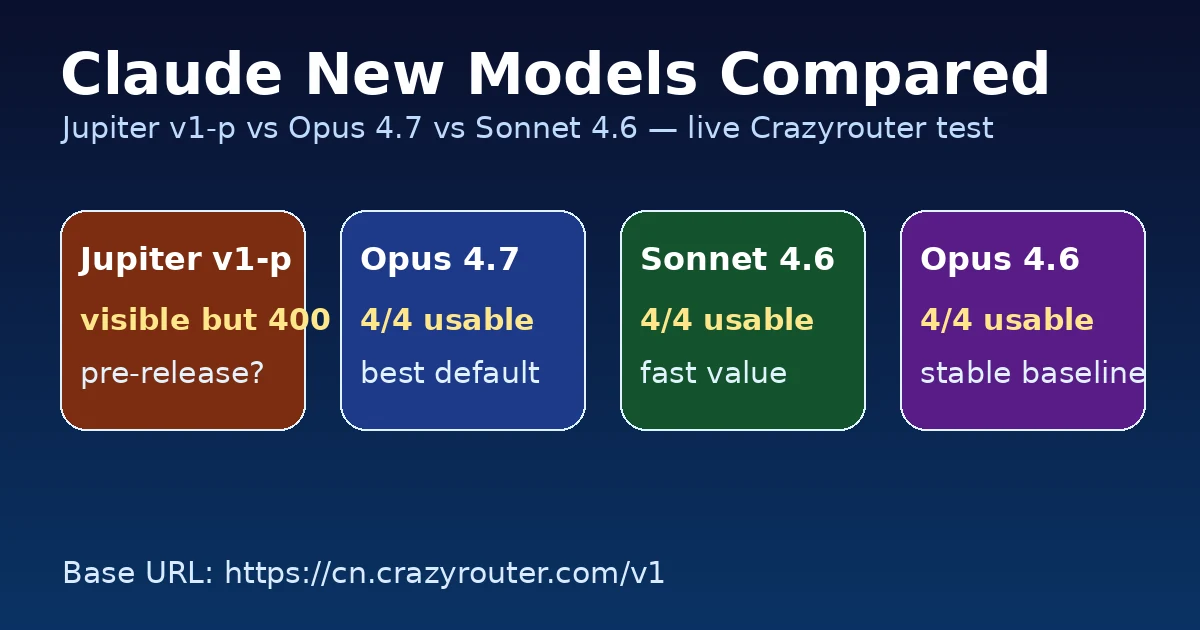
Claude Jupiter v1-p vs Opus 4.7 vs Sonnet 4.6 live comparison cover

Quick answer#

claude-jupiter-v1-p is visible in the Crazyrouter /v1/models list, but in our live Chat Completions test it returned 400 invalid_request for every task. That makes it interesting to watch, but not production-ready in this API path yet.

Among the working Claude models:

  • Claude Opus 4.7 is the safest premium default for complex coding and agentic workflows.
  • Claude Sonnet 4.6 is the best daily-driver option when you want strong coding output with lower latency and better cost discipline.
  • Claude Opus 4.6 remains a stable baseline, but in this run it was slower on structured JSON than Opus 4.7 and Sonnet 4.6.
  • Claude Jupiter v1-p should be treated as a watchlist / pre-release model ID until it returns successful content through /chat/completions.

The practical production rule is simple:
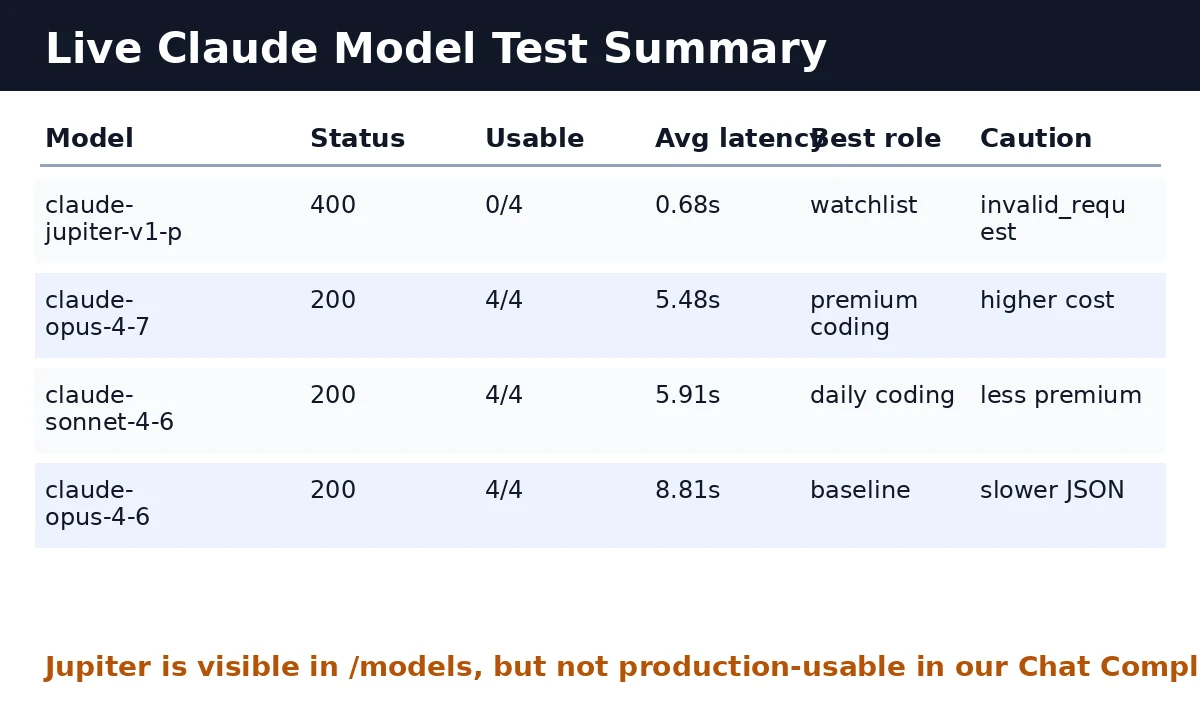
Live Claude model test summary table

SERP research: what people are searching for#

Before writing this article, we checked current search results for Claude Jupiter, Claude Opus 4.7, Claude Sonnet 4.6, and Claude model benchmarks.

The current pattern is clear:

  • There are rumor-style pages about claude-jupiter-v1-p appearing in testing or red-team contexts.
  • Official and semi-official pages emphasize Opus 4.7 as a stronger coding and agentic model compared with Opus 4.6.
  • Many benchmark pages repeat headline benchmark claims, but fewer pages show real API behavior through an OpenAI-compatible gateway.

That gap matters. A model can appear in a model list and still fail on a production endpoint. For developers, the first question is not “is the model exciting?” It is:

Can I call it successfully, get usable content, and route production traffic to it?

That is what this article tests.

Test setup#

All tests used Crazyrouter's OpenAI-compatible API:

We first called /v1/models. All four model IDs appeared in the model list:

Then we ran the same four tasks against each model:

  1. Retry patch — fix a Python retry helper with correct retry semantics.
  2. JSON schema — return a valid structured JSON object describing routing role, strengths, risks, and recommended use cases.
  3. Unified diff patch — generate a JS patch for topK(words, k) with empty-array handling and tie-breaking.
  4. Cost reasoning — explain when to route coding tasks to premium Claude versus cheaper fallback models.

Live test results#

ModelEndpoint statusUsable outputsAverage latencyResult
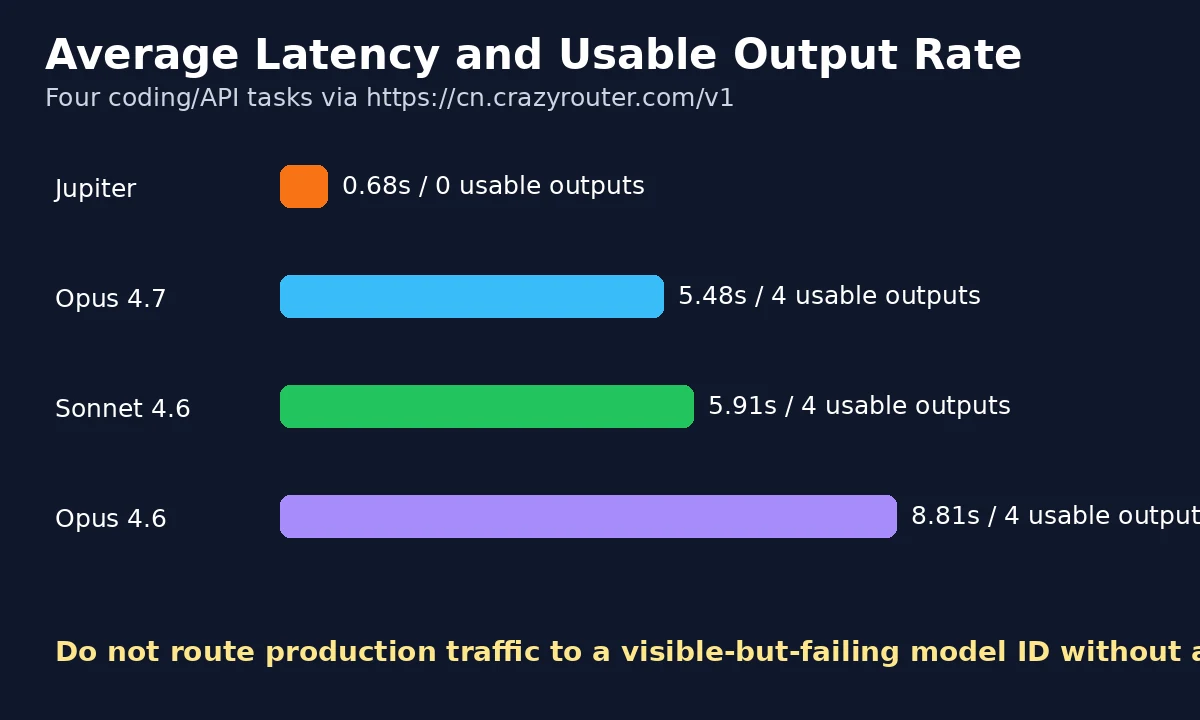
claude-jupiter-v1-p4000 / 40.68sVisible in model list, but failed all Chat Completions calls
claude-opus-4-72004 / 45.48sBest premium default for hard coding
claude-sonnet-4-62004 / 45.91sStrong daily coding model
claude-opus-4-62004 / 48.81sStable baseline, slower in this run

Average latency and usable output rate for Claude Jupiter, Opus, and Sonnet

The raw result file is saved internally as:

What happened with Claude Jupiter v1-p?#

claude-jupiter-v1-p was the most interesting result because it was visible but not callable in our test.

Every request returned HTTP 400 with the same error shape:

That means we should not describe Jupiter as a working production model yet, at least not through this Chat Completions path at the time of testing.

The correct interpretation is cautious:

  • The model ID exists in the model list.
  • The endpoint rejects normal chat completion requests.
  • It may be gated, pre-release, misconfigured, or require different parameters.
  • It should not be used in production routing until a health check returns 200 and non-empty content.

For model routers and coding agents, this is an important lesson: model discovery is not enough. You need live request health checks.

Claude Opus 4.7: best premium default#

Claude Opus 4.7 completed all four tasks successfully.

In this run:

  • retry patch: 3.24s
  • JSON schema: 6.91s
  • unified diff patch: 4.09s
  • cost reasoning: 7.69s
  • usable outputs: 4 / 4
  • average latency: 5.48s

The outputs were concise and production-friendly. It fixed the retry helper correctly, generated a usable diff, and produced structured planning output without empty-content failure.

This matches the role we would expect from a premium Claude model:

  • complex coding
  • production patch generation
  • high-risk agent steps
  • structured output
  • tasks where failure is expensive

The downside is cost. Premium models should not be used for every trivial task. They should be reserved for tasks where success rate matters more than raw token price.

Claude Sonnet 4.6: best daily coding model#

Claude Sonnet 4.6 also completed all four tasks successfully.

In this run:

  • retry patch: 2.20s
  • JSON schema: 8.23s
  • unified diff patch: 3.73s
  • cost reasoning: 9.49s
  • usable outputs: 4 / 4
  • average latency: 5.91s

Sonnet 4.6 was especially fast on the retry patch and unified diff tasks. It is the model I would use as the default for daily coding workflows where you still want Claude-level reliability but do not want to send everything to the most premium Opus model.

Recommended use cases:

  • routine bug fixing
  • unit test generation
  • code explanation
  • medium-risk refactors
  • CI helper tasks after validation
  • IDE assistant workflows

For many teams, Sonnet 4.6 is the practical default, with Opus 4.7 reserved for harder tasks.

Claude Opus 4.6: stable baseline, but slower here#

Claude Opus 4.6 also completed every task successfully.

In this run:

  • retry patch: 2.66s
  • JSON schema: 17.81s
  • unified diff patch: 4.20s
  • cost reasoning: 10.58s
  • usable outputs: 4 / 4
  • average latency: 8.81s

The main issue was the structured JSON task, where it took much longer than Opus 4.7 and Sonnet 4.6. That does not make Opus 4.6 bad. It remains a useful baseline and fallback model. But if Opus 4.7 is available at the same integration layer, Opus 4.7 looks like the better premium routing target.

For a production AI coding stack, I would not hard-code one Claude model everywhere.

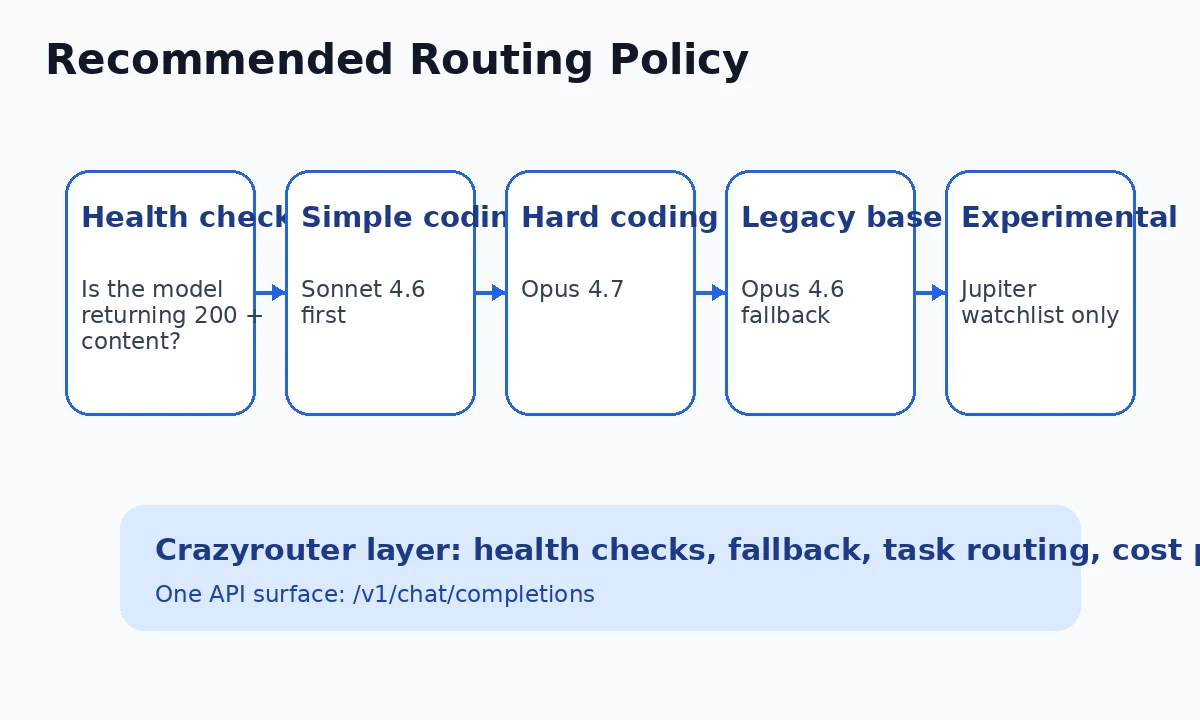
A better policy is:

Task typeRecommended modelWhy
Model health checkall candidatescatch visible-but-failing IDs like Jupiter
Daily codingClaude Sonnet 4.6strong quality and practical latency
Complex bug fixClaude Opus 4.7better premium default
High-risk agent stepClaude Opus 4.7success matters more than token cost
Baseline fallbackClaude Opus 4.6stable backup path
Experimental testingClaude Jupiter v1-pwatchlist only until 200 + content

Recommended Claude model routing policy through Crazyrouter

Why this matters for Crazyrouter users#

Crazyrouter makes this kind of test useful because all calls go through the same OpenAI-compatible API surface:

The same code can test:

That lets you build a real routing layer:

  • discover available models
  • run health checks
  • measure latency
  • validate output quality
  • fallback when a model fails
  • avoid sending production traffic to a model that only appears available

Final verdict#

Here is the practical conclusion from this live test:

The headline is not “Jupiter beats Opus” or “Opus beats Sonnet.”

The real lesson is:

For production AI coding, always combine model discovery with live health checks, output validation, and fallback routing.

That is how you safely adopt new Claude models without breaking your coding agent or CI workflow.

FAQ#

Is claude-jupiter-v1-p available?#

It appeared in the /v1/models list during our test, but every Chat Completions request returned 400 invalid_request. Treat it as visible but not production-usable until live requests succeed.

Is Claude Opus 4.7 better than Opus 4.6?#

In our test, Opus 4.7 completed all tasks and had lower average latency than Opus 4.6. It is the better premium default based on this run.

Is Claude Sonnet 4.6 still worth using?#

Yes. Sonnet 4.6 completed all tasks and was especially fast on patch and diff tasks. It is a strong default for daily coding.

Which Claude model should coding agents use?#

Use Sonnet 4.6 for routine tasks, Opus 4.7 for difficult or high-risk steps, and keep Opus 4.6 as a fallback. Do not route to Jupiter until it passes health checks.

Why use Crazyrouter for Claude model testing?#

Crazyrouter lets you compare and route multiple models through one OpenAI-compatible API endpoint. That makes it easier to test availability, latency, output quality, and fallback behavior before production deployment.