








DeepSeek, Qwen and GLM are now part of the serious production LLM stack. The problem is that integrating every provider separately creates API-key sprawl, different SDK patterns, separate billing flows and inconsistent monitoring.
The cleaner approach is to use one OpenAI-compatible gateway and switch model IDs by task.
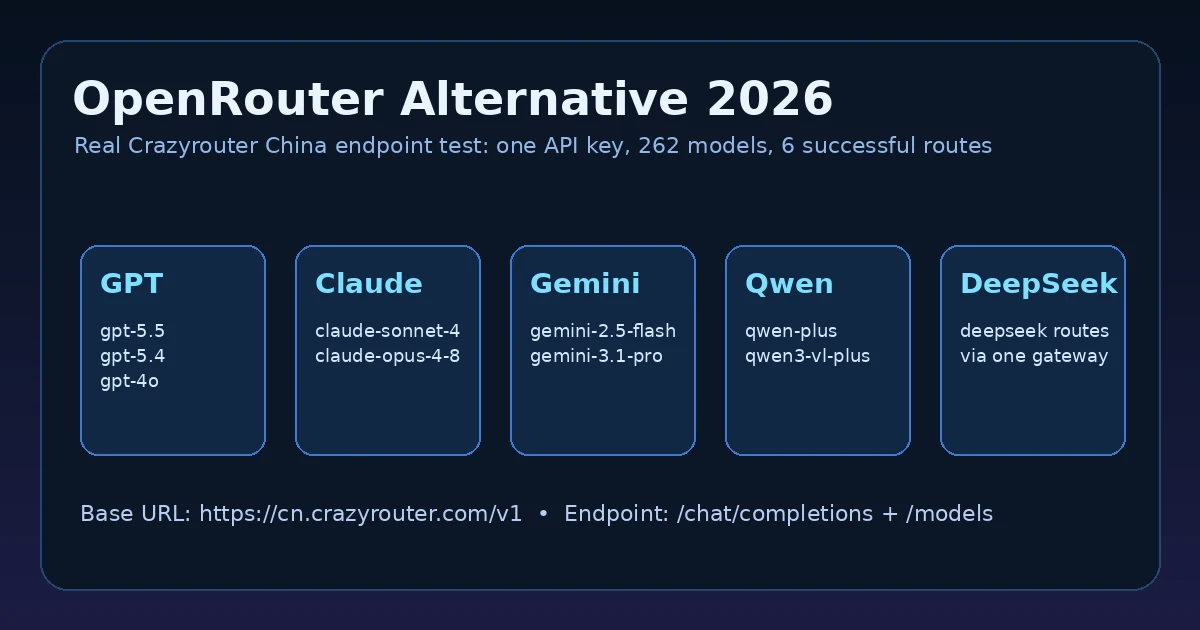
Real test evidence used in this article:
Sample model families discovered by /v1/models:
deepseek-v4-flash, deepseek-v4-proqwen3-vl-plus, qwen2.5-coder-14b-instruct, qwen2-vl-72b-instruct, qwen3-coder-480b-a35b-instruct, qwen3-vl-30b-a3b-instruct, qwen3-30b-a3b, qwen-plus, qwen2.5-72b-instructglm-5v-turbo, glm-4-flash, glm-4.1v-thinking-flash, glm-5-turbo, glm-5, glm-4.5-flash, glm-4.5, glm-4vThis confirms that a single /v1/models endpoint exposed DeepSeek, Qwen and GLM routes in one model list.
If you build with Chinese and global LLMs, you usually want:
To switch to another family, change only the model ID.
deepseek-v4-flash, deepseek-v4-pro
qwen3-vl-plus, qwen2.5-coder-14b-instruct, qwen2-vl-72b-instruct, qwen3-coder-480b-a35b-instruct, qwen3-vl-30b-a3b-instruct, qwen3-30b-a3b, qwen-plus, qwen2.5-72b-instruct
glm-5v-turbo, glm-4-flash, glm-4.1v-thinking-flash, glm-5-turbo, glm-5, glm-4.5-flash, glm-4.5, glm-4v
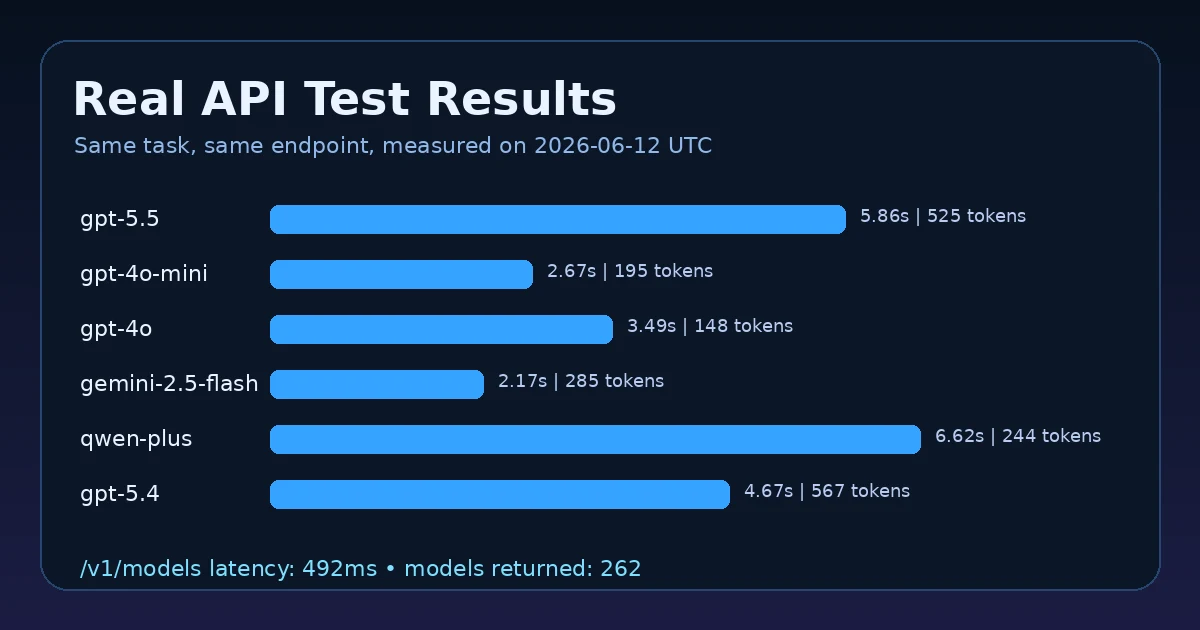
| Tested model | HTTP | Latency | Prompt tokens | Completion tokens | Total tokens | Note |
|---|---|---|---|---|---|---|
gpt-4o-mini | 200 | 2.9s | 39 | 53 | 92 | stop |
qwen-plus | 200 | 3.69s | 40 | 42 | 82 | stop |
glm-4-flash | 200 | 5.54s | 34 | 47 | 81 | stop |
deepseek-chat | 200 | 3.27s | 36 | 180 | 216 | returned reasoning tokens, empty content at max_tokens=180; useful validation/fallback example |
qwen3-coder-480b-a35b-instruct | 200 | 28.53s | 40 | 47 | 87 | stop |
The result shows why production teams should validate outputs, not only HTTP status. Some routes returned clean content; the DeepSeek test hit the token limit and returned reasoning tokens without final content under this constrained prompt. That is exactly the kind of case where a gateway-based fallback strategy helps.
| Task | First route | Fallback route | Validation |
|---|---|---|---|
| Low-cost summarization | Qwen or GLM flash route | GPT/Gemini mini route | non-empty content |
| Chinese content | GLM/Qwen | stronger Qwen/Claude/GPT route | language + facts |
| Coding helper | Qwen coder route | GPT/Claude coding route | tests/build output |
| Reasoning | DeepSeek route | GPT/Claude/Gemini route | final answer present |
| Extraction JSON | stable JSON route | retry with stricter schema | JSON parse |
Separate integrations seem simple at first, but production complexity grows quickly:
A gateway turns this into one integration surface.
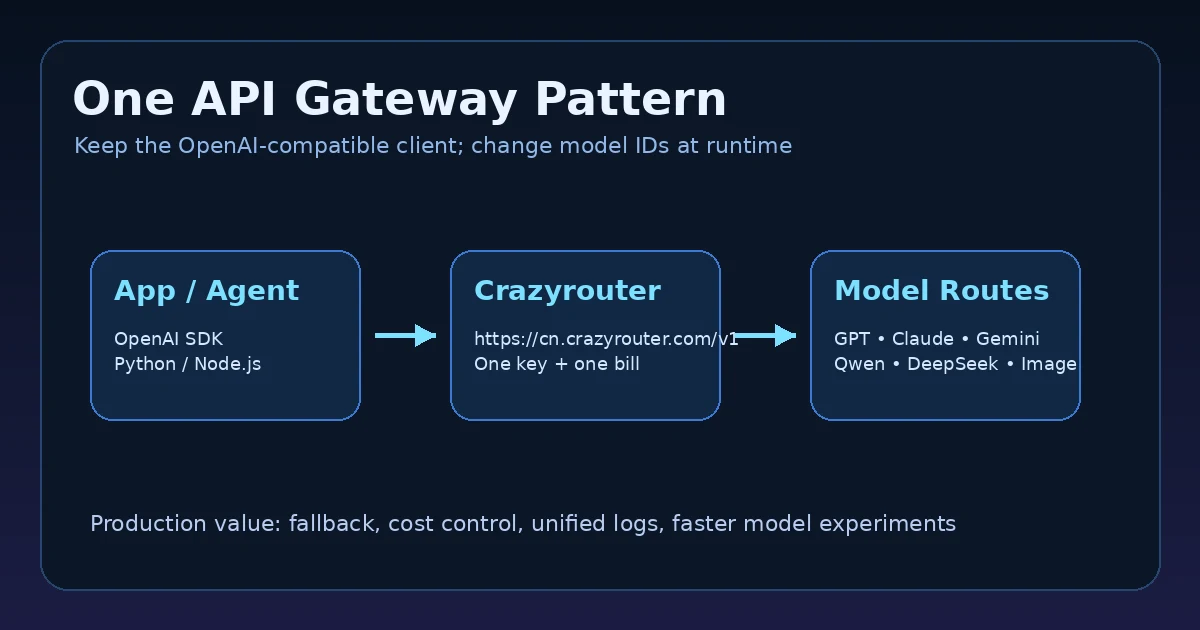
Yes. In this test, Crazyrouter exposed DeepSeek, Qwen and GLM routes through https://cn.crazyrouter.com/v1/models.
The tested Chat Completions flow uses the OpenAI SDK with base_url="https://cn.crazyrouter.com/v1".
Use Qwen or GLM for many Chinese/multilingual tasks, DeepSeek for cost-efficient reasoning experiments, and stronger GPT/Claude/Gemini routes when accuracy or formatting needs escalation.
No. Always validate content, JSON shape, finish reason and token limits.
DeepSeek, Qwen and GLM are useful individually, but they are much easier to operate through one gateway. Crazyrouter lets developers keep one OpenAI-compatible client while routing across Chinese and global model families.
Start here: Crazyrouter
此内容由惯性聚合(RSS阅读器)自动聚合整理,仅供阅读参考。 原文来自 — 版权归原作者所有。