





AI coding tools are no longer just chat boxes. Claude Code, Codex-style agents, Cursor workflows, OpenClaw agents and internal automation scripts all need reliable model access, fallback, usage tracking and payload compatibility.
Crazyrouter can act as the API layer behind those tools: one key, one OpenAI-compatible base URL, many model routes.
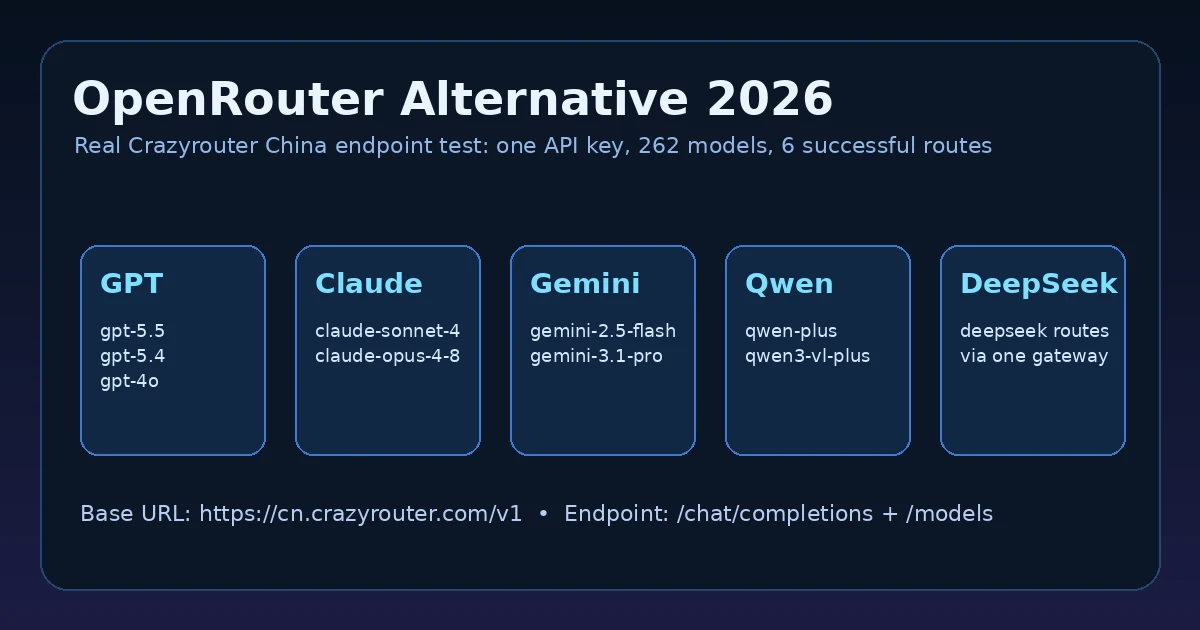
Real test evidence used in this article:
Sample model families discovered by /v1/models:
deepseek-v4-flash, deepseek-v4-proqwen3-vl-plus, qwen2.5-coder-14b-instruct, qwen2-vl-72b-instruct, qwen3-coder-480b-a35b-instruct, qwen3-vl-30b-a3b-instruct, qwen3-30b-a3b, qwen-plus, qwen2.5-72b-instructglm-5v-turbo, glm-4-flash, glm-4.1v-thinking-flash, glm-5-turbo, glm-5, glm-4.5-flash, glm-4.5, glm-4vThe model list included coding-relevant routes such as qwen3-coder-480b-a35b-instruct, GPT routes, Claude routes, Gemini routes, Qwen routes and GLM routes.
Most AI coding tools that support an OpenAI-compatible endpoint need three values:
Example Python client:
| Agent task | Suggested route type | Why |
|---|---|---|
| Small code edits | fast/cheap coding-capable model | keep latency low |
| Large refactor | stronger coding/reasoning route | reduce broken changes |
| Test generation | model with structured output discipline | easier validation |
| RAG answer | retrieval-aware route | factual grounding matters |
| Tool planning | stronger reasoning route | agent steps compound errors |
| Review pass | different model family | catches blind spots |
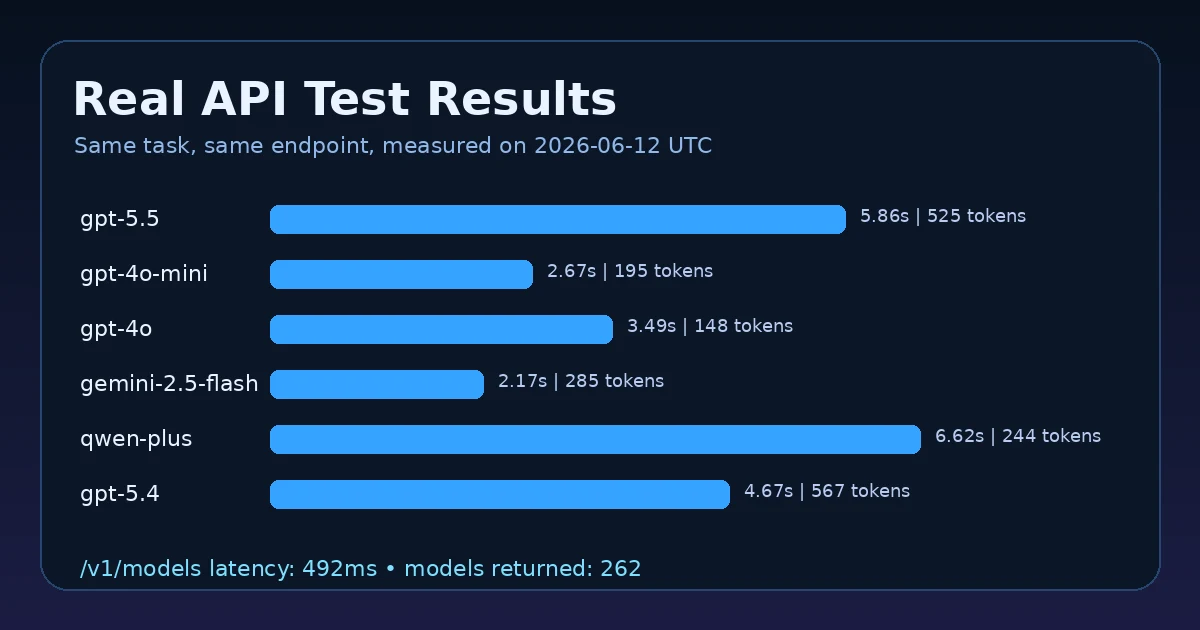
Agent workflows are expensive because they multiply calls:
If every step uses the strongest model, cost explodes. If every step uses the cheapest model, quality collapses. A gateway lets you route by task.
| Tested model | HTTP | Latency | Prompt tokens | Completion tokens | Total tokens | Note |
|---|---|---|---|---|---|---|
gpt-4o-mini | 200 | 2.9s | 39 | 53 | 92 | stop |
qwen-plus | 200 | 3.69s | 40 | 42 | 82 | stop |
glm-4-flash | 200 | 5.54s | 34 | 47 | 81 | stop |
deepseek-chat | 200 | 3.27s | 36 | 180 | 216 | returned reasoning tokens, empty content at max_tokens=180; useful validation/fallback example |
qwen3-coder-480b-a35b-instruct | 200 | 28.53s | 40 | 47 | 87 | stop |
The test shows a key coding-agent lesson: model availability is not enough. Agents must check content shape, finish reason and token limits. A route can return HTTP 200 but still require fallback or retry.
Use Crazyrouter as the OpenAI-compatible endpoint when the tool supports custom base URL. Put the base URL in the model provider settings, then choose model IDs that match task cost and quality.
For CLI agents, keep model routing in config rather than hard-coding it inside prompts. That makes it easier to switch between cheaper edit models and stronger review models.
Use Crazyrouter routes for different skill types: cheap models for classification, stronger models for planning, image/video routes for multimodal skills and coding models for code tasks.
Before using a model route in an agent loop, test:
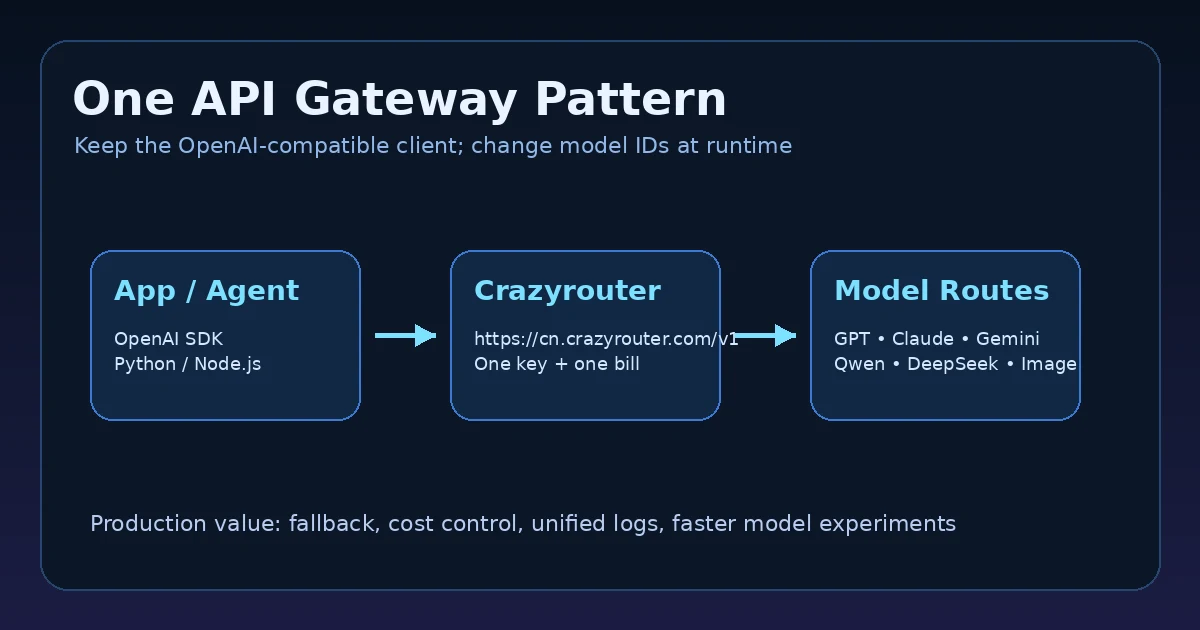
Yes, when the tool supports OpenAI-compatible API settings. Use https://cn.crazyrouter.com/v1 as the base URL and choose a model ID from /v1/models.
There is no universal best model. Use fast routes for simple edits, stronger coding/reasoning routes for refactors, and a different family for review.
Because agents call models repeatedly. Routing by task reduces cost without sacrificing the high-value steps.
Validate output shape, empty content, finish reason, test results and whether the agent actually completed the task.
Crazyrouter is useful for coding tools because coding agents need routing, not just intelligence. One OpenAI-compatible endpoint lets you test model families, control costs and build fallback into the workflow.
Start here: Crazyrouter
此内容由惯性聚合(RSS阅读器)自动聚合整理,仅供阅读参考。 原文来自 — 版权归原作者所有。