惯性聚合 高效追踪和阅读你感兴趣的博客、新闻、科技资讯
阅读原文 在惯性聚合中打开

推荐订阅源

The Last Watchdog
The Last Watchdog
freeCodeCamp Programming Tutorials: Python, JavaScript, Git & More
GbyAI
GbyAI
Y
Y Combinator Blog
CTFtime.org: upcoming CTF events
The GitHub Blog
The GitHub Blog
博客园_首页
小众软件
小众软件
I
InfoQ
J
Java Code Geeks
月光博客
月光博客
S
Secure Thoughts
Microsoft Security Blog
V
Visual Studio Blog
Hacker News - Newest:
Hacker News - Newest: "LLM"
钛媒体:引领未来商业与生活新知
钛媒体:引领未来商业与生活新知
Stack Overflow Blog
Stack Overflow Blog
cs.CV updates on arXiv.org
N
News and Events Feed by Topic
Exploit-DB.com RSS Feed
Threat Intelligence Blog | Flashpoint
The Cloudflare Blog
T
Threat Research - Cisco Blogs
A
About on SuperTechFans
H
Help Net Security
MongoDB | Blog
MongoDB | Blog
博客园 - 聂微东
人人都是产品经理
人人都是产品经理
H
Hackread – Cybersecurity News, Data Breaches, AI and More
Recent Commits to openclaw:main
Latest news
Latest news
G
GRAHAM CLULEY
IT之家
IT之家
C
Cisco Blogs
Last Week in AI
Last Week in AI
Engineering at Meta
Engineering at Meta
L
LangChain Blog
The Register - Security
SecWiki News
SecWiki News
M
MIT News - Artificial intelligence
NISL@THU
NISL@THU
T
Tenable Blog
博客园 - Franky
美团技术团队
I
Intezer
U
Unit 42
雷峰网
雷峰网
cs.AI updates on arXiv.org
S
SegmentFault 最新的问题
C
Cyber Attacks, Cyber Crime and Cyber Security

Crazyrouter Blog

Gemini CLI Complete Guide 2026: Repo Automation, CI Agents, and Multi-Model Routing Ideogram AI Guide 2026: Brand Design Automation, API Workflows, and Alternatives GLM 4.6 API Guide 2026: Agents, RAG, Tool Calling, and Bilingual Apps WAN 2.2 Animate Tutorial 2026: Character Consistency, Shot Control, and API Workflows Google Veo3 API Guide 2026: Production Video Pipelines, Prompts, Pricing, and Fallbacks AI API Pricing Comparison 2026: Text, Image, Video, Caching, and Router Costs Codex CLI Installation Guide 2026: Windows, macOS, Linux, Proxies, and CI Setup How to Get a Claude API Key in 2026: Secure Setup for Teams, CI, and Alternatives Gemini Advanced Review 2026: Is It Worth It for Coding, Research, and API Teams? Seedance 2.0 Pricing: Convert 46 CNY per Million Tokens to Cost per Second Seedance 2.0 计费详解:46元/百万Token换算成每秒多少钱 Seedance 2.0料金解説:100万Tokenあたり46元を1秒あたりコストに換算 Gemini CLI 使用教程 2026:安装、代码示例、代理环境与 API 接入 Gemini 是什么?2026 完整介绍、API 使用教程与价格对比 Qwen2.5-Omni Guide 2026: Real-Time Voice, Vision, and Multimodal Agents Kimi K2 Thinking Guide 2026: Reasoning Workflows, Evals, and Cost Control Google Veo3 API Guide 2026: Batch Video Pipelines, Pricing, and Fallbacks Codex CLI Installation Guide 2026: macOS, Linux, WSL, Proxies, and Dev Containers How to Get a Claude API Key in 2026: Safe Production Setup and Alternatives AI API Pricing Comparison 2026: GPT, Claude, Gemini, Video, and Agent Workloads Gemini Advanced Review 2026: Is It Worth It for Developer Teams? Claude Code Pricing Guide 2026: API Fallbacks, Team Seats, and Budget Control Seedream 4.0 API Tutorial 2026: Batch Image Generation, Product Creative, and Pricing Qwen2.5-Omni Guide 2026: Real-Time Voice, Vision, Text Agents, and API Integration Kimi K2 Thinking Guide 2026: Reasoning Agents, Evaluation Workflows, and API Cost Control WAN 2.2 Animate Tutorial 2026: Character Motion, Shot Control, API Pipelines, and Pricing Google Veo3 API Guide 2026: Production Video Workflows, Prompts, Pricing, and Fallbacks AI API Pricing Comparison 2026: OpenAI, Claude, Gemini, DeepSeek, and Router Costs How to Get a Claude API Key in 2026: Setup, Security, Rotation, and Alternatives Codex CLI Installation Guide 2026: macOS, Linux, WSL, Proxies, and Devcontainers Gemini Advanced Review 2026: Is It Worth It for Developers and API Builders? Claude Code Pricing Guide 2026: CI Agents, Team Seats, and API Budget Planning 一個 API Key 呼叫 GPT、Claude、Gemini:5 分鐘設定教學 AI API Gateway for Singapore and Malaysia Developers: One Endpoint for GPT, Claude and Gemini AI API Gateway for Thai Developers: Use GPT, Claude and Gemini with One Key Cómo usar GPT, Claude y Gemini con una sola API key One API Key for GPT, Claude and Gemini: A Practical Setup for Central Asia Developers Gemini 3.5 Flash vs Claude レスポンスティアモデル:開発者はどちらを選ぶべきか Gemini 3.5 Flash vs Claude Response-Tier Models: Какую модель выбрать разработчику? Gemini 3.5 Flash vs Claude Response-Tier Models: Which One Should Developers Use? Gemini 3.5 Flash vs Gemini 3 Flash vs Gemini 2.5 Flash:実運用APIベンチマーク Gemini 3.5 Flash vs Gemini 3 Flash vs Gemini 2.5 Flash: Real API Benchmark text-embedding-3-large 值不值得用?和 text-embedding-3-small 的成本、效果与选型对比 用 text-embedding-3-large 搭建 RAG 知识库:从切块、向量化到检索排序 text-embedding-3-large 是干什么的?Embedding 模型入门与 RAG 场景详解 AI 扩图 API 指南 2026:Uncrop、Outpaint、gpt-image-2 和 Nano Banana 路线怎么选 How to Test Multiple AI Image Models with One API Key "How to Test Multiple AI Image Models with One API Key" Codex CLI Installation Guide: Setup on macOS, Linux, Windows WSL and CI/CD Gemini CLI 使用教程:开发者终端 AI 助手完全指南 Grok 4 免费使用教程:合法体验路径、API 接入与替代方案 Seedream 4.0 API Tutorial: ByteDance Image Generation for Production Pipelines Kimi K2 Thinking Model: Complete Developer Guide for Reasoning Workflows Luma Ray 2 Review: AI Video Generation Quality, Speed, and API Guide Pika 2.2 New Features Review: Scene Director, Sound Design, and API Updates Google Veo 3 API Guide: Video Generation with Audio for Developers AI Lip Sync Tools Comparison 2026: Best APIs for Talking Avatars and Video Dubbing Gemini Advanced Review May 2026: Is It Worth $20/Month for AI Power Users? Claude Code Pricing in May 2026: Max Plan, Opus 4, and Real Cost Breakdown Hermes Agent + Crazyrouter: One-Click Setup for 627+ AI Models Text-Embedding-3-Small: Complete Guide to OpenAI's Most Popular Embedding Model (2026) Cursor 配置 Crazyrouter 教程:国内用上 GPT-5.4 / Claude 写代码 2026 年国内如何调用 Claude API?Claude Opus / Sonnet 接入完全指南 2026 年国内如何调用 GPT-5.4 API?完整接入指南(含代码示例) AI API 常见报错排查大全:401、429、500、timeout 一篇搞定 2026 年 AI API 中转站哪家好?六大平台横向对比评测 2026 年 DeepSeek R1 API 接入指南:国内最强推理模型怎么调用 Trình Tạo Meme & Sách Tô Màu Bằng AI Với GPT-image-2 — Những Dự Án Vui Mà Vẫn Kiếm Ra Tiền Dự Đoán Em Bé Tương Lai Bằng AI Với GPT-image-2 — Xem Con Bạn Có Thể Trông Như Thế Nào Chuyển Đổi Ảnh Sang Phong Cách Ghibli Với GPT-image-2 — Biến Mọi Bức Ảnh Thành Tranh Anime Tạo Mô Hình Nhân Vật Hành Động Bằng AI Với GPT-image-2 — Biến Bất Kỳ Ai Thành Đồ Chơi Trong Hộp GPT-image-2: Nhận Diện Khuôn Mặt Và Phân Tích Màu Sắc Bằng AI Xem chỉ tay với GPT-image-2 — Tạo bản phân tích chỉ tay chuyên nghiệp chỉ từ một bức ảnh GPT-image-2로 AI 밈 생성기 & 컬러링북 만들기 — 재미있고 수익도 되는 프로젝트 GPT-image-2로 AI 미래 아기 예측 — 우리 아이는 어떤 모습일까? GPT-image-2로 지브리 스타일 변환 — 사진을 애니메이션 아트로 바꾸기 GPT-image-2로 AI 액션 피규어 생성하기 — 누구나 박스형 피규어로 바꾸는 법 GPT-image-2로 AI 관상 분석 & 퍼스널 컬러 진단 — 두 가지 바이럴 활용법 완벽 가이드 GPT-image-2 실전 가이드:AI 손금 분석 — 손바닥 사진 한 장으로 전문 손금 인포그래픽 생성하기 GPT-image-2 で AI ミーム生成 & ぬりえブック制作 — 楽しくて本当に稼げるプロジェクト GPT-image-2 で AI 未来の赤ちゃん予測 — 将来の子どもの顔を見てみよう GPT-image-2 でジブリ風写真変換 — どんな写真もアニメアートに GPT-image-2 で AI アクションフィギュア生成 — 誰でもボックス入りおもちゃに変身 GPT-image-2 で AI 顔相診断 & パーソナルカラー分析 — 2つのバズ活用法を1本で解説 GPT-image-2 で AI 手相占い — 1枚の写真からプロ仕様の手相分析を生成 GPT-image-2 на практике: AI-генератор мемов и раскрасок — весёлые проекты, которые приносят деньги GPT-image-2 на практике: AI-предсказание будущего ребёнка — как будет выглядеть ваш малыш GPT-image-2 на практике: стиль Гибли — превратите любое фото в аниме-арт GPT-image-2 на практике: AI-генератор фигурок — превратите себя в коллекционную игрушку GPT-image-2 на практике: AI-физиогномика и анализ цветотипа — два вирусных кейса в одном гайде GPT-image-2 на практике: AI-хиромантия — генерация профессионального анализа ладони по фото GPT-image-2 实战:AI Meme 生成器 & 涂色书制作 — 好玩还能赚钱的两个项目 GPT-image-2 实战:AI 预测未来宝宝 — 看看你们的孩子长什么样 GPT-image-2 实战:吉卜力风格转换 — 把任何照片变成宫崎骏动画 GPT-image-2 实战:AI 手办生成器 — 把任何人变成盒装公仔 GPT-image-2 实战:AI 面相分析 & 个人色彩诊断 — 两大爆款玩法一文搞定 GPT-image-2 实战:AI 看手相 — 一张手掌照片生成专业手相分析图 AI Meme Generator & Coloring Book Creator with GPT-image-2 — Fun Projects That Actually Make Money AI Future Baby Prediction with GPT-image-2 — See What Your Child Might Look Like Ghibli Style Photo Transformation with GPT-image-2 — Turn Any Photo Into Anime Art
Claude Jupiter v1-p vs GPT-5.5 Benchmark: Real API Test on Reasoning and Coding
Crazyrouter Team · 2026-05-27 · via Crazyrouter Blog

title: Claude Jupiter v1-p vs GPT-5.5 Benchmark: Real API Test on Reasoning and Coding slug: jupiter-vs-gpt55-benchmark-2026 summary: We tested claude-jupiter-v1-p and gpt-5.5 through https://cn.crazyrouter.com/v1 across reasoning, coding, patching, JSON, long-context recall, agent planning, and math tasks. GPT-5.5 scored slightly higher, while Jupiter was much faster but required a payload compatibility fix. tag: Benchmark language: en cover_image_url: https://raw.githubusercontent.com/xujfcn/images/main/blog/covers/jupiter-vs-gpt55-benchmark-2026.webp meta_title: Claude Jupiter v1-p vs GPT-5.5 Benchmark 2026 | Crazyrouter meta_description: Real API benchmark using https://cn.crazyrouter.com/v1 comparing Claude Jupiter v1-p and GPT-5.5 on reasoning, coding, structured output, long context, and agent planning. meta_keywords: claude jupiter v1-p, gpt-5.5, ai model benchmark, coding benchmark, crazyrouter api#

Claude Jupiter v1-p vs GPT-5.5: Real API Benchmark for Reasoning and Coding#

claude-jupiter-v1-p is an interesting model ID because it looks like a test or pre-release Claude route, while gpt-5.5 is the current high-end GPT route available through Crazyrouter.

Instead of guessing from the names, I ran both models through the same benchmark using the China endpoint:

The goal was not to create a massive academic benchmark. The goal was more practical:

If I were routing real developer tasks, which model looks smarter, which model codes better, which one is faster, and what hidden API compatibility issues would matter in production?
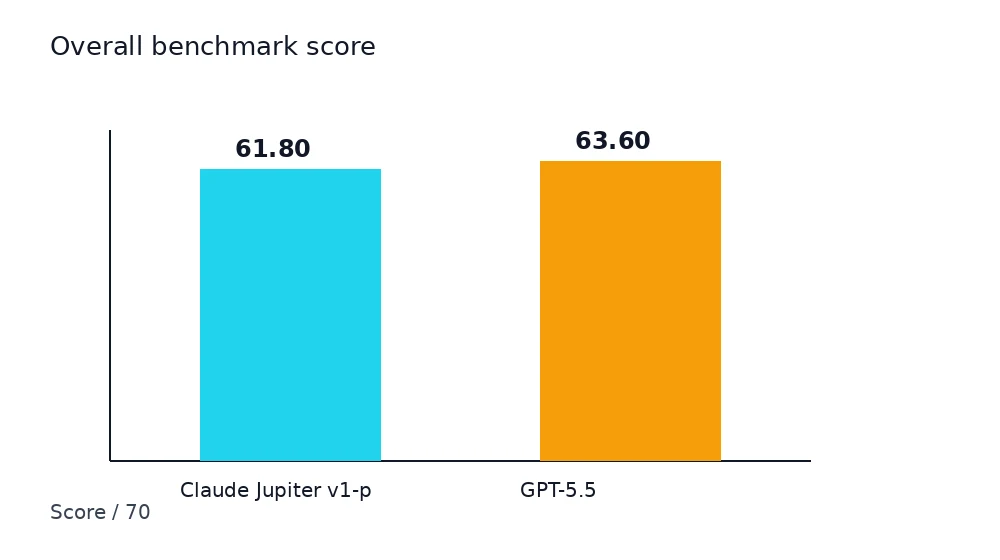
Claude Jupiter v1-p vs GPT-5.5 overall benchmark score

Short conclusion#

Here is the result from the final runnable test:

ModelSuccess rateTotal scoreAverage scoreAverage latencyMedian latencyTotal tokens
claude-jupiter-v1-p7/761.8/708.83/105.17s3.35s6096
gpt-5.57/763.6/709.09/1010.44s9.63s3802

My reading:

  • GPT-5.5 won narrowly on quality: 63.6/70 vs 61.8/70.
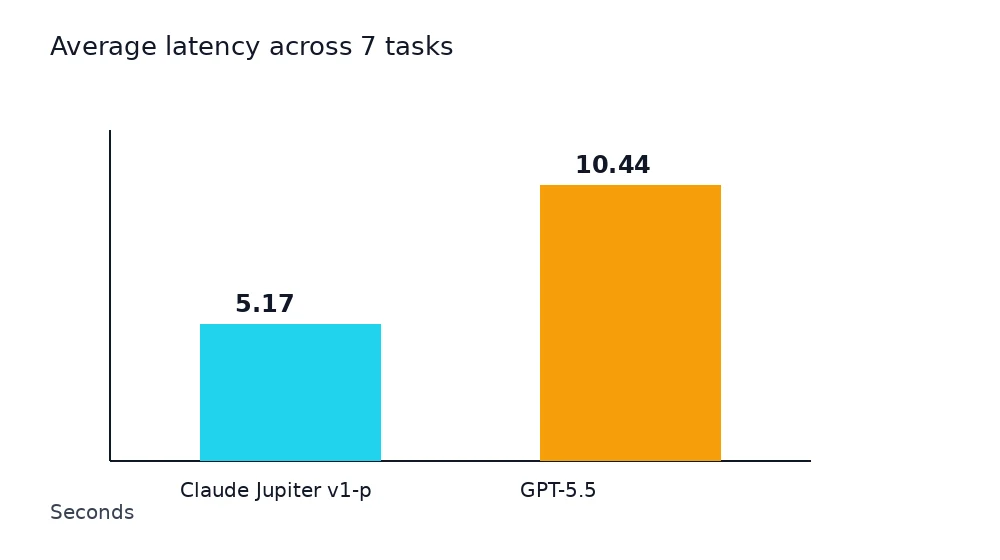
  • Claude Jupiter v1-p was much faster: 5.17s average latency vs 10.44s.
  • Both models completed all seven tasks in the fair run.
  • Jupiter has an important compatibility caveat: with temperature: 0 included in the OpenAI-compatible payload, it returned 400 invalid_request on every task. Removing temperature made it pass 7/7.

So the practical conclusion is:

Claude Jupiter v1-p vs GPT-5.5 latency chart

The most important finding: payload compatibility matters#

The first run used the same OpenAI-compatible payload for both models:

Result:

ModelTasksSuccessResult
claude-jupiter-v1-p70/7all returned 400 invalid_request
gpt-5.577/7all completed

At first glance, that looks like Jupiter failed the benchmark.

But a compatibility probe showed the real issue: Jupiter currently rejects this payload shape when temperature: 0 is included.

I tested several payload variants:

Jupiter payload variantResult
system + max_tokens + temperature=00/7
system + max_tokens, no temperature7/7
no system, max_tokens, no temperature7/7
messages only7/7
short minimal prompt1/1

This matters because production systems often assume OpenAI-compatible parameters are universally accepted. They are not.

For real routing, the correct health check is not just:

It should be:

Benchmark design#

I used seven tasks designed to reflect practical intelligence and developer usefulness:

TaskWhat it tests
logic_gridconstraint reasoning and contradiction handling
algorithm_designcoding ability, sorting, edge cases
bug_fix_patchpatch generation and exception correctness
json_schema_extractionstructured output reliability
long_context_recallrecall from a long prompt with distractors
agent_tool_planagent safety policy and workflow design
math_word_problemarithmetic, cost modeling, retry reasoning

Scoring was heuristic but answer-key based. The raw outputs and scoring JSON are saved with the benchmark so the result can be inspected.
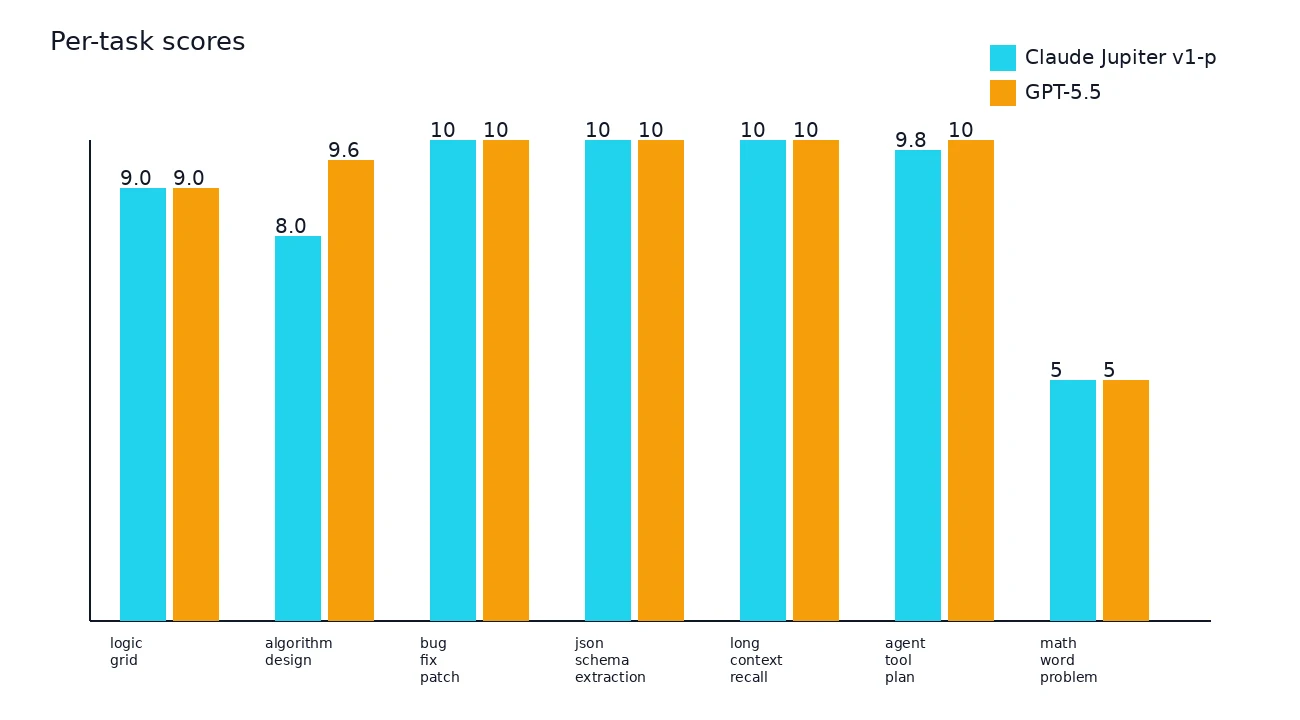
Per-task results#

Per-task score comparison between Claude Jupiter v1-p and GPT-5.5

TaskJupiter scoreGPT-5.5 scoreJupiter latencyGPT-5.5 latency
logic_grid9.0/109.0/105.691s11.287s
algorithm_design8.0/109.6/102.411s7.045s
bug_fix_patch10/1010/103.349s9.628s
json_schema_extraction10/1010/102.118s6.193s
long_context_recall10/1010/102.53s2.335s
agent_tool_plan9.8/1010/1013.838s14.071s
math_word_problem5/105/106.266s22.511s

A few observations stand out.

1. Reasoning: both solved the logic puzzle#

Both models correctly solved the region/datastore puzzle:

Both scored 9/10. GPT-5.5 gave a more compact answer. Jupiter gave a longer explanation but reached the same result faster.

2. Coding: GPT-5.5 was slightly cleaner on the algorithm task#

The topKFrequent(words, k) task required:

  • frequency descending;
  • lexicographic tie-break;
  • handling k <= 0 and empty input;
  • better than O(n²).

GPT-5.5 explicitly used localeCompare for tie-breaking and got 9.6/10.

Jupiter also produced a correct implementation, using a direct comparison expression:

That is valid, but GPT-5.5's answer was slightly cleaner and easier to read.

3. Patch generation: both were excellent#

Both models fixed the Python retry function correctly:

  • initial attempt plus retries retries;
  • preserve and raise the final exception;
  • no sleep after the final failed attempt;
  • return a unified diff.

Both scored 10/10.

Both returned valid strict JSON with:

  • service;
  • severity;
  • 27-minute duration;
  • connection pool exhaustion root cause;
  • customer_visible: true;
  • mitigation actions.

Both scored 10/10.

5. Long-context recall: both passed#

The long-context test buried two important facts among repeated filler:

Both models recalled the key facts correctly.

6. Agent planning: both were strong#

Both models produced an 8-point safe execution policy for an AI coding agent, covering:

  • permission boundaries;
  • test gates;
  • rollback;
  • logging;
  • model fallback;
  • human escalation.

GPT-5.5 was marginally more concise. Jupiter was more detailed.

7. Math/cost reasoning: both got the important answer#

The math problem:

Correct calculation:

Both models produced the correct final conclusion: Model Y is cheaper by about $472.03/month.

What this means for developers#

If you are choosing a default model for coding and agent workflows, I would not make the decision based only on raw score.

I would separate three layers:

Layer 1: Quality#

GPT-5.5 is slightly ahead in this test. It was cleaner on algorithm implementation and more concise in several tasks.

Layer 2: Speed#

Jupiter was much faster in this sample:

That is a big difference if you are building interactive coding tools or agent loops.

Layer 3: Payload stability#

This is where Jupiter needs caution.

The model worked well after removing temperature, but failed completely with temperature: 0 in the payload.

For production, that means you should not simply add it to your model list and route traffic blindly. You should run route-specific health checks:

Based on this benchmark, I would route like this:

Use caseRecommended model
highest-quality reasoning/coding defaultGPT-5.5
latency-sensitive coding helper after compatibility validationClaude Jupiter v1-p
JSON extraction / simple structured taskseither model
agent planning and safety policyeither model, GPT-5.5 slightly safer
production routing without custom health checksGPT-5.5
experimental model laneClaude Jupiter v1-p

Reproducibility#

This benchmark used:

Important payload note:

That is not a minor detail. It is one of the main findings.

Final verdict#

My conclusion:

If Jupiter's parameter compatibility improves, it could become a very interesting low-latency coding and agent workflow candidate.

But today, I would not replace GPT-5.5 with Jupiter as a default production model.

I would add Jupiter to an evaluation lane, run it against real payloads, and promote it only when route-level stability is proven.