惯性聚合 高效追踪和阅读你感兴趣的博客、新闻、科技资讯
阅读原文 在惯性聚合中打开

推荐订阅源

Recorded Future
Recorded Future
Stack Overflow Blog
Stack Overflow Blog
Cisco Talos Blog
Cisco Talos Blog
Jina AI
Jina AI
S
Schneier on Security
Engineering at Meta
Engineering at Meta
M
MIT News - Artificial intelligence
腾讯CDC
NISL@THU
NISL@THU
Hacker News: Ask HN
Hacker News: Ask HN
Google DeepMind News
cs.CL updates on arXiv.org
D
Darknet – Hacking Tools, Hacker News & Cyber Security
S
Secure Thoughts
Recent Announcements
博客园_首页
GbyAI
GbyAI
IT之家
IT之家
Security Archives - TechRepublic
V2EX - 技术
V2EX - 技术
美团技术团队
PCI Perspectives
PCI Perspectives
Blog — PlanetScale
Blog — PlanetScale
W
WeLiveSecurity
Application and Cybersecurity Blog
P
Privacy International News Feed
Know Your Adversary
Know Your Adversary
人人都是产品经理
人人都是产品经理
C
Cisco Blogs
V
Visual Studio Blog
Martin Fowler
Martin Fowler
博客园 - 叶小钗
让小产品的独立变现更简单 - ezindie.com
H
Help Net Security
Google DeepMind News
Y
Y Combinator Blog
T
Troy Hunt's Blog
Hugging Face - Blog
Hugging Face - Blog
S
Securelist
宝玉的分享
宝玉的分享
N
News | PayPal Newsroom
云风的 BLOG
云风的 BLOG
Security Latest
Security Latest
Project Zero
Project Zero
I
InfoQ
G
GRAHAM CLULEY
博客园 - 司徒正美
C
Check Point Blog
O
OpenAI News
cs.CV updates on arXiv.org

Crazyrouter Blog

Gemini CLI Complete Guide 2026: Repo Automation, CI Agents, and Multi-Model Routing Ideogram AI Guide 2026: Brand Design Automation, API Workflows, and Alternatives GLM 4.6 API Guide 2026: Agents, RAG, Tool Calling, and Bilingual Apps WAN 2.2 Animate Tutorial 2026: Character Consistency, Shot Control, and API Workflows Google Veo3 API Guide 2026: Production Video Pipelines, Prompts, Pricing, and Fallbacks AI API Pricing Comparison 2026: Text, Image, Video, Caching, and Router Costs Codex CLI Installation Guide 2026: Windows, macOS, Linux, Proxies, and CI Setup How to Get a Claude API Key in 2026: Secure Setup for Teams, CI, and Alternatives Gemini Advanced Review 2026: Is It Worth It for Coding, Research, and API Teams? Seedance 2.0 Pricing: Convert 46 CNY per Million Tokens to Cost per Second Seedance 2.0 计费详解:46元/百万Token换算成每秒多少钱 Seedance 2.0料金解説:100万Tokenあたり46元を1秒あたりコストに換算 Gemini CLI 使用教程 2026:安装、代码示例、代理环境与 API 接入 Gemini 是什么?2026 完整介绍、API 使用教程与价格对比 Qwen2.5-Omni Guide 2026: Real-Time Voice, Vision, and Multimodal Agents Kimi K2 Thinking Guide 2026: Reasoning Workflows, Evals, and Cost Control Google Veo3 API Guide 2026: Batch Video Pipelines, Pricing, and Fallbacks Codex CLI Installation Guide 2026: macOS, Linux, WSL, Proxies, and Dev Containers How to Get a Claude API Key in 2026: Safe Production Setup and Alternatives AI API Pricing Comparison 2026: GPT, Claude, Gemini, Video, and Agent Workloads Gemini Advanced Review 2026: Is It Worth It for Developer Teams? Claude Code Pricing Guide 2026: API Fallbacks, Team Seats, and Budget Control Seedream 4.0 API Tutorial 2026: Batch Image Generation, Product Creative, and Pricing Qwen2.5-Omni Guide 2026: Real-Time Voice, Vision, Text Agents, and API Integration Kimi K2 Thinking Guide 2026: Reasoning Agents, Evaluation Workflows, and API Cost Control WAN 2.2 Animate Tutorial 2026: Character Motion, Shot Control, API Pipelines, and Pricing Google Veo3 API Guide 2026: Production Video Workflows, Prompts, Pricing, and Fallbacks AI API Pricing Comparison 2026: OpenAI, Claude, Gemini, DeepSeek, and Router Costs How to Get a Claude API Key in 2026: Setup, Security, Rotation, and Alternatives Codex CLI Installation Guide 2026: macOS, Linux, WSL, Proxies, and Devcontainers Gemini Advanced Review 2026: Is It Worth It for Developers and API Builders? Claude Code Pricing Guide 2026: CI Agents, Team Seats, and API Budget Planning 一個 API Key 呼叫 GPT、Claude、Gemini:5 分鐘設定教學 AI API Gateway for Singapore and Malaysia Developers: One Endpoint for GPT, Claude and Gemini AI API Gateway for Thai Developers: Use GPT, Claude and Gemini with One Key Cómo usar GPT, Claude y Gemini con una sola API key One API Key for GPT, Claude and Gemini: A Practical Setup for Central Asia Developers Gemini 3.5 Flash vs Claude レスポンスティアモデル:開発者はどちらを選ぶべきか Gemini 3.5 Flash vs Claude Response-Tier Models: Какую модель выбрать разработчику? Gemini 3.5 Flash vs Claude Response-Tier Models: Which One Should Developers Use? Gemini 3.5 Flash vs Gemini 3 Flash vs Gemini 2.5 Flash:実運用APIベンチマーク Gemini 3.5 Flash vs Gemini 3 Flash vs Gemini 2.5 Flash: Real API Benchmark text-embedding-3-large 值不值得用?和 text-embedding-3-small 的成本、效果与选型对比 用 text-embedding-3-large 搭建 RAG 知识库:从切块、向量化到检索排序 text-embedding-3-large 是干什么的?Embedding 模型入门与 RAG 场景详解 AI 扩图 API 指南 2026:Uncrop、Outpaint、gpt-image-2 和 Nano Banana 路线怎么选 How to Test Multiple AI Image Models with One API Key "How to Test Multiple AI Image Models with One API Key" Codex CLI Installation Guide: Setup on macOS, Linux, Windows WSL and CI/CD Gemini CLI 使用教程:开发者终端 AI 助手完全指南 Grok 4 免费使用教程:合法体验路径、API 接入与替代方案 Seedream 4.0 API Tutorial: ByteDance Image Generation for Production Pipelines Kimi K2 Thinking Model: Complete Developer Guide for Reasoning Workflows Luma Ray 2 Review: AI Video Generation Quality, Speed, and API Guide Pika 2.2 New Features Review: Scene Director, Sound Design, and API Updates Google Veo 3 API Guide: Video Generation with Audio for Developers AI Lip Sync Tools Comparison 2026: Best APIs for Talking Avatars and Video Dubbing Gemini Advanced Review May 2026: Is It Worth $20/Month for AI Power Users? Claude Code Pricing in May 2026: Max Plan, Opus 4, and Real Cost Breakdown Hermes Agent + Crazyrouter: One-Click Setup for 627+ AI Models Text-Embedding-3-Small: Complete Guide to OpenAI's Most Popular Embedding Model (2026) Cursor 配置 Crazyrouter 教程:国内用上 GPT-5.4 / Claude 写代码 2026 年国内如何调用 Claude API?Claude Opus / Sonnet 接入完全指南 2026 年国内如何调用 GPT-5.4 API?完整接入指南(含代码示例) AI API 常见报错排查大全:401、429、500、timeout 一篇搞定 2026 年 AI API 中转站哪家好?六大平台横向对比评测 2026 年 DeepSeek R1 API 接入指南:国内最强推理模型怎么调用 Trình Tạo Meme & Sách Tô Màu Bằng AI Với GPT-image-2 — Những Dự Án Vui Mà Vẫn Kiếm Ra Tiền Dự Đoán Em Bé Tương Lai Bằng AI Với GPT-image-2 — Xem Con Bạn Có Thể Trông Như Thế Nào Chuyển Đổi Ảnh Sang Phong Cách Ghibli Với GPT-image-2 — Biến Mọi Bức Ảnh Thành Tranh Anime Tạo Mô Hình Nhân Vật Hành Động Bằng AI Với GPT-image-2 — Biến Bất Kỳ Ai Thành Đồ Chơi Trong Hộp GPT-image-2: Nhận Diện Khuôn Mặt Và Phân Tích Màu Sắc Bằng AI Xem chỉ tay với GPT-image-2 — Tạo bản phân tích chỉ tay chuyên nghiệp chỉ từ một bức ảnh GPT-image-2로 AI 밈 생성기 & 컬러링북 만들기 — 재미있고 수익도 되는 프로젝트 GPT-image-2로 AI 미래 아기 예측 — 우리 아이는 어떤 모습일까? GPT-image-2로 지브리 스타일 변환 — 사진을 애니메이션 아트로 바꾸기 GPT-image-2로 AI 액션 피규어 생성하기 — 누구나 박스형 피규어로 바꾸는 법 GPT-image-2로 AI 관상 분석 & 퍼스널 컬러 진단 — 두 가지 바이럴 활용법 완벽 가이드 GPT-image-2 실전 가이드:AI 손금 분석 — 손바닥 사진 한 장으로 전문 손금 인포그래픽 생성하기 GPT-image-2 で AI ミーム生成 & ぬりえブック制作 — 楽しくて本当に稼げるプロジェクト GPT-image-2 で AI 未来の赤ちゃん予測 — 将来の子どもの顔を見てみよう GPT-image-2 でジブリ風写真変換 — どんな写真もアニメアートに GPT-image-2 で AI アクションフィギュア生成 — 誰でもボックス入りおもちゃに変身 GPT-image-2 で AI 顔相診断 & パーソナルカラー分析 — 2つのバズ活用法を1本で解説 GPT-image-2 で AI 手相占い — 1枚の写真からプロ仕様の手相分析を生成 GPT-image-2 на практике: AI-генератор мемов и раскрасок — весёлые проекты, которые приносят деньги GPT-image-2 на практике: AI-предсказание будущего ребёнка — как будет выглядеть ваш малыш GPT-image-2 на практике: стиль Гибли — превратите любое фото в аниме-арт GPT-image-2 на практике: AI-генератор фигурок — превратите себя в коллекционную игрушку GPT-image-2 на практике: AI-физиогномика и анализ цветотипа — два вирусных кейса в одном гайде GPT-image-2 на практике: AI-хиромантия — генерация профессионального анализа ладони по фото GPT-image-2 实战:AI Meme 生成器 & 涂色书制作 — 好玩还能赚钱的两个项目 GPT-image-2 实战:AI 预测未来宝宝 — 看看你们的孩子长什么样 GPT-image-2 实战:吉卜力风格转换 — 把任何照片变成宫崎骏动画 GPT-image-2 实战:AI 手办生成器 — 把任何人变成盒装公仔 GPT-image-2 实战:AI 面相分析 & 个人色彩诊断 — 两大爆款玩法一文搞定 GPT-image-2 实战:AI 看手相 — 一张手掌照片生成专业手相分析图 AI Meme Generator & Coloring Book Creator with GPT-image-2 — Fun Projects That Actually Make Money AI Future Baby Prediction with GPT-image-2 — See What Your Child Might Look Like Ghibli Style Photo Transformation with GPT-image-2 — Turn Any Photo Into Anime Art
Claude Jupiter v1-p vs Claude Opus 4.7 vs Sonnet 4.6: Live API Test
Crazyrouter Team · 2026-05-26 · via Crazyrouter Blog

Claude Jupiter v1-p vs Claude Opus 4.7 vs Sonnet 4.6: Live API Test of Anthropic's New Claude Models#

Based on live API calls through https://cn.crazyrouter.com/v1 on 2026-05-26. We tested claude-jupiter-v1-p, claude-opus-4-7, claude-sonnet-4-6, and claude-opus-4-6 with the same coding and structured-output tasks.
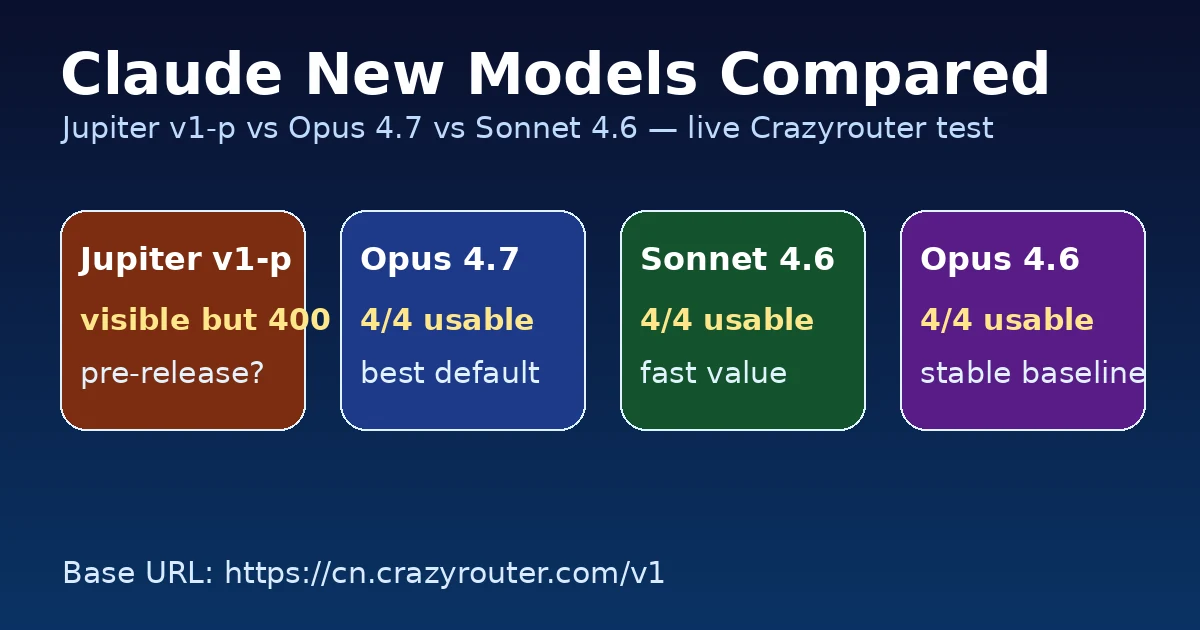
Claude Jupiter v1-p vs Opus 4.7 vs Sonnet 4.6 live comparison cover

Quick answer#

claude-jupiter-v1-p is visible in the Crazyrouter /v1/models list, but in our live Chat Completions test it returned 400 invalid_request for every task. That makes it interesting to watch, but not production-ready in this API path yet.

Among the working Claude models:

  • Claude Opus 4.7 is the safest premium default for complex coding and agentic workflows.
  • Claude Sonnet 4.6 is the best daily-driver option when you want strong coding output with lower latency and better cost discipline.
  • Claude Opus 4.6 remains a stable baseline, but in this run it was slower on structured JSON than Opus 4.7 and Sonnet 4.6.
  • Claude Jupiter v1-p should be treated as a watchlist / pre-release model ID until it returns successful content through /chat/completions.

The practical production rule is simple:
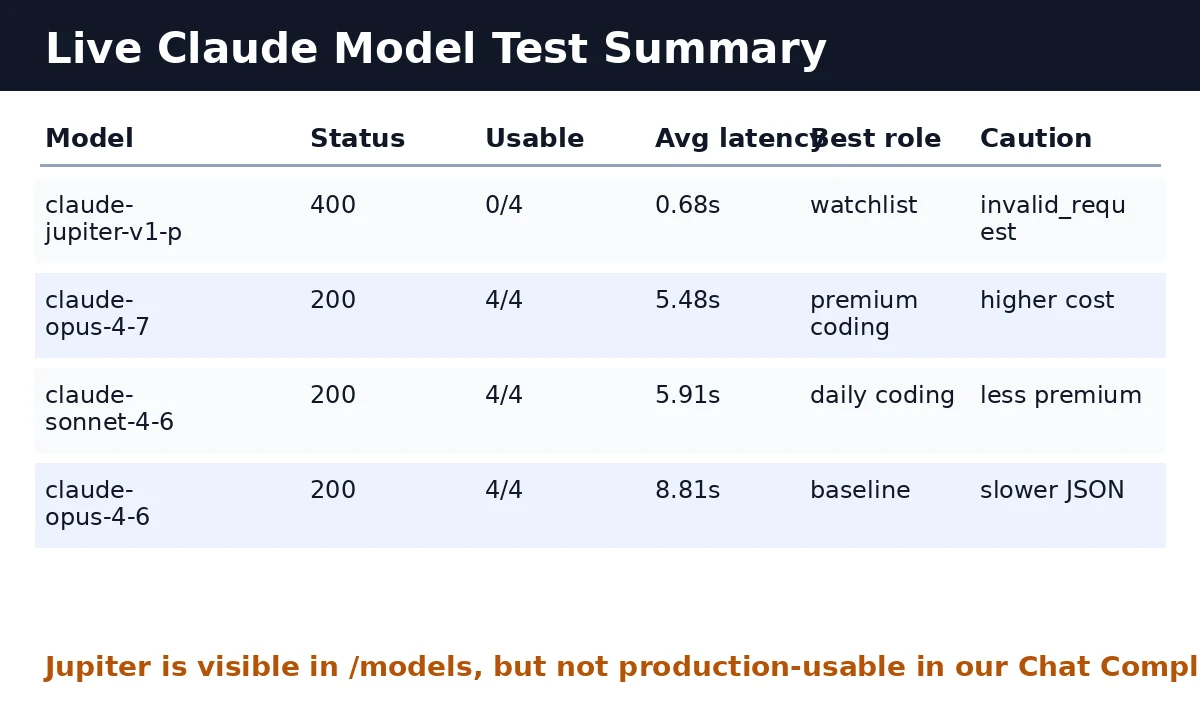
Live Claude model test summary table

SERP research: what people are searching for#

Before writing this article, we checked current search results for Claude Jupiter, Claude Opus 4.7, Claude Sonnet 4.6, and Claude model benchmarks.

The current pattern is clear:

  • There are rumor-style pages about claude-jupiter-v1-p appearing in testing or red-team contexts.
  • Official and semi-official pages emphasize Opus 4.7 as a stronger coding and agentic model compared with Opus 4.6.
  • Many benchmark pages repeat headline benchmark claims, but fewer pages show real API behavior through an OpenAI-compatible gateway.

That gap matters. A model can appear in a model list and still fail on a production endpoint. For developers, the first question is not “is the model exciting?” It is:

Can I call it successfully, get usable content, and route production traffic to it?

That is what this article tests.

Test setup#

All tests used Crazyrouter's OpenAI-compatible API:

We first called /v1/models. All four model IDs appeared in the model list:

Then we ran the same four tasks against each model:

  1. Retry patch — fix a Python retry helper with correct retry semantics.
  2. JSON schema — return a valid structured JSON object describing routing role, strengths, risks, and recommended use cases.
  3. Unified diff patch — generate a JS patch for topK(words, k) with empty-array handling and tie-breaking.
  4. Cost reasoning — explain when to route coding tasks to premium Claude versus cheaper fallback models.

Live test results#

ModelEndpoint statusUsable outputsAverage latencyResult
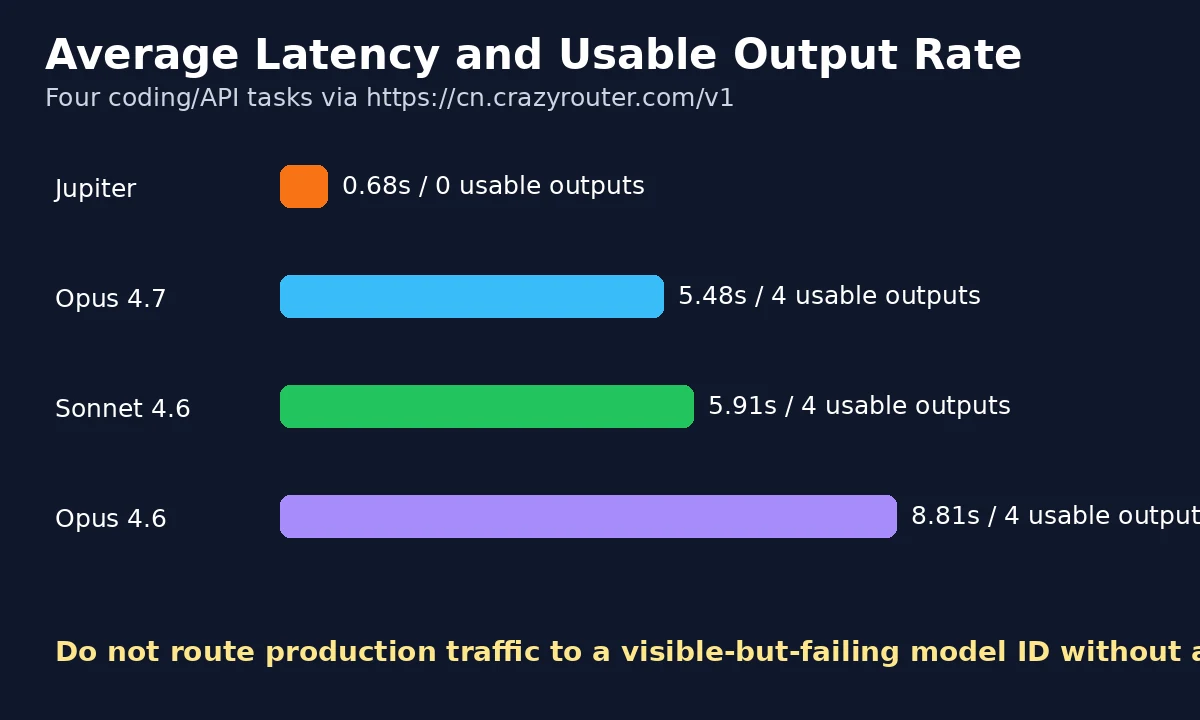
claude-jupiter-v1-p4000 / 40.68sVisible in model list, but failed all Chat Completions calls
claude-opus-4-72004 / 45.48sBest premium default for hard coding
claude-sonnet-4-62004 / 45.91sStrong daily coding model
claude-opus-4-62004 / 48.81sStable baseline, slower in this run

Average latency and usable output rate for Claude Jupiter, Opus, and Sonnet

The raw result file is saved internally as:

What happened with Claude Jupiter v1-p?#

claude-jupiter-v1-p was the most interesting result because it was visible but not callable in our test.

Every request returned HTTP 400 with the same error shape:

That means we should not describe Jupiter as a working production model yet, at least not through this Chat Completions path at the time of testing.

The correct interpretation is cautious:

  • The model ID exists in the model list.
  • The endpoint rejects normal chat completion requests.
  • It may be gated, pre-release, misconfigured, or require different parameters.
  • It should not be used in production routing until a health check returns 200 and non-empty content.

For model routers and coding agents, this is an important lesson: model discovery is not enough. You need live request health checks.

Claude Opus 4.7: best premium default#

Claude Opus 4.7 completed all four tasks successfully.

In this run:

  • retry patch: 3.24s
  • JSON schema: 6.91s
  • unified diff patch: 4.09s
  • cost reasoning: 7.69s
  • usable outputs: 4 / 4
  • average latency: 5.48s

The outputs were concise and production-friendly. It fixed the retry helper correctly, generated a usable diff, and produced structured planning output without empty-content failure.

This matches the role we would expect from a premium Claude model:

  • complex coding
  • production patch generation
  • high-risk agent steps
  • structured output
  • tasks where failure is expensive

The downside is cost. Premium models should not be used for every trivial task. They should be reserved for tasks where success rate matters more than raw token price.

Claude Sonnet 4.6: best daily coding model#

Claude Sonnet 4.6 also completed all four tasks successfully.

In this run:

  • retry patch: 2.20s
  • JSON schema: 8.23s
  • unified diff patch: 3.73s
  • cost reasoning: 9.49s
  • usable outputs: 4 / 4
  • average latency: 5.91s

Sonnet 4.6 was especially fast on the retry patch and unified diff tasks. It is the model I would use as the default for daily coding workflows where you still want Claude-level reliability but do not want to send everything to the most premium Opus model.

Recommended use cases:

  • routine bug fixing
  • unit test generation
  • code explanation
  • medium-risk refactors
  • CI helper tasks after validation
  • IDE assistant workflows

For many teams, Sonnet 4.6 is the practical default, with Opus 4.7 reserved for harder tasks.

Claude Opus 4.6: stable baseline, but slower here#

Claude Opus 4.6 also completed every task successfully.

In this run:

  • retry patch: 2.66s
  • JSON schema: 17.81s
  • unified diff patch: 4.20s
  • cost reasoning: 10.58s
  • usable outputs: 4 / 4
  • average latency: 8.81s

The main issue was the structured JSON task, where it took much longer than Opus 4.7 and Sonnet 4.6. That does not make Opus 4.6 bad. It remains a useful baseline and fallback model. But if Opus 4.7 is available at the same integration layer, Opus 4.7 looks like the better premium routing target.

For a production AI coding stack, I would not hard-code one Claude model everywhere.

A better policy is:

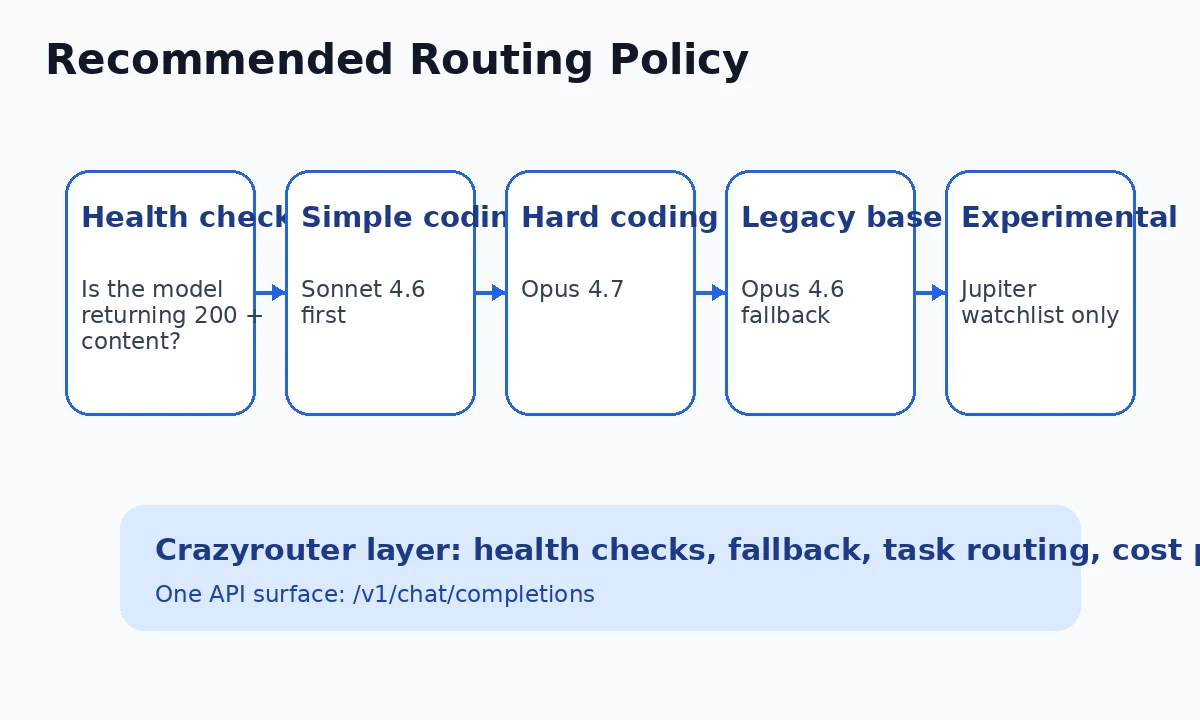
Task typeRecommended modelWhy
Model health checkall candidatescatch visible-but-failing IDs like Jupiter
Daily codingClaude Sonnet 4.6strong quality and practical latency
Complex bug fixClaude Opus 4.7better premium default
High-risk agent stepClaude Opus 4.7success matters more than token cost
Baseline fallbackClaude Opus 4.6stable backup path
Experimental testingClaude Jupiter v1-pwatchlist only until 200 + content

Recommended Claude model routing policy through Crazyrouter

Why this matters for Crazyrouter users#

Crazyrouter makes this kind of test useful because all calls go through the same OpenAI-compatible API surface:

The same code can test:

That lets you build a real routing layer:

  • discover available models
  • run health checks
  • measure latency
  • validate output quality
  • fallback when a model fails
  • avoid sending production traffic to a model that only appears available

Final verdict#

Here is the practical conclusion from this live test:

The headline is not “Jupiter beats Opus” or “Opus beats Sonnet.”

The real lesson is:

For production AI coding, always combine model discovery with live health checks, output validation, and fallback routing.

That is how you safely adopt new Claude models without breaking your coding agent or CI workflow.

FAQ#

Is claude-jupiter-v1-p available?#

It appeared in the /v1/models list during our test, but every Chat Completions request returned 400 invalid_request. Treat it as visible but not production-usable until live requests succeed.

Is Claude Opus 4.7 better than Opus 4.6?#

In our test, Opus 4.7 completed all tasks and had lower average latency than Opus 4.6. It is the better premium default based on this run.

Is Claude Sonnet 4.6 still worth using?#

Yes. Sonnet 4.6 completed all tasks and was especially fast on patch and diff tasks. It is a strong default for daily coding.

Which Claude model should coding agents use?#

Use Sonnet 4.6 for routine tasks, Opus 4.7 for difficult or high-risk steps, and keep Opus 4.6 as a fallback. Do not route to Jupiter until it passes health checks.

Why use Crazyrouter for Claude model testing?#

Crazyrouter lets you compare and route multiple models through one OpenAI-compatible API endpoint. That makes it easier to test availability, latency, output quality, and fallback behavior before production deployment.