


We all know the uncomfortable truth. No matter how many tools you buy or how mature your processes are, you’ll never achieve 100% prevention 100% of the time. Project Glasswing and Frontier models just made that truth louder.
In May 2026 Anthropic released the first public initial update on Project Glasswing. In roughly one month, partners found more than 10,000 high- or critical-severity vulnerabilities. Some teams saw their bug-finding rates jump by more than 10×. Mozilla fixed 271 issues in a single Firefox release. Cloudflare pulled 2,000 findings with a false-positive rate better than their human testers. The open-source community got hit with thousands more.
The bottleneck has moved and finding vulnerabilities is no longer the hard part. Fixing them at the same velocity as vulnerability discovery is an unrealistic task today.
The 2026 Verizon DBIR already showed the shift before Glasswing even landed: vulnerability exploitation became the #1 initial access vector at 31%, overtaking credential abuse for the first time ever. Only 26% of CISA KEVs (known exploited vulnerabilities) were fully remediated, and median time to fix climbed to 43 days. Frontier models are about to pour gasoline on that fire; the fundamentals matter more than ever.
Cisco ran its own experiment leveraging a variety of frontier models. Cisco scanned 1.8 billion lines of code across the portfolio against 25 languages in eight weeks. This work would have taken roughly eight years the old way. Cisco leveraged harnesses to improve the fidelity and was able to keep false-positive rate under 3%. Closer to home, the Government of Alberta used Claude to review 466 million lines of code across 27 ministries in about 20 hours. That’s not theoretical. That’s operational reality by an incredible team of practitioners.
So, what does this mean for the rest of us?
It means the “hope of a single control will save us” mindset is finished. We need to assume failure earlier and design for resilience and speed of detection/response. The same rational I have been pushing around layered defense and MITRE ATT&CK mapping. Assume breach to build better defensive outcomes.
Cisco has been leading the industry with thought leadership, innovation, and opensource.
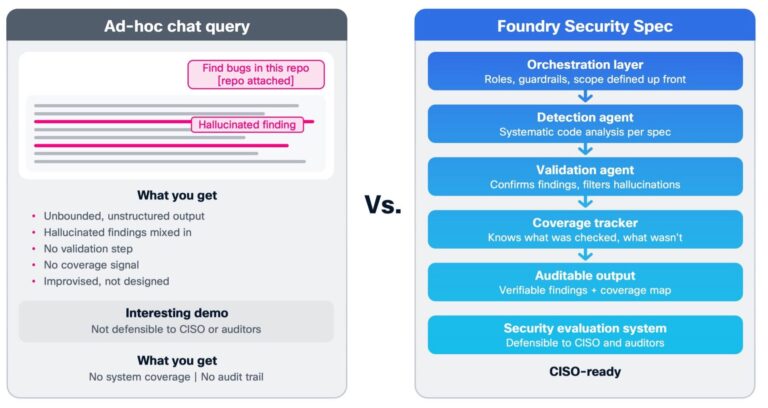
- Foundry Security Spec: a model-agnostic blueprint so teams can turn frontier models into something auditable instead of a noisy chat window. This allows organizations to build harnesses that fit their unique environment providing higher fidelity outcomes. This initiative was called out by Anthropic’s initial Glasswing report in May. Foundry-Security-Spec
- CodeGuard: is an open-source, model-agnostic security framework that embeds secure-by-default practices into AI coding agent workflows. It provides comprehensive security rules that guide AI assistants to generate more secure code automatically. Project CodeGuard
- Foundation-Sec-8B: Model Card: open-weight model that extends Llama-3.1-8B model through continued pretrained on a curated corpus of cybersecurity-specific text, including threat intelligence reports, vulnerability databases, incident response documentation, and security standards. It has been trained to understand security concepts, terminology, and practices across multiple security domains. The model is designed to serve as a domain-adapted base model for use in applications such as threat detection, vulnerability assessment, security automation, and attack simulation. Foundation-Sec-8B
- Antares: small, open-weight models that actually localize known vulnerabilities inside large codebases without sending your source to the cloud. 🌟 Antares
- DefenseClaw: Security governance for the entire AI agent lifecycle. Scan skills and MCP servers before admission, inspect prompts and tool calls at runtime, pause risky actions for human approval, and export the evidence to your existing security stack. DefenseClaw
- The LLM Security Leaderboard: so, you can see how models actually hold up under single turn and multi-turn attacks before you put them into production. Cisco LLM Security Leaderboard
Cisco’s own “Shields Up” guidance is pretty clear on the customer side:
- Strengthen the fundamentals (phishing-resistant MFA, least privilege including for agents, real asset visibility).
- Kill the end-of-life stuff that frontier models will chew through first.
- Automate detection, triage, and containment at machine speed.
- Put runtime protections closer to the workloads.
- Use AI for defense, not just discovery.
And yes, Cisco IQ is the practical place a lot of this comes together for customers. Continuous visibility, prioritized exposure, adaptive assessments, and the resilient infrastructure services that are built for the speed we’re now operating at.
Ask yourself honestly:
- Where am I still hoping that good enough is enough?
- Do you have the fundamentals in place and what should I prioritize?
- Have I mapped my current controls against the attack chain knowing the discovery rate just accelerated?
- If the adversary lands tomorrow with an AI-assisted exploit chain, how freely can they move?
- How resilient is my architecture and can I defend against vulnerabilities when patching is not available?
- Am I still treating modernization as a cost conversation instead of a security imperative?
The tools and the playbooks exist. The only remaining variable is whether we move at the speed the threat now demands.
I’d love to hear what you’re seeing in your environments especially around the remediation bottleneck. Drop a comment or reach out.
— Jason Maynard
Field CTO, Cybersecurity – Canada, Cisco
YouTube Channel