







You might’ve heard of the Internet Phone Book, a collection of poetic, interesting, personal websites, and essays about websites, collected by Kristopher and Elliott. We chatted about how the phonebook was made, and about why they’re optimistic about the web that’s made by real people and artists.
TLDR: Make a website, it’s good for your soul.
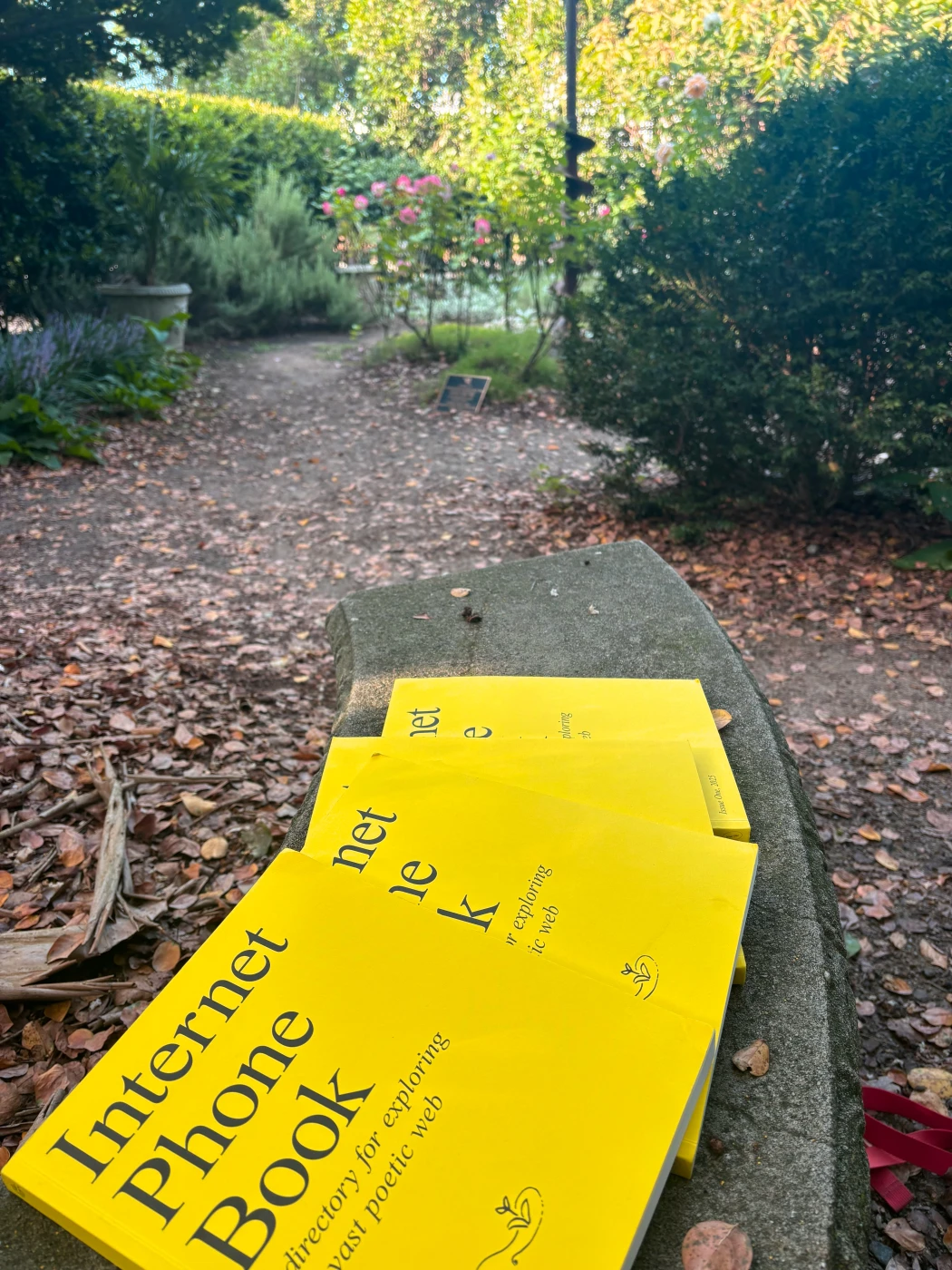
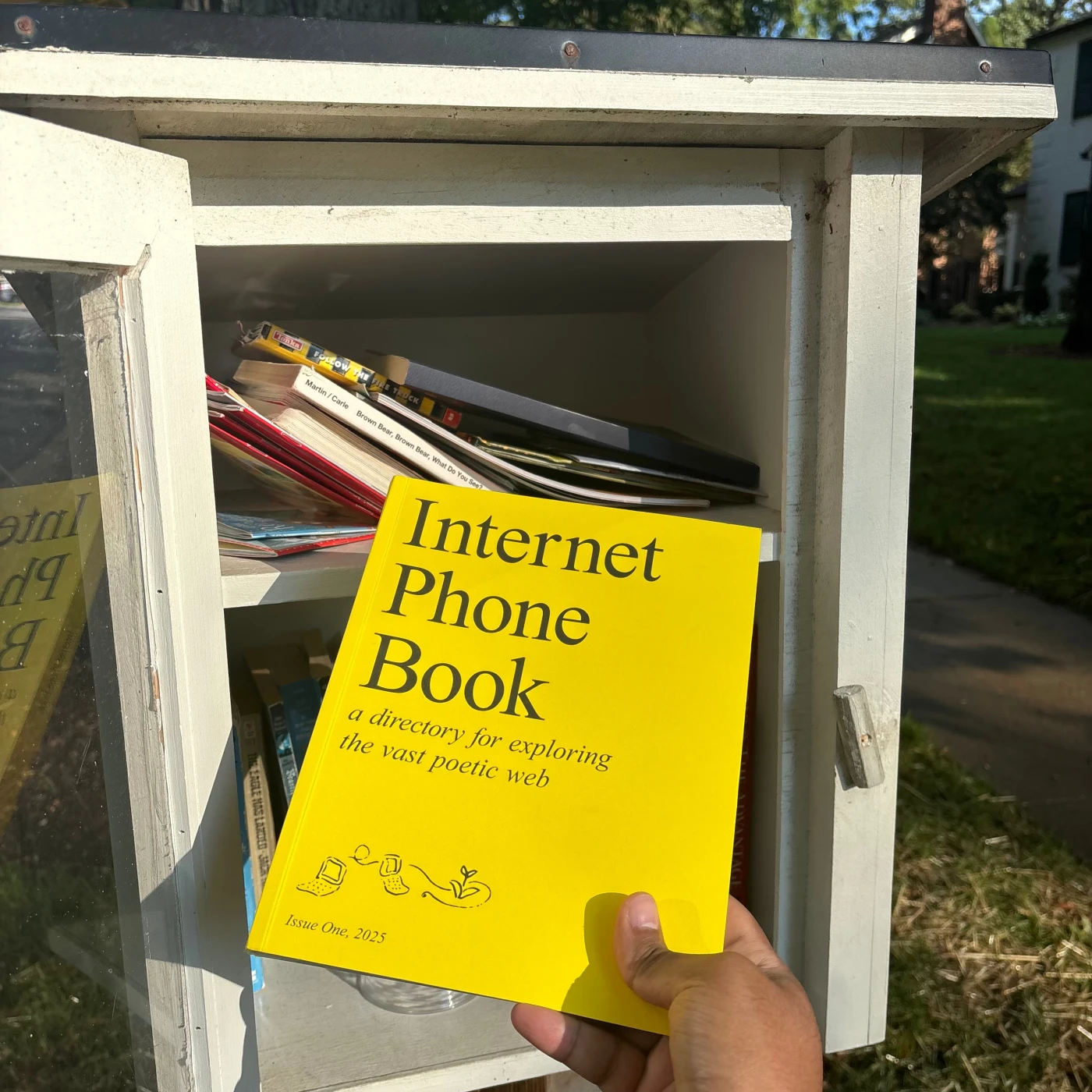
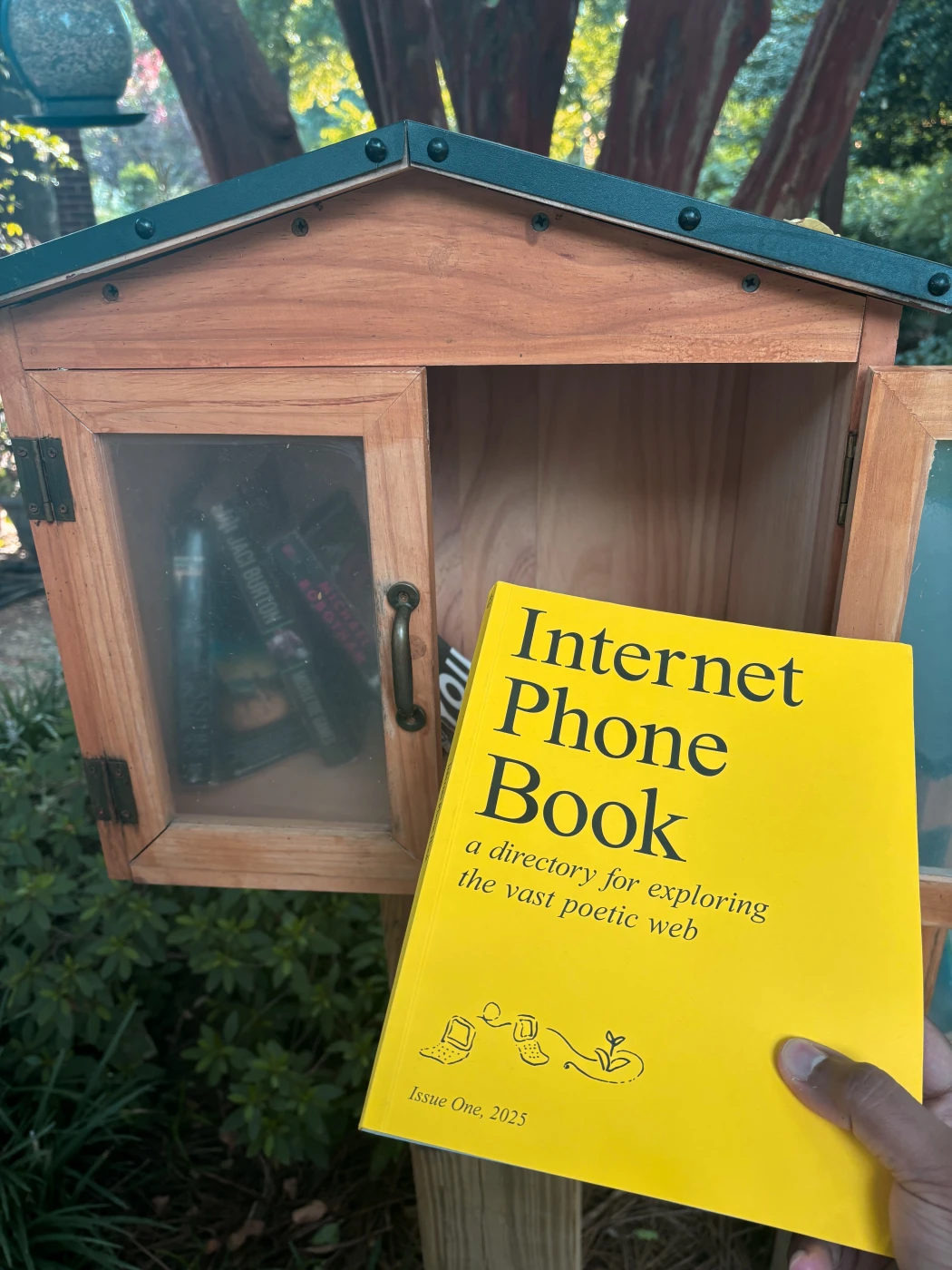
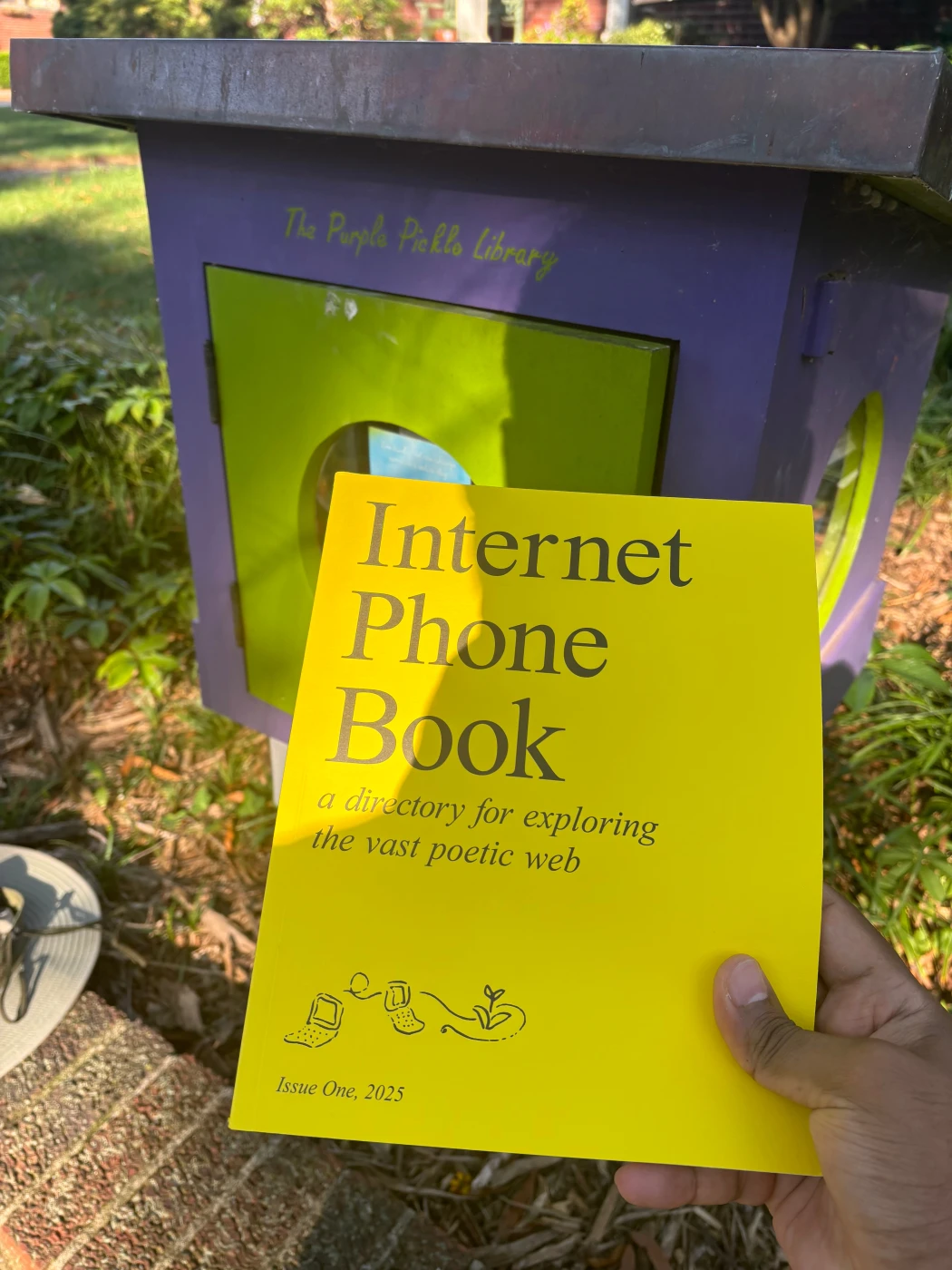
Right now, I’m living in Charlotte, NC. Beautiful weather, but not a place you’ll find many indie web enthusiasts. So I decided to drop them off in little libraries around town in the hopes that maybe someone new will have their eyes opened to the world of websites outside corporate control.
| Name | Info | |
|---|---|---|
| P | Piri | The proprietor of this website, and your host |
| K | Kristoffer Tjalve | Author, artist, organizer of naive yearly |
| E | Elliott Cost | Author, artist, sees the html.energy all around us |
P You describe the book as a directory for exploring the vast “poetic web”, not the “indie web”, nor the “blogging web”. Why the term poetic web?
Personally, I’m not sure that I’m part of the ‘poetic’ web. I don’t write poetry, but I do want the things I make to be beautiful in a way.
K Laurel Schwulst started to write that she was interested in the poetic potential for the internet. I believe this inspired Chia Amisola to name the Poetic Web. Now there are more people using it. For me, it’s not that the web has to be poetry. I don’t need to identify a particular grain and substance that these sites all share. Rather I like the term because poetry is less in-your-face, less trying to be right. It’s a bit more like asking questions. A little bit more suggestive. And I find that a way of describing the internet or the web that we engage with.
I also like that the reading of poetry requires a bit more work on the reader’s behalf. You need to kind of make up your own mind of how you interpret poems. If non-fiction leans more towards five-step guides, then poetry is more like the Oracle with arbitrary answers. I’d like that the web is something people feel agency to shape and participate in.
P So it’s more like poetry is like an art form, which websites can also be.
The internet phone book really reminds me of the original idea of Yahoo as a directory of websites. Hand-curated where some guy was like “oh there’s a new cooking website, better add that in”. Do you think there’s a place for a new Yahoo-style site with trusted links? Maybe as a portal-y destination for people to come back to? Like a wirecutter of websites, if you will.
E That’s kind of our intention with this book. In many ways we couldn’t take a conventional approach, like what worked in the 90s, when the directory served primarily as a utility. The phonebook speaks to a different time and context. The web is so vast that we can’t and didn’t want to fit it all into a book. Some artists have tried to print the internet, which is interesting, but in many ways we see the phonebook as a community-building project that connects people through printed matter. Starting small, and within the context of where we’ve already been working, felt important.
P It reminds me of the Famicase exhibitions where artists come together each year to print their own physical Nintendo™ cartridges displayed in a physical place, which brings a lot of artists together.
I’m wondering if most of these websites are fully hand-coded. To be part of the poetic web, is there a requirement that you write the HTML yourself?
E Not necessarily. I think it’s great when people are hand-coding their sites. There’s something beautiful about that, where you can see the human behind the site through the code or the design. But we want to be open to anyone, and we also included sites made through a web builder, which is fine as well.
K You’re hearing this from the organizer of HTML Day, which started as free-writing HTML on paper in parks, but I would say, to Elliott’s point, I never got an exclusive feeling, of one type being better than the others. With Elliott and Laurel’s HTML energy it’s just much more about putting your fingerprint on what you do, and I think you can do that with any tool. So it’s more like, can you feel that someone is actually behind this?
P Can commercial sites ever be a part of the poetic web? In the same way that you have Walmart, but you also have your neighborhood coffee shop, and they have a very different influence on the community.
E I think it was interesting how the advertisers in the book form their own organic software directory. The ads are a directory of companies that are doing good for the web, respecting people’s privacy, and staying small. They have more sustainable ways of keeping their businesses alive that are less extractive. So yeah, I think there’s definitely a place for commercial sites in the directory, and I think we’ll explore that more. Like, maybe you could have a small inline ad within the directory for people who can’t necessarily afford a full-page ad.
P Yeah, it’s not like Google where people, mostly bots, bid on adsense and if you win the bidding war your ad is displayed. In contrast to that, you know that to be in the internet phonebook you have to meet a criteria of non-shitty-ness – so there’s a sense of trust in the directory.
K And also we picked yellow which was originally like the commercial phone book. In many countries you would also have another phone book for residential numbers, in my birth country that was white.. But when you ask people “what color is a phone book?” They say yellow.
Buying ads are… let’s say, optimizing towards some very large companies. I wish there were other ways of finding your customers. And I think as Elliott said, I like your term of organic software. There are a lot of these kinds of companies on the internet, and I would love to help them also establish nice customer relationships. I think those are, like, the mom-and-pop stores of the internet, right?
P Yeah, it’s one of those things where the companies that need the help don’t have the resources for it, and the big ones that don’t have all the resources for marketing. But you reached out to me, to ask if I’d be interested in sponsoring and I thought that proactive outreach was really cool and helpful.
P
Before printing the book was there a point where you were like if we don’t get n feedback or reassurance then we won’t do this? Because a print run is an expensive commitment.
K We emailed potential sponsors to help us front the costs so at least we wouldn’t come up with a loss. And then that was actually really positive. You and other people that we wrote to were like “yeah sure, let’s do this, it sounds fun”. And I also wrote to a few bookshops to check if they would be interested in carrying it and some very nice bookshops said yes. So then we felt like, okay, it’s not gonna be a pile of paper that no one’s gonna look at, I think we can justify printing 500 copies.
P How did you decide on 500 as a number to print? Did it just feel right, or was there some other consideration?
K Because we wanted to do offset print, which gives a nicer look and is a nicer reading experience, the minimum order for that to make sense was 500. With printing you have these different levels, where beyond a few thousand it becomes more about the bookbinding than the printing cost because binding has different gluing techniques and the machines need different quantities. Anyways, I like doing physical stuff which has different constraints that are really fascinating.
P I’ve read a little bit about that from Craig Mod writing about his own membership books that he prints, and yeah, it’s pretty intense.
How successful has the phone book been? Especially compared to your past work?
E I’d say very successful – it sold out in less than 24 hours after the are.na article. I think we were a bit surprised by that. We would have printed more if we’d known that people really wanted this. So yeah, it’s been surprising, but also lovely.
P Sounds like the way is paved for future releases. Do you see the phonebook as a yearly periodical? You mentioned in the book itself that a lot of these URLs will be lost to time. Some domains will expire, they’ll be replaced by scam pages and whatnot, so in theory, there is effort required to keep everything up to date.
K Given the reception and how many people seem excited about it, I think we would love to keep it going and make it a thing for some time. The support has really been crazy, from the people reading, to the bookshops, to, of course, all the people featured in it. I personally find that the book hits all the things that excites us and it’s kind of easier to understand. Like if people ask me, “so what are you doing?”, and I say, “I do internet stuff”, and then they want to understand, now I can just give them this phone book and it kind of explains what it is, and we can talk through that. And it kind of exemplifies a lot of the virtues around what I’m doing, and that feels very exciting, so it would be really cool to keep it going.
I remember Olia Lialina, who also has an essay in the book, posted that the phonebook is kind of like the Whole Earth catalog of our time, which I think is a very sweet reference. It would be incredible to do anything remotely similar in terms of cultural importance. And I think there is something about living around or outside of the big tech company platforms that the phonebook could be a part of.
P Despite the name, I noticed the book is half traditional phonebook-style listings, and also half essays about the web in general. Do you think you’ll keep that 50-50 balance in future editions?
K Originally we planned to do this one book, and thought there would be 250 people and their sites in it. And then when we actually opened for submissions, there were like 700~. But then when we put them together in a column layout, we had maybe like 20 pages – which was not enough to look like and feel like a book. That led us to put in essays. But I’m very happy we ended up with that, because the book ended up in all these bookshops, and people have been picking it up who have no familiarity of the part of the internet we’re talking about, so the essays sort of work like a primer to that. So we definitely want to keep having essays in the future.
P How do you see the present and future relationship between the digital and real world evolving?
E Hmm… personally, I’ve been looking for what I’ve called off-ramps from the web to real-life spaces. I’ve been part of a lot of projects trying to explore this more, like HTML Energy with offline events, where people meet and write HTML together. Friends of ours, Benjamin Earl and Kirsten Spruit, who are part of Extra Practice, the studio I’m in, came up with the term coding in situ. It’s about working on technology that is situated in a physical place and has a sense of locality. I’m not really sure what these explorations will look like in the future, but I do hope that physicality is given more consideration. Think websites that don’t have to be “on” all the time and digital tools designed around physical, local spaces.
P What advice would you give someone like me, perhaps, who kind of doesn’t live in a cool city. Can they be part of the poetic web, too? It’s a little tough here because you wonder if anyone will show up.
K You can host your own HTML Day, we’ll help. We were also thinking that we would really like for the book to integrate with these local physical spaces. Like, what are the doors that you can enter in different cities around the world, where you can have conversations with people who are interested in this kind of the internet?
So, like, I think Extra Practice in Rotterdam is such a place, because we know the people there. There are like 5 members and all of them are interested in this. You have Bird Call in Seoul, and of course, these are bigger cities, but it would be nice to integrate everyone with a sort of ‘place directory’ in the phone book as well.
P And you guys are doing a book tour, which sounds pretty rock and roll. But I don’t know what a book tour is, so what can visitors expect when they come by?
E It’s kind of based on the space and the organizers there, how they want to run it. So they’ve all been a little different.
K The Athens one was really nice, there were dear friends, but there were also strangers who came, some lived in New York. They came to get the book as it was sold-out online. So strange how the world works.
E I see it also as a way of meeting people, having conversations about the web, our hopes and dreams for it and such.
P Speaking of, are you optimistic or pessimistic overall about the internet’s future?
K I’m very optimistic. I continuously meet more and more people doing very meaningful things on the web. When I started writing Naive Weekly, which was, I guess was 6 or 7 years ago, I would just write all the same things that everyone else did, often critical stuff about big tech. And then at some point, I was like, okay, I need to stop just criticizing, I need to find out what I really like, and it started a long journey…
Now I keep finding new cool digital publications, or conferences and events related to this. So many people are doing such cool things outside the few big platforms. I find it really very exciting,
E It also feels like maybe in the last two years, things have shifted a bit, especially with what happened to platforms like Twitter and the people looking for other spaces to be online. But in some ways these other online spaces are all the same, which is a little disheartening. But then I’ve seen a lot of people kind of go deeper and ground themselves in their websites, which has been super inspiring. They were just like, “I’m gonna spend some time just really building out my website, and adding all the features that I want, or that I’ve always dreamed about”. It seems like there’s more mental space for that now.
P Lately, there seems to be way more people who want to get off social media, but they also feel addicted to it. They’ve identified a problem in their lives, but to fix it they usually try things like setting a timer or something, which to me sounds a bit like “I have a problem with cocaine, so maybe I’ll limit it to 30 minutes a day”.
But I think an actual solution could be … make a website. I’ve found that by just grounding myself more in this blog it kind of takes away my interest in social media. I still post on it, but I don’t really care about the feeds, because I have my own site and other people’s blogs to wander in.
E It’s definitely better to be addicted to your website than social media. And not everything has to be public too.
K Social media made it very easy for us to feel like we were staying connected with people, like they’d surface our friends when they have birthdays and stuff like that. But I think that we also forgot some of the important things about being a human, which is to also remember the people we care about and show up for them. Once you start to do your own website and you realize that, oh, people don’t just automatically come there, it’s kind of a good reminder that it takes a little bit of effort to go to other people’s sites and see what they’re doing – like checking in on them.
Also websites have longevity. They’re a longer commitment than a social media post, and I think the pace is more healthy for humans. Like, tending to a website is more aligned with what it means to live a fulfilling life.
At the time of this writing the Internet Phone Book is now back in stock.
The Internet Phonebook is currently sold out.
此内容由惯性聚合(RSS阅读器)自动聚合整理,仅供阅读参考。 原文来自 — 版权归原作者所有。