






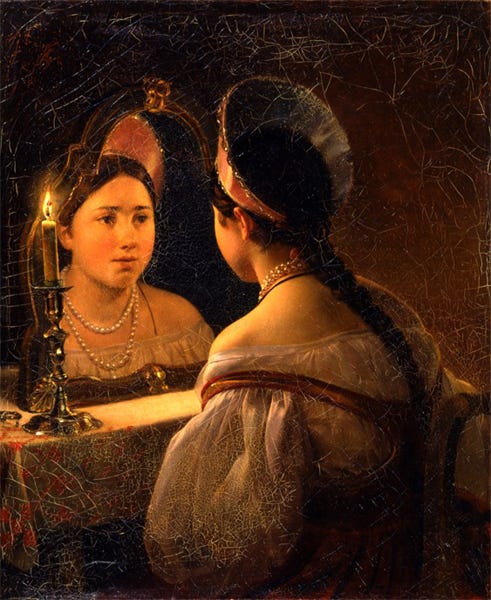
Svetlana at fortune-telling by K.Bryullov, 1836
Mirrors have a powerful effect on people who have only seen their reflection in stll water. Individuals recognize themselves immediately, but that's just the beginning.
Anthropologist Edmund Carpenter presented mirrors to indigenous people in New Guinea, and noted that they were intensely curious about them, and they underwent a series of shocks. These same shocks occur in other cultures, too:
Recognition shock. Realizing it’s your face. Followed by testing and play. This is a human universal, and holds true for several non-human animals, including apes, dolphins, elephants (and maybe mice, manta rays, and perhaps even ants.)
Grooming. Using the mirror to apply makeup, face painting. Societies that get universal access to mirrors typically go through a phase of obsession with personal adornment and identity. If mirrors are more rare they become objects of high status and trade value.
Moral Framing. Sometimes an elder will use the mirror to drive home an ethical or moral point. Socrates told young people to look often into a mirror, and “if they were handsome, they should not disgrace their beauty by evil conduct, and if they were ugly, they should counterbalance the defect by their accomplishments.” (Lives of Eminent Philosophers II.33)
Spiritual Uses. Some Greeks participated in catoptromancy, a kind of divination using mirrors, which was later condemned by the church.
Normalization. This is the mode of interaction we’re familiar with, where the mirror is just an ordinary tool and part of our personal grooming routine.
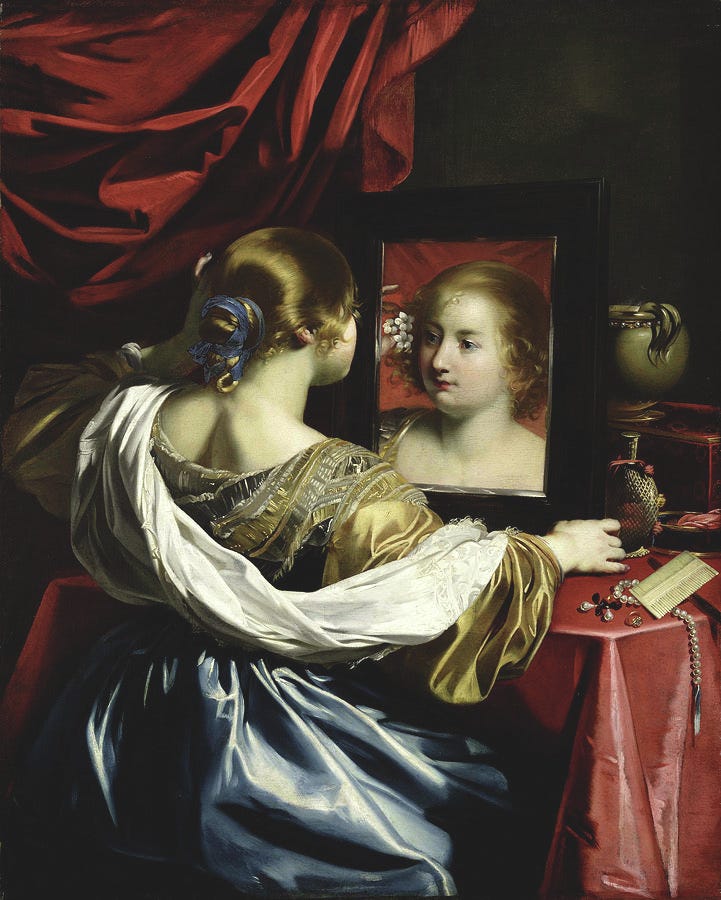
Young Woman Looking in Mirror by Nicolas Regnier
Carpenter on the “shocks” of first mirrors
In Oh, What a Blow That Phantom Gave Me! (1972), Edmund Carpenter recalls giving mirrors to people in Papua New Guinea’s Sepik region:
“The visual shock was overwhelming. After the first startled recognition, came testing. They grimaced, danced, made faces. They examined their teeth, painted themselves, laughed or cried. Some hid the mirrors, as if they were too dangerous, others traded them as treasures. … The mirror provided an image of the self, detached and external, and this provoked not vanity so much as metaphysical unease.” (Carpenter 1972, pp. 118–120)
What looked to early European observers like narcissism was in fact a deeper confrontation or encounter with a person’s identity. The mirror was a shock because it externalized the self.
A mirror gives us an image without substance. It is never a neutral object to someone encountering it for the first time. It can be a goad to virtue, a diagnostic of fate, or a glimpse of another order of reality.
此内容由惯性聚合(RSS阅读器)自动聚合整理,仅供阅读参考。 原文来自 — 版权归原作者所有。