








You first see it from a distance. A concrete slab spanning the boulevard, across the flow of traffic below, drawing the eye above. I like the building. Its simple forms and material use. You can often reveal more by doing less.
This sense ends once entering the space and looking at the work. The building overpowers it all. Viewing work against the unfinished concrete walls strains the eye. Robert Irwin, when producing large abstract canvases nine miles to the west and sixty years in the past, fell into an obsession with cracks in the wall. The effect it had on the perceptual quality of the work. This building would be his nightmare.
Glass envelops the volume, natural light spills in from all angles. I prefer natural light when viewing work, but only when diffused from above. The Dia Beacon sets the gold standard. But from the side? No thanks. Oil canvases become unviewable due to glare. LACMA tries addressing this with fine drapes, strategically missing in areas as to not obscure the view of the surrounding hills. A complex and distracting moire pattern appears when drapes overlap.
Wandering the floor leads to disjointed confusion. One moment you’re looking at Egyptian artifacts, one unguided turn and, surprise, a Monet. It becomes evident that the openness of the space has been designed around the view outside, not what’s on view inside. Line of sight for the camera takes priority over seeing the work. Los Angeles is the land of the image, no exceptions found here.
As disorienting as this is, sometimes luck finds you. A Studebaker sits in the sunlight in cherry condition. Beside it a low plinth covered in layers on layers of auburn lacquer. Flecks in the paint reflecting the horizontal rays in all directions. Outside the exterior glass, parking lots full to the brim. A room dedicated to Finish Fetish hovering above gridlock traffic on Wilshire Boulevard… I’m into it.
Continuing to meander, I hook a left. “Plastic ‘is in essence the stuff of alchemy’, wrote French cultural critic Roland Barthes in 1957, invoking the malleable material’s almost infinite transmutability.” I’m excited about this. “Plastic” is my favorite essay by Barthes, and I think of it frequently concerning material use. Specifically when designing interfaces for screens.
The room was full of plastic objects, many produced in Southern California. A breastplate cast in plastic by Issey Miyake. A naturally unnatural object to exhibit in Los Angeles, the land of plastic tits. The air conditioning gently excites a dangling tapestry. Nylon monofilament, multi-layered nylon micro-slit film, aluminum vacuum-coated polyester, titanium-oxide vacuum coated micro-slit film. Now that’s the stuff.
Small Cloud Box refracts the dim overhead light. A cast resin cube by Peter Alexander. June gloom, in a cube, in a room, in a museum, in June gloom.
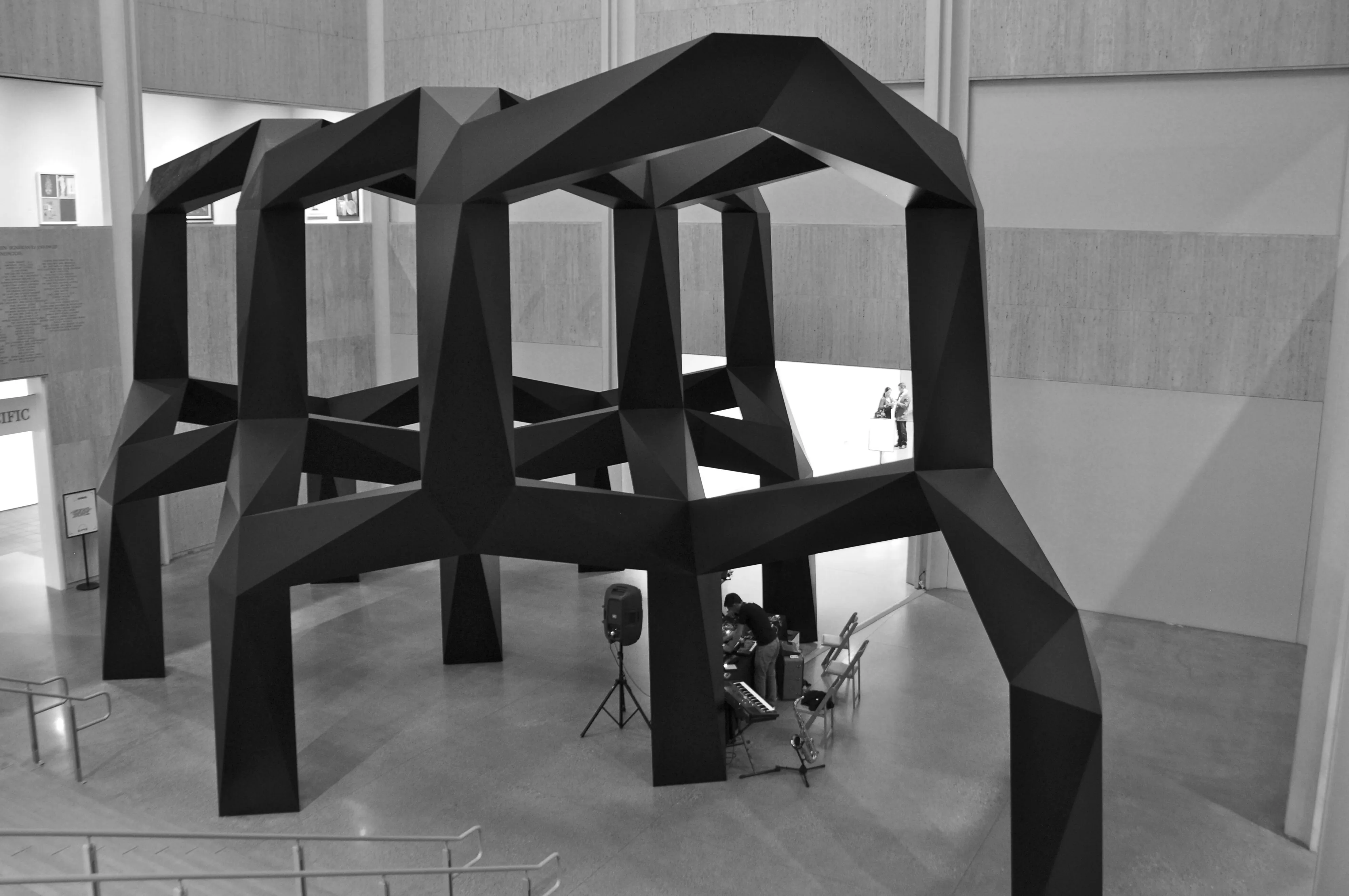
Exiting down the stairs back to street level. My last time seeing “Smoke” by Tony Smith was when performing beneath it over a decade ago during an evening of Dublab Programming. It was the focal point when entering the original William L. Pereira structure. I remember being instructed to carefully negotiate movement around it. Now installed outside, fresh bird shit bakes in the afternoon sun on the tessellated black surface. I like the increased accessibility.
I also like the building. But it’s terrible for viewing work. A building for the image.
Cross the courtyard and up the escalator to the Broad contemporary. Magritte’s “The Treachery of Images (This is not a Pipe)” on the opposing wall. Part of the permanent collection, I had first seen it shortly after moving to Los Angeles. A pipe painted on a canvas, with the words “this is not a pipe.” I remember reading about it. “An image is simply a representation of an object, not the thing itself.” This was a new idea to me. Simple but true. Seeing it now, I think of how often a thing is confused for something it isn’t, and how this confusion moves and changes through history.
“The Treachery of Intelligence”
The Guston hits. Love to see Sol LeWitt. I’ve never seen a copper Judd wall box. A canvas with three horizontal lines. Two white, one yellow. Robert Irwin. “I painted a total of twenty lines over a period of two years of very, very intense activity.” The best. I hadn’t seen any Bob since some scrims at the Dia. “Seeing is Forgetting the Name of the Thing One Sees” is an all time favorite. Don’t call it a pipe? Don’t call it intelligence? Just see.
Ducking behind a black curtain, feeling my way along the edge of a hot, loud, and deeply dark room. Towering machines with light spilling out of them consume miles of film on display, zagging all over the place. The mechanical complexity and precision of these old analog machines reveal the mechanics of the image. I’ve never seen analog projectors of this scale this close. I see what inspired Paul Virilio when writing “War and Cinema: The Logistics of Perception.” How the mechanical advancements of the automatic machine gun made possible the motion film camera. Both shoot, one a round of bullets and the other a canister of film. The mechanics largely the same. One leads to the other, feedback takes hold.
War and cinema. War and image. I think back to Magritte, and how my mind continuously wanders these days to the nature of intelligence. This afternoon plays out as the government puts export controls and is revoking access to the latest foundational models like Fable, Anthropic’s flagship model. War and intelligence. How does intelligence fit into all this? We’re presently at an equivalent moment to when projectors were the size of rooms. Images no longer static, no longer paint on canvas, but put into motion. Tricking the eye into seeing something that isn’t there. Seeing a thing for what it is can be quite hard.
At least twenty minutes have passed since entering the room before looking at the images being projected. Violent images, none of them real. Just images. I watch the volumetric light made visible in the haze.
Thanks Mag for reading a draft of this.
此内容由惯性聚合(RSS阅读器)自动聚合整理,仅供阅读参考。 原文来自 — 版权归原作者所有。