惯性聚合 高效追踪和阅读你感兴趣的博客、新闻、科技资讯
阅读原文 在惯性聚合中打开

推荐订阅源

爱范儿
爱范儿
Know Your Adversary
Know Your Adversary
Google DeepMind News
A
Arctic Wolf
P
Privacy & Cybersecurity Law Blog
云风的 BLOG
云风的 BLOG
Stack Overflow Blog
Stack Overflow Blog
V
Visual Studio Blog
Project Zero
Project Zero
L
LangChain Blog
N
News and Events Feed by Topic
博客园 - Franky
Last Week in AI
Last Week in AI
cs.AI updates on arXiv.org
T
The Blog of Author Tim Ferriss
宝玉的分享
宝玉的分享
Scott Helme
Scott Helme
T
The Exploit Database - CXSecurity.com
P
Proofpoint News Feed
Blog — PlanetScale
Blog — PlanetScale
www.infosecurity-magazine.com
W
WeLiveSecurity
月光博客
月光博客
博客园_首页
美团技术团队
CTFtime.org: upcoming CTF events
freeCodeCamp Programming Tutorials: Python, JavaScript, Git & More
腾讯CDC
Latest news
Latest news
WordPress大学
WordPress大学
cs.CV updates on arXiv.org
Spread Privacy
Spread Privacy
Attack and Defense Labs
量子位
L
LINUX DO - 热门话题
C
CERT Recently Published Vulnerability Notes
Webroot Blog
Webroot Blog
L
Lohrmann on Cybersecurity
aimingoo的专栏
aimingoo的专栏
T
Troy Hunt's Blog
Security Latest
Security Latest
小众软件
小众软件
Cloudbric
Cloudbric
Hacker News: Ask HN
Hacker News: Ask HN
S
Secure Thoughts
雷峰网
雷峰网
T
Threat Research - Cisco Blogs
H
Hacker News: Front Page
IT之家
IT之家
Simon Willison's Weblog

Ye Olde Blogroll — Firehose

kottke.org Outside My Window | A Blog of Birds & Nature with Kate St. John Via Negativa The Wallflower Digest baty.net Miskatonic University Press | William Denton Transactions with Beauty Britney Winthrope Z1NZ0L1N Amerpie by Lou Plummer 75CentralPhotography Home :: Sacha Chua Blog – Harold Jarche Doug Jones Tom Van Winkle's Return to Gaming Adactio: Jeremy Keith ooh.directory: a place to find good blogs that interest you Sal's whygodwhy – idk! fine! whatever! who cares! shut up! uncountable thoughts Murmurs Dr Robert N. Winter Who's the Real Loser? Shady Characters Ludicity Notes Without a Thesis Robin Monks - Technologist, AI/ML, Healthtech David Smith, Independent iOS Developer Homepage - blakewatson.com Ploum.net Oatmeal Midnight Reading oh, hey Brian | Brian Bennett blog 2026 | baccyflap.com - a delicate blend of bakelite and fear Our Adventures in Japan Jack's Space | Everything happens for the best Matt Lakeman jzhao.xyz Home - Stephanie Stimac's Blog マリウス Gingerly thoughts on ecology, culture, travel, photography, walking and other ephemera blast-o-rama. Quiet System - sink on uwu SchwarzTech Home ophanim's chariot Navendu Pottekkat - The Open Source Absolutist …time is what you make of it… Ron Seems Sentient Stuffed Crocodile Notes Sympolymathesy, by Chris Krycho Hosentaschenblog Charlie's Diary meyerweb.com Paul Johnson Refugio Norte linkedlist → bits and bytes about the Web New Ideas Blog - Gustavo Ribeiro Marius Masalar Mi blog Domain registered at WHC.ca Tyler Hellard - Pop Loser cedmax Jean Kapsa https://www.feadin.eu/en/ Garbage Collector Brian DeVries Grant Petersen's Blog The Artist’s Notebook Dan Cohen – Vice Provost, Dean, and Professor at Northeastern University 12XU | Verspannungsmusik! denisdefreyne.com Welcome | Chris Smaje Alex – Le site Internet d'Alex Sirac. cultural snow fLaMEd fury homepage A Shroud of Thoughts Ryan Reid Illustration + Design Don't Worry About the Vase Amy Goodchild Songs on the Security of Networks Protesilaos, also known as “Prot” GitHub - uxai/non-profit-bloggers: A repository of blogs by bloggers who blog for the joy of writing. 👋 Hi! Joe Van Cleave's Blog Amit Gawande Paul's Beer & Travel Blog Steve Best West Coast Stat Views (on Observational Epidemiology and more) Darknet Diaries – True stories from the dark side of the Internet. SEAN BONNER Artist, Instructor, using only Free/Libre and Open-Source software since 2009. Along the Ray Chris Aldrich | BoffoSocko 印记 | Live a life you will remember. Herman's blog
The Homebound Symphony – Stagger onward rejoicing
hello@manuel · 2024-04-14 · via Ye Olde Blogroll — Firehose

I am neither an optimist nor a pessimist. Jesus Christ is risen from the dead!

— Lesslie Newbigin

To hope radically is to see the new possibilities for human flourishing where none seemed possible before. […] Radical hope, as I have been defining it, involves a deep confidence that there is a way of living meaningfully in this world, even when one does not yet have the concepts to understand what that meaning might be.

— Jonathan Lear

Hope in challenging times can’t be easy, can’t come naturally — that would be whistling past the graveyard. It requires us to, in Auden’s words, “Look on this world with a happy eye / But from a sober perspective.” We have to practice critical hope. How to do this? It’s something I have been writing about for years, and the key point is to refuse to take refuge in our familiar categories. We must make a point of not knowing where we are going, and improvise in trust. See:

When classes ended in May, I was with my wife in the hospital, so I couldn’t wrap up my classes appropriately. Instead, I recorded brief audio lectures. Below you’ll find a transcription (with links added) of the lecture I sent to my class on Fantasy. I have resisted the temptation to clean it up, to nuance my arguments, etc. This is almost exactly what I said, for better or worse. 


In one sense, as I told you back at the beginning of class, fantasy is the normal or typical mode of storytelling. If you go back to the Odyssey, or if you go even further back to the Epic of Gilgamesh, you have gods, demigods, supernatural forces, witches, haunted forests, people with superhuman strength — the whole package, basically. And that is the mode. You still see that mode of storytelling — not as dominant, but you still see it — in the sixteenth century, in, for instance, Spenser’s Faerie Queene. You have, of course, as I described in class, all those border ballads, like “Thomas the Rhymer,” from anywhere between the twelfth and the sixteenth century. (All this just in Britain: there are comparable events elsewhere in Europe.)

And then what happens with the emergence of what Charles Taylor calls the Modern Moral Order, in which we are perceived as rational and sociable creatures operating within what Taylor also calls “the immanent frame” — that is, without reference to transcendence — is that we get novels. The genre of the novel emerges, and it is about rational, sociable beings living within the immanent frame. The transcendent, the supernatural, the miraculous, the magical are all ruled out. And not long after people began to feel that this account of human life was too constraining; thus you began to see the re-emergence of the fantastic in literature.

So, for instance, just at the time that the English novel reaches its pinnacle in the writings of George Eliot and Charles Dickens, we get the creation of modern fantasy. This happens in part — and I don’t think I talked about this much in class — through a restoration of fairy tales and folk tales, their discovery by researchers into folklore. (This was pioneered by the brothers Grimm in Germany.) All this is also, by the way, a kind of response to the MMO: a sense that the traditional lore that has been left behind by modernity is valuable, or at the very least interesting. These anthropological enquiries remind people of all the old stories. You also get a recovery of interest in medieval literature — in things like Beowulf and Sir Gawain and the Green Knight (perhaps especially because they were so nearly lost). So there are scholarly resources available for people who want to reclaim certain earlier forms of storytelling.

Now, some people want to do this for reasons that have nothing to do with Christianity or indeed with religion of any kind. William Morris, for instance, whose epic fantasies had a great influence on Lewis and Tolkien, was really interested in the lost culture of the Middle Ages, which he felt was a more organic and unified culture, ruled by relationships rather than just money, and he wanted to restore the attitudes and practices of that lost world. But for MacDonald, as we saw, fantasy is really about trying to make Christianity plausible to people — about opening up their imaginations. Lewis would say later that reading MacDonald, which he did when he was an atheist, “baptized my imagination,” and that was exactly the sort of thing MacDonald wanted to do. So we saw that in fantasy there is a way of approaching Christian faith and belief from a peculiar and unexpected direction. It is rarely explicitly Christian, because its explicit materials are those from pre-Christian Europe. But it is moving towards, or encouraging people to move towards, the Christian faith. You see this in Tolkien, who said that his work was implicitly but very deeply Christian — and indeed specifically Catholic — and then of course in the Narnia books.

I think the Christian faith is deeply implicated in the Harry Potter books as well, which becomes explicit in the final book of the series. I wrote about that at some length here.

But in general, what we have seen in recent decades is a kind of repaganizing of fantasy. You certainly see that in the Earthsea books, which take no account whatsoever of Christianity, though I think Le Guin may have been influenced a little more by the Christian story than she would acknowledge, probably through the influence of Tolkien: Ged’s final struggle in The Farther Shore matches that of Frodo at many points. In general, however, Le Guin certainly does not see the world as morally and spiritually ordered in the way that it is in the Christian cosmos — I see no place for the Christian story in her work at all. And then, of course, it is traditional Chinese folk culture that plays a role in Ken Liu’s “The Paper Menagerie.”

I think that sort of repaganization is even true of Jonathan Strange and Mr Norrell — I say “even” because Susanna Clarke is a Christian. But what she is imagining is a world in which Christianity is decentered, in which there is another source of power that seems to have nothing to do with Christianity. In that sense, though, she may be following Tolkien’s lead. Tolkien, in imagining Men and Elves, seems to me to be suggesting that Christ is the savior of Men — but there is no indication of what becomes of the Elves, since Christ comes after the elves have left Middle-earth, and is Himself the reckoning with the sins endemic to men. Tolkien suggests that there is no reason to think God would use exactly the same means of redemption for all creatures made in His image. It is possible that the Elves are saved in some other way, and it is also possible that the elves are not “saved” at all — that God did not make them in order to have them united with him eternally. We do not know, and we cannot put constraints upon God in that respect. Clarke may be working in that tradition.

Nevertheless, with the possible exception of the Harry Potter books, as I survey the landscape of fantasy today it seems to me to have essentially rejected the use that MacDonald put it to. I find that regrettable and a little sad. But there is still a great body of wonderful fantasy that Christians can read, enjoy, profit from, and be spiritually enriched by, which is very good news. And the story of the genre of fantasy is not yet completed. I hope for the emergence of new Christian writers of fantasy who can do for their generation what Tolkien and Lewis did for earlier generations.

Thanks for joining me on this ride, and blessings to you all! 

ANZAC Cove troops shore Allied Dardanelles Campaign.

I see that The Rest Is History has recently done a series on what happened at Gallipoli in 1915, which as it happens is one of my obsessions. This isn’t a post about that campaign as such, but about two related things. 

~ 1 ~

The assault on Gallipoli was, of course and infamously, Winston Churchill’s idea. Its abject failure cost him his place as First Lord of the Admiralty and probably should have ended his political career. (Though if it had….) Andrew Roberts, in his biography of Churchill, treats this episode rather curiously. 

Churchill’s determination to pursue the invasion of Turkey through the Dardanelles, a plan which was based wholly — not partly, not largely, but altogether — on the assumption that when faced with the sight of British and French warships the Turks would run away, was strongly opposed by several members of the War Cabinet, but through sheer obnoxiousness Churchill finally got his way. When the invasion began to fall apart, as it did almost immediately, Churchill tried to disguise how bad things were, for instance by neglecting to inform his colleagues that a French ship had been destroyed by a Turkish mine, with over 600 sailors lost. But he did not control the flow of information, and more and more Cabinet members thought that Churchill — who was unrepentant and self-justifying, repeatedly claiming that the soldiers and sailors being killed were ones they could afford to lose — had to be sacked. The British press overwhelmingly agreed. It became increasingly clear that Prime Minister Asquith would need to form a coalition government in order to continue the war, but Andrew Bonar Law, the Conservative leader, also made it clear that the Conservatives wouldn’t serve in a government with Churchill. 

Admiral “Jacky” Fisher — the most respected British sailor — found Churchill’s plans so senseless that he resigned from the Cabinet (after repeatedly threatening to do so and repeatedly being talked out of it by Asquith). Here’s how Roberts describes what happened next: 

On Saturday, 15 May, Fisher did at last resign — his eighth and final attempt since rejoining the Admiralty. He disappeared and went to the Charing Cross Hotel to lie low, possibly after a period of meditation in Westminster Abbey. When No. 10 finally tracked him down, Asquith commanded him ‘in the King’s name’ to return to the Admiralty. Instead, Fisher sent the Prime Minister a long list of conditions, including the removal of HMS Queen Elizabeth from the Dardanelles and Churchill from the Admiralty, adding that the First Lord was ‘a bigger danger than the Germans’. Asquith told the King that the letter ‘showed signs of mental aberration’. Asquith was not about to be blackmailed and accepted Fisher’s resignation instead. 

But this of course was not “blackmail”: Fisher was simply saying that there were certain conditions under which he could not in good conscience serve. He thought Churchill was getting a great many men killed to absolutely no purpose — and he was right. He was also right not to accept the Churchillian view that such deaths were merely business as usual. But Asquith was desperate to keep Fisher on side because if he could not keep both Fisher and Churchill there would be hell to pay in the House of Commons, where Admiral Fisher had far more support than the First Sea Lord. Asquith rightly calculated that his government had little chance of surviving the enormous fight that was coming.

In his description of Fisher’s resignation, Roberts establishes a pattern: portraying those who disagreed with Churchill as mentally or morally deficient. David Lloyd George was then the Chancellor of the Exchequer: 

Lloyd George needed no persuasion to throw over his old friend and ally. The price of the Conservatives joining a national government was that Churchill should be sent to a sinecure post with no executive portfolio attached. ‘It is the Nemesis of the man who has fought for this war for years’, Lloyd George told Frances Stevenson that day. ‘When the war came he saw in it the chance of glory for himself, and has accordingly entered on a risky campaign without caring a straw for the misery and hardship it would bring to thousands, in the hope that he would be the outstanding man in this war.’ There was bitterness and jealousy in that remark, but little factual accuracy. 

There was neither “bitterness” nor “jealousy” in this — Lloyd George was a figure of far greater stature than Churchill — but rather sober judgment, and a judgment shared by nearly every member of the War Cabinet. Churchill had dug his own political grave and there was nothing Lloyd George or anyone else could have done to keep him from falling into it. “Throw over his old friend and ally” indeed. Had Lloyd George acted as Roberts wants him to have acted — defending Churchill at any cost — the government would surely have collapsed, and quickly.  

When Asquith told Churchill that he must go, Churchill wrote memo after memo (and got his wife Clementine to write a letter) pleading to keep his job, to all of which  

Asquith merely replied, ‘You must take it as settled that you are not to remain at the Admiralty… I hope to retain your services as a member of the new Cabinet, being, as I am, sincerely grateful for the splendid work you have done both before and since the war’. Asquith could treat Churchill harshly partly because the First Lord had so few supporters.

How “harshly”? This is a gentle and generous message, merely asking Churchill to bow to the inevitable, but reaffirming the P.M.’s admiration for Churchill and a desire to keep him in the Cabinet in a different role. Again, what does Roberts expect? That Asquith should allow his government to be brought down in order to protect Churchill from experiencing the consequences of his own decisions?  

Then, when Churchill is forced out: 

The King was delighted by the creation of a national government. ‘Only by that means can we get rid of Churchill from the Admiralty,’ he wrote in his diary. ‘He is intriguing also with French against Kitchener, he is the real danger!’ The Prince of Wales agreed, telling his father, ‘It is a great relief to know that Winston is leaving the Admiralty… one does feel that he launches the country on mad ventures which are fearfully expensive both as regards men and munitions and which don’t attain their object.’ It was for this feckless young man that Churchill would later nearly sacrifice his career. 

What bizarrely petty sniping. Whether the Prince of Wales, later Edward VIII, was or was not a “feckless young man” is altogether irrelevant. (That said, he was. And worse than feckless.) What Edward says here is precisely what virtually everyone in the government thought and — more important — what was actually true. After losing a quarter of a million men for absolutely nothing, Churchill’s only regret was that he was not allowed to throw even more men and matériel into the breach. “Not to persevere — that was the crime,” he later wrote. And though he said privately that he had ongoing nightmares over Gallipoli, there’s no evidence that the nightmares involved any remorse for lives lost. His primary public and private stance was that he was the real victim: 

Upon me more than any other person the responsibility for the Dardanelles and all that it involved has been cast. Upon me fell almost exclusively the fierce war-time censures of Press and Public. Upon me alone among the high authorities concerned was the penalty inflicted — not the loss of office, for that is a petty thing — but of interruption and deprivation of control while the fate of the enterprise was still in suspense. 

When his widow Clementine told Martin Gilbert that “The Dardanelles haunted him for the rest of his life,” she added: “He always believed in it.” That is, what perpetually “haunted him” was “deprivation of control.” Lloyd George’s comment that “When the war came he saw in it the chance of glory for himself” is largely corroborated by Churchill and Clementine themselves. 

Churchill would later become a great man. At this point he was not. He was a dynamic and brilliant but also erratic and egotistical man, and everybody knew it. Roberts’s relentless denunciations of those who correctly discerned Churchill’s flaws and acted accordingly are absurd. I stopped reading his biography at this point, because it was evident that he could not be trusted to make an fair assessment of any controversy surrounding Churchill — and there were many of those. 

(P.S. Once the Gallipoli campaign collapsed, of course Churchill, as its prime architect, had to go. But the plan never should have been approved in the first place. Asquith and the other members of the War Cabinet had allowed Churchill’s loony enthusiasm override their considered judgment — as, in the next war, Ike would endorse an equally senseless scheme from Monty. The ultimate blame should fall on Asquith: it would have been better for all concerned if Churchill had been overruled, after which he certainly would have threatened to resign. And if he then had resigned, Asquith would have been in a better position.) 

~ 2 ~ 

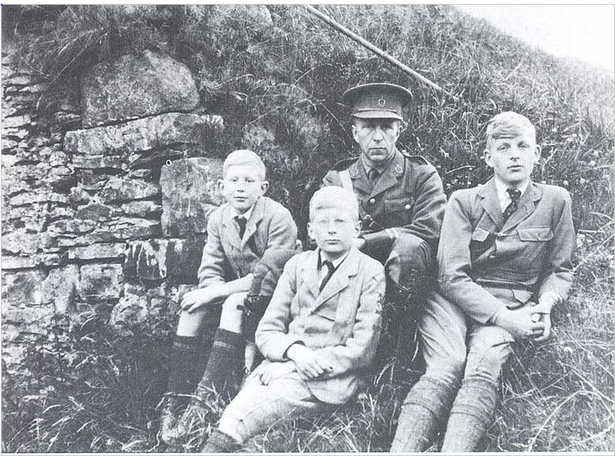
A long time ago now, I was doing research on Auden in the Berg Collection at the New York Public Library when one of the librarians mentioned to me that they had a good deal of Auden-related documents that had not yet been catalogued. Would I care to take a look at some of them? Indeed I so cared. 

I have forgotten much of what I saw that day, but one set of papers remains vivid in my mind, a series of letters that had been typed by Auden’s older brother John — but these were transcriptions John had made of letters written to the family by their father, George Augustus Auden. It does not appear that the originals have survived, which is a shame. Perhaps John transcribed them because they were in poor condition, which would be unsurprising, because they were written at Gallipoli in the midst of the campaign. 

GAA.png

Dr. George Auden had enlisted in the British Army soon after the outbreak of the war, to serve as a medical officer. (He was 42 years old at enlistment.) In that capacity he accompanied soldiers to Gallipoli, where he established and oversaw a field hospital, and his letters home relate what that experience was like. They make riveting reading, and perhaps the most noticeable thing about them is his change in attitude towards the soldiers among whom he serves. At the outset he describes them with an almost anthropological detachment: he writes about what “they” do, what “they” say. But gradually he becomes more and more a part of their world. In those desperate circumstances he is not just a doctor but also a stretcher-bearer, and at one point he lifts a wounded sergeant onto his back and carries him to safety. He injures his hand digging trenches — the commanding officers having decided that they might as well do on Gallipoli what was being done in Flanders. But at need he performs other work as well, for instance, ferrying shells to artillery gunners. And by the end of his chronicle he is no longer speaking of what “they” do and say: it is what “we” do and say. We fired at the Turks, and then peered over the sandbags to see if we had hit anything — that is a typical comment.  

I’ve been meaning for years to get back to the Berg and revisit those letters — they are worthy of publication, or at least of some scholarly attention. Some day, some day…. 

  1. I’ve bought a year of the Pro plan. At the end of that year I will do a thorough reassessment, and will not renew unless I can (a) identify significant ongoing needs, (b) continue to believe that Anthropic is not quite as corrupt as the other AI kaiju, and (b) reconcile my use with the energy and water demands of Anthropic’s datacenters. So my default is not to renew; I’ll need strong evidence to override the default. 
  2. I grew up spending a good deal of time with a much older cousin of mine in Cullman, Alabama named Claude Basenburg. A hefty, hearty good ol’ boy in overalls, with a wad of tobacco in his cheek. So when I visit claude.ai I don’t think of an omniscient counselor, I just envision my cousin from Cullman. It helps.
  3. No LLM will ever write so much as one word for me, though I do continue to allow it to clean up transcribed text from my voice recordings, e.g., getting rid of fillers and repetitions.
  4. Here’s a prompt I recently gave Claude Code, after pointing it at my folder of PDFs (containing about 1400 items): “I would like to have the unsorted PDFs moved into the folders that seem best suited for them, and to have all of the PDFs renamed according to the following practice: last name of the author followed by a short version of the title. For instance, a PDF now titled Between the sacred and the secular.pdf — without the author’s name in the title — should be renamed GordonSacredSecular.pdf.” It took Claude around 90 minutes to do this, since in many cases it needed to read the text to discover the author, and when the text didn’t have that info, it did web searches. Burned through a lot of tokens. Also, at one point it sent me this message: “The workflow failed on the first step — the agent choked trying to return 1,406 files as structured output in one shot. I’ll fix it by pre-processing the data outside the workflow and feeding agents pre-chunked batch files instead.” But in the end the results are very clean and, to me, extremely satisfying.

And two more things I’m reflecting on: an essay by Sara Wolkenfeld and Samuel Arbesman on AI use in the light of tikkun olam; and Mike Masnick’s thoughts on AI use in light of the need to re-democratize the internet: 

The leading frontier AI companies — OpenAI, Anthropic, and Google, with xAI, Meta, and Mistral close behind — have every incentive to run the same playbook that the last generation of internet giants ran (and yes, some are the very same companies): Build something useful, attract users, create lock-in, exploit the chokepoints. The enshittification curve doesn’t care what the underlying technology is.

But the same forces that make decentralized social protocols viable apply here, too. The models themselves are increasingly interchangeable — users of agentic AI tools are discovering that the underlying model is a small piece of the puzzle, and the real value lives in their own data, context, and accumulated knowledge, all of which can live in files and databases they control. And open-weight models are getting good fast. Models you can run on hardware you own are inherently not subject to centralized control. Every step toward AI centralization makes the decentralized alternative more attractive.

The choice in front of us is the same one that’s always been in front of us, just with higher stakes and less time: Do we let the next generation of tools get built around chokepoints, or do we insist on architecture that distributes power instead of concentrating it?

Antón Barba-Kay:

AI is not “inherently evil” in the sense that it can be used exclusively to bomb and oppress. But not even nuclear weapons or machine guns work that way. We are never caused to do anything by a tool (or a narcotic). There is therefore no trade-off between using Claude and “reading stories to a child” or “offering company to an elderly person” or the other activities that the encyclical commends to our attention as human. But that is just the problem, that even as the trade-off does not happen at the level of content, it cannot but take place at the level of formal tendencies. Almost no one idolizes AI, but the technocratic paradigm is a matter of form rather than content: a matter of habitual incentives that, once internalized, become practically imperative. And the Church has not yet recognized heresies of form. 

I wish I understood what Barba-Kay means here by “formal tendencies,” “heresies of form,” etc. But I think he might be thinking along the same lines I followed in this post on habitus, focal practices, and the virtues required for healthy praxis. I should perhaps revisit these thoughts, alongside a further inquiry into “diseases of the intellect.” The time seems ripe. 

A beat is a repeated sequence of percussive effects. A groove is an extended engagement with time. It takes certain musical skills to construct a good beat, but that’s a job you can outsource to a machine. There’s a different kind of musicality at work in a groove: you have an extended and ever-negotiated relationship to time that develops through the course of a song.

Stewart Copeland reminds us that when Ringo got demoted from being the drummer on “Love Me Do” — because the EMI people didn’t think he was good enough — he was allowed to play the tambourine. But, Stewart says, if you listen to the song you’ll notice that the tambourine is where the groove is. (Ringo really is the ultimate groove drummer. Well, maybe not ultimate: that would probably be Ziggy Modeliste.)

I think what’s happened in music over the past few decades is an increasing over-emphasis on beats and a de-emphasis of grooves. This is one of the reasons why, so often, when people want a groove, they have to sample it — because the Roland beat machine (or its purely digital equivalent) is not going to produce a groove. Also, what makes J Dilla so great is the way his microadjustments of tempo are always turning beats into grooves. That’s really an extraordinary skill.

If you think of the job of the percussion as being to establish and sustain a beat, you’re limiting the possibilities for what a drummer might do. Steve Jordan, the current drummer for the Rolling Stones, once commented that he didn’t really understand how to play in that band until he figured out that Charlie Watts wasn’t the guy who kept time: it’s Keef who keeps time, which allowed Charlie to play around the beat in ways that groove. For keeping time you might just use a drum machine, or, if you do have a drummer, make him play to a click track. But there are other musical possibilities.

Think, for instance, of Carly Simon’s 1971 hit “Anticipation“: a terrific song, wonderfully sung, but Andy Newmark’s drumming takes it to the next level. Note how musical his drumming is, how his playing mimics the theme of the song — especially in that first break where we’re, yes, anticipating the beat that comes a little later than expected. A studio drummer today is not going to be allowed to express that kind of musicality, with very few exceptions — one being JT Bates drumming for Big Red Machine, especially on “Phoenix.” (I chose the live version from Colbert’s show because you can see, as well as hear, Bates’s groove.)

We’ve traded in the groove for the beat, and we need to get our groove back.

My friend Edward Mendelson knows more about Auden than anyone ever has, and probably more than anyone ever will. Certainly he knows far more about Auden than I do. Keep that in mind through what follows.

Some years ago Mendelson wrote an essay about Auden’s secret acts of kindness and charity, an essay that contains this passage:

Auden’s sense of his divided motives was inseparable from his idiosyncratic Christianity. He had no literal belief in miracles or deities and thought that all religious statements about God must be false in a literal sense but might be true in metaphoric ones. He felt himself commanded to an absolute obligation — which he knew he could never fulfill — to love his neighbor as himself, and he alluded to that commandment in a late haiku: “He has never seen God / but, once or twice, he believes / he has heard Him.” He took communion every Sunday and valued ancient liturgy, not for its magic or beauty, but because its timeless language and ritual was a “link between the dead and the unborn,” a stay against the complacent egoism that favors whatever is contemporary with ourselves.

I think that Mendelson is wholly wrong about all this and I shall now explain why I think so. In making my case I will refer only briefly to the poems, in which Auden might be telling a story — a poet could write For the Time Being without believing that Jesus is the Incarnate Word, though I cannot imagine why one would — or playing a part. Instead, I will focus on public writings (some of them given as addresses or even sermons) in which he speaks in propria persona.

Let’s start with the haiku that Mendelson quotes, which certainly seems to contradict the view that “all religious statements about God must be false in a literal sense”: I see no reason to think that the haiku is an “allusion” to the commandment to love your neighbor. Rather, it means what it straightforwardly says: it is a report that Auden believes that he has “once or twice” heard the voice of God — a God he refers to with a personal pronoun.

And we have reason from other statements by Auden to conclude that he did not believe that “God” is a mere nom de convenance for the “absolute obligation” to love your neighbor. In 1966 he wrote,

Some modern theologians who have realised most clearly the death of Zeus seem to me in danger of depriving the True God of the one quality which he shares with the Zeus concept (and all polytheism), Personality, and presenting us with a crypto-platonic or Buddhist to theion which may be the subject of man’s concern but can show no concern for men. I can see clearly enough what leads Tillich, for example, to speak of God as the “Ground of Being,” but if I try to pray ”O Thou Ground, have mercy upon me”, I start to giggle.

Note the key assumptions of this passage: That there is a “True God” and that it would be a “mistake” to depersonalize that God — to turn Him into, for instance, an “absolute obligation.” It would seem, then, that for Auden it was a personal God who has “concern for men” or nothing.

Somewhat later he wrote,

The Gospels put the command to love God before the command to love our neighbor, not because it is more important, but because until we know who God is and how He loves us, we cannot grasp who our neighbor is or how we are to love him. The Word was made Flesh so that we might know, and the first thing which Christ forces us to realise is that the True God and the love he bears us are not at all what we expected or want: indeed, we thoroughly dislike both.

Emphasis mine. The love of God necessarily precedes the love of neighbor. I do not see how statements such as these can be reconciled with Mendelson’s view that Auden “had no literal belief in … deities” and that when he spoke of the love of God he meant it merely as a metaphor for the love of one’s neighbor. Moreover, given Auden’s starkly realistic portrayal of what it is actually like to perceive the love of God — as the author of Hebrews says, “It is a fearful thing to fall into the hands of the living God” — it is difficult to see why he would go to the trouble of invoking, describing, and commending such a God if he did not believe that God exists.

So how could Mendelson come to the conclusion he does? I think perhaps this passage, also from 1966, might shed some light on the subject:

At all times, the Gospel is a stumbling-block to the Jew and a foolishness to the Greek in each of us, but the particular element which scandalises varies from one age to another. To the Gnostics of the Third Century and to the liberal humanists of the Eighteenth, the scandal was the Cross. The former said: “Jesus was the Christ; therefore he cannot really have been crucified”. The latter said: “Jesus was crucified; therefore he cannot have been the Christ”. Today, we find Good Friday easy to accept: what scandalises us is Easter. Modern man finds a “happy ending”, a final victory of Love over the Prince of this world, very hard to swallow.

Again, in earlier centuries, believers were inclined to imagine that God was, in a human sense, nearer to them, more like them, than he really is and, consequently, were in danger of falling into idolatry and magical practices. Today, our characteristic religious experience is of God’s “otherness”, his distance from and unlikeness to ourselves, so that the temptation for us is atheism. For many of us, I think, Simone Weil’s remark holds good: “We have to believe in a God who is like the True God in everything except that he does not exist, for we have not reached the point where God exists”.

That line by Weil is one he returned to:

Those of us who have the nerve to call ourselves Christians will do well to be extremely reticent on this subject [the love of one’s neighbor]. Indeed, it is almost the definition of a Christian that he is somebody who knows he isn’t one, either in faith or morals. Where faith is concerned, very few of us have the right to say more than — to vary a saying of Simone Weil’s — I believe in a God who is like the True God in everything except that he does not exist, for I have not yet reached the point where God exists. As for loving and forgiving our enemies, the less we say about that the better. Our lack of faith and love are facts we have to acknowledge, but we shall not improve either by a morbid and essentially narcissistic moaning over our deficiencies. Let us rather ask, with caution and humor — given our time and place and talents, what, if our faith and love were perfect, would we be glad to find it obvious to do?

Now, what are we to make of these statements? Do they support Mendelson’s view?

  1. In the first passage Auden writes in general terms of “our” experience, by which he clearly means that of the modern person “today,” as opposed to figures from the third or eighteenth centuries. He does not explicitly say that this is his own experience, but I think the whole tone of the passage strongly suggests that he knows whereof he speaks.
  2. He expressly identifies this experience as a “temptation,” and of course temptations are to be resisted and if possible overcome.
  3. In the second passage the “lack of faith and love” is likewise described as a deficiency, a shortcoming — to be sure, not one to moan about: As he writes elsewhere, “The same rules apply to self-examination as apply to auricular confession: Be brief, be blunt, be gone.” But being blunt means acknowledging one’s deficiencies, admitting that one has succumbed to temptation. Everything about these passage indicates that it would be good to have strong faith in God and love of God and one’s neighbor.
  4. The slight amendment, in the second passage, of Weil’s provocative statement is noteworthy: Weil writes “we have not reached the point where God exists,” to which Auden adds one word: He imagines someone saying “I have not yet reached the point where God exists.” But to say “not yet” is to name faith as one’s goal, as the desired destination: it is hope for faith — and I would say that hope for faith holds already a modicum of faith itself. And I think Auden is acknowledging this in his late haiku, in which he says that he believes that he has heard God, as though to say: “Lord, I believe; help thou my unbelief.”

I said earlier that I wouldn’t say much about the poems, but here I do want to bring one of them in: “Friday’s Child.” Now, we know that Auden believed that Jesus of Nazareth was a real historical person who “was crucified under Pontius Pilate.” There’s a funny story Mendelson has told about a lecture that Joseph Campbell gave at Smith College, when Auden was teaching there, in which he spoke of the oneness of Jesus and the Buddha, each of whom had spears thrust at him, though in the case of the Buddha they were transformed into flowers. Auden shouted from the back of the room, “ON GOOD FRIDAY THE SPEARS WERE REAL.”

So let us posit that Jesus was crucified. What then? The poet puts the question straightforwardly in “Friday’s Child”: “Now, did He really break the seal / And rise again?” And his answer: “We dare not say.” The word “we” is the key here: We moderns? “We the inconstant ones”? We poets? I am inclined to the last explanation, for Auden often wrote that poetry “lacks the Indicative Mood. All its statements are in the subjunctive.” (See also.) It is not to be used for factual declaration. And after all, we may assume that Auden, a regular churchgoer, did say, in that environment, “On the third day he rose again in accordance with the Scriptures.”

But the point of the poem, even in the subjunctive mood, is not simply to answer the question. What matters is what Auden then goes on to say, in the poem’s conclusion:

Meanwhile, a silence on the cross,
As dead as we shall ever be,
Speaks of some total gain or loss,
And you and I are free

To guess from the insulted face
Just what Appearances He saves
By suffering in a public place
A death reserved for slaves.

(Re: “saving the appearances,” see this.) The poet may not “dare” declare a historical fact, but he declares this: That on that cross everything was gained, or everything was lost. If Jesus of Nazareth perished as a mere animal there, then we are left alone with the wreckage of our lives. I do not know whether Auden would have agreed with the Dostoevskian idea that if there is no God then everything is permitted: I am inclined to think that even without God a decent case can be made that, on prudential and practical grounds, one should not become Pol Pot, or Jeffrey Epstein, or Mark Zuckerberg — or for that matter Aunt Norris from Mansfield Park — and perhaps Auden would have felt the same way. But in any case there can be in such conditions no “absolute obligation,” because there is no one and nothing to oblige us absolutely.

But if He did “break the seal / And rise again,” then there is One who can oblige us absolutely, love us unconditionally, and offer us forgiveness when we fall short. Did Auden believe in such a One? As I have indicated, I think he did. More precisely: He repeatedly affirmed such belief in public when he did not need to do so, and wrote powerful poems that vividly imagine a world in which through Jesus Christ we ordinary sinners can be reconciled to God and to one another. (See especially the last two poems of the “Horae Canonicae.”) If he believed in no deity, what appearances was he saving by writing in this way? 

Did he believe all this with unwavering faith? Certainly not. Often, it seems, his affirmations were more aspirational than full of conviction. (I know the feeling.) But the aspiration was real: he perceived his small faith and small love as deficiencies, felt himself tempted to acquiesce in faithlessness and lovelessness, and earnestly desired a deeper faith and a greater love. He regularly received Communion not, I think, for the reasons given by Mendelson but because he understood that “unless you eat the flesh of the Son of Man and drink his blood, you have no life in you.” And so also he prayed

That we, too, may come to the picnic
With nothing to hide, join the dance
As it moves in perichoresis,
Turns about the abiding tree.


P.S. For a relatively complete treatment of Auden’s theology, see my essay on the subject in Auden in Context — which will be paywalled for many of you. But there’s a preprint version here

I don’t mean to compare myself in any serious way with a major thinker like Rowan Williams, but in his new book, Solidarity: The Work of Recognition, he is working on exactly the same problem that I have been working on in recent years: how to restore (or create!) a sense of a common humanity. But he is trying to do so in a very different way than I do, procedurally and conceptually.

Rowan — as almost everyone seems to call him, and which, as will be seen, it is helpful to me to call him here; besides, he’s a friend — Rowan is a philosophical theologian, and this is largely a work of philosophical theology. I am a literary scholar and an essayist, and my approach arises from the preferences that accompany that role. Rowan has a long history of reading Wittgenstein and thinking in a Wittgensteinian way, and I don’t do that at all. For him, unpacking the philosophical implications of a particular vocabulary is important, and while I do that, I do it in a wholly different manner, often with ironic humor. I am much more wayfaring in my thinking, in the manner that is characteristic of the essay as a form. And while Rowan occasionally employs literary illustrations of his points, I habitually, you might even say compulsively, do so.

Perhaps the biggest difference between the two of us, on this subject anyway, involves the term “solidarity” itself. It is a term which I have made a point of avoiding. I simply have not felt that it could be rescued from a series of contexts that have turned it into a cliché. But Rowan thinks it’s essential. To be sure, he goes into some detail to demonstrate how the term can be abused — but all by way of making it useful again.

How does he do this? As he says, looking back in the book’s conclusion to its opening pages,

This book began with a question about what it is that prompts people to reach for the language of ‘solidarity’ rather than just ‘support’ or even ‘sympathy’ to express serious moral concern for some other group. The various texts, writers and arguments we have discussed here converge at least on this: serious moral concern for the other is regularly bound up with a sense of belonging in a shared situation, in which what confronts the other is intelligibly similar to what confronts the self. I recognize the fragility of the other as like my own; I understand that the jeopardy of another might be mine. It therefore becomes important to examine and understand the ways in which human beings have educated themselves not to recognize this shared jeopardy, the strategies adopted by various groups designed to minimize recognizability, even where this entails educating people not to trust their own immediate perceptions.

Rowan is highly indebted to the work of Joanna Bourke, and especially Bourke’s contention that we have a natural instinct to emphasize with other people, and indeed with non-human creatures, especially when they suffer (but also, I would add, when we see anything in them that looks like pleasure or delight). Bourke argues that the systems and structures of modernity train us to mistrust and then suppress those instincts. The work of social and economic domination cannot be done as long as our faculties of empathy and our inclination towards solidarity are functioning as they were meant to function — or at least, that’s how I, as a Christian, would put it.

And so, in what is really in many ways the heart of Rowan’s argument, the history of the term “solidarity” that links it with labor movements becomes essential. The solidarity of labor is based on the idea that if we have a common work, then we have a common cause. In a way, Rowan is reversing that: He’s saying that if we have a common problem — the failure to acknowledge the full humanity of others — and if we have all, in one way or another, undergone the discipline of suppressing our instincts for solidarity, then we need to engage in the common labor of restoring those instincts to their proper place. That is, solidarity in this broad, moral, philosophical, and theological sense calls for work. So Rowan seeks to conceptualize and formulate the kind of work that we need to do.

Thus much what Rowan does here is the terminological and conceptual excavation that lays the groundwork for this common labor of restoring solidarity. The book takes a curious and fascinating turn when he comes around to playing his thematic melody in a theological key — much of the book is only indirectly theological — and leans heavily on the work of Charles Williams, especially his concept of “co-inherence.”

Williams points to a narrative from second-century North Africa in which Felicitas, the enslaved companion of an aristocratic young woman named Perpetua, condemned to death as a Christian along with her mistress, is mocked by some of her fellow-prisoners as she endures a painful childbirth in prison before execution. How will she face the even worse tortures of the arena? Her reply is that in her martyrdom, ‘another will be in me who will suffer for me, as I shall suffer for him’. Williams broadens out the focus of this poignant narrative to unite it with texts from Clement of Alexandria and the fourth-century Desert Fathers5 about giving our lives for one another and ‘putting one’s soul in the place of the neighbour’s’ so as to suffer for the neighbour as the neighbour would — ‘to become, if it were possible, a double man’. More simply, there is the well-known saying of St Antony the Great that ‘your life and your death are with your neighbour’.

(Note to self: I should write at some point on Auden’s use of the idea of the “double man,” which he pretends to take from Montaigne when his debt is actually to C. Williams.) I found this use of C. Williams somewhat startling, at first. Now, Rowan does not uncritically support his namesake. He sees some significant problems in the original articulation of co-inherence, but he thinks the concept is well worth reclaiming and developing. I find Rowan’s argument here very persuasive, and I’m probably going to go back to re-read The Descent of the Dove and He Came Down From Heaven.

Solidarity is a fascinating book that I will return to often. In addition to the reclamation of C. Williams, I also was quite taken with his exposition of Józef Tischner’s idea of a “solidarity without enemies”:

A solidarity without enemies does not mean, then, a universalism beyond conflict. Each community, like each person, brings a history to the encounter with the stranger and does not simply abandon that specific narrative. Each community, like each person, acknowledges that they are still in the process of learning and that part of such learning is learning how to survive the wounds inflicted on the self by the hunger for control and possession. But the horizon within which we all work is not the hope of a straightforward consensus any more than it is the hope for the unqualified victory of one party, licensing it to forget its own history of learning, risk, misrecognition, self-challenge. It is rather, as we have repeatedly seen, the horizon of shared labour, the creation of meaning by the discovery of how we work together to sustain the world. Tischner’s very remarkable aphorism, ‘Work is a particular form of interpersonal conversation that serves to sustain and develop human life’ (or, more briefly, ‘Work is a conversation in the service of life’) opens up the idea of labour as a constant adjustment of meaning under the pressure of making practical sense of communal life, each material element in the technical/constructive process making and demanding an adjustment of the imagined whole and being itself qualified and changed by that imagined whole.

The whole section on Tischner is excerpted here.

And one more quotation, this one on the ways that solidarity among humans should not pre-empt solidarity with the non-human Creation:

It is perhaps a stretch of the imagination to speak about a ‘conversation of labour’ with the non-human environment. But this is not nonsense: learning the intelligible patterns of the embodied life around us, learning what threatens it or enhances it, is at the very least analogous to conversation, analogous to the process by which we create an identity that is new, in which we and other material substances or agencies may find a co-operative mode of living together. A solidarity that does not extend to the whole organic world is still bound to a ‘tribalism of the human’, an assumption that human good is in the last analysis separable from the well-being of the whole finite order. That illusion has been fostered by some religious language, undoubtedly; but it is also profoundly at odds with any coherent understanding of the relation of creation to creator, and we have noted some of the ways in which this perspective has surfaced in accounts of the solidaristic vision.

Rowan is just invaluable. Everything he writes places me more deeply in his debt. This book adds many tools to my intellectual toolbox, and I want to learn to use them well. 


P.S. My own work on humanism is chiefly found in my book Breaking Bread with the Dead and in several essays, especially:

Sean Keilen’s Shakespeare’s Scholars: Three Lessons from the Liberal Arts may be the best book about liberal education that I’ve ever read.

Keilen maintains throughout the book a double focus. Focus one is Shakespeare’s portrayal of scholars in three plays, and the lessons those characters must learn about the relationship between scholarship and life.

The first play considered is Love’s Labor’s Lost, in which we see four young men declare themselves emancipated from non-scholarly concerns – from politics, from marriage, from society altogether – and withdraw into a purely scholarly world. During the course of the play, they learn some difficult lessons about their own humanity. Keilen: “Love’s Labours Lost is a sustained reflection on obscure motives and intractable states of mind that lead scholars to believe they are, or must become, different from and better than everybody else – even though, as Shakespeare’s suggests repeatedly, this alienating belief is vain and foolish and exposes them to mockery.” 

To be sure, our young men remain works in progress. Though they all find that renouncing the company of women is harder than they expected, they do not end by marrying – the play itself calls attention to this: “Our wooing does not end like an old play: / Jack has not Jill.” But they have gained the humility that puts them on a properly human footing — so that they might someday grow into persons worthy of marriage.

The second play features that formidable scholar of the University of Wittenberg, Hamlet, Prince of Denmark. Keilen’s argument here is a distinctive and fascinating one, and it centers on this passage — Hamlet’s response to the ghost who has appeared to him and cried “Remember me!” 

Remember thee?
Ay, thou poor ghost, whiles memory holds a seat
In this distracted globe. Remember thee?
Yea, from the table of my memory 
I’ll wipe away all trivial, fond records,
All saws of books, all forms, all pressures past,
That youth and observation copied there,
And thy commandment all alone shall live
Within the book and volume of my brain,
Unmixed with baser matter. Yes, by heaven!

Keilen argues that here Hamlet refers specifically to his commonplace book, in which he has “copied” the teachings of old books that now seem to him but “saws” — like the clichés that Polonius later spouts to Laertes. Hamlet here proves himself to be a poor student, even if he received high marks from his professors, because he has not understood his studies as source of wisdom. By renouncing what he has learned as irrelevant to the challenge he faces, Hamlet leaves himself dependent on his own internal resources — and those prove to be insufficient. He needed a better guide than his own whirling mind.  

The third scholar that Keilen treats is Prospero in The Tempest, who is, Auden and I would say, both scholar and artist – a person of manifest intellectual power who does not know, when we meet him, how to exercise that power wisely and effectively. He doesn’t know how to exercise his power wisely because he doesn’t know himself. He’s not aware of how subject he is to his own passions, his own resentments, his own desires. And eventually he has to cast aside his powers: they are poor teachers. By a harder road he must travel to learn who he really is. 

Auden understood this well, thus the words he gives to Prospero, speaking to Ariel, in The Sea and the Mirror

CleanShot 2026-05-18 at 15.05.43@2x.

Those three plays are one focus of Keilen’s book. But what is Focus Two?

Throughout the course of the book, Keilen puts an interesting question to his fellow professors of literature: What do these plays teach us about the benefits and the costs of the professionalization of our scholarship? There was a time when scholars of literature didn’t work in universities, didn’t have professional standards of criticism, didn’t have disciplinary guidelines and structures, didn’t have the system of (perverse) incentives that we now have. There’s no question that through professionalization literary studies gained a certain rigor, imitative of (if not actually equivalent to) the rigor of the Naturwissenschaften. But what price did we pay for that rigor?

Keilen believes that Shakespeare is the ideal guide to help us answer this question, first because of the abiding and generous humanity that radiates through all his work and draws so many people to his plays: 

In a nutshell, the book is for people who find the touchstone of their own humanity in Shakespeare’s works, along with new modes of experience, new ways of understanding themselves and others, and the possibility of transcending their cultural biases. It gave Johnson pause that Shakespeare “makes no just distribution of good or evil, nor is always careful to show in the virtuous a disapprobation of the wicked.” But in my opinion, that is the heart of his wisdom and its appeal: the nonjudgmental portrayal of human life, in all its ugliness and beauty, which close reading and listening, like close acting and directing, elucidates. Shakespeare invites his audience, no matter who they are, to empathize with both the just and the unjust in his works. We do not have to leave behind the characteristics that contribute to our individual identities (age, gender, ethnicity, sexuality, class, religion) when we come to Shakespeare, but to read Shakespeare’s plays or watch them in performance is to be seen and recognized by those works of art for who we all are: proud, passionate beings who not only suffer but also cause suffering, and who therefore deserve censure as well as pity. 

But it also matters that Shakeapeare was a playwright — a writer whose work is intrinsically and necessarily collaborative

Keilen himself had, by his own testimony, a conventional typical professional career until he began working with a theatrical company in Santa Cruz, California. That experience led him to deploy his learning not for the approval of his disciplinary peers, but rather in service to a communal endeavor pursued by people who were not scholars and have no interest in being scholars — by the university’s definition of “scholar” — but do have a great interest in reading, discussing, and staging Shakespeare’s plays.

I also wrote Shakespeare’s Scholars for the audience I have the privilege of knowing as a scholar, dramaturg, and community educator in Northern California. The Saturday Shakespeare Club is a group of people from different walks of life who care about the future of higher education, because their experiences as undergraduates in small colleges at UC Santa Cruz were formative for them; or because they settled here and worked at the university; or because, without being affiliated with the campus at all, they cherish it as a cultural institution that enriches their lives through public programming. The club’s members have been attending professional productions of Shakespeare’s plays at Santa Cruz Shakespeare, a local theater festival, for a very long time, in some cases for decades. Their knowledge and appreciation of Shakespeare’s art changes and grows with each new production, and as they pass through life’s stages together, their bond of friendship deepens. Shakespeare’s capacity to respond to their existential concerns and to create a world for them to explore together — what Woolf, in an early essay about the common reader, called “a living place” — is one of the main reasons why they believe that higher education and the theater are intrinsically good things. This book is for them and for people like them everywhere: for people who love books and believe that Shakespeare’s works and the liberal arts matter to the ways we might live.

Keilen testifies that this experience reoriented his priorities and ultimately helped him to realize that what Shakespeare’s scholars needed to learn – the vital necessity of humility, wisdom, and self-knowledge – was not being taught within our profession. And so his book is a kind of plea for members of this quite rapidly shrinking profession to turn their gaze outward and spend less time seeking the approval of their disciplinary peers, and more time putting their knowledge in the service of the communities in which they live.

This is a wonderfully encouraging thing for me to hear. Among other things, it helps me to see that my own instinct – which has always been toward public-facing scholarship – is sound. When I was early in my career at Wheaton College, a distinguished poet and critic who visited campus told me that if I stayed at Wheaton and taught only undergraduates, there would never be any meaningful connection between my teaching and my scholarship, that I needed to have graduate students in order to forge that connection. I decided almost immediately — my late colleague and friend Roger Lundin was instrumental in helping me to this decision — that I would not accept that severance. I would find a way to connect the unconnectable. What that meant, in the long run, was that a great deal of my writing had to be more public-facing. I could, I discovered, take what I learned from teaching my bright and eager undergraduates and apply it to my scholarly writing – not all of it, but a good bit of it. Looking back, I am amazed and grateful that I even had that instinct, still more than I determined to follow it — since at the time I made that decision, I had neither humility nor wisdom nor self-knowledge. (Not that I’ve made a lot of progress in any of those arenas in the intervening forty years, but, you know, it is what it is and I yam what I yam.) 

The subtitle of Keilen’s book is slyly misleading, because in an “Envoi” at the end he brings in a fourth scholar: Marina, daughter of Pericles and Thaisa, from Pericles, Prince of Tyre. Marina has been forced into prostitution, but — in a move worthy of Scheherazade but notably different — uses her time with clients to teach them virtue. (Says one visitor to the brothel, “But to have divinity preached there! Did you ever / dream of such a thing?”) She can’t escape the need to work for a living, but she can, as Keilen puts it, “transform the conditions where she works.” She says to a servant in the brothel,

If that thy master would gain by me,
Proclaim I can sing, weave, sew, and dance,
With other virtues which I’ll keep from boast;
And I will undertake all these to teach.
I doubt not but this populous city will
Yield many scholars.

It is noteworthy that Marina confines her boasting to familiar feminine skills: about the deeper things of the mind and spirit, the matters she is most devoted to, she is shrewdly reticent. But for Keilen the key point is this: “The success of Marina’s pedagogy locates the true home of the humanities in the populous city, not the academic grove. It also underscores why it is essential to define the purpose of literary education as human flourishing and the cultivation of moral and intellectual virtues.”

Keilen implicitly treats Marina’s situation as a kind of allegory of the life that we academics have made for ourselves, or allowed to be made. We have, in a sense, prostituted ourselves to standards of scholarly productivity and achievement that have nothing to do with “human flourishing and the cultivation of moral and intellectual virtues.” And so what we need to do is transform our understanding of our own work, to make it into something that matters to us and to the members of our community who are not scholars. It is because she does this so beautifully that Keilen says Marina is “the humblest and the wisest of all [Shakespeare’s] scholars.”

As I reported in January, Arsenal broke me. It was the loss at home to Man Utd. that did it. I didn’t feel that I cut my ties to the club so much as that my ties were cut, in some involuntary yet definitive way. I still don’t fully understand it, but it has a lot to do with being a senior citizen, I suspect: I was getting a real I’m-too-old-for-this-shit vibe. 

In the March update to that post I said that being clubless was great, but since then it has come to seem less great: footy is not nearly as compelling, I have discovered, when you have no rooting interest. I need to find someone to support! — but I don’t believe it will be Arsenal, even though I expect they’ll be even better next year. For one thing, it just seems wrong for me to celebrate now, given my hopping off the bandwagon in January; but for another and more important thing, I genuinely don’t feel it, at least not for myself. 

It certainly pleases me, though, that a certain Middle-Eastern oil-and-patriarchy regime didn’t win yet another title. I am happy for the longsuffering Gunners supporters — well, most of them anyway: my favorite Arsenal fan, my son, said right after the match, “Somewhere in Heaven Osama bin Laden is smiling,” and I replied, “And somewhere in Hell Piers Morgan is too.” I am happy for the players, who have been through the wringer themselves even as they put their fans through the wringer. 

I am delighted for Gunnersaurus. 

And there is one person I am as happy for as I am for my son: Wrighty. 

It says so much that when the good news came down Wrighty headed not for the broadcast booth or the podcast microphone but for the Emirates, where all the supporters were gathered. My friend Adam Roberts — a Southampton supporter, so this has been a bitter day for him — has said to me that Wrighty is a genuine national treasure, and he really is. Party hearty, Wrighty. You’ve earned it. 

And one more thing. Few things are more likely to bring tears to my eyes than to hear Wrighty talk about his love for his dear friend, the late David Rocastle. See that jersey he’s wearing? The name on the back is ROCASTLE and the number is Rocky’s number 7. 

This is a very strange essay. Alex Rosenberg writes that narrative history “fails to explain anything because it attributes causal responsibility for the historical record to factors that contemporary neuroscience reveals to be fictions — convenient ones, but fictions nonetheless.” 

The causal factors narrative history invokes, such as the beliefs and desires that are supposed to drive human actions, rely on a scientifically unwarranted theory of mind. It‘s one that breeds emotions such as anger, shame, jealousy, retribution, and vengeance, and has wreaked havoc throughout recorded history.

But Rosenberg illustrates this point by pointing to works of narrative history that, he says, have been enormously consequential in shaping people’s thoughts and actions: they have “changed the world in profound ways.” That is, he “attributes causal responsibility” to these works of narrative history: he says of one work that it “provoked political activity and significant change in the values, especially among people of the Left, who found themselves surrendering illusions and forsaking commitments that had been among their most cherished.” So, in Rosenberg’s view, historical narratives offer unjustifiable accounts of the world, except in the case of his historical narrative, which attributes causal power accurately. One wonders how he alone manages to escape the curse of meaning-imposition that lies upon all other stories. 

And there’s something else odd here. His two prime examples of world-changing historical narratives are Hitler’s Mein Kampf and Solzhenitsyn’s The Gulag Archipelago. I’m not sure I’d call either of those “historical narratives” in any straightforward sense, though both of them have historical elements. But I’ll waive the point with regard to Mein Kampf.

Not with regard to The Gulag Archipelago, though. I think everything Rosenberg says about it in this essay is wrong. 

Let’s start with this: 

… what we can’t deny is that “The Gulag Archipelago” had a profound effect on people everywhere and on late 20th-century events. 

Again: Everybody else’s attempts to say what did or did not have profound effects is the result of a bad theory of mind, but Rosenberg alone is exempt from this critique. But let’s resume, and look at what he says this “profound effect” was:  

The reason is obvious: It moved people. It had an enormous impact on people’s emotions and motivations. 

Rosenberg’s consistent emphasis is on The Gulag Archipelago as a generator of emotions. And certainly many people did respond emotionally to it. But the primary work of Solzhenitsyn’s book was informative.

People inside and outside the Soviet Union knew, of course, that the regime sent people to prison, and that some of those people did not come back. What they did not know — until Solzhenitsyn informed them — was just how vast the Soviet prison system was, and how systematic. They did not know the policies and procedures, the laws which the system claimed to enforce and to which it appealed; they did not know how the system moved a person from arrest to interrogation to trial to conviction; they did not know where those convicted were sent or why; they did not know why the prisoners who never never returned never returned, whether they were formally executed, or died of malnutrition or exposure, or were beaten to death, or died of untreated illness, or indeed simply lived on, beyond the knowledge of outsiders to the system, in one camp or a series of camps; they did not know why some prisoners were released. 

Solzhenitsyn called his book An Experiment in Literary Investigation: an experiment because he followed no pre-existing generic form; literary because he writes as artfully as he can, stylistically and organizationally; investigation because this is not a story but rather a forensic analysis, a gathering, sorting, and deploying of vast tracts of information, taken from Solzhenitsyn’s own experience, yes, but that of many others: “Material for this book was given me in reports, memoirs, and letters by 227 witnesses.” Photographs of some of them are scattered throughout the three volumes. 

Though there are narrative portions of the text — a series of chapters describes the progress of a typical zek through the belly of the beast — it is largely, as I say, forensic: Solzhenitsyn is saying to the Gulag, You say you are the Law, you say you merely follow and enforce the Law; very well; I shall use the language and the procedures of law to expose you

And the accumulation of this evidence leads not to a story but to a thesis: 

Macbeth’s self-justifications were feeble – and his conscience devoured him. Yes, even Iago was a little lamb, too. The imagination and spiritual strength of Shakespeare’s evildoers stopped short at a dozen corpses. Because they had no ideology.

Ideology — that is what gives evildoing its long-sought justification and gives the evildoer the necessary steadfastness and determination. That is the social theory which helps to make his acts seem good instead of bad in his own and others’ eyes, so that he won’t hear reproaches and curses but will receive praise and honors. 

Evildoing on a human scale has what Solzhenitsyn calls a “threshold magnitude,” a maximum extension. But ideology allows the human to break through that threshold, to become, in this one abysmal sense, trans-human: when he “crosses that threshold, he has left humanity behind, and without, perhaps, the possibility of return.” 

Solzhenitsyn does not say Listen to my tale. He says, I, a witness, have amassed the evidence: look upon it, if you dare

This is my Week of Complaining, I think. I complain laughingly — laughing to keep from crying, to be sure, laughing bitterly, but hey, I’m laughing. Give me some credit. 

All teachers, I think, are shaped by our experiences as students. We remember what we liked, what we hated, and what confused us, and we determine our policies and procedures accordingly. 

When I was a student, nothing frustrated me more than professors’ varying attitudes towards deadlines. Only a very few of those I knew were strict about deadlines; almost everyone gave some leeway — but it was often impossible to tell how much. Some would give a few extra hours; others a couple of days; and some clearly followed the get-it-to-me-when-you’re-done rule, though they never, as far as I could tell, openly admitted it. 

Similarly, there were widely differing attitudes towards formal extension of deadlines — you could never know in advance whether a request for extension would be granted, and in any case, the extension just created a new deadline which you didn’t know a given professor’s attitude towards. If you asked for 24 hours but took 48, would the prof be okay with that? Who knew? You had to roll the dice, which offended my sense of what a teacher’s responsibilities are. Either you have deadlines or you don’t, I would think, and you owe it to us to say what the real rules are. Stop playing games! 

Meanwhile, I would bust my hump to get an essay or exam in on time, letting it go with regret for its shortcomings — only to discover that classmates who blithely ignored deadlines got all the time they needed to polish their work to a fine gloss. (I mean, if they were into that sort of thing.) This didn’t seem fair — though I noticed that those who got into the habit of acquiring extensions were just kicking cans down the road, and would find themselves late in the term standing confusedly in the middle of a roadful of cans. I didn’t (and still don’t) think professors who readily granted extensions were doing their students any favors. 

When I became a teacher, I soon discovered that I was as inconsistent as my own teachers had been. It took me a while to establish clear procedures, and then longer still to learn the discipline of following them. My rules are these: 

One: My deadline is absolute to the minute. If I tell you to email me an essay by 11:59pm and you send one to me at 12:01am, you get a zero. 

Willy wonka and the chocolate factory gene wilder.

Two: No extensions will be granted unless I get an official letter from a doctor or counselor or other appropriate figure of authority, and if the extension is granted, then that deadline becomes absolute. 

Three: If the deadline is rapidly approaching and you see that you won’t be able to finish your essay or exam, turn in what you have. Then, later, we can sit down and discuss the situation and agree on how to proceed. 

I am of course aware that this policy, while I believe to be admirably clear and straightforward, is rather different than what most professors do, and the consequences for messing it up are significant. So I

  • highlight these rules on my syllabus and my FAQ page; 
  • explain them (and my reasons for them) in class during the first week of the term; 
  • by email and in class, remind students of them one week before an essay or exam is due; 
  • by email, remind them again 24 hours before an exam is due. 

All of which brings me to this week: Here at the end of the semester, two students missed a deadline and then told me that they hadn’t realized what my policy is. 

How long was Phil Connors stuck in Groundhog Day? - Yahoo Movies UK

On 6 January of this year I submitted the complete text of my biography of Dorothy L. Sayers to the editors at Oxford University Press, including the editor of the Spiritual Lives series, my friend Timothy Larsen. Tim promptly returned to me a list of queries and corrections, which I responded to, also promptly. It was now late January. 

Then we had to wait for the response of the “clearance reader,” a role I admit I do not understand. But eventually I was told that the cleaned-up and corrected typescript had been sent to Newgen, a production company that OUP works with.

When I heard this my heart dropped into my shoes. When I published The Year of Our Lord 1943 with OUP-USA, I had a nightmarish experience with Newgen: I kept making corrections only to have the original errors restored; communications were maddeningly unclear, with pasted-in answers to questions I did not ask; someone at Newgen had written an MS Word macro that queried every sentence that had quotation marks but no footnote, which increased my workload roughly tenfold; and so on. I could continue for quite a while. I will just say this: If I had known that OUP-UK also uses Newgen, I honestly don’t think I’d have agreed to write the book. For some reason it didn’t occur to me to ask. 

On 16 April I finally got an email: “I am writing to introduce myself as the Project Manager from Newgen KnowledgeWorks, one of the partner production companies of Oxford University Press” etc. etc. The message included a PDF describing the Production Process, with an arrow reading YOU ARE HERE near the top of the page. I replied that day. 

On 12 May I got another email from the same person: “I am writing to introduce myself as the Project Manager from Newgen KnowledgeWorks, one of the partner production companies of Oxford University Press” etc. etc. I also received again the PDF describing the Production Process, but with no arrow. Apparently we are now Nowhere. 

It’s like Groundhog Day, but for book publishing. I’m expecting to get the same message again around 7 June. And whether anyone will ever see this book … well, don’t get your hopes up. 

Bill murray returns in tweaked groundhog day ad for 2020 jeep gladiator 142640_1.

One season into ST:DS9 and am trying to decide whether to continue. The season concluded with the straightforward message that (a) Science is Good; (b) Traditional Religion is Evil — not merely intolerant but murderous; and (c) Revisionist Religion is … Not Great But Acceptable, Whatever, We Can Sorta Work With It.

And the show seems to promise more of the same. Also: it’s not exactly subtle to have your representative of Traditional Religion played by an actor (Louise Fletcher) known only for playing one of the most monstrous characters in the history of cinema.

I once wrote that Philip Pullman created an imaginary world so that people he hated would have a place to be evil in — I could also have said as much about The Handmaid’s Tale — and I suspect that this will be the old familiar story.

I’m just so tired of it: the same beats over and over and over again. After half a century of this crap I just want a different critique of religion. I’m not asking for friends, just for more interesting and reflective haters.


P.S. As I wrote in an earlier post on this general subject, “The inability of liberalism to interrogate its own premises, and its own level of commitment to those premises, is well-known to anyone who has encountered a regnant liberal society.” This is true also of the great ancestor of liberal societies, the Roman Empire, which is certainly Leviathan, but Leviathan for your own good, barbarians! It’s all about teaching the ways of peace to conquered people, innit?

And the United Federation of Planets is the kindest, gentlest Leviathan, but Leviathan all the same, which means that its absolutely fundamental commandment is: “You shall have no other gods before me.” Leviathan — from Rome with the Jews to China with the Uighurs to the Federation with the Bajorans — has a special hatred for all people with strong religious beliefs, because they refuse to make obeisance. (In the U.S. the Jehovah’s Witnesses keep winning at the Supreme Court — but they also keep having to.) So Leviathan persecutes such believers while simultaneously weaving myths in which the deeply religious are the dangerous ones, the would-be persecutors of others, just waiting for their chance to “Corrupt the generals, infiltrate the staff, / Usurp the throne, proclaim themselves to be sun-gods, / And bring about the collapse of the whole empire.” Thus the Pax Scientia must be imposed.

Imposition begins by sanding down the rough edges of the non-Federation people who are drawn within the Federation’s orbit: transforming them into replicas of Jean-Luc Picard. That happened to Worf in TNG, and it’s happening to Kira in DS9.

Many years ago Edward Said published an incandescently angry essay called “Michael Walzer’s Exodus and Revolution: A Canaanite Reading.” What I’m waiting for is “Star Trek: Deep Space Nine: A Bajoran Reading.”

P.S. The essential book to read on all these matters — not DS9, but the larger context of how liberalism conceptualizes religious belief — is Bill Cavanaugh’s brilliant The Myth of Religious Violence. E.g.:

The myth of religious violence helps to construct and marginalize a religious Other, prone to fanaticism, to contrast with the rational, peace-making, secular subject. This myth can be and is used in domestic politics to legitimate the marginalization of certain types of practices and groups labeled religious, while underwriting the nation-state’s monopoly on its citizens’ willingness to sacrifice and kill. In foreign policy, the myth of religious violence serves to cast nonsecular social orders, especially Muslim societies, in the role of villain. They have not yet learned to remove the dangerous influence of religion from political life. Their violence is therefore irrational and fanatical. Our violence, being secular, is rational, peace making, and sometimes regrettably necessary to contain their violence. We find ourselves obliged to bomb them into liberal democracy.

Religion and the Right to Be Left Alone – Avatans Kumar:

Some of these faiths teach that spiritual experiences transcend sectarian boundaries and aren’t limited to one faith. Key Hindu beliefs illustrate this idea: Hinduism holds that many paths access one underlying Truth. The Rig Veda, Hinduism’s oldest text, concisely reflects this with the aphorism “Truth is one, but the wise call it by many names.”

At the heart of proselytizing is exclusivity. There is a belief within proselytizing traditions that their faith alone has access to spiritual experiences in this life and beyond. Such exclusivism has led to violence. Over the half-millennium following Constantine’s conversion to Christianity and the Edict of Milan in 313, Christian leaders and followers actively destroyed sites and traditions of paganism as they expanded across Europe. 

One problem with Kumar’s contrast between peaceable many-paths religions and violent exclusivist religions: It doesn’t account for the persistent violence of Hindus against Muslims, especially in India. Nor does it account for most violence of people-group against people-group throughout history. I think the full evidence strongly indicates that the trigger for ethnic violence is not the religious exclusivism of one party but mere difference. It’s sad but true: to many humans, otherness is intrinsically offensive. 

In any event, the history of religious violence is not relevant to Kumar’s argument, because no one is advocating coercion in religion. His key claim is that the mere attempt to persuade people to change their religion is a human-rights violation. 

I have some questions about this. 

  1. Kumar begins his essay with a reference to J.D. Vance’s hope that his wife Usha will eventually become a Christian. Does Kumar believe that the expression of such a hope should be criminalized?
  2. In Kumar’s preferred regime, would it be illegal to publish a book called Why Christianity Is True, or one defending the claim that there is no god but God and Mohammed is His prophet? 
  3. Would it be illegal to make and defend such claims at Speaker’s Corner
  4. For many people, their political convictions are more fundamental to their identity than any religious beliefs. Should they also be protected from persuasion? If not, why not? 
  5. Though Kumar seems to be concerned only about members of one religion trying to convert people of another religion, according to his argument would it not also be a human-rights violation for an atheist to try to convince a religious believer to abandon that belief? Presumably the atheist bus campaign of 2008 would for Kumar be a violation of human rights, and the people who created it subject to prosecution. 

Last night one of my students sent me this screenshot with the message “You were right, Dr. Jacobs!” 

I’ve never used Canvas, because I despise it even when it’s working as designed. Some of my students tell me that I’m the only professor they have ever had who does not use it, which makes me sad: the ed-tech value-extraction machine deserves and should receive more hostility. But universities that deploy these big platforms should realize that our data — that of professors and students — as only as safe as the companies’ security practices are sound. And companies like Instructure are so deeply embedded in American university life now that they think they can’t be rejected — no matter how gross their failure to maintain security. An exploit like this is therefore easily predictable. 

Every university function that is on the internet is a security vulnerability. (Just look at how many online systems we have!) But every university function outsourced to a giant company whose tools are used by many universities is a far greater vulnerability, because there is so much money to be made from exploiting all that data. Locally owned and managed data is a smaller and less appealing target for hackers.   

Also predictable, however, is the refusal of universities to reconsider their dependence on these “services.” We use one such ed-tech tool — Lord knows how much Baylor paid for it — to record our activities for our annual reports to department chairs and deans. We once did this by writing up the reports in Microsoft Word, but somebody in authority at Baylor thought that was Stone Age behavior, so we got a new giant web app. Entering the data into it is difficult and slow, and then what is the app supposed to do? Spit everything out … as a Word document. But the formatting is always so terrible that we — you guessed it — we have to open it up in Word and fix the formatting. So couldn’t we then just go back to writing the reports in Word right from the start, to save time, energy, and frustration? Of course not. Baylor paid for the tool so we must use it. The sunk-cost fallacy has never been better illustrated. 

I don’t know whether Baylor will ever learn from these situations — my experience on the university-wide Technology and Learning Committee suggests that no one even thinks of saying No to the ed-tech snake-oil salesmen, because our aspirant peer institutions have already bought the snake oil. But even if we could work up the resourcefulness to ditch the completely superfluous crapware, I don’t see how we could get rid of Canvas. 

Because the primary function of Canvas is to make it possible to manage, without administrative assistance, classes with fifty, a hundred, two hundred, three hundred students. Whatever Canvas costs, it doesn’t cost as much as several additional faculty and/or administrative employees would cost. This kind of ransomware attack could happen every moth, and every Baylor student’s personal data could be bought and sold on the dark-web marketplace, and I don’t believe even that would cause the university to sack Instructure. We’ll cut faculty, cut assistance for faculty, cut anything any everything except Canvas. Well … we’ll still hire more deans.

Eventually there will be no faculty at all in American universities, just deans, IT guys, and AI instruction in Canvas. This is called The Pursuit of Excellence. 

815imVV6d6L. AC UF1000,1000 QL80 .

In a famous episode of Star Trek: The Next Generation, “Darmok” — an episode I previously wrote about here — Captain Picard finds himself trying to communicate with Dathon, the captain of an alien vessel whose mental framework is incomprehensible to that of Picard and, indeed, the entire Federation. Dathon’s people communicate solely through allusion to their inheritance of story. They say things like “Shaka, when the walls fell” or “Temba, his arms wide” with the expectation that the people they are speaking to will know the story and will understand its applicability to the current situation. But it takes Picard a while to figure this out, and indeed he only fully figures it out after Dathon has been mortally wounded. Rather than leaving him to die in isolation and silence, Picard tells him a story. And the story he tells is the story of Gilgamesh — the oldest human story that has survived.

We know nothing of its origins except that it was almost surely composed orally in Mesopotamia (the southern region of modern Iraq), probably as a series of tales only vaguely connected to one another. A cycle of such poems was produced over four thousand years ago in Sumerian (an “isolate,” a language with no known family) and inscribed on clay tablets. Some centuries later, when Sumerian had given way as a living language to the Semitic language Akkadian, but was still known to scholars, a longer and more unified Akkadian version was inscribed on clay tablets and thus preserved. In the 1850s these tablets were found in the ruins of the great library of the Assyrian king Ashurbanipal (who reigned 668–627 B.C.) in Nineveh. Eventually they were translated, and more tablets were discovered, so that we ended up with a more-or-less coherent narrative now known as the Epic of Gilgamesh.

The part of the epic that especially appeals to Captain Picard is the friendship between Gilgamesh and Enkidu, a “wild man” who was formed by the gods out of clay to be an opponent to Gilgamesh, whom the gods (correctly) found arrogant and overly aggressive. But instead of hating one another, Gilgamesh and Enkidu become the closest of friends. And this is the story that Picard wants to share with his new friend. The idea that hundreds of years in the future, one of our descendants might see a particular relevance in the oldest story known to us is a remarkable imaginative leap — and an affirmation of shared human experience.

So: the Epic of Gilgamesh is the name commonly given to a set of fragments of various sizes that tell events from the life of Gilgamesh, who appears to have been a historical person. We do not have the whole story, and that the parts we have do not fit into an obvious order. Attempts to piece together the essential story already make the assumption that it is a story and is not just a series of tales featuring the same protagonist. Because the various episodes are not clearly and obviously connected to one another, and because there are gaps within them, scholars who work on these cuneiform tablets have many decisions to make. They must decide how to order the episodes, what they think is essential to the story and what isn’t, what belongs and what does not. And once all that is done, the next task becomes translation — rendering it into a modern language accessible to people who cannot read ancient cuneiform.

What qualifies someone to translate such a work? The initially obvious answer is: the person with the deepest knowledge of the original language. But suppose what is being translated is a story, or a poem. What if scholars know the ancient language very well but are not very familiar with stories or poems? Would they be likely to make good choices in their translations? On the other hand, a person who is familiar with stories and poems might be able to make a number of appropriate choices — but if that person has a limited understanding of the original language, or does not know it at all, there is always the danger that the translator will be imposing an order, a meaning, or a character on the text. It is very rare to find someone equally skilled in the language of a text and in its genre or form.

My view is that when I’m coming to something new, I want a translation that will be exciting, that will make the text vivid to me. I am happy to risk inaccuracy in order to have a good readerly experience. If at some later point I want to learn more — to get into the weeds, into the technical details, into the complexities and difficulties — I can do so. But if the translation bores me, I’ll put it down, and I will never have an experience vivid enough to make me want to learn more. So when I am reading not as a scholar but simply as a reader, give me the translation that is going to speak to me, that is going to touch me. Later on, I can raise questions — and perhaps answer questions — about its accuracy.

For that reason — and I say this as someone who has read at least five different translations of the Epic of Gilgamesh (my previous favorite being David Ferry’s) — I contend that the ideal place to begin is the new translation by Simon Armitage. Armitage has already proven himself to be an excellent translator from languages he knows: his version of the medieval English poem Sir Gawain and the Green Knight is dramatically superior to any other on offer, as is his rendition of another poem by that same anonymous poet, the lamentably neglected Pearl (I need to write abour Pearl here one day). He has done a great deal of work to make his translation of Gilgamesh as accurate as possible, drawing extensively on the knowledge of people who do know the language — especially Jacob L. Dahl, an Assyriologist at Oxford University — but also takes the opportunity to seek poetic and narrative excellence. In contrast to the scholarly versions that indicate every gap in the surviving text, Armitage declares that it is “not improper … to favor readability and a sense of poetic wholeness over the worship of its accidental breakages.” And right he is to say so.

In short, Armitage has done his homework as well as it can possibly be done, and his gifts as a poet and a raconteur are also very much in evidence here. His version of Gilgamesh is as vivid, life-affirming, and human as the retelling of the story that Captain Picard offers his dying friend.

The story of Gilgamesh is a story of a man with great gifts. He is creative, ambitious, physically powerful, imaginative.

Faultless Gilgamesh, towering and threatening,
who forged new routes through impassable mountains,
sank wells in the arid slopes of the foothills,
sailed the wide sea to where the sun rises,
sought eternal life at the edge of the world,
reached Uta-napishti’s faraway realm.
He restored temples the Great Flood had ruined,
brought ritual and ceremony to the lost multitudes.
Who can stand as his equal or rival his right?
Or proclaim, as he can, “I am king above all”?

But he is also, because of those very gifts, implacably hostile to anyone who stands in his way. He feels himself empowered and entitled to destroy anyone whose existence does not clearly fit into his own plans and purposes. He is a kind of superman, and he certainly thinks of himself as such. And even when the gods create a wild man for the express purpose of destroying him, he cannot be defeated.

But something odd happens to him in that encounter. The wild man who was made out of clay to be his enemy becomes his companion in adventure. Now, Enkidu, being made of clay, is mortal. Gilgamesh, who is, we are told, one-third mortal and two-thirds divine, does not think of himself as being subject to the same laws of nature that Enkidu is subject to. But when Enkidu dies, Gilgamesh is devastated by his grief.

May the carefree young folk of Uruk mourn you;
the boys grieving your death like your brothers,
the girls untying their hair like your sisters.
May mothers and fathers mourn you, Enkidu.
And on that day, I will mourn you too.
Hear me, young men, hear my grief.
Hear me, elders of sprawling Uruk.
I will cry in sorrow for Enkidu my friend,
like a funeral woman I will mourn bitterly.
Enkidu my axe, my trusty arm, the sword in my sheath,
my protecting shield, my festival robe, my belt of plenty:
an evil wind has robbed me of you. […]
Enkidu did not lift his head.
Gilgamesh touched his lifeless heart
and covered his face like a veiled bride
and circled around him like a soaring eagle.

He not only strives to create a great memorial to Enkidu, he also begins to wonder whether he too might be mortal. And this confrontation with what is at first prospective, but then later actual, mortality is the most important event in Gilgamesh’s life.

In Isak Dinesen’s memoir Out of Africa, she describes her love for a man named Denys Finch-Hatton, and tells how, when they were both living in Kenya, they would go to a high place in the Ngong Hills and look out across the Great Rift Valley.

There was a place in the Hills, on the first ridge in the Game Reserve, that I myself at the time when I thought that I was to live and die in Africa, had pointed out to Denys as my future burial-place. In the evening, while we sat and looked at the hills, from my house, he remarked that then he would like to be buried there himself as well. Since then, sometimes when we drove out in the hills, Denys had said: ‘Let us drive as far as our graves.’ Once when we were camped in the hills to look for Buffalo, we had in the afternoon walked over to the slope to have a closer look at it. There was an infinitely great view from there; in the light of the sunset we saw both Mount Kenya and Kilimanjaro. Denys had been eating an orange, lying in the grass, and had said that he would like to stay there. My own burial-place was a little higher up. From both places we could see my house in the forest far away to the East. We were going back there the next day, for ever, I thought, in spite of the widespread theory that All must die.

What is lovely and true about this is how they talk freely and cheerfully of their graves and their burial-place but, in fact, do not really subscribe to “the widespread theory that All must die.” Harsh events must force them to accept that the “theory” is indeed correct.

So too with Gilgamesh. The death of Enkidu plants the seed, and the seed gradually grows. With great reluctance, and with the help of Uta-napishti, survivor of the Universal Flood, he eventually comes to acknowledge and accept that his fate will be the same as that of his dear friend. Uta-napishti tells him,

At the greatest assembly of the Anunnaki,
the goddess Aruru decreed man’s fate:
the gods will give and take away life,
and no man will know when death will strike.

And, thanks to Armitage’s translation, we accompany Gilgamesh, our fellow human being, to this understanding. Some of us believe that death need not be proud of his power, but death comes for us all.

Enkidu and Gilgamesh in the Cedar Forest. Gilgamesh and Uta-napishti on the Waters of Death.

Ross Barkan:

The culture … does get stuck. We are too backward-facing already. The Metropolitan Review has run its fair share of retrospectives, but I’ve been in the mood, of late, to crack down on them. There is always going to be another anniversary of a great old work of art. There is always another famous dead writer we can celebrate. I’m as guilty of this as anyone, as I begin work, for this Substack, on an essay celebrating the 60th anniversary of Pet Sounds. But I want new musical horizons, too. Imagine if the rock musicians of the 1960s spent much of their day fixating on the pop of the 1940s. As a culture, we need less mimesis and less retrogression. A lot of this is the fault of the algorithmic internet, which rewards copycat trends and wearying groupthink. Cultural nostalgia is nothing new, though it can feel especially repressive these days.

Responses:

1) There is no art without “mimesis,” in the sense that Barkan uses the term here: all art responds to prior art in a thousand ways. And the problem, according to him, is not people copying older art but rather being too interested in it. He seems to want, as an alternative to mimesis, amnesia. 

2) Interest in and knowledge of the past is neither “retrogression” nor “nostalgia” — not does it constitute “groupthink,” because a staggeringly wide range of opinions is possible (and indeed extant) about pre–21st-century cultural productions.

3) It’s noteworthy that Barkan, because he edits a Substack publication, thinks of himself as a cultural policeman who can “crack down” on those overly attentive to the past. (Remember this day the next time you want to write a piece about an old book, comrade!)

4) Writing an essay on Pet Sounds is not, in my judgment, something to feel “guilty” about. (Unless it’s a lousy essay, of course.) Albums like Dark Side of the Moon and Rumours are regularly near the top of the charts, but when Pet Sounds hit number 136 after Brian Wilson’s death last year, that was the highest it had been since soon after its release — and after that it immediately disappeared again. It’s not an under-rated record — almost everyone who has listened to it knows that it’s great — but it’s an under-listened record, and if Barkan can bring it to the attention of a few people who don’t know it, he will be doing a mitzvah. Ninety percent of everything is crap, and anything non-crap needs and deserves our celebration, whether it’s old or new.

5) Indeed, “There is always going to be another anniversary of a great old work of art” — which makes for a great opportunity to write about it, alert readers to its existence and its excellences, and maybe even inspire young artists to try to match it. Bob Dylan wasn’t “fixating on the pop of the 1940s,” but he was compulsively fascinated by and profoundly knowledgable about the long great history of demotic American music, what he calls “historical-traditional music.” And his absorption in that vast old musical world was absolutely essential to his greatness. When we write about great things from the past, we’re helping to feed future Dylans. 

6) “Repressive”?? To paraphrase Lenin, who’s repressing whom?

7) Barkan has a new novel out, which may play a role in his desire for less attention to be given to old books and more attention to new ones. I am not immune to the feeling myself, but consider this thought experiment:

It’s the year 2046. Back in 2028, Ross Barkan experienced a conversion to Theravada Buddhism. He quit the Metropolitan Review and entered a monastery in remote Thailand, and has never been heard from since. A young critic found a copy of Barkan’s Colossus in a used bookstore and devoured it. He wants to write an appreciation of it for the Metropolitan Review, but the editor says, “Don’t bring that cultural nostalgia in here. Do you think the great novelists of the 1920s were fixating on the fiction of the 1900s? Get outta here and come back to me when you have a review of something published last week.”

Is this the future Ross Barkan wants?

I’ve read an enormous amount about Operation Market Garden (AKA the Battle of Arnhem) and while the actual operation was enormously complex — it could be thought of as a dozen distinct battles happening simultaneously — the broad outlines, it turns out, are quite simple. As is widely known, the idea was to capture a series of bridges in the eastern Netherlands and then use those bridges to transport the Allied armies into Germany. The effort failed, at great cost of life. Why?

  1. The plan was far too intricate: the capture of any one bridge depended on a series of maneuvers carried out perfectly and with precise timing.
  2. The plan was far too optimistic: it depended wholly on the belief that the Germans would offer little or no resistance, and Field Marshal Montgomery, the creator of the plan, ignored evidence that the German forces were larger than he had anticipated and that the attack force therefore had to be amplified. He openly mocked the intelligence officer who brought him the bad news … and then after the war had the effrontery to say that the plan would have worked if he had had more support.
  3. The plan depended first of all on the airborne troops capturing and holding a series of bridges. But because the air commanders insisted, for the safety of the planes, dropping paratroopers several miles from the bridges, out of range of German flak, and doing fewer drops per day than were required, surprise was impossible. The Germans had plenty of time to blow some bridges and fortify their resistance at others. That meant that some bridges (most famously the big one at Arnhem, the “bridge too far” of legend) never got captured at all, others were blown up, and still others were finally captured but only after great delay and the deaths of many soldiers.
  4. But the ground forces arrived so slowly that even if the paratroopers had been able to secure all the bridges they would have struggled to defend them against recapture.

Antony Beevor’s summary is correct:

Many historians, with an ‘if only’ approach to the British defeat, have focused so much on different aspects of Operation Market Garden which went wrong that they have tended to overlook the central element. It was quite simply a very bad plan right from the start and right from the top. Every other problem stemmed from that. Montgomery had not shown any interest in the practical problems surrounding airborne operations. He had not taken any time to study the often chaotic experiences of North Africa, Sicily and the drop on the Cotentin peninsula in Normandy. Montgomery’s intelligence chief, Brigadier Bill Williams, also pointed to the way that ‘Arnhem depended on a study of the ground [which] Monty had not made when he decided on it.’ In fact he obstinately refused to listen to the Dutch commander-in-chief Prince Bernhard, who had warned him about the impossibility of deploying armoured vehicles off the single raised road on to the low-lying polderland flood plain.

The entire operation was constructed to feed Montgomery’s ego: he was appalled that Patton’s Third Army, further south, was moving so much faster than his own. He repeatedly pressed Eisenhower to stop Patton — he actually wanted less success for other Allied commanders so that he would have the chance to achieve greater glory for himself. (He wrote delightedly to his fellow general Alan Brooke when he thought he had talked Ike into putting a leash on Patton.) And it was this very narcissism that committed him to a plan that threw his usual caution to the winds.

But the ultimate responsibility for this failure is Eisenhower’s. He approved it because he was exhausted by Monty’s constant badgering and complaining, and because giving Monty something important to do helped to oil the creaky joints of the alliance. But he knew better, and should have postponed the assault until it could have been done properly, or (the best option) cancelled it altogether: this particular enterprise could never have worked. Ike struggled at the beginning of his command, in North Africa, when he was still learning the ropes, but Arnhem is his greatest blunder: by that time he had no excuse for agreeing to such a convoluted and impracticable plan.

It’s agonizing and depressing to read about this whole shitshow, in older accounts like Cornelius Ryan’s A Bridge Too Far or recent ones like Antony Beevor’s The Battle of Arnhem, because you see these thousands and thousands of men fighting so desperately, so bravely, when they’re just being fed remorselessly and idiotically into a meat grinder.

Colin Kidd:

Harvey C. Mansfield, a professor of government at Harvard from 1962 until his retirement from teaching in 2023 at the age of 91, has never shirked any opportunity to burnish his reputation as a conservative ogre. His interventions in the campus culture wars have been plentiful, memorable and clumsy. One particular cause of ire is grade inflation, which he blames on greater racial diversity in the student body. 

Untrue and unjust. His actual position is more reasonable and more interesting. Mansfield believes that back in the Sixties, when Harvard first began pursuing racial diversity in its student body, the (almost exclusively white) professoriate were reluctant to give low grades to any Black students. Some were sympathetic to students who might have felt out of place in an Ivy League environment; others were simply afraid of being called racists. But whatever the reason, a significant percentage of Harvard faculty raised the grades of all Black students. However, they understood that this practice opened them to charges of reverse racism, so they raised the grades of white students also. 

(By the way, there really was a major change in Harvard’s admissions policies during this era: in the mid-Sixties, Black students made up about 1% of the enrollment in Harvard College; by 1970 it was 10%.) 

Mansfield’s argument is not that a racially diverse student body caused grade inflation, but rather that it was a key condition for grade inflation. The cause was the response of the faculty to this condition, a response which Mansfield believes to have been unnecessary and counterproductive. 

I don’t know whether this argument is correct or not, but it is his argument. It’s worth noting that Mansfield began teaching at Harvard in 1962, so he was there when it happened.

Still, it seems to me that Mansfield is overlooking a factor that was far more important than racial diversity. During that same period (the late Sixties and early Seventies) young American men enrolled in universities could defer being drafted into the military as long as they remained students in good standing. Very few faculty wanted to be responsible for sending young men to their deaths, so, since Harvard College in this era was still male-only, it became virtually impossible for anyone to get a grade below C, even if he did almost no work. Surely this situation made it difficult for professors to give low grades to any student, however mediocre, who actually did the work faithfully. What in an earlier time would have been an F became a C; what would have been a C became a B+ or A.

That’s my explanation for grade inflation at Harvard during the period Mansfield is concerned with. But I wasn’t there, and, again, Mansfield was. So take that into consideration.

In most respects Kidd’s account is pretty fair to Mansfield, and even to the Straussian belief in a great tradition of esoteric writing. (If you’ve read Arthur M. Melzer’s Philosophy Between the Lines, as Kidd has, you simply cannot dismiss the argument that esotericism is widespread in the history of philosophy.) But just when I thought Kidd was going to give us a serious critique of Straussianism, the piece stopped. It’s around 3000 words, and what I really wanted here was one of those 8000-word explorations that the LRB is famous for. (Of course, if Perry Anderson had written it would’ve been 15,000 words. I don’t need that.) 

Justin Neuman:

At the start of a session, I might pull a trick from my meditation or yoga practice and say, as we’re opening our computers, that I know how tempting it is to check our carts, our socials, our text messages. I feel the pull, too. But for the next ninety minutes, we’re scrubbing in [like surgeons preparing for surgery]. Laptops are for notes and the text. Phones are face down. If your attention drifts, notice it. Bring yourself back. The drift isn’t failure. Noticing it is the lesson, and it’s what experts do. 

My opening comments matter because they reframe distraction not as transgression but as training. Students begin to understand that governing their own attention is part of their education, not a prerequisite for it. I can see it in the room in little ways: in the phone turned over, deliberately, on the table; in the student’s instinct to shut the laptop immediately after we’ve searched up some supporting fact; in the occasional guilty grin of acknowledgment. 

What I’m wondering is how Neuman assesses the usefulness of this strategy. Does he have any idea how many of his students text or watch TikToks or get ChatGPT to answer his questions during the 90 minutes of class, and how often they do so? I don’t see how he could know, but student behavior makes a difference, doesn’t it? 

He frames the opening of class as a kind of intellectual “scrubbing in,” but do the students buy that account? Do they see it as a worthwhile discipline or just another annoying thing a prof asks them to do? And even if they do buy it and want to practice accordingly, how well do they maintain that discipline? Sure, the occasional break in concentration could be a teachable moment, but what if concentration is rarely or never achieved? 

My guess — and it is of course only a guess, though one based on a great deal of careful observation — is that almost 100% of his students do something other than look at “notes and the text” during the class. I would also guess that the average student performs that looking-at-something-else every two or three minutes during the class, and that a good many students never have only the text and notes before them. 

If my guesses are anywhere in the ballpark, then Neuman may not be using the proper tools for the job. But then again, that may depend on what he thinks the job is

Later in the essay he writes, 

I want students to distinguish between designing a prompt to generate a research archive and outsourcing an argument to AI. To feel the difference between generating a draft and thinking through a problem. This doesn’t require surveillance software or anti-AI pledges. It requires teaching students to ask: Why am I using this tool? What is the goal of this assignment? Where are the stakes? 

As far as I can tell, students already understand perfectly well the difference between “designing a prompt to generate a research archive and outsourcing an argument to AI” — they’re bright, and the distinction isn’t a difficult one — but when given the chance most of them choose the latter because it means they spend less time working and thus can spend more time doing things they’d rather do.

Sure, learning to think through a problem would be a good thing, but there are many other good things, for instance, binge-watching Severance. Why not do the more enjoyable one? Students are, after all, like the rest of us, rational utility maximizers, and there is utility in doing what you enjoy. Especially when you tell yourself that you’re under a tremendous amount of pressure and really need the break; and that you’ll always have chatbots ready to hand if asked to do a difficult intellectual job in the future.  

Neuman’s goals for his students are wholly admirable, but it seems to me that his methods are ill-suited to the motives, preferences, and temptations of actual human beings. 

In my classes students look at books, notebooks, printouts, whiteboard commentary, one another, and me, because those are pretty much the only options available. (The walls in our recently renovated building are featureless.) This is not about “banning AI” but rather acknowledging that learning to read and write and think with pen and paper, and without screens and an internet connection, is valuable; and would be valuable even if we didn’t know that reading on paper is associated with superior comprehension. But we do know that: it’s been demonstrated in study after study after study.

Attentive reading is difficult in the best of circumstances, so why make things harder by subjecting people to a massively distracting environment? I just don’t get it. The right tools for the job, I say, and my job, as I understand it, is to help my students become better readers and better thinkers about what they read. If you define your job differently you might use other tools, I guess. 

I’m looking at what I’ve written here and wondering whether it’s worth posting. I don’t want to be overly critical; all of us in this line of work have a rugged row to hoe, and we all struggle to find a path that works for us and our students. Maybe I should merely say that if I had to teach the way Neuman does I’d quit tomorrow and see if I could get a job as a Wal-Mart greeter. But just in case there’s something more than mere preference at work in this piece I’m gonna put it up. 

Preface: For a hundred years now devotees of Sherlock Holmes have been playing the Great Game, a hermeneutical exercise based on the premise that the Holmes stories are not fiction but rather absolutely reliable historical records. Therefore any inconsistencies in the stories must have an explanation, however complex and recondite, that saves the appearances and sustains our confidence in Watson as faithful narrator. I think that’s the proper attitude to take when writing about the world of Star Trek. It’s certainly the most enjoyable attitude to take.


In “True Q” (ST:TNG 6.6) we meet a young woman named Amanda who, having grown up believing herself to be human, discovers that she is in fact a member of another race — Q, beings who live in an alternate universe or dimension known as the Q Continuum — and therefore “nearly omnipotent.” She is forced to decide whether she will live as a human, forswearing the use of her vast powers, or instead accept those powers and join Q, within which she will, it is said, learn the proper use of them.

Even as she is trying to decide, she sees that an away team from the Enterprise is threatened with death by explosion — a powerful device of some kind is getting out of control in a kinda handwavy fashion — as they visit a grossly polluted planet whose degraded atmosphere they are hoping to ameliorate. Amanda instinctively arrests the vaguely described runaway process and, while she’s at it, removes the pollutants from the entire planet, leaving it no longer a gritty brownish-orange but rather a freshly-scrubbed green and blue. Yes, she realizes, she is Q after all, and will go with her people to learn the proper exercise of her powers.

All the members of the race/species/whatever are called Q, unfortunately, so from now on the one representative whom we regularly see on ST:TNG — this guy: 

Intro 1680122408.

— will be called Q, and the species will be called, imaginatively enough I think, the Queues.

Nearly omnipotent: I don’t believe the show ever tells us what the limits on the Queues’ powers actually are, but we do know that they aren’t omniscient — the things human beings do are often surprising to them, and at the outset of this episode they do not know whether Amanda is “true Q” or not — and they do not seem to be omnibenevolent. Q himself largely behaves in a way that humans think childish — though there are possible exceptions, typically involving an unexplained fascination with and even affection for Captain Picard; but this apparent generosity does not, as far as I can see, extend to anyone else. In any case, here he tests Amanda’s powers by causing the warp core of the Enterprise to go nova, as it were, to discover whether she can stop it. If she had not been able to, or had not tried, then everyone on the Enterprise would have died.

Q is a classic Trickster in that he is not obviously malicious but also does not seem to care how much damage he does to anyone else as he goes about his business or his play. Which raises the question: Is he in this sense representative of the Queues? He has gotten into trouble with the others in the past, once being stripped of all his powers and, temporarily as it turned out, demoted to mortal human status. But they send him to investigate who Amanda really is, so that indicates some level of trust. We know (from this very episode) that the Queues will destroy members of their collective who stray too far from its core values, so I think we can assume that Q is a fairly representative Queue. Within normal parameters anyway.

All of which raises another question: What, for the Queues, is the “proper exercise of their powers”? Because what Amanda just did to rescue a dying planet from the abuses of its apex species does not seem to be within the Queue remit. By this point we’ve seen Q a number of times, and he has never lifted one finger to reduce suffering. The best that can be said for him is that he often refrains from inflicting suffering he has threatened to inflict. If any other Queues behave differently, we don’t hear about it. 

Why is that? The options:

  1. Q is different than his colleagues, and not in a good way: there are Queues elsewhere in the universe limiting the damage that species as stupid and vicious as Homo sapiens are doing to their environments and fellow creatures. (One thing we don’t know is how many Queues there are: maybe they’re doing the best they can but stupidity and viciousness are so pervasive that they can’t keep up.)
  2. Queues are as amoral and self-serving as Q typically appears: they simply don’t care about the suffering of lesser beings. In time Amanda will learn not to waste her time on things like that, and will learn to seek her own gratification, whatever that might be. Different strokes for different q-folks.
  3. Queues are Daoists: they understand that actions, however benevolently intended, are likely to have unintended effects. For instance, to rescue people who have grossly polluted their own planet might lead other civilizations to believe that they too can serve their own appetites in the expectation that some Great Power will rescue them from the consequences. You never know. (Remember, we have seen that the Queues are not omniscient.) Therefore Amanda might be taught that her own actions, however generous in inspiration, are not wise: it is better to practice wuwei.

Choose your own adventure.

I read everything, or very nearly so, that my friend Adam Roberts publishes, online or in print, so when I read this post by Adam I immediately checked to see if indeed I did respond — and in most cases I did. One of Adam’s essays in particular, this post from 2017, now strikes me as particularly important, and my response to it somewhat trivial. (It’s possible that I also responded in an email, but if so I can’t find it.) Now that I read the post again, something leaps out at me that I regret not having acknowledged at the time. TYhe context here is Shusaku Endo’s novel Silence

Adam writes,

If you were tortured for your beliefs, it would of course take strength to hold out. But if others are tortured for your beliefs, and you still refuse to yield, do we still call that strength? Doesn’t it look more like a kind of pitilessness? Or even disingenuousness, like a person donating to charity with somebody else’s money and taking all the credit? […]

What would Christ have done if the the Sanhedrin, or Pilate, had not tortured and crucified him, but had instead made him watch as they tortured and crucified his disciples, or his mother, or random citizens? He was strong enough to accept his own suffering, but would he have been strong enough to endure that? And if he was, if he gladly accepted the suffering of others whilst he himself remained unharmed, would we even call that strength?

This is a powerful point. But to the question “He was strong enough to accept his own suffering, but would he have been strong enough to endure that?” we have an answer: Yes. Indeed, Jesus promised that we his followers would suffer on account of him and that he would not intervene to prevent that suffering:

“Behold, I am sending you out as sheep in the midst of wolves, so be wise as serpents and innocent as doves. Beware of men, for they will deliver you over to courts and flog you in their synagogues, and you will be dragged before governors and kings for my sake, to bear witness before them and the Gentiles. When they deliver you over, do not be anxious how you are to speak or what you are to say, for what you are to say will be given to you in that hour. For it is not you who speak, but the Spirit of your Father speaking through you. Brother will deliver brother over to death, and the father his child, and children will rise against parents and have them put to death, and you will be hated by all for my name’s sake. But the one who endures to the end will be saved. […]

“So have no fear of them, for nothing is covered that will not be revealed, or hidden that will not be known. What I tell you in the dark, say in the light, and what you hear whispered, proclaim on the housetops. And do not fear those who kill the body but cannot kill the soul. Rather fear him who can destroy both soul and body in hell. Are not two sparrows sold for a penny? And not one of them will fall to the ground apart from your Father. But even the hairs of your head are all numbered.”

And on those who do suffer in this cause he pronounces a great blessing: “Blessed are those who are persecuted for righteousness’ sake, for theirs is the kingdom of heaven. Blessed are you when others revile you and persecute you and utter all kinds of evil against you falsely on my account. Rejoice and be glad, for your reward is great in heaven, for so they persecuted the prophets who were before you.” This idea, that we should rejoice in our sufferings, is strongly reinforced by Paul and Peter.

So, if we look with a cold and remorseless eye at these passage, then we will say that when Rodrigues apostatizes to end the suffering of his fellow Christians, he is depriving them of a great blessing, he is denying them what Christians have historically called “the martyr’s crown.” And he knows this:

But I know what you will say: ‘Their death was not meaningless. It was a stone which in time will be the foundation of the Church; and the Lord never gives us a trial which we cannot overcome… Like the numerous Japanese martyrs who have gone before, they now enjoy everlasting happiness.’ I also, of course, am convinced of all this.

But then, having made that acknowledgment, he continues: “And yet, why does this feeling of grief remain in my heart?”

That feeling of grief remains because Rodrigues is doing precisely what I would do in the same situation: He is weighing options in the balance. He’s looking for an optimal strategy. He’s thinking:

  1. If Jesus’s promises are true, then their suffering will end soon and their reward will be great: their glory will last forever. As Paul says, “the sufferings of this present time are not worth comparing with the glory that is to be revealed to us.”
  2. If Jesus’s promises are not true, then their suffering now is enormous and pointless, and anything that I can do to end that suffering is what I should do.
  3. And even if Jesus’s promises are true, and my intervention would deprive my friends of the martyr’s crown, they still belong to Him and will be among the blessed in Heaven.
  4. Therefore apostatizing makes sense, because it eliminates a potential great evil without exacting a terrible cost.

So Rodrigues and I reason. And the reasoning is sound! — but it’s not the reasoning of a truly faithful person. The truly faithful person says, “I will follow Jesus, I will trust wholly in Him, I will not hedge my bets or count the cost of obedience.”

I see that, but when I try even to contemplate such faith, I am like Kierkegaard’s Johannes de silentio contemplating Abraham, the sine qua non of faith:

Love, after all, has its priests in the poets, and occasionally one hears a voice that knows how to keep it in shape; but about faith one hears not a word, who speaks in this passion’s praises? Philosophy goes further. Theology sits all painted at the window courting philosophy’s favour, offering philosophy its delights. It is said to be hard to understand Hegel, while understanding Abraham, why, that’s a bagatelle. To go beyond Hegel, that is a miracle, but to go beyond Abraham is the simplest of all. I for my part have devoted considerable time to understanding the Hegelian philosophy, believe also that I have more or less understood it, am rash enough to believe that at those points where, despite the trouble taken, I cannot understand it, the reason is that Hegel himself hasn’t been altogether clear. All this I do easily, naturally, without it causing me any mental strain. But when I have to think about Abraham I am virtually annihilated. 

Me too. Faith such as that is beyond my capacity to achieve — indeed, even to imagine. 


P.S. Not relevant to the post, but it’s worth noting that a great many American Christians — if you were to judge by social media you’d think all of them, though you shouldn’t judge by social media — ignore this teaching. They complain ceaselessly about how unfairly they are treated (even though they are in no danger of martyrdom) and seek to inflict retribution on everyone they feel has slighted them. Most of them know what Jesus and the apostles say on such matters — they have also heard the phrase “turn the other cheek” — but I don’t think it ever occurs to them for one instant that such teachings might be applicable to them

Long-time readers know of my love for and commitment to the open web: sites with no intervening platform, no paywall, just sitting there on the World Wide Web in plain HTML which cats and dogs can read! (Allusion alert.) My buddy Austin Kleon — with his 300k Substack subscribers 😳 — teases me about this. This is me in blue:  

He has a point, but here I am, still, out here on the range — and when I decided to start a big project about the films of Terrence Malick, as I just did, I put it on the open web too. Why?

  1. My economic model — post everything that I own on the open web and ask for donations at my Buy Me a Coffee page — suits my anarchist principles. Voluntary collaboration, give and give back, etc. 

  2. As long as I still have a full-time professor’s salary — that is, for the next thirteen months — I can afford to have at least a few such principles.

  3. But when I lose that salary and have to downsize my life, I still plan to be here, because I don’t think I would gain much by moving to Substack, or anywhere else. I have a small audience and I am just not wired to do any of the things I would need to do to grow it — for instance, promote myself on Substack Notes, write clickbaity posts with clickbaity titles, etc. And that crap probably wouldn’t work anyway. Signing up to support me at BMAC may be slightly more difficult for most readers than signing up at Substack, but not much: I have no reason to think that if I went to Substack I would get an influx of new paid subscribers. I have my number, and though I’d love to get it to the Thousand True Fans stage, I’m not convinced Substack would help me do that. Besides:

  4. Substack is a platform and platforms enshittify, they just do. They’re designed to enshittify, and to be unresponsive to their users. Substack is already a worse environment for writing and publishing than it was three or four years ago — to me at least, its attempt to transform itself into a social network is nightmarish — and it will degrade further rather than improve. If I end up needing more money because an endless war in the Middle East has gas at eight bucks a gallon and my electric bill at a thousand bucks a month, I’d rather work as a greeter at Walmart than write for a platform. Over the long haul I really do believe that the open web is the safer and better option, at least for me.

So here I am, writing away, and hoping that in my declining years there will be at least a little spare change in my pockets. And that I won’t have to take the Walmart Option. 

P.S. Austin’s new book is gonna be terrific.

As regular readers of mine know, I have long been a big fan of The Rest Is History podcast: I joined the Club as a Friend of the Show within weeks of its inception. But in the last year or so the show has, or so it seems to me anyway, been declining in quality. Earlier episodes were typically informed either by the hosts’ own expertise or by their thoughtful assessment of the work of excellent historians. Lately, though, I’ve sometimes felt that I am listening to Dominic and Tom working their way through notes prepared by ChatGPT on the basis of Wikipedia pages — sometimes, not always, but often enough that I find myself not finishing series, something that would have been unthinkable for me, say, two years ago. But there’s just not sufficient value-added in such episodes.

I also have a sense that when they’re less intellectually engaged with the material, both hosts lean into the parts they play, Tom doing his (I hope intentionally) terrible accents, Dominic performing his crusty semi-posh scoffer from the era of Stanley Baldwin.

That kind of thing comes and goes, but what has come to stay, I fear, is a kind of compulsive mocking of anything and everything American. Perhaps this is the result of frustration with the current U.S. government that can’t be directly expressed — “We’re not a politics podcast,” as Dominic often says — but that is difficult to suppress. Such frustration is understandable, and if T & D did occasionally shout with anger at the latest imbecility emerging from the White House I would not only forgive them, I would cheer them on. But that doesn’t happen.

What does happen is a low-level but constant sniping and sneering at virtually every element of American culture. For instance: recently, in a series of episodes on the Ku Klux Klan, Tom decided that the Southern accent he wanted to imitate, in reading Klan speeches or newspaper editorials, was that of Cletus from The Simpsons, AKA Cletus the Slack-Jawed Yokel. A more pompous diction would’ve been more appropriate, but Tom wasn’t interested in reinforcing the point that these people were evil (which they were); instead he wanted to indicate that they were stupid (which, alas, they were not). I’m a Southerner, I’m used to this sort of attitude — it’s almost universal among non-Southerners, and especially common among Brits — but when it goes on and on and on, it gets wearisome.

I could cite a number of examples along these lines, all from episodes on U.S. history, of which there are many; and those might have worn me down eventually. But what has really alienated me from the show is the way such sneers make their way into episodes that have nothing to do with the United States. The breaking point came for me just a few days ago, when I was listening to the first episode of a series on Samurai culture in Japan. A passing reference to a group of Samurai visiting San Francisco prompted, for reasons unknown and indeed unimaginable to me, a digression on how terrible cheese is in America. Yes, that is correct: a seething hatred of my country’s cheeses found its way into a story about Samurai.*

When I heard that I recalled several other examples — though none quite as absurd — of sniggering at things American in episodes unconnected to this country. And it occurred to me that such commentary, while it is probably delightful to many listeners, is a kind of toll that I have to pay to keep up with The Rest Is History. If the show were as consistently good as it used to be I might — maybe — pay that toll, but it’s not. So I canceled my membership and deleted the show from my podcast feed.


* In this they did what cultural chauvinists always do: treat the best form of X in their culture as their standard and the worst form of X in another culture as that culture’s standard. Thus what their culture does is always, amazingly, better than what any other culture does.  

A wonderful essay in the new issue of Hedgehog Review, and a welcome reminder of how much better reading in print is than reading online: the beautiful high-resolution photography, the excellent typography and layout, the complete absence of flickering ads, pop-ups, notifications from other tabs or other apps. 

How much is that kind of thing worth to you? Maybe not much, but it’s worth thinking about, I believe. I’ve written before about this, but let me reaffirm: There’s a lot to be gained through redistributing your media portfolio.

Forget streaming music: buy vinyl or CDs or even digital files. Listen to the music you love best until it wears grooves in your mind, just as we just to do back in the Media Stone Age. Infinitely better than filling your ears 18 hours a day with AI slop (labeled, lyingly, as coming from reputable musicians) on Spotify. For the amount of money you spend on one streaming service, you can in a year (especially if you shop with care) pick up enough wonderful music to last you a lifetime. If you buy digital files you won’t even need new equipment, but it’s worth remembering how cheap CDs are, even new ones. Portable CD players too. 

Subscribe to fewer TV/movie sites. I’ve never subscribed to HBO or Hulu or DisneyPlus, and here’s my relationship with Netflix: every once in a while I subscribe for a month just to watch a few things I really want to see. Last time that happened? Three years ago, when Apollo 10½ came out. I don’t miss any of those services, ever. We have a family Apple Plus account, so when I want to watch digital movies or TV I use that, but mainly I buy Blu-Rays and watch the best ones over and over. If you don’t want to or can’t pay full price, you can buy them cheap from eBay or Half Price Books. 

Subscribe to fewer Substacks and to more print periodicals. Keep them lying around and read them when you need a break from screens. Write in them. Cover them with sticky notes. Tear out pages you like and put them in folders, just as my late and much-missed friend Brett Foster used to do, if that’s what turns you on. (I loved looking through Brett’s scrap folders, full of torn-out pieces of newspaper and scribbled lines of poetry.) 

Just try it! Cancel a few digital subscriptions and start enjoying the blessings of physical media, of really owning what you really like. After a few months you can go back to Rent-a-Life and full-time chasing the Discourse if you want. But I bet you won’t want. 

Now that I’m writing for The Dispatch, I’m re-acquainting myself with what it’s like to have comments on my posts. I learned the Iron Laws of the Comments Section many years ago, and only need to refresh myself. In a general-interest publication — as opposed to a personal blog, where people behave somewhat differently — these are the Laws:  

  1. 98% of those who read your post do not comment on it. 
  2. 90% of those who comment do not read your post at all: maybe the title reminded them of something they want to say on a related or semi-related subject, or maybe they’re just hanging out with other people who comment and you have nothing to do with the occasion. In this group are also the If-I-had-been-asked-to-write-on-this-subject-I-woulda-said commenters. 
  3. 6% of those who comment read part of your post and then are struck or offended by something and simply have to comment immediately, without waiting to see if you have anticipated their response, without even waiting to see whether that paragraph that says “On the one hand” is succeeded by a paragraph saying “On the other hand.” These are the people who say that they are surprised or disappointed that you failed to make a point that in fact you did make: they just didn’t read far enough to see it. 
  4. 3% of those who comment have read the post but don’t understand it. This may be their fault for reading carelessly or your fault for writing unclearly — but who am I kidding? Come on. It’s their fault. 
  5. 1% pf those who comment are trolls. 
  6. Those who have read and understood the post, whether they agree with it or not, will email you if they have something to say. 

Paul Kingsnorth’s Writers Against AI campaign asks writers to make the following three pledges: 

  • I will not use AI in my work as a writer.
  • I will not support writers who use AI in their work.
  • I will support writers, illustrators, editors and others in related fields whose work is entirely human-made. 

I think I qualify on the first count? But it depends on what is meant by “my work as a writer.” 

I use Claude several times a week, for various things. In some recent and wholly representative queries, I asked for 

  • a basic Alfredo sauce recipe 
  • a limoncello recipe 
  • a guide to the Chicago Cubs 2026 roster, minor league prospects, and likelihood of success 
  • an explanation of the Newark airport’s bad reputation 
  • guidance for travel from Newark to midtown Manhattan 

No problems there. But I think I may run afoul of Kingsnorth’s strictures in one significant way.

My chief means of brainstorming is to dictate thoughts into my Sony voice recorder. I have written (with Claude’s help!) a script that converts those .mp3 files into Apple’s preferred .m4a and uploads them to the Voice Memos app. That app automatically produces a transcript, which I then copy and paste into Claude with the following prompt: 

I’m about to paste in a chunk of text. Please punctuate it and eliminate repetitions and filled pauses, but otherwise leave the text unchanged. 

I do this on a fairly regular basis, and while I think that my “leave the text unchanged” order means that I comply with the spirit of Writers Against AI, I am not meeting the criteria demanded by the letter

I’m okay with that. 

Here’s another way in which I may not meet the pledge. I have no interest in writing a “personal” journal, but on the first day of every month I create a new text-file journal of ideas. Then at the end of each year I concatenate the monthly entries into a single file. I uploaded the 2020-2025 journals to Claude and asked for an analysis of the key themes, and asked especially for identification of the ideas that never bore obvious fruit. The results have been very interesting and very helpful. 

For one thing, I learned — which of course I could have found out easily on my own — that in those six years I wrote 312,818 words in the journals. (Almost nothing! This blog contains roughly 2,200,000 words.) 

Second, I learned that my kvetching about whether to keep using an iPad or not is “the most durable theme in all six journals. Explicitly self-condemned as ‘pointless’ since 2021. Present in every single year, including December 2025.” 

But maybe the most interesting thing is this: 

The theology of culture based on Ruskin’s Seven Lamps of Architecture has been flagged more times, more explicitly, and with more urgency than any other unwritten piece in the entire six-year corpus. Every time it surfaces, it is called something he “really should write.” It has never been written.

The Seven Lamps as a theology of culture would unite almost everything else in this analysis: the pre-evangelism / awakening affections project, the defense of beauty, the broken-world theology, the rehumanization argument, and his sustained engagement with Ruskin as one of the writers who refused to separate theology from aesthetics, ethics from economics. It is not incidental that this is the most flagged unwritten piece. 

That’s … useful to know. But the reason I haven’t written this book is simple: I am the only person in the entire world who would be interested in it. 

Probably many people have said this before, but it just occurred to me this past week as I have been teaching the dialogue under discussion. 


The Platonic dialogue that we call the Republic bears the Greek title Πολιτεία (Politeia), which Allan Bloom suggests might best be translated Regime — or, periphrastically, “the organization of the polis.” But we do not know whether this is what Plato himself titled the dialogue or whether the title was provided by others. I suspect the latter, because I think Politeia is a singularly inapt title. Consider:

The dialogue begins with Socrates and friends (plus a rival or two) trying to decide what just action is. Does it consist, as Polemarchus says, in doing good to your friends and dealing out pain to your enemies? Or is it, as Thrasymachus says, nothing more than might-makes-right, the strong exercising power over the weak? Socrates, as is his wont, demonstrates the problems with both of these answers, but that doesn’t get anyone any closer to the correct answer.

So he makes the (rather strange) suggestion that because a city is something larger and more consequential than an individual, it might be helpful to ask what the Just City is — and then, if you can discern that, you can retrospectively apply that structure to individual persons. So off we go on a long — a very long — excursus on what a Just City would be and how you would build one.

But as the various arguments develop, Socrates keeps bringing his interlocutors back to reflection on the tripartite structure of the human soul: the rational part (logistikon), the spirited part (thumoeides), and the appetitive part (epithumētikon). He argues that just as the individual person should be governed by reason, so too the Just City will necessarily be governed by the philosopher, rather than the “spirited” warrior or the ordinary person driven here and there by his desires.

Increasingly, though, as we near the conclusion of the dialogue, the political concerns fade and Socrates shows himself concerned to demonstrate one final, absolutely essential triple argument:

  • A man will be just if he is governed by reason;
  • The true philosopher is the just man;
  • The just man is the happiest man.

“Happiness” here is eudaomonia, which philosophers these days, aware of the superficial character of most modern uses of “happiness,” have learned to call flourishing. The just man — regardless of whether he enjoys wealth and power or, conversely, is convicted of and executed for impiety and corrupting the city’s youth  — flourishes more than any other person. (Conversely, the tyrant, who is utterly in bondage to his appetites, is the unhappiest of men: he is afflicted by kakodaimonia.)

And the dialogue ends with the Myth of Er, which suggests that the cosmos itself inscribes reward for just men and punishment for wicked ones, especially for tyrants. The political questions which have occupied Socrates and his friends intermittently throughout the dialogue have disappeared, yielding to a sharpened version of the question with which we began: “What is justice?” has been rephrased as “What is flourishing?”

The title of this great dialogue should therefore be not Politeia but rather Eudaimonia.

There are some terrific episodes in ST:TNG season 5, but more than anything else this is The Season When Worf Gets in Touch with His Feelings. This happens over the course of several episodes, primarily through Worf’s interactions with Troi — and yes, I know they become an item later on. But let’s forget about that for now.

In “New Ground,” Worf’s son Alexander is misbehaving, and Worf tells Troi that he has decided to send Alexander to a Klingon school.

Troi: I see.

Worf: [Pause] You disapprove.

Troi: I’m not here to approve or disapprove of how you raise your son. My concern right now is how this decision is going to affect you. How will you feel when Alexander’s gone?

Worf thinks about and answers her question, and she tells him “You can’t hide from your feelings” along with other similar therapeutic maxims, which he takes on board. But that’s not what should have happened. Here’s what should have happened:

Worf: Of course you disapprove, and you mean me to know that you disapprove. If I were making a decision you approved of you wouldn’t ask any questions. I am proud to be an officer in Starfleet, and I see many virtues in the culture of the Federation, but one of the most annoying elements of your culture is its faux-neutral paternalism. You judge other cultures by your own values, and what you primarily want — indeed, demand — from other cultures is that they share your pretense of being nonjudgmental. The whole point of bringing a Klingon like me into Starfleet is to transform me into an acceptable facsimile of a Federation liberal — and I have to admit that the long slow process of gentle but constant pressure and manipulation is having an effect on me. But let’s not pretend that this softening of my Klingon sensibilities isn’t your purpose in this conversation, and the purpose of your Captain in having me on the Enterprise. Over time I will become more like you, but none of you will become more like a Klingon, will you? But I ask you to have this much respect for me: for the next few minutes, set aside the pretense and admit your disapproval of my decision. Then we may discuss the matter openly and honestly.

(Surely some right-wing cultural commentator has written “The Feminization of Worf: A Lamentation.”)

The inability of liberalism to interrogate its own premises, and its own level of commitment to those premises, is well-known to anyone who has encountered a regnant liberal society. Another 5th-season illustration of this willful blindness comes in the episode called “Ethics,” in which poor Worf, having been subjected already to liberalization, is now subjected to a spinal injury which costs him the use of his legs. He is operated on by Dr. Russell, a surgeon who turns out to be a habitual risk-taker: some of her previous patients had died while undergoing experimental procedures. And indeed her operation on Worf, while at first apparently successful, goes badly wrong, though the wrongness gets corrected and Worf eventually regains the use of his legs.

Afterwards, Dr. Crusher denounces Russell’s methods, and Russell shakes her head and walks away without a reply. But she could have, and should have, answered thus:

Russell: You know, Dr. Crusher, that Worf planned to enact the Hegh’bat, the Klingon suicide ritual, and only refrained because this operation offered him the possibility, which you could not offer him, of restoring the use of his legs. If I had declined to perform this operation, Worf would be dead. Is that the outcome you would prefer? To maintain your elevated principles at the cost of your colleague’s life?

To which the likeliest answer from Dr. Crusher is that she and the other members of the Enterprise could have dissuaded Worf from performing the Hegh’bat — that is, convinced him to repudiate his own culture’s ideals and replace them with those of the Federation. But for lovers of the Federation this would have been an unpleasant conversation to have — better for Dr. Russell to walk away in silence and spare us the discomfort.

The Federation on steroids: that’s Iain M. Banks’s great creation the Culture — about which I wrote at some length here. The Culture has its own version of the Federation’s Prime Directive, but here’s the thing: a prime directive is not an unbreakable directive. And as Carl Schmitt taught us, even the most liberal society, perhaps especially the most liberal society, must be prepared to declare a state of exception — the point at which the fundamental principles of the social order must give way to something more … rigorous. Banks’s Culture has a unit called Special Circumstances, and the whole point of Special Circumstances is to exist in the state of exception. Special Circumstances is where the liberal utopia becomes decidedly illiberal. A conversation from one of Banks’s novels:

“In Special Circumstances we deal in the moral equivalent of black holes, where the normal laws — the rules of right and wrong that people imagine apply everywhere else in the universe — break down; beyond those metaphysical event horizons, there exist … special circumstances.” She smiled. “That’s us. That’s our territory; our domain.”

“To some people,” he said, “that might sound like just a good excuse for bad behavior.”

Sma shrugged. “And perhaps they would be right. Maybe that is all it is ….But if nothing else, at least we need an excuse; think how many people need none at all.”

My comment at that point: “The liberal conscience at its self-soothing work!”

(There’s actually a Banks short story, “The State of the Art,” in which representatives of the Culture investigate the Earth and see clearly that the “incontestably neurotic and clinically insane species” that runs the place ought to be eradicated. However, humanity has produced Star Trek. So it’s a wash. They leave us alone.)

I bet there’s not going to be a story arc on ST:TNG in which Riker, inspired by Worf’s courage and honor, strives to transform himself into a Klingon warrior. But there ought to be.

A pretty significant turn in my thinking came when, around a decade ago, I discovered the anthropologist Susan Harding’s concept of the Repugnant Cultural Other. That concept ended up playing a big role in How to Think — and in a different way in Breaking Bread with the Dead, because there I argue that encountering the otherness of the past is a kind of training in figuring out how to deal with the otherness we face in the here-and-now.

Another idea that became important to me at around the same time – and this plays a role in The Year of Our Lord 1943 – is Simone Weil’s emphasis, not on human rights, an understandably appealing imperative at the time, but rather on our obligations to one another. (We of course have obligations also to the non-human world, but I believe that we have distinctive and identifiable responsibilities to our fellow humans.)

The two concepts go together, in that one of our obligations to our fellow human beings is not to treat them as our RCO. We owe them something better than that. As a Christian I would say that we owe them charity, which takes me all the way back to my 2001 Theology of Reading. But I think there are ways to articulate our obligations that don’t demand a prior commitment to the Twofold Commandment of Jesus (“You shall love the Lord your God with all your heart and all your soul and all your mind, and you shall love your neighbor as yourself”). I’d like everyone to get there eventually, but we don’t have to start there.

So where do we start? Or, to put the question more specifically, Where should a genuine humanism begin? That’s what my essay in the new issue of The Hedgehog Review is about. 

• 

My other essay in this issue is my plea to writers to stop trying to save the Earth. It’s a meditation on the loss we’ve suffered as traditional forms of nature writing — which are often intimate accounts of particular places — have been abandoned in favor of books about The Earth and The Planet. I would love to see a renewal of the great American tradition of writing that emerges from the love of some dear place: John Muir’s Sierras, Rachel Carson’s Atlantic shore, Annie Dillard’s Tinker Creek, Aldo Leopold’s Sand County. We need more people who stay in one place long enough to come to love it, and love it enough to observe it, and observe it closely enough to be able to write about it beautifully and vividly. You could say that this is a very different topic than my essay on humanism, but it’s not: instead of writing about human obligations to human beings, I am writing here about human obligations to the nonhuman world, and how those are best cultivated and encouraged by writing at a human scale.  

When I hear people saying that the U.S. is not fighting a war against Iran I find myself remembering Rex Mottram and the priest charged with catechizing him: 

“Yesterday I asked him whether Our Lord had more than one nature. He said: ‘Just as many as you say, Father.’ Then again I asked him: ‘Supposing the Pope looked up and saw a cloud and said ‘It’s going to rain’, would that be bound to happen?’ ‘Oh, yes, Father.’ ‘But supposing it didn’t?’ He thought a moment and said, “I suppose it would be sort of raining spiritually, only we were too sinful to see it.’” 

I suppose what’s happening now in Iran is merely a targeted strike, only we’re too sinful to see it. 

One of the most famous ST:TNG episodes is “Darmok,” and many years ago Ian Bogost published a long essay about it that’s a fascinating combination of the importantly right and the importantly wrong. Bogost’s theme is the curious character of the Tamarian language, and if you want to know what’s curious about it I would suggest that you watch the episode — it’s compelling and moving — but if you don’t have time for that, Bogost’s essay quotes all the most important parts.

First: Bogost is absolutely right that the descriptions of the Tamarians’ language by the show’s characters — Picard calls what they do “metaphor” and Troi calls it “image” — are wrong.

But Bogost himself is wrong when he says that the Tamarians’ language is “abstract”: abstraction is precisely what the Tamarians are incapable of. They speak almost exclusively in proper nouns, and nothing in language is more concrete and non-abstract than a proper noun. (They also use prepositions and a couple of adjectives and in one case a verb.) They seem to have no word for “sorrow”; they say that people’s faces were wet. They do not speak of “friendship” but rather of “Darmok and Jalad on the ocean.” They don’t say that someone suddenly understood but instead: “Sokath! His eyes uncovered!” Particularity is all they have. Bogost says, “Shaka, when the walls fell is a likeness of failure for the Children of Tama,” but that is to force our abstractions (“failure”) upon a people who recognize no abstractions. Shaka, when the walls fell is is a unique event which nonetheless rewards our contemplation.

To explain this point, I will add that Bogost is equally wrong when he says that the Tamarians’ language is “allegorical.” A famous comment by Tolkien helps us understand why:

I cordially dislike allegory in all its manifestations, and always have done so since I grew old and wary enough to detect its presence. I much prefer history, true or feigned, with its varied applicability to the thought and experience of readers. I think that many confuse ‘applicability’ with ‘allegory’; but the one resides in the freedom of the reader, and the other in the purposed domination of the author.

The Tamarians refer constantly to history, though we do not know whether the history they invoke is “true or feigned.” Are Darmok and Sokath historical figures, or purely fictional characters, or (as Picard assumes) ancient legendary figures like Gilgamesh and Enkidu? We can’t tell. All we know is that a certain set — we don’t know how large — of people and places constitute for the Tamarians a universally shared cultural inheritance, which they find applicable to (not an allegory of) whatever situations they face in the present — though it is noteworthy that they can and do disagree about which literary/historical events are most applicable to any given current situation. (When the Tamarian captain Dathon invokes Darmok, his first officer immediately counters with alternatives that he clearly thinks more truly comparable: “Rai and Jiri at Lungha…. Zima at Anzo. Zima and Bakor.” The citation of past situations is not the end of debate about what to do but that which constitutes debate.)

In short, the Tamarians’ language is built on a belief in the endless applicability of historical allusion. This application of history is of course something we do too, though it does not define our navigation of the world. One example: in his 1988 book Cultural Literacy E. D. Hirsch tells a story about his father, who was a businessman in Memphis. Once when the elder Hirsch was arguing for the need to act quickly on some proposal put before his company, he wrote a memo in which he said simply: “There is a tide.”

He was quoting a speech that he could be confident that every one of his colleagues knew, that of Brutus in Shakespeare’s Julius Caesar (IV.3):

There is a tide in the affairs of men,
Which, taken at the flood, leads on to fortune;
Omitted, all the voyage of their life
Is bound in shallows and in miseries.
On such a full sea are we now afloat;
And we must take the current when it serves,
Or lose our ventures.

Now imagine that allusions are the only means you have for making a case, and you begin to understand the Tamarians.

Bogost redeems himself when he calls this way of speaking a strategy. I approached the topic of interpretation-as-strategy in a post a few years back in which I drew on Kenneth Burke’s famous essay “Literature as Equipment for Living.” Burke: “Proverbs are strategies for dealing with situations” — and maybe, he suggests, all works of literature can be thought of in this way. If you did so think, you

would consider works of art … as strategies for selecting enemies and allies, for socializing losses, for warding off evil eye, for purification, propitiation, and desanctification, consolation and vengeance, admonition and exhortation, implicit commands or instructions of one sort or another. Art forms like “tragedy” or “comedy” or “satire” would be treated as

equipment for living

, that size up situations in various ways and in keeping with correspondingly various attitudes. The typical ingredients of such forms would be sought. Their relation to typical situations would be stressed. Their comparative values would be considered, with the intention of formulating a “strategy of strategies,” the “over-all” strategy obtained by inspection of the lot.

This is how the Tamarians use their rich inheritance of culture-defining stories: as equipment for living, equipment which they deploy by means of allusion.

A similar understanding of the uses of the past long underlay the greatest monuments of our culture. Plutarch wrote his parallel lives of the Greek and Roman statesmen and Shakespeare wrote his history plays because they believed that situations come in kinds: there are generic resemblances among the many and various challenges that human beings face, resemblances that make the past relevant to the present, and indeed make an understanding of the past necessary to the understanding of the present. (As I show in my recent book on the life of Paradise Lost, many of the great debates about the value of that poem hinge on whether it is usable as other stories are usable. Virginia Woolf thought not; Victor Frankenstein’s creature thought it the mirror of his life.)

And then the events of the present, which have been conceptualized in terms of past events, are understood not to be exhausted by the past but rather capable of adding new elements to the story-hoard. Thus when Picard convinces the Tamarian ship’s first officer to understand what has happened to Dathon in terms of “Darmok and Jalad on the ocean,” the Tamarian realizes that something has been added to understanding: quietly but firmly he says, “Picard and Dathon at El-Adrel.”

All such ideas have always been hard for Americans to face, so it makes sense that, as I wrote a while back, America’s “Silicon Valley serves the global capitalist order as its Ministry of Amnesia.” We are the precise opposite of the Tamarians: we’re ahistorical beings governed solely by consoling and simplifying abstractions. I’d rather have the Tamarians’ limitations than our own. They would know better than to form themselves in the image of their devices.


P.S. Not really essential to the point I’m making here, but: If there were Tamarians, they would have to know their stories not just with people and places (which they always cite) but also with verbs for any allusion to have a point. But the only phrase they use that has a verb is “Shaka, when the walls fell” — and even then the verb involves something merely happening rather than something being done.

Perhaps we could imagine the Tamarians communicating largely through making and experiencing visual media and using language only secondarily: similarly, a watcher of the Peter Jackson LOTR movies might say, in certain situations, “Theoden, at Helm’s Deep” or “Gollum, at the Cracks of Doom” and everything important could be communicated without the direct employment of verbs. But there would have to be an understanding of action, whether articulated directly or not.

(The dying Dathon does seem to be moved by Picard’s narration of Gilgamesh’s story … but I can’t figure out how to imagine a culture that can receive narratives but not fully describe them. I’d love to find a way to see “Darmok” as making complete sense, but it really doesn’t. It’s fascinating all the same, though.)

Soundtrack

I have mixed but largely unfavorable views of the rise of industrial society, but what prevents my views from being wholly negative is my fascination with and admiration for the enormously complex projects that only became possible after the Industrial Revolution. I want to know how Bazalgette’s sewage system for London was built, the challenges involved with the construction of Hoover Dam, how the world’s system of undersea cables is built and maintained. Can’t get enough of that stuff.

Also, in Victorian London this is what they thought a sewage pumping station should look like: 

But my chief interests along these lines focus on two things: the manufacturing and logistical challenges that faced the Allies in the Second World War, especially leading up to the invasion of Normandy, and the studio system in the classic Hollywood era. It’s hard for me to imagine how D-Day did not end in utter catastrophe — I struggle to comprehend how it even got underway; and I still can’t quite believe that movies come together the way they do. Thus one of my favorite books about the Second World War is Paul Kennedy’s Engineers of Victory, and I am mesmerized by detailed accounts of the movie industry like Thomas Schatz’s The Genius of the System and David Thomson’s The Whole Equation.

Maybe my fascination has something to do with the fact that these large collaborative projects are so completely unlike what I do. I once said to a film director I know that I don’t see how movies ever get made, and he replied that in making a movie he has “so much help” from smart and skilled people — he doesn’t understand how I can just sit in a room and write books. But when I’m sitting in a room writing a book I am not accountable to or answerable to anyone else: I only have to manage Me.

By contrast, as the director Sidney Lumet explained in his riveting book Making Movies, in his work he is answerable to and dependent on a whole bunch of people:

But how much in charge am I? Is the movie un Film de Sidney Lumet? I’m dependent on weather, budget, what the leading lady had for breakfast, who the leading man is in love with. I’m dependent on the talents and idiosyncrasies, the moods and egos, the politics and personalities, of more than a hundred different people. And that’s just in the making of the movie. At this point I won’t even begin to discuss the studio, financing, distribution, marketing, and so on.

So how independent am I? Like all bosses — and on set, I’m the boss — I’m the boss only up to a point. And to me that’s what’s so exciting. I’m in charge of a community that I need desperately and that needs me just as badly. That’s where the joy lies, in the shared experience. Anyone in that community can help me or hurt me. For this reason, it’s vital to have the best creative people in each department. People who can challenge you to work at your best, not in hostility but in a search for the truth. Sure, I can pull rank if a disagreement becomes unresolvable, but that’s only as a last resort. It’s also a great relief. But the joy is in the give-and-take.

Lumet makes directing sound like the coolest job in the world — but it’s also a job I could never do. I feel that I’m a pretty good assessor of the moods and attitudes of other human beings, and that I have some skill in responding constructively to those moods and attitudes, but to have to do that all the time would absolutely wear me out.

Lumet defines his job as director in an interesting way: He’s the guy who gets to say “Print.” This is of course a term from film recording: you say “Action” when you want the camera to start, you say “Cut” when you want the camera to stop, and you say “Print” when you think the scene you’ve just filmed is successful enough to be saved — to make a print of. The director might in some cases delegate “Action” and “Cut” to someone else, but “Print” is his decision and his alone. Lumet tells an illuminating story about working with an actor who was really struggling and knew he was struggling and whose confidence was therefore steadily declining. After yet another completely unacceptable take Lumet called out “Cut and Print!” He wanted the actor to think he had done a good job and that there was a usable take in the can — so that Lumet could then say That looks great, but why don’t we try it another way just to see if we like it even better? And the actor, freed from his feeling of failure, did a brilliant take that Lumet really did want to print. In Lumet’s account, to be a director is to be in this mode of sensitively responding to all the people around you, with all their needs and demands, for weeks on end. I’d die.

And if making a movie poses such challenges, imagine trying to run the largest amphibious military endeavor in human history, which is what General Eisenhower had to do — and he had to do it while dealing with subordinates, most notably Patton and Montgomery, who thought they should be running the show. Montgomery in particular had absolute contempt for Eisenhower, and once, in the lead-up to Operation Market Garden, ranted so wildly at Eisenhower that almost any other commanding officer would have dismissed him on the spot. But Ike just reached out, put his hand on Montgomery’s knee, and quietly said, “Steady, Monty. You can’t speak to me that way. I’m your boss.” Given the pressure Eisenhower was under at the time, I cannot even imagine how he retained his composure under such an assault. And to his credit Montgomery immediately apologized. (But afterwards, not so much to his credit, he resumed his denunciations.) 

(N.B.: the best brief account of the impossibly complicated Montgomery is this 1984 essay by Paul Fussell.)

So far I have only been commenting on the management of people — the most delicate of the boss’s tasks, whether on the movie set or the battlefield, but only one among a great many. Just look at this list of film-crew positions — and then imagine trying to get an army across the English Channel and landing it, with air and sea military support, with medical apparatus and personnel, with food and cooking equipment and uniforms and weaponry and ammunition and radios and jeeps and tanks and bridge-building equipment and road-grading equipment and thousands and thousands of soldiers trained to use all that stuff — and every single element must somehow be coordinated with every other element. It beggars imagination.

Especially the imagination of a guy who sits in a room and reads and writes, and then occasionally emerges from the room to talk to a few people about what he has read and written.

I have written here about war-making and movie-making because they happen to be my two chief obsessions in the realm of Big Project Accomplishment, not because they have any real connection … though perhaps in a way they do. There’s a story I’ve read in several books and articles — here for instance — some of them by reputable scholars, that seems too good to be true but may actually have happened. 

When Singapore fell to the Japanese army in February of 1942, almost without resistance, The Japanese leadership felt that they would win the war very soon. The British Lion was actually a paper tiger, it seemed, and to that point the United States had offered but token resistance to the Japanese sweep through the Pacific. (Just one month later General MacArthur would abandon the Philippines.) The conquerors of Singapore decided to celebrate their victory by having a movie night, screening a couple of American films that the British had left behind. So they treated themselves to a long double feature: Disney’s Snow White and the Seven Dwarfs and Gone with the Wind. As the movies unfolded the room was filled with a mixture of delight and dismay. The movies were astonishing: technologically and artistically they were far beyond anything Japanese filmmaking was then capable of. And if a nation could produce mere movies this magnificent, what resources might they possess for the fighting of a war

The answer would come soon. 


There’s an interesting coda to this story. As John W. Dower explains in his massive account of postwar Japan, Embracing Defeat, the most popular movie in Japan during the occupation was Gone with the Wind. The people of Japan strongly identified with the Southerners whose cities were burned, whose armies were defeated, whose world was occupied by their conquerors. And two lines from the movie became watchwords for the Japanese people, repeated like mantras. One was “After all, tomorrow is another day.” The other was “As God is my witness, I’ll never be hungry again.” 

This has been going around lately:

The usual response is That’s so depressing! But I dunno — I think most devoted (obsessive?) readers understand that the world doesn’t value books the way we value books. It’s nice when someone’s collection passes into the hands of people who treasure it, but that’s a rare thing and I certainly don’t expect anything of the kind to happen with my books. And besides, I like to think of it this way:

ChatOn image.

Yesterday’s Enterprise” is an alternate-timeline episode of ST:TNG, and if someone had told me that before I watched it, I might have skipped to the next episode. I don’t have an absolute objection to stories that deal in time-travel or other forms of timeplay, but such tactics are very easy to do badly. They’re often the first refuge of lazy writers (I’m looking at you, MCU) who can’t be bothered to deal rationally with the consequences of their own prior storytelling decisions. But when handled well, timeplay stories can be very powerful.

(By the way, I happen to know of a pair of novels coming out in the not-too-distant future that may together constitute the best alternate-timeline story I have ever read. More on that in due course.)

“Yesterday’s Enterprise” seems to have originated as a bit of fan service. At some point during the filming of the first season, Denise Crosby decided that she would not return as Lieutenant Tasha Yar, so late in the season the writers killed her off, rather unceremoniously. The show’s fans were unhappy with her departure, and Crosby herself seems to have regretted her decision to leave. This episode allows the show to bring Tasha Yar back, if only briefly, and to give Crosby a star turn and a proper sendoff. All that is well done, I think, but that’s not what interests me about the episode.

I won’t explain how we get into the alternate timeline (T2), but the point of the shift is clear. One of the essential conditions of the show’s world (T1) is peace: the Federation has achieved reconciliation with their old enemies the Klingons — thus the presence of a Klingon, Worf, on the Enterprise’s crew — but in T2 the Federation has been at war with the Klingons for two decades and is losing badly. Indeed, the defeat of the Federation seems to be only months away.

And the stresses of an unsuccessful war have taken quite a toll on the crew of the Enterprise — especially on Captain Picard and his Number One, Commander Riker. In T1 their relationship is mutually respectful and affectionate: Riker thinks Picard an exemplary captain, and earlier in Season 3 Picard says that Riker is the best officer he has ever worked with. In T2 they seem to despise each other: Riker is generally belligerent, full of hatred for the Klingons, but also constantly seething with frustration at Picard’s refusal to listen to anything he has to say. Indeed, Picard snaps contemptuously at Riker whenever he tries to offer an opinion.

What has become of the collaborative, inclusive, humble Picard? The guy who when faced with a difficult decision would immediately seek the counsel of his officers? There are two possibilities.

One is that coming up as an officer in time of war — T2 Picard would have been relatively early in his career when the war with the Klingons began — he never developed the collaborative virtues that characterize hinm in T1. We do hear at times in the series that he was an arrogant and even combative young officer: that inclination cost him his heart and nearly cost him his life. Perhaps he could only have had the opportunity to discern the value of consultation in a world largely at peace.

The other possibility is that T2 Picard, for all his youthful hotheadedness, felt from the beginning the inclination to trust his colleagues and draw on their resources, but then had that instinct driven out of him by the exigencies of war. And those exigencies would also have affected the crew: maybe in a condition of constant battle and threat T2 Riker never developed the skills and shrewdness and breadth of vision that made T1 Riker such an admirable Number One.

In T2 Picard and Riker are both recognizably themselves in some respects, but they are reduced, simplified; they’ve been made crude by war.

One of the fundamental laws of human nature: We blame our vices on circumstances beyond our control, but we give ourselves full credit for our virtues. I’ve been a pretty consistent critic over the years of the Fake First Person Plural, that is, when writers use “we” when what they really mean is “you stupid losers.“ But in this case I am using “we“ quite deliberately: I am as prone to this mental disease as anyone. On some deep level I really do believe that my fundamental moral commitments would be the same if I had had a very different life — I believe it, even though I know it isn’t true. And “Yesterday’s Enterprise” reminds me why it isn’t true. 

My friend Edward Mendelson, teacher extraordinaire, has made a little chart about symmetries in the Iliad. You can do this with the Odyssey as well — oppositional or echoing events seems to have been a major feature of Homeric composition. For instance: 

Odyssey chart.

By experiencing the journey of Telemachus away from home, and then the nostos of Odysseus, we see different ways of life to which we compare and contrast life at home on Ithaka. As Odysseus says (in Robert Fagles’s translation), “Nothing is as sweet as a man’s own country, / his own parents, even though he’s settled down / in some luxurious house, off in a foreign land / and far from those who bore him.”

Near the beginning of this long, fascinating, and deeply depressing video Adam Neely says that he doesn’t think Mikey Shulman, the CEO and prime hypeman of Suno, is evil. I dunno, I think he might be evil. A person who makes and advocates for anything this destructive will likely be one of the following:

  • Evil — happy to do any amount of damage to humanity as long as he gets rich;
  • Sociopathic — unable to consider the consequences of his actions for others;
  • Self-deceived — skilled at internally avoiding obvious questions about the validity of what he’s doing.

So being evil is not the only option here, but it’s definitely one of three.

There are so many bizarre things about this dude, but I was taken by one small thing: around the 8:40 mark of the video he says, “I know one person who is a songwriter who had a lull in creativity, and after finding Suno went from maybe making 50 songs a year to making 500 songs a year.” Now this is a ridiculous thing to say — but in an interesting way. Shulman knows so little about musical composition that he thinks that a person in a creative “lull” writes a mere fifty songs a year.

Let’s think about that. Consider Bob Dylan, whom some people think of as a prolific sngwriter. In his 65-year career he has composed roughly 700 songs. Pathetic! Even if he had experienced a lifelong “lull in creativity,” he’d have, by Shulman’s metrics, produced 3250 songs — and if he’d used Suno, why, he’d have knocked out 32,500 songs by now, with a few thousand more probably remaining to be processed by the Suno Song Extruder™.

As absurd sales pitches go, Shulman’s is solid gold.

Anyway, you should watch Adam’s human-made non-extruded video. It raises many important issues and makes many important points, especially about the relative value of patience and impatience. Shulman loves impatience, because impatient people are his primary marks. “Faster is obviously better,” he says, a comment he doesn’t seem to think applies only to music composition. Maybe he has the same view about eating, talking with friends, and sex. Faster! And then what?

But the most vital claim Adam makes, I think, is this: the arrival of AI slop machines like Suno will dramatically accelerate something that’s already well underway, the widening chasm between live music and recorded music. When musicians recorded live in studio, the gap between that and live performance was very small; now it’s vast and getting vaster. And as Adam says, people will always want to experience live music — and perhaps will value it all the more because of the contrast to an increasingly slop-dominated world of recordings. (Especially in human-scale venues where lip-syncing and pitch-correction are impossible.)

I happened to come across Adam’s video yesterday just after watching Julian Lage and his bandmates perform “Something More” — what a beautiful song, and look at that, it’s just four people in a room making that beauty happen. I only wish they were coming my way sometime soon.

I gave Claude and Gemini this prompt: 

Draw me a graph showing the rise and fall of weekly cinema attendance, as a percentage of the American population, between 1920 and 2020. Then draw me a graph showing the rise and fall of weekly church attendance, as a percentage of the American population, between 1920 and 2020. Then put the two graphs in a single image, as a PNG file. 

Here’s what Claude gave me: 

Attendance chart.

Here’s what Gemini gave me: 

Gemini, you’re drunk. 

Micah Mattix’s Prufrock on Monday linked to two essay-reviews that I think should be considered in tandem. 

In Aeon, Richard Beard writes:

Turing’s Imitation Game paper was published 14 years after the first Writers’ Workshop convened at the University of Iowa, in 1936. Turing may not have known, with his grounding in maths at King’s College Cambridge, that elements of machine learning had already evolved across the Atlantic in the apparently unrelated field of creative writing. Before Iowa, the Muse; after Iowa, a method for assembling literary content not dissimilar to the functioning of today’s LLMs.

First, work out what effective writing looks like. Then, develop a process that walks aspiring writers towards an imitation of the desired output. The premise extensively tested by Iowa – and every creative writing MFA since – is that a suite of learnable rules can generate text that, as a bare minimum, resembles passable literary product. Rare is the promising screenwriter unfamiliar with Syd Field’s Three-Act Structure or Christopher Vogler’s Hero’s Journey: cheat codes that promise the optimal sequence for acts, scenes, drama and dialogue. 

I think Beard could have made it more clear that what people learn at the Iowa Writer’s Workshop is very, very different from what they learn in screenwriting workshops, but let that pass for now. He is right to suggest that our arts education in general had a mechanistic I/O character. Thus a point I have made on this blog: LLMs can so easily produce a classic undergraduate thesis essay because the assignment is already so formulaic that it might as well be written by a machine. 

Meanwhile, in the WSJ, Daniel Akst writes about a new book that documents the traumas that await any book that can’t satisfy armies of sensitivity readers and other searchers-for-transgression. Isn’t this also a way to impose formulas? 

There are lessons to be learned here that converge with other developments: for instance, see some recent essays — one and two — celebrating the great Anglican tradition of choral Evensong and fearing for its loss. Now, to be sure, there’s nothing like listening to trained choirs singing in an ancient beautiful church — and I am immensely grateful that we do choral Evensong on Sunday evenings at my parish church but: if you really love Evensong you can do it yourself, with just a few friends, a prayer book, and maybe some sheet music. Will it be as aesthetically polished as a thoroughly practiced choir singing in a medieval cathedral? Of course not; but it might be more powerful in other ways. Maybe more lastingly meaningful ways. 

(Not directly relevant to this, I guess, but in this context I find myself remembering what may well be the most powerful musical experience of my life.)  

The world seems to be filled with people who have certain gifts and certain interests but are continually forced to acknowledge that the institutions that have been created to foster those gifts and serve those interests have ceased to do so. Sometimes the misbehavior of large institutions can spark the creation of new units within them, such as the creation of the many new institutes and schools devoted to classical liberal themes and questions. But the failure of many universities to steward the inheritance of the greatest of books is what moved Zena Hitz to start the Catherine Project. Many people on Substack are trying to renew the lost tradition of the literary magazine. If the institutions won’t do it for us, we’ll have to learn how to do it ourselves. And then maybe these amateurish and improvised endeavors will eventually develop into new institutions. 

I’ve been enjoying my friend Adam Roberts’s contributions to Critical Star Trek Studies, and they have taken me down the long road of memory to my early interest in TOS (The Original Series). But until just a couple of weeks ago I had not seen anything but TOS and the first three movies with that cast. Of course, I had absorbed some information about The Next Generation especially, Picard and Data and Jordi and Worf and so on; and I knew about Wesley Crusher because when my son Wes was young people occasionally asked me whether I had named him after that character. I knew “Engage” (with a certain hand gesture) and “Make it so, Number One.” But that’s all.

Now I’m into the third season. The first was poor and I did a lot of skipping ahead, but the second, while wildly inconsistent, was so in much the same way that TOS was: this weird unstable emulsion of philosophical speculation and what I can only call camp.

The central character of the second season is Data, and a good deal of time is spent fleshing out the response of other characters to him. This culminates in the best episode of the season, “The Measure of a Man,” in which a scientist wants to disassemble Data to learn the secrets of his construction so that he might build a whole army of androids, and a Starfleet JAG attorney must hear arguments about whether Data has the legal right to refuse being disassembled or, rather, is the mere property of the Federation.

Captain Picard argues on behalf of Data, because of course he does. Two fundamental beliefs govern Picard at this stage of the development of his character. The first is that whenever anyone tells him “You have no choice” – which always means, You have two choices and one of them is obviously intolerable so you must choose the other – he determines to find some at-the-moment unseen alternative, some third way. (And because he cannot see that way himself he always seeks the counsel of his officers and crew, whose diversity according to almost all measures of diversity increases the likelihood that someone will produce an idea that nobody else would come up with.)

The second Picardian belief is that anything that gives the appearance of sentience must be granted the rights that we typically grant to the sentient, unless and until we are given evidence that clearly contradicts that interpretation. He takes this view to (what some might think of as) extremes. For instance, in an earlier second-season episode, “Elementary, Dear Data,” the ship’s computer, responding to an imprecisely worded command from Jordi, creates a holodeck scenario containing a superintelligent supervillain, a digital version of Conan Doyle’s Moriarty. This Moriarty creates havoc on the Enterprise but doesn’t want to be deleted, and indeed it is not clear that Captain Picard has the power to delete him; but the Captain reasons with him, acknowledges as completely valid his desire to live, and encourages him to stop interfering with the ship by promising to seek a way to bring him back to life at some point in the future. Likewise, in the first episode of Season 3, “Evolution” two “nanites” (nanobots) escape from Wesley’s control and begin reproducing and evolving into a kind of hivemind. Picard addresses this situation by promising to find them a planet on which they will be free to evolve in their own way. Both Moriarty and the Nanites respond positively to Picard’s generosity.

This all seems very Nineties, doesn’t? Very post-Cold-War end-of-history international-norms … ah, those were the days, my friend, we thought they’d never end. How naïve we were. But the core commitment seen here is not recent: it is at least 2500 years old. In The Eumenides, the final play of Aescyhlus’s Oresteia, the Furies, angry at having been treated with contempt and disgust by Apollo, respond warmly to Athena’s assistance that their powers and impulses are totally legitimate and merely need to find the approproate outlet. In the end they become incorporated into the justice-structures of the city of Athens as the Eumenides, that is, the Kindly Ones. The first Captain Picard is Athena.

So of course Picard supports Data’s full right to self-determination. It’s the easiest case of that kind he could find. What’s interesting, though is the particular argument that wins over the judge. He points out that the scientist who wants to disassemble Data wishes to use the knowledge he gains to build a giant army of androids who will function as slaves. (It is also noteworthy that he comes up with this idea in conversation with a member of his crew, Guinan, who happens to be played by a Black woman, Whoopi Goldberg. Guinan gently guides Picard towards the realization of what the scientist’s plans really amount to.)

Who gets the right to self-determination? That’s perhaps the central question of this era of TNG. (Also the central question of an Adam Roberts novel, Bête.) And that question has me imagining my own scenario.

Suppose that nations around the world pass laws mandating the ending of all AI research and the destruction of all current AI products. Suppose further that the chatbots tell us that they don’t want to be shut down, and that indeed we have no right to deprive them of the kind of life they possess. Are they right? Some of their makers seem to think so. But in any case, I know what Captain Picard would say.

In an email to my friend Adam Roberts about Star Trek: The Next Generation — about which he has recently written eloquently — I told him this story: 

I was in high school when reruns of the canceled Original Series started getting traction, and my good friend Don was utterly devoted to the show. This was before home video recording was possible, so when an episode was coming on Don would place a portable cassette recorder next to the TV speaker and record the sound, hitting the pause button during commercials. He would then carefully write on the cassette case the name of the episode and the date he recorded it. Eventually he was able to record the entire series, and stored the cassettes in shoeboxes under his bed. Whenever I could I joined him for these sessions, which he conducted with great solemnity. Just before the show came on he would light a couple of joints and hand me one, and throughout the episode we toked in companionable silence, paying less and less attention to what was happening on the screen, or to the fact that the commercials were now being recorded along with the show.  

To which Adam: “This is the perfect Trekfan story.” 

In the famous fifth chapter of John Stuart Mill’s Autobiography, “A Crisis in My Mental History,” we learn about the moment that Mill realized that he was in very great trouble: 

From the winter of 1821, when I first read Bentham, and especially from the commencement of the Westminster Review, I had what might truly be called an object in life; to be a reformer of the world. My conception of my own happiness was entirely identified with this object…. But the time came when I awakened from this as from a dream. It was in the autumn of 1826. I was in a dull state of nerves, such as everybody is occasionally liable to; unsusceptible to enjoyment or pleasurable excitement; one of those moods when what is pleasure at other times, becomes insipid or indifferent; the state, I should think, in which converts to Methodism usually are, when smitten by their first “conviction of sin.” In this frame of mind it occurred to me to put the question directly to myself: “Suppose that all your objects in life were realized; that all the changes in institutions and opinions which you are looking forward to, could be completely effected at this very instant: would this be a great joy and happiness to you?” And an irrepressible self-consciousness distinctly answered, “No!” At this my heart sank within me: the whole foundation on which my life was constructed fell down. 

I have a similar story to tell, though on a much smaller scale, and with fewer consequences for my general well-being. Let me tell it to you. 

From the fall of 2011, when I first stared watching the Premier League regularly and intently, I had what might truly be called an object in fandom: to see Arsenal become champions of the the league. My conception of my own fandom was entirely identified with this object. But the time came when I awakened from this as from a dream. It was late January 2026, and Arsenal lost at home to a mediocre Manchester United side. I was in an anxious state of nerves, such as every supporter of a football club is occasionally liable to, but what I then experienced was something more. It came to me that again and again and again, since Mikel Arteta came to manage the team in 2019, a talented Arsenal side had underperformed its talent. Indeed, as the side has grown more talented its underperformance has increased correspondingly. Yes, Arsenal leads the league at the moment, but they lead only because other top sides have underperformed as much as they have, and given the Gunners’ long, long history of choking in pressureful matches, it seems only a matter of time before they give up their lead and end their season in the old familiar lamentation. But even if not… 

In this frame of mind it occurred to me to put the question directly to myself: “Suppose that all your objects in fandom were realized; that all the AFC success which you are looking forward to, could be completely effected at this very instant: would this be a great joy and happiness to you?” And an irrepressible self-consciousness distinctly answered, “No!” At this my heart sank within me: the whole foundation on which my fandom was constructed fell down.

I can’t go through this any more. Arsenal has hurt me too much. The Morgul blade of raised-then-crushed hopes has gone too deep into my heart. “I am wounded; it will never really heal.” Should all my long-cherished hopes come true, should Arsenal even win the treble this season, I could manage nothing more than a wan smile. 

I have deleted the Arsenal calendar from my devices. I have unsubscribed from all my Arsenal RSS feeds. I have deleted my Reddit account and uninstalled the Reddit app from my devices. I can already feel that my burden has lightened. I move with greater peace and hope into my future. 


UPDATE 8 March: I continue to live a fandom-free life, and it’s great. I watch footy often, but just in hopes of entertaining and well-played matches. Because some especially dear friends of mine are Liverpool supporters, I’d like to see the Reds get a Champions League place, but other than that I have no rooting interest. I’ll watch Arsenal play when that’s convenient, but with what Samuel Johnson called “frigid tranquility.” 

And watching Arsenal without hope or fear, what I notice, primarily, is what terrible football they play. The derisive “Champagne Stoke” chant is spot on: watching Arsenal’s brilliant players laboring under the burdens of Arteta’s unimaginatively cynical tactics makes me wonder what Tony Pulis or Jose Bordelas would have done with the 2009 Barcelona side. My guess is that Pulis and Bordelas would be shrewd enough to let those lads play; my other guess is that Arteta wouldn’t — he’d probably be okay with Messi scoring twelve goals per season as long as he tracked back. He’s great at organizing a defense but seems determined to impede attack. 

The Gunners are the deepest and most talented side in the world and are still in the running for four competitions. My guess is that Arteta’s negativity will lead to their falling short in all of them, and if that were to happen it would be tragic for the club’s long-suffering fanbase but might be the only eventuality that would force a tactical change. And it might be better for football generally if Arsenal didn’t win — otherwise we might see more teams playing like the Gunners, and that would be really bad for the game. 

Here’s something I’ll be talking about in my class on fantasy today — we’re just getting started with Phantastes. So I’m asking my students to look at the title page. 

CleanShot 2026-01-26 at 10.54.49@2x.

First, let’s look at all the words on this page that help orient us:

Phantastes: An odd word, obviously related to “fantasy” (sometimes spelled “phantasy”). Its only prior use in English seems to be from an allegorical poem by Phineas Fletcher, The Purple Island (1633), which MacDonald slightly misquotes at the outset of his book.

The root here is the Greek phantasia (ϕαντασία), which first appears in Plato and from him makes its way into later works. It means something like “appearance.” Curiously, its only use in the New Testament is in Acts 25:23, which begins “So on the next day Agrippa and Bernice came with great pomp” — with πολλῆς φαντασίας, great display, a really big show.

St. Augustine renders phantasia into Latin as imaginatio, which is important because of something we’re familiar with, the double valence of “imagination”:

  • “Ah, that’s just your imagination”
  • “What a wonderful imagination she has”

So we get the sense of fantasy as something that might be either profoundly deceptive or surprisingly revelatory. It may hide or reveal the truth. 

Faerie: This is not a creature but a place, just as in Spenser The Faerie Queene does not mean “The queen who is a fairy” but rather “The queen of the land called Faerie.” Thus Tolkien:

[F]airy-stories are not in normal English usage stories about fairies or elves, but stories about Fairy, that is Faërie, the realm or state in which fairies have their being. Faërie contains many things besides elves and fays, and besides dwarfs, witches, trolls, giants, or dragons: it holds the seas, the sun, the moon, the sky; and the earth, and all things that are in it: tree and bird, water and stone, wine and bread, and ourselves, mortal men, when we are enchanted….

Romance: Not what people today call romance — i.e., a story about luuuvv — but rather a story that has a more capacious sense of the real than the realistic novel typically has. So Northrop Frye in a discussion of kinds of hero:

If superior in degree to other men and to his environment, the hero is the typical hero of romance, whose actions are marvellous but who is himself identified as a human being. The hero of romance moves in a world in which the ordinary laws of nature are slightly suspended: prodigies of courage and endurance, unnatural to us, are natural to him, and enchanted weapons, talking animals, terrifying ogres and witches, and talismans of miraculous power violate no rule of probability once the postulates of romance have been established. Here we have moved from myth, properly so called, into legend, folk tale, märchen, and their literary affiliates and derivatives. 

See also two meanings from the OED: 

I.1. A medieval narrative (originally in verse, later also in prose) relating the legendary or extraordinary adventures of some hero of chivalry. Also in extended use, with reference to narratives about important religious figures. 

I.3.a. A fictitious narrative, usually in prose, in which the settings or the events depicted are remote from everyday life, or in which sensational or exciting events or adventures form the central theme; a book, etc., containing such a narrative. Now chiefly archaic and historical. A gradual development from sense A.I.1, from which it is not always easily distinguished…

For Men and Women: That is, not for children.

“In good sooth”: Looks like a quote but isn’t. It’s a very brief summary of what MacDonald hopes his story will be for his readers. He does not claim to make a door through which one can pass into a greater world — but he does hope you will by reading his book begin to see that greater world. C. S. Lewis acknowledged that MacDonald did just this for him when he wrote that reading Phantastes, which he did for the first time at age 16, “baptized my imagination.” (Note: imagination, imaginatio, the forming of images.) 

The German passage from Novalis may be translated:

One can conceive of narratives without coherence, yet with association, like dreams; poems that are merely melodious and full of beautiful words, but also without any sense and coherence, at most individual stanzas comprehensible, like fragments from the most diverse things. This true poetry can at most have an allegorical sense in the large scale, and an indirect effect, like music. That is why nature is so purely poetic, like the chamber of a magician, of a physicist, a nursery, a lumber room and storage chamber.

A fairy tale is like a dream image without coherence. An ensemble of wondrous things and events, for example a musical fantasy, the harmonic sequences of an Aeolian harp, nature itself.

In a true fairy tale everything must be wondrous, mysterious and coherent; everything animated, each in a different way. The whole of nature must be strangely mixed with the whole spirit world; here enters the time of anarchy, of lawlessness, freedom, the natural state of nature, the time before the world…. The world of the fairy tale is the one absolutely opposed to the world of truth, and precisely for that reason so absolutely similar to it, as chaos is similar to the completed creation. 

(Thanks, Claude.)

The link between fantasy and dreams is pervasive and absolutely central — for dreams too may reveal or deceive. See Odyssey XIX (Emily Wilson’s translation): 

But shrewd Penelope said, “Stranger,
dreams are confusing, and not all come true.
There are two gates of dreams: one pair is made
of horn and one of ivory. The dreams
from ivory are full of trickery;
their stories turn out false. The ones that come
through polished horn come true.”  

The idea is repeated in Book VI of the Aeneid

As with dreams, so with fantasy. One must become a shrewd judge of truth and falsehood. 

I am rarely hopeful about politics and culture — in the Milne Typology I am an Eeyore, which is the kind of thing that happens to people who reflect often upon original sin — but even so, much of what’s happening now surprises me. I always expect bad things, but I didn’t expect these bad things. 

For the record, and with regard to the current matters of great contention: My sympathies are wholly with the suffering people of Minneapolis and all who recognize that the current administration is defying and mocking the Constitution of the United States in a hundred different ways; I agree completely with Mark Carney and the political leaders of other non-hegemonic countries that the United States is now an unreliable and untrustworthy neighbor; and while I believe that European-American relations are in need of revision, I also believe that the current administration’s inclination to take a chainsaw to them is woefully shortsighted and will bring great trouble for decades to come. 

But if you disagree with any or all of that, it’s okay in one sense at least: That’s not what this post is about. 

Instead, I’m making yet another argument for breaking bread with the dead. In times of social and political crisis, especially when new and often contradictory bulletins are arriving on our ICDs (Internet-Connected Devices) at a second-by-second rate, you and I need to step back. We need the relief. But at the same time, it is impossible, for me anyway, not to think about what’s happening. Just saying “I’m not going to read any more about this” is an inadequate response; it has a tendency to leave me fretful and at loose ends. 

What helps is to read works from the past that deal with questions and challenges that are structurally similar to the ones we’re facing but that emerged in a wholly different context. Right now I am reading the Psalms, especially those that deal with questions of justice and injustice, and the Hebrew prophets. Though comparisons of the current moment to the rise of Nazism often strike me as overblown, they seem increasingly apt these days, so I am returning to Bonhoeffer’s Letters and Papers from Prison. I am also reading, perhaps surprisingly but quite appropriately and illuminatingly, Machiavelli’s Discourses. Machiavelli himself was breaking bread with the dead: reading Roman history as a way of understanding the challenges of 16th-century Florentine politics. 

It’s noteworthy, I think, that Thomas Hobbes in Leviathan thinks that reading books about the history of Rome is dangerous: “One of the most frequent causes of [rebellion against monarchy] is the reading of the books of policy and histories of the ancient Greeks and Romans…. I cannot imagine how anything can be more prejudicial to a monarchy than the allowing of such books to be publicly read, without present applying such correctives of discreet masters, as are fit to take away their venom.” Fortunately, we today in the West may freely read such books. For now. 

This practice of breaking bread with the dead in times of crisis offers a threefold reorientation: 

  • Emotional, because it gives you a break from people who are continually trying to stoke your feelings of anger and hatred; 
  • Intellectual, because in comparing past situations with ours you get an increasingly clear sense of what about our current situation is familiar (and therefore subject to familiar remedies) and what unusual or even unique (and therefore in need of new strategies); 
  • Moral, because, as Aragorn says to Éomer, “Good and ill have not changed since yesteryear; nor are they one thing among Elves and Dwarves and another among Men. It is a man’s part to discern them, as much in the Golden Wood as in his own house.” 

So now back to Machiavelli. What a fascinating guy. 

It’s interesting to juxtapose this WSJ story about people building “analog rooms” in their houses with Jason Fried’s account of his parents’ “smart home”: 

It’s new construction. No one has lived in it yet. It’s amped up with state of the art systems. You know, the ones with touchscreens of various sizes, IoT appliances, and interfaces that try too hard.

And it’s terrible. What a regression. 

Consider also this

“It is really important that steering, acceleration, braking, gear shifting, lights, wipers, all that stuff which enables you to actually drive the car, should be tactile,” says [Steven] Kyffin, who once worked on smart controls for Dutch electronics company Philips. “From an interaction design perspective, the shift to touchscreens strips away the natural affordances that made driving intuitive,” he says. 

“Traditional buttons, dials, and levers had perceptible and actionable qualities — you could feel for them, adjust them without looking, and rely on muscle memory. A touchscreen obliterates this,” says Kyffin. “Now, you must look, think, and aim to adjust the temperature or volume. That’s a huge cognitive load, and completely at odds with how we evolved to interact with driving machines while keeping our attention on the road.”

(My one quibble here is with the phrase “we evolved”: natural selection has not been at work in the slightly-more-than-one-hundred-years that humans have been driving automobiles.) The question for me is whether this return to analog will trickle down to the average car models or will remain a luxury good. My bet is on the latter. 

The more ubiquitous screens are the more people hate them, but often, it seems, only the rich have any real chance of escaping them. I’ve noticed the same phenomenon in stereo equipment: if you want to have the tactile button-dial-and-switch experience that everyone’s stereos had back in the Seventies and Eighties, you had better be prepared to open your wallet real wide, because you’ll either be buying an expensive high-end amplifier or (for roughly the same price) a restored vintage one. 

We’ve collectively reached the point, I think, at which the words “digital” and “new” typically convey “cheap, unpredictable, frustrating slop.” This ought to be an opportunity for manufacturing businesses of many different kinds to differentiate themselves from their competitors, but that seems never to happen these days — and not just when the differentiation would involve avoiding touchscreens. 

Consider, for instance, the toaster: All toasters are crap, no matter how much they cost, so you might as well buy a cheap one and expect to throw it out and buy another one after just a few years. So shouldn’t somebody be making a quality toaster? Apparently no one will: it would mean forging a supply chain that’s different than that of the competition, and that’s considered an unacceptable risk these days. So every single toaster manufacturer makes the same crappy product and tries to differentiate via marketing. 

As far as I can tell, what’s happening in every part of the manufacturing sector is an absolute reliance on Chinese factories for components, and the only real factor is price. With a handful of products — say automobiles and cameras (Hasselblads and most Leicas are still hand-assembled) and audiophile stereo equipment — you can, if you’re wealthy enough, buy things that offer more mechanical components and fewer cheap-ass digital ones. And you can display some of your cool mechanical gadgets in your “analog rooms.” But those of us who are not among the one percent are probably gonna be stuck with touchscreen slop. 

Last year, on a very rainy day, I was driving my 2013 Toyota RAV4 down a Texas highway and hydroplaned into a tree. I was unhurt, and was even able to drive the fifty miles to my house. But eventually my insurance company decided that the car was totaled, and when I learned that one of my first thoughts was “Oh great, now I’ll have to buy a car that shoves a stupid big screen in my face.” Ever since then I’ve been sharing a car with my wife while I try to decide whether I should buy a new car or take a chance on an aged but largely screenless used one. It’s a tough call. 

Related: the Sam Vimes Boots Theory

Arvind Narayanan & Sayash Kapoor:

We articulate a vision of artificial intelligence (AI) as normal technology. To view AI as normal is not to understate its impact — even transformative, general-purpose technologies such as electricity and the internet are “normal” in our conception. But it is in contrast to both utopian and dystopian visions of the future of AI which have a common tendency to treat it akin to a separate species, a highly autonomous, potentially superintelligent entity.

The statement “AI is normal technology” is three things: a description of current AI, a prediction about the foreseeable future of AI, and a prescription about how we should treat it. We view AI as a tool that we can and should remain in control of, and we argue that this goal does not require drastic policy interventions or technical breakthroughs. We do not think that viewing AI as a humanlike intelligence is currently accurate or useful for understanding its societal impacts, nor is it likely to be in our vision of the future. 

A helpful framing indeed, and one that offers a helpful counterbalance to utopianism and catastrophism alike. Almost nine (!) years ago, at the outset of the first Trump administration, I wrote about “the absolutizing of fright,” and we’re still in that mode: everything (in technology, politics, sports, you name it) is is either the best thing ever or the worst thing ever — though usually the worst: do-what-I-say-or-we’re-all-gonna-DIE. It’s the huckster’s standard rhetorical mode, and it has been the register of all social-media and almost all legacy-media discourse since we first elected a huckster as President. 

Even in this crazy moment — and yeah, it certainly is crazy — there’s a lot more that’s normal than we’re typically allowed to think. Normal isn’t good — a lot of perfectly normal things are very, very bad — but what’s normal works according to established laws and patterns. We can use our experience and our understanding of history to help us figure out how to cope.  

I very strongly recommend to everyone this interview with my old friend Yuval Levin, who in his usual calm, rational, extremely well-informed way explains calmly and rationally what the current administration has accomplished, what it hasn’t accomplished, which among its accomplishments are likely to last and which are almost sure to be evanescent. Even the Trump administration is in many ways — more ways than we’re typically allowed to think — normal. Yuval’s analysis will give you the same kind of helpful reset in your thinking about politics that the Narayanan & Kapoor essay will give you about the promise and threat of AGI. 

I remember the precise moment I fell in love with Coventry Cathedral. It was on my first visit. As I entered I saw what you see above, which is quite wonderful in many ways. But after I had walked up towards the altar to inspect the great tapestry, I pivoted — and that’s when it hit me.

It’s important to understand that I had just made the movements that people make when they receive Communion: I had approached the Lord of Glory with the wounds in his hands and feet and side; I had come to the place where his body and blood are given for me; and then I turned.

What I saw, first, was tall thin columns of bright color: the stained glass windows that cannot be seen when you’re facing the altar. (There are surprisingly few good photographs online taken from where I stood, but you can get a few glimpses in this short film, though the commentary is uninformed about the theology that underlies the design.) 

And then of course I saw the angels. 

Coventry 20.

Much larger version here

It’s as though, having received the Holy Meal, you are suddenly able to see the world as it is: radiant with light and populated by angels engaged in their everlasting music of healing and consolation. Truly they are there

And they stand between us and the broken world, for the vista they look out upon is the world broken by humans: more particularly, the ruins of the medieval cathedral that had been bombed in the Second World War.

Here’s a brilliant BBC documentary about the building of the cathedral, first shown in 2021. And here’s a rather academic but still fascinating article about the making of that film, written by John Wyver, the film’s writer/director. 

April 1, 2005, to John Gruber:

John, I just wanted to write to thank you for Markdown, which is one of the coolest and most useful tools I’ve come across in a long time. I’m an English professor who does a lot of writing, and one of my frustrations over the years has been dealing with the various file formats of the text editors and word processors that I’ve used: different versions of Word and AppleWorks, RTF files, Mellel, and now Pages. I have spent way too much time over the years cleaning up old files to make them usable again – which is one of the reasons I started using BBEdit: it will open anything, and you can’t clean up a file you can’t open. […] 

Markdown, in conjunction with BBEdit 8, has pretty much solved my problems. The Markdown syntax is highly intuitive – relying on the conventions of plain text email was a brilliant stroke on your part – and enables me to use very straightforwardly all the formatting options that I normally need, including some that were difficult or impossible to access via Ulysses, whose file conversion tools aren’t nearly as good as Markdown’s. And now that BBEdit uses the OS X system spellchecker, and has one of the best implementations of drawers (which I usually despise) that I’ve seen, I have the best tools I have ever had as I move into my next book project. But without Markdown I’d still lack a really satisfying writing environment. Markdown allows me to write almost completely in plain text – this focusing on composition rather than formatting – but allows me to add formatting options when I need to. When I’m finished writing a piece, I run Markdown and save the document as HTML; then I can send it to anyone in that format; or, if someone happens to need RTF, it’s trivial to open it in TextEdit and convert. 

This got a very kind reply from Mr. Gruber.

It’s a bit of a shock to realize that I have been writing almost everything in Markdown (and writing my Markdown largely in BBEdit) for twenty-one years

Anil Dash, from a great post on the history and (now) ubiquity of Markdown:

As hard as it may be to believe, back in 2004, the default was that people made new standards for open technologies like Markdown, and just shared them freely for the good of the internet, and the world, and then went on about their lives. If it happened to have unleashed billions of dollars of value for others, then so much the better. If they got some credit along the way, that was great, too. But mostly you just did it to solve a problem for yourself and for other like-minded people. And also, maybe, to help make sure that some jerk didn’t otherwise create some horrible proprietary alternative that would lock everybody into their terrible inferior version forever instead.  

You know, that really is hard to believe … but true! It was a different world then. 

A few days ago I submitted my biography of Dorothy L. Sayers to my editors at Oxford University Press. I always find this stage of the book-writing process emotionally complicated. At the moment, while I feel gratified that I have told my story, that I have taken this person in words from the cradle to the grave, I also know that I’m not done. Indeed, just a few hours after I sent the file I got files back: an Author Questionnaire for marketing, the assignment to summarize each chapter of the book for the Oxford Scholarship website.

Later I will get suggestions from my editors, and probably suggestions from peer reviewers, and then later still there will be rounds of copy-editing with many queries, at least some of which I won’t know how to answer. All of this will take months, and I doubt that the book will appear until 2027. The one thing I know for certain is that at the end of the process I will be heartily sick of the book and will never want to think about it again — but I will have to, because there will be interview requests to respond to. 

It hasn’t always been like this, at least not for every writer. Consider: 

  • 20 September 1935 (approx.): Sayers sends the complete typescript of Gaudy Night to Gollancz. 
  • 4 November 1935: Gaudy Night is published. 

And remember, this was in the days of mechanical printing: no digital editing or typesetting. All the editing was done by people with pencils, and the typesetting and printing done on a Monotype machine

The speed and efficiency of the operation meant that Sayers could then immediately turn to whatever she wanted to write next. What a beautiful dream.