
惯性聚合 高效追踪和阅读你感兴趣的博客、新闻、科技资讯
阅读原文 在惯性聚合中打开

推荐订阅源

cs.AI updates on arXiv.org
V
Visual Studio Blog
The GitHub Blog
The GitHub Blog
Apple Machine Learning Research
J
Java Code Geeks
T
Tailwind CSS Blog
大猫的无限游戏
大猫的无限游戏
Jina AI
Jina AI
OSCHINA 社区最新新闻
OSCHINA 社区最新新闻
Hugging Face - Blog
Hugging Face - Blog
WordPress大学
WordPress大学
宝玉的分享
宝玉的分享
freeCodeCamp Programming Tutorials: Python, JavaScript, Git & More
罗磊的独立博客
人人都是产品经理
人人都是产品经理
H
Heimdal Security Blog
Last Week in AI
Last Week in AI
博客园 - 【当耐特】
Cyberwarzone
Cyberwarzone
Google DeepMind News
雷峰网
雷峰网
Hacker News: Ask HN
Hacker News: Ask HN
Webroot Blog
Webroot Blog
Microsoft Azure Blog
MyScale Blog
MyScale Blog
A
About on SuperTechFans
V2EX - 技术
V2EX - 技术
小众软件
小众软件
博客园 - Franky
博客园 - 司徒正美
P
Privacy International News Feed
爱范儿
爱范儿
U
Unit 42
博客园 - 叶小钗
The Hacker News
The Hacker News
C
Check Point Blog
奇客Solidot–传递最新科技情报
奇客Solidot–传递最新科技情报
Simon Willison's Weblog
N
News and Events Feed by Topic
D
Docker
T
Threatpost
MongoDB | Blog
MongoDB | Blog
让小产品的独立变现更简单 - ezindie.com
H
Help Net Security
L
LINUX DO - 最新话题
Security Latest
Security Latest
T
The Exploit Database - CXSecurity.com
S
SegmentFault 最新的问题
A
Arctic Wolf
Spread Privacy
Spread Privacy

Hacker News: Front Page

SPICE simulation → oscilloscope → verification with Claude Code — Lucas Gerads GitHub - GainSec/AutoProber: Hardware hacker’s flying probe automation stack for agent-driven target discovery, microscope mapping, safety-monitored CNC motion, probe review, and controlled pin probing. Introducing Claude Opus 4.7 Qwen Studio The Future of Everything is Lies, I Guess: Where Do We Go From Here? GitHub - SeanFDZ/macmind: Single-layer transformer in HyperTalk for the classic Macintosh Virginia Bans Sale of Geolocation Data Show HN: Agent-cache – Multi-tier LLM/tool/session caching for Valkey and Redis Ancient DNA reveals pervasive directional selection across West Eurasia [pdf] AI cybersecurity is not proof of work Moving a large-scale metrics pipeline from StatsD to OpenTelemetry / Prometheus GitHub - Nightmare-Eclipse/RedSun: The Red Sun vulnerability repository GitHub - SethPyle376/hiraeth: Local AWS emulator focused on fast integration testing, with SQS support, SQLite-backed state, and a debug-friendly web UI. A Better Ludum Dare; Or, How to Ruin a Legacy GitHub - macOS26/Agent: Any AI, replaces Claude Code, Cursor, OpenClaw. Over 18 LLM providers (Claude, OpenAI, Gemini, Ollama, Zai, HF, Qwen) wired into a native Mac app that writes code, builds Xcode projects, bumps versions, manages git, automates Safari, use AppleScript, JS or Accessibility, extend Agent! w/ MCP Servers, run tasks from your iPhone via Messages. YouTube now lets you turn off Shorts I Made a Terminal Pager Burgers | マクドナルド公式 Commands — HackerNews CLI documentation ChatGPT for Excel PiCore - Raspberry Pi Port of Tiny Core Linux Live Nation illegally monopolized ticketing market, jury finds Google Broke Its Promise to Me. Now ICE Has My Data. Founding Engineer at Adaptional | Y Combinator CRISPR takes important step toward silencing Down syndrome’s extra chromosome GitHub - saffron-health/libretto: The AI toolkit for building reliable browser automations US v. Heppner (S.D.N.Y. 2026) no attorney-client privilege for AI chats [pdf] Unexpected €54k billing spike in 13 hours: Firebase browser key without API restrictions used for Gemini requests Fragments: April 14 Cal.com Goes Closed Source: Why AI Security Is Forcing Our Decision | Cal.com - Scheduling Software for Online Bookings Laravel raised money and now injects ads directly into your agent Codex Hacked a Samsung TV Tech Valuations Back to Pre-AI Boom Levels A perfectable programming language — Soter GitHub - halfwhey/claudraband: Claude Code for the Power User Partnership through Play: Investigating How Long-Distance Couples Use Digital Games to Facilitate Intimacy Textbooks and Methods of Note-Taking in Early Modern Europe (2008) Eternity in six hours: Intergalactic spreading of intelligent life (2013) Seven countries now generate 100% of their electricity from renewable energy Tell HN: OpenAI silently removed Study Mode from ChatGPT Pro Max 5x Quota Exhausted in 1.5 Hours Despite Moderate Usage Show HN: Oberon System 3 runs natively on Raspberry Pi 3 (with ready SD card) Tell HN: docker pull fails in spain due to football cloudflare block Bring Back Idiomatic Design No one owes you supply-chain security GitHub - xsawyerx/curl-doom: DOOM, played over cURL Apple update turns Czech mate for locked-out iPhone user The Grand Line Cache TTL silently regressed from 1h to 5m around early March 2026, causing quota and cost inflation Building a Z-Machine in the worst possible language The peril of laziness lost Iran war: We spoke to the man making Lego-style AI videos that experts say are powerful propaganda AI Will Be Met With Violence, and Nothing Good Will Come of It GitHub - duguyue100/midnight-captain: Inspired by Midnight Commander, tailored to my taste. How to build a `git diff` driver · Jamie Tanna | Software Engineer Center for Responsible, Decentralized Intelligence at Berkeley The Local Universe’s Expansion Rate Is Clearer Than Ever, but Still Doesn’t Add Up - A new synthesis of astronomical measurements confirms a persistent mismatch that could point to physics beyond current models The disturbing white paper Red Hat is trying to erase from the internet – OSnews NetBlocks (@netblocks@mastodon.social) The Future of Everything is Lies, I Guess: Annoyances ‘Abhorrent’: the inside story of the Polymarket gamblers betting millions on war Productive procrastination — Max van IJsselmuiden maps, territory and LMs 447 Terabytes per Square Centimetre at Zero Retention Energy: Non-Volatile Memory at the Atomic Scale on Fluorographane Show HN: Pardonned.com – A searchable database of US Pardons 20 Years on AWS and Never Not My Job The Seasons are Wrong The FAA wants gamers to apply for air traffic control jobs Artemis II crew splashes down near San Diego after historic moon mission Why weekends are under threat We gave an AI a 3 year retail lease in SF and asked it to make a profit | Andon Labs How a dancer with ALS used brainwaves to perform live On filing the corners off my MacBooks Installing every* Firefox extension OpenClaw’s memory is unreliable, and you don’t know when it will break Steve Blank Nowhere Is Safe Chimpanzees in Uganda locked in vicious 'civil war', say researchers watgo - a WebAssembly Toolkit for Go linux/Documentation/process/coding-assistants.rst at master · torvalds/linux GitHub - callumlocke/json-formatter: Makes JSON easy to read. Founding Product Engineer at Bild AI | Y Combinator A compelling title that is cryptic enough to get you to take action on it GitHub - Keychron/Keychron-Keyboards-Hardware-Design: Industrial design files for Keychron keyboards and mice. 100+ models with CAD assets in STEP, DXF, DWG, and PDF. Source-available, with commercial use allowed for original compatible accessories within the license terms. [ANNOUNCE] WireGuardNT v0.11 and WireGuard for Windows v0.6 Released 1D-Chess Helium Is Hard to Replace Keeping a Postgres queue healthy — PlanetScale Serenity Forge (@serenityforge.com) Our response to the Axios developer tool compromise Do Americans read print books, e-books or audiobooks more? Uncharted island soon to appear on nautical charts The Problem That Built an Industry Fragments: April 2 Python Release Python install manager 26.1 Bitcoin miners are losing $19,000 on every BTC produced as difficulty drops 7.8% God sleeps in the minerals Harness engineering: leveraging Codex in an agent-first world Apple Silicon and Virtual Machines: Beating the 2 VM Limit What have been the greatest intellectual achievements? The APL Programming Language Source Code
Seeing in Pangram Space
2026-06-25 · via Hacker News: Front Page

Exploring the internal representations of Pangram 3.3.2

By Elyas Masrour, Katherine Thai, and Bradley Emi

June 2026

Fig. 1. Each dot is a human or AI document. The animation shows the progressive separation between AI and human documents throughout Pangram's layers.
01

Introduction

Since ChatGPT’s debut in 2022, AI-assisted writing has expanded at a staggering pace. Because AI-generated text now appears across so much of what we read, it has become obvious that some forms of writing lose their value when produced by a machine. In academia, essays are meant to cultivate student reasoning. In the marketplace, product reviews are valuable because they reflect the experiences of other people.

Pangram is a research company that builds state-of-the-art AI detection models for this problem. Our flagship product is an AI text detection model with industry-leading low false positive rates, multilingual capabilities, and differentiation between AI-generation and AI-assistance.

Since the launch of our first whitepaper in 2024, we’ve had a unique seat to watch wave after wave of AI advancements. Our researchers have wrestled with overly strict content filters, seen our fair share of mode collapse1Our researchers particularly recommend this article by Gwern on mode collapse in language models., and dodged waves of em-dashes and the word “delve”.

Our flagship model is an LLM that is fine-tuned to this sequence classification task. We do not use custom metrics like perplexity or burstiness. We do not do any manual feature extraction. We do have a customer-facing product called AI Phrases, where we provide information to our users about phrases that appear more frequently in AI text. But these are not directly used as features for the model. After a while, one gets curious. What does the model see?

For us as researchers, this question matters. We are highly incentivized to prevent shortcutting, fix unintended model behavior, and understand this problem deeply. In this post, we will outline our initial interpretability efforts using document-level analysis.

02

Data

We built an interpretability dataset from in-domain held-out samples from our production training set. The interactive explorer on this page uses a balanced 5,000-document subset, evenly split between human and AI, across 20 even-numbered layers. The AI samples span the model variants below across the six model families used for the classifier probe.

Models

  • Claude 3.7 Sonnet
  • Claude Sonnet 4
  • Claude Sonnet 4.5
  • Claude Opus 4
  • Claude Opus 4.1
  • Claude Opus 4.5
  • GPT-3.5 Turbo (Nov ’23)
  • GPT-3.5 Turbo (Jan ’24)
  • GPT-4 (Mar ’23)
  • GPT-4 (Jun ’23)
  • GPT-4o
  • GPT-5
  • GPT-5.1
  • GPT-5.2
  • o1
  • Gemini 2.0 Flash
  • Gemini 2.5 Flash
  • Gemini 2.5 Pro
  • Gemini 3 Pro
  • DeepSeek R1
  • DeepSeek V3
  • Qwen 2.5 7B
  • Qwen 2.5 72B
  • Qwen 3 235B
  • Llama 3.1 8B
  • Llama 3.1 70B

Source domains

  • News
  • Scientific Abstracts
  • Product Reviews
  • Business Reviews
  • Reddit Creative Writing
  • Reddit ELI5
  • Books (Self-Published)
  • Books (Project Gutenberg)
  • Wikipedia (English)
  • Wikipedia (Multilingual)
  • Lang-8 (ESL)
03

Pangram 3.3.2 Overview

Pangram 3.3.2 is an AI detection model released by Pangram Labs in 2026. It uses the same underlying model as Pangram 3.3, with later bug fixes that improve performance. Pangram 3.3 succeeded Pangram 3.2 and improved recall on newer LLM outputs, humanized text, and long-form AI-generated content, while reducing false positives on non-native English writing.

Model cardRead the Pangram 3.3 model cardSee the release details behind Pangram 3.3.2.Read article

Interpretability work is ongoing. Throughout this article, we also apply our methods retroactively to Pangram 3.2 and Pangram 3.1.

04

Methods

Activations

The EditLens architecture is a bucket-based classification system that collapses into a single ai_assistance_score. For this project, we discard the model’s final readout, and instead focus on the internal representations the model learns. To probe these, we collect activations by completing a forward pass of a model with a given input document, and saving the model’s hidden representation at multiple internal layers. For this project, we extracted activations for every document, for every even layer throughout the network.

Dimensionality Reduction

Each extracted activation vector was 5,120-dimensional. To gain a better understanding of the representations, we employ a number of dimensionality reduction techniques.

PCA

Principal Component Analysis (PCA) is the simplest linear projection: it finds directions of maximum variance in the activation space. In this project, we find that towards the end of the network, most variance is contained within principal components 1 and 2, and as such we plot them against each other.

UMAP

UMAP gives a nonlinear view designed to preserve neighborhood structure. If two documents are close together in the model’s internal space, UMAP tries to keep them close in 2D space. However, the exact axes and distances between clusters should not be over-interpreted.

t-SNE

t-SNE is another nonlinear projection method that is good at revealing local clusters. For the purposes in this project, we use t-SNE to ask whether groups that matter semantically, such as model families or human/AI labels, become visibly clustered as the network deepens.

Linear Probes

We use linear probes to quantify the qualitative results we observe from our dimensionality reduction methods. For each layer, we ask whether a simple classifier can recover a target label from that layer’s activation vectors. High probe accuracy means the relevant distinction is already encoded in a linearly accessible direction of the representation space.

05

The AI Detection Task

Binary Accuracy

To understand how the final class separation is achieved over the course of the network, we train linear probes at each layer. We train on 500 samples, evenly split between human and AI, with an 80:20 train/test split. We find that, even early on in the network, performance is already strong: we achieve a 0.83 accuracy directly after layer 2. This matches our intuition, as “bag-of-words” models are often serviceable baselines for the AI detection task. Throughout the network, the accuracy strengthens until topping out at 1.0 at layer 24.
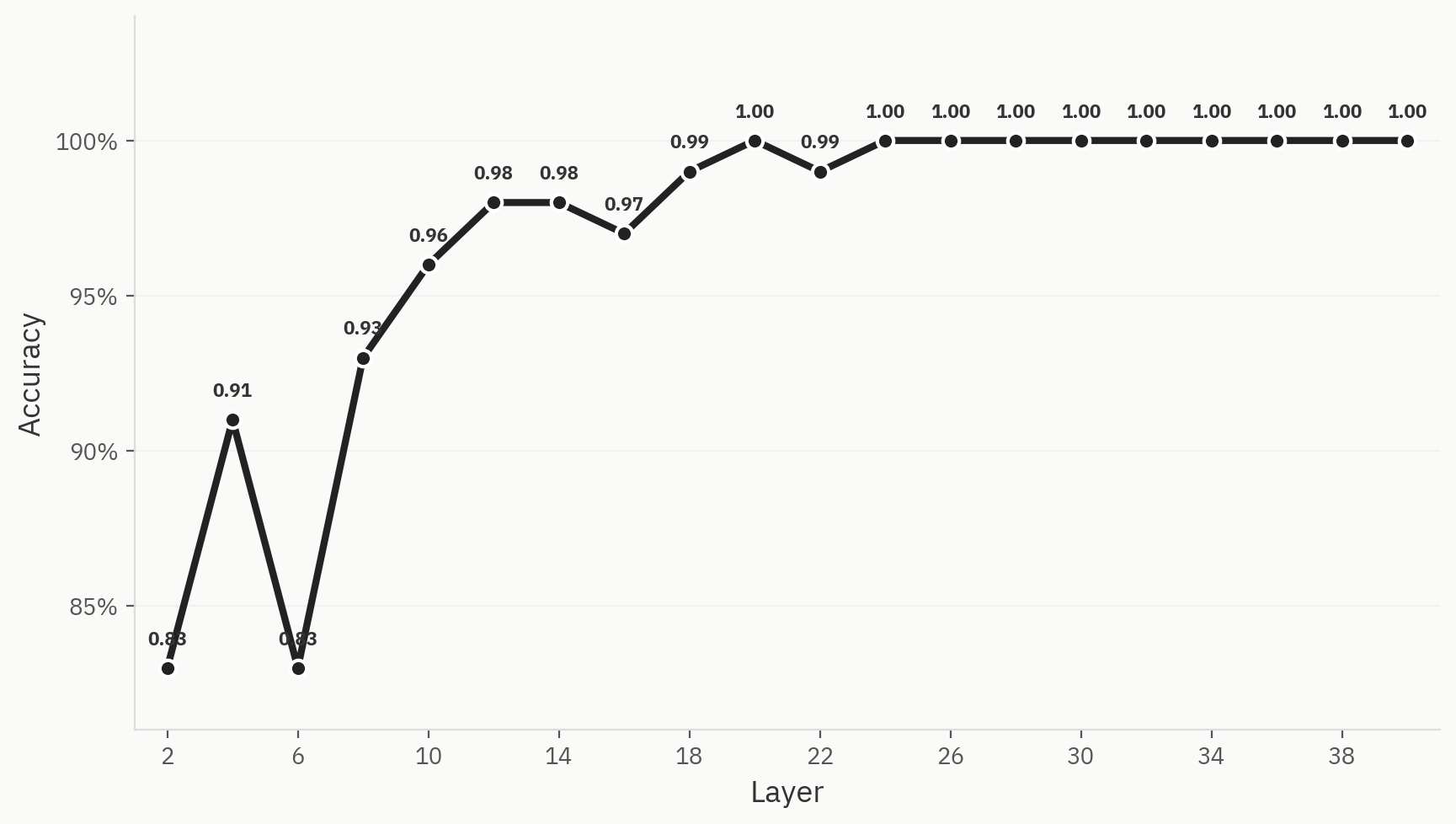
Probe accuracy across layers
Fig. 2. Human/AI linear-probe accuracy across layers on held-out data.

Loading embeddings…

Fig. 3 This separation is clearly visible in all three dimensionality reduction methods.

06

LLM Classification

In the t-SNE and UMAP plots, we noticed that documents appeared to cluster by the model that generated them. This was a surprise to us. Old iterations of Pangram had a separate LLM-classifier head, but that particular task had long been dropped. In its training process, Pangram 3.3.2 is given no labels corresponding to the originating model of an AI document.

Even so, clusters formed around the originating model family. Even more interesting, the clusters seem to emerge throughout the layers of the network.

Model Cluster Emergence

Color the same embeddings by model family to see provider-level geometry appear across layers.

Loading embeddings…

Fig. 4 Layer 2-40 embeddings colored by model family. Provider-level clusters become more visible across later layers.

Probe

To quantify this phenomenon, we train a classifier across six model families (Anthropic, OpenAI, Google, Qwen, Llama, DeepSeek) on 500 samples per model family, and 3,000 samples overall, at an 80:20 train/test split. We find that we can indeed train a probe capable of classifying the originating model family of a particular document using Pangram activations only, with a maximum top-1 accuracy of 91%.
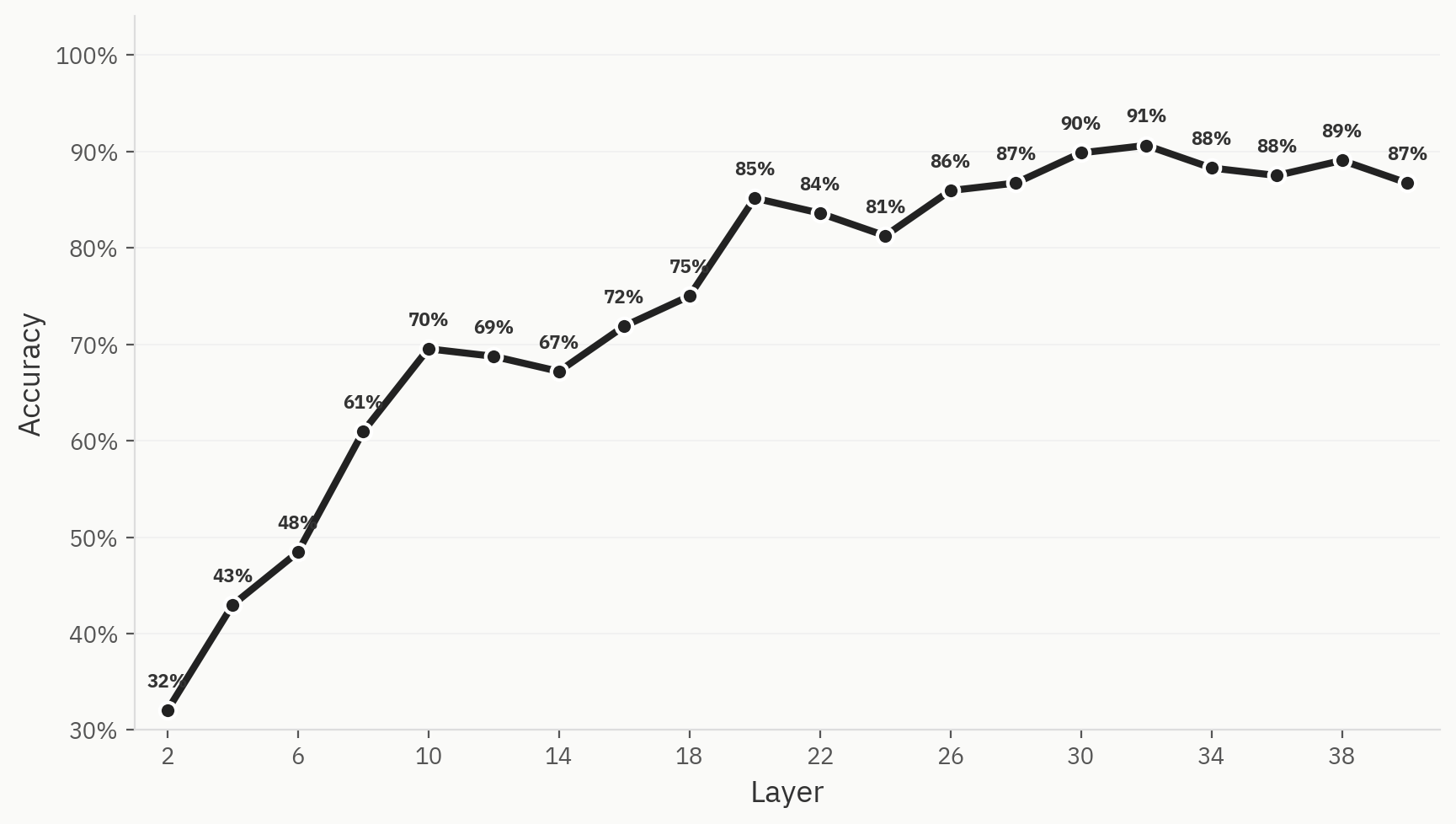
Model classifier accuracy across layers
Fig. 5. Model-family linear-probe accuracy across layers. The originating model family becomes increasingly recoverable from Pangram activations.

Emergence is Not Guaranteed

Our initial interpretability experiments included testing with a number of models. To our surprise, the emergence of an “LLM classification” ability was one of the only findings from this project that materially differed across models.

The figure below compares the clustering behavior of Pangram 3.1, 3.2, and 3.3.2. Despite the model performing better than 3.1 on the binary human-AI task in our internal signoff evals, the model clusters in general are less defined on Pangram 3.2 than in Pangram 3.1 or 3.3.2.
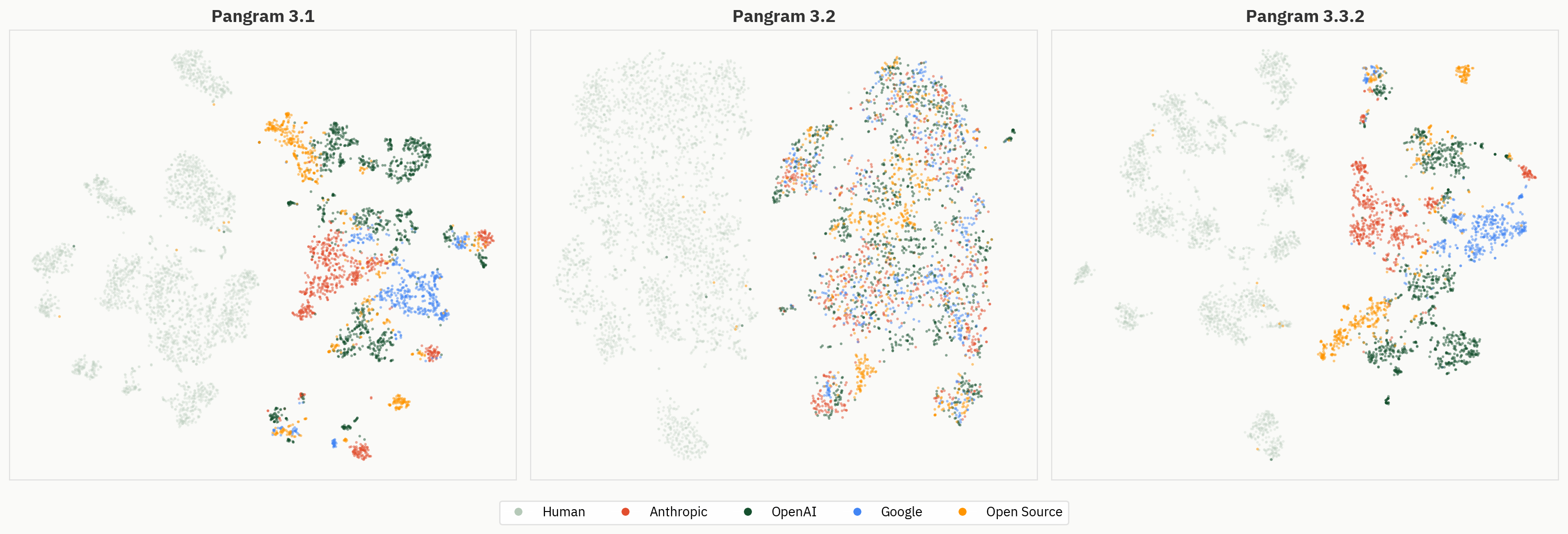
t-SNE comparison of Pangram 3.1, 3.2, and 3.3.2 at layer 40
Fig. 6. t-SNE at layer 40 for Pangram 3.1, 3.2, and 3.3.2. The geometry of model-family clusters shifts across model versions.

To further illustrate this difference, we compare the LLM classifier probe across Pangram 3.1, 3.2, and 3.3.2. All three improve their top-1 accuracy in early layers, but the probe for Pangram 3.2 starts to decay after layer 12 while Pangram 3.1 and 3.3.2 remain high.
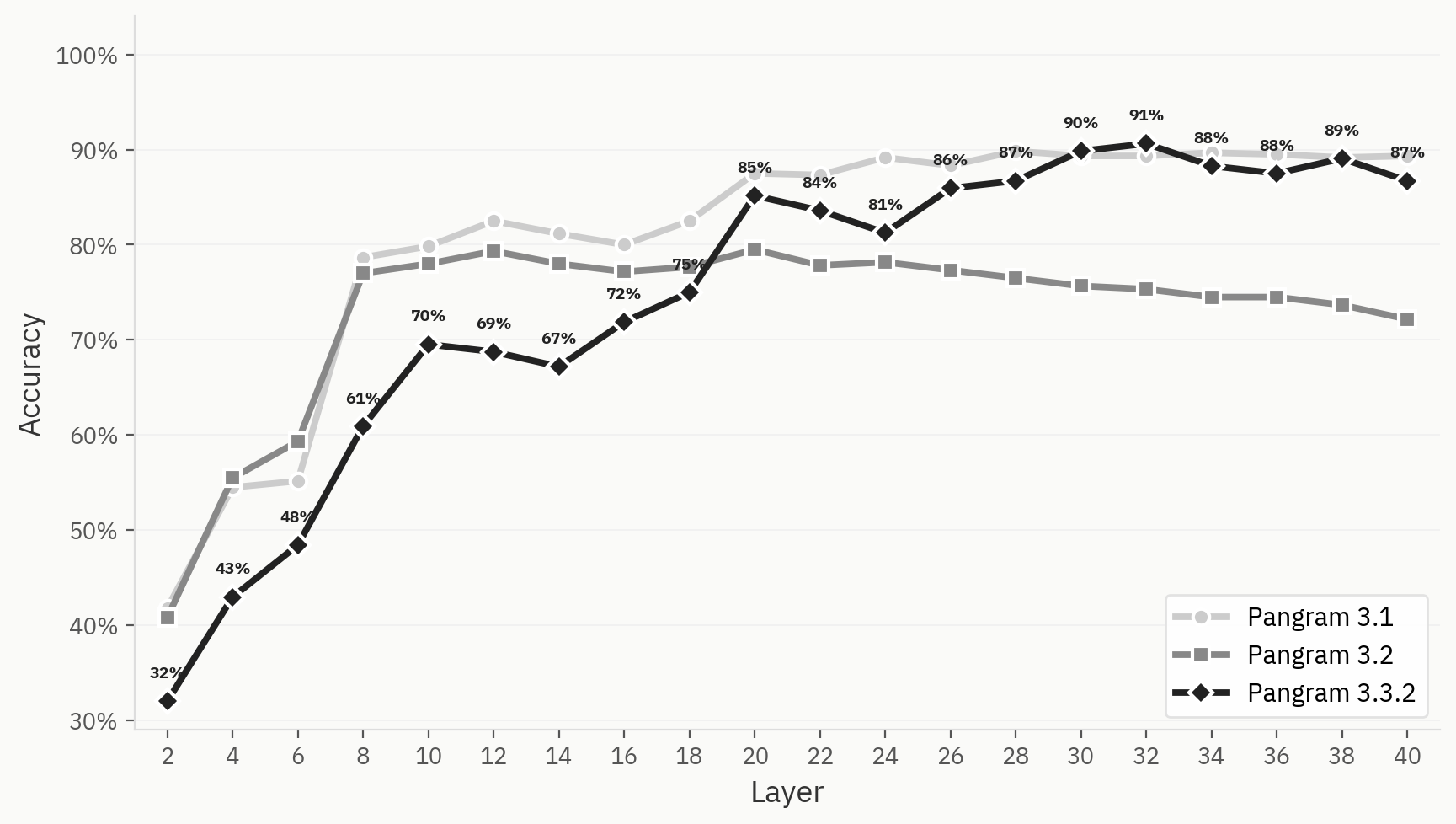
Probe accuracy comparison of Pangram 3.1, 3.2, and 3.3.2
Fig. 7. Probe accuracy comparison across layers for Pangram 3.1, 3.2, and 3.3.2.
07

Humanizers

Humanizers are a class of adversarial tools designed to modify AI-generated text in a manner that evades AI detectors.2We previously published a paper on these tools here. To see where humanized text sits relative to human and AI text in activation space, we created a separate humanizers dataset, which consists of roughly 1,900 samples, roughly balanced across three generative models (Claude Sonnet 4.5, Gemini 2.5 Pro, and GPT-5), ten different humanizer services, and the same source domains as the original interpretability dataset. Because of the adversarial risks, we do not disclose which services we use.

How the Model Reads Out Humanizers

Certain samples from our humanizer dataset are indeed challenging for our model to detect. Here, we use the same linear probe for the human/AI task, except with humanized text labelled as AI, as we do in the original training setup. We see that even from the first layer, humanized text is consistently read out as more human than its direct AI counterpart.
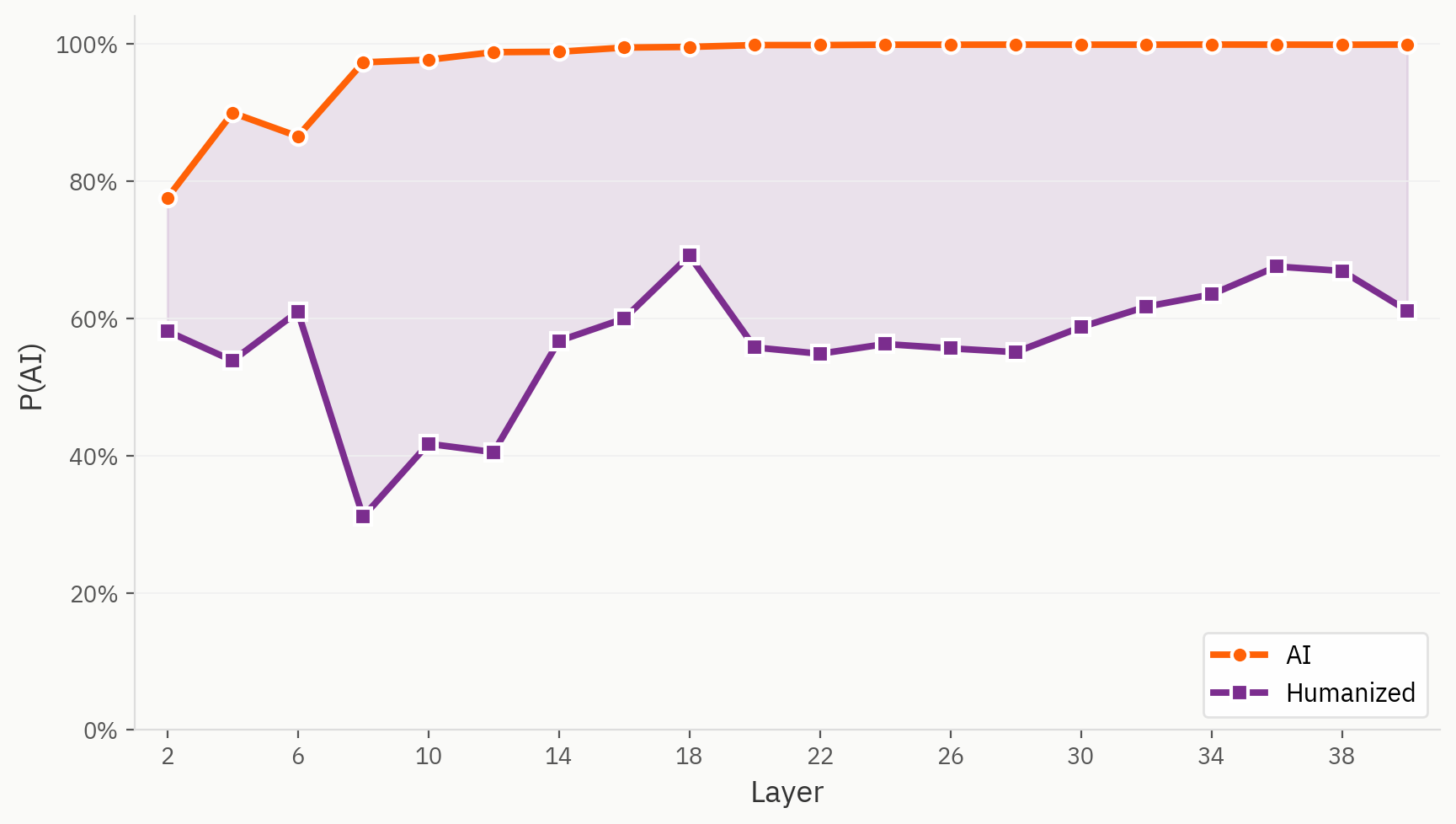
Humanizer probe delta across layers
Fig. 8. Mean P(AI) difference between direct AI samples and their humanized counterparts across layers.

Where Humanizers Exist in Embedding Space

However, when we look beneath the final readout, we find a much richer representation of humanized text. Below, we apply our dimensionality reduction methods to the human, AI, and humanized texts. Qualitatively, we can observe that humanizers tend to occupy separate parts of activation space, and form clusters outside of the human and AI regions.

Our hypothesis is that despite not having labels for humanized text, the model is capable of distinguishing between humanized, human, and AI text. However, in the final readout, the model is forced to collapse that signal and does so inconsistently.
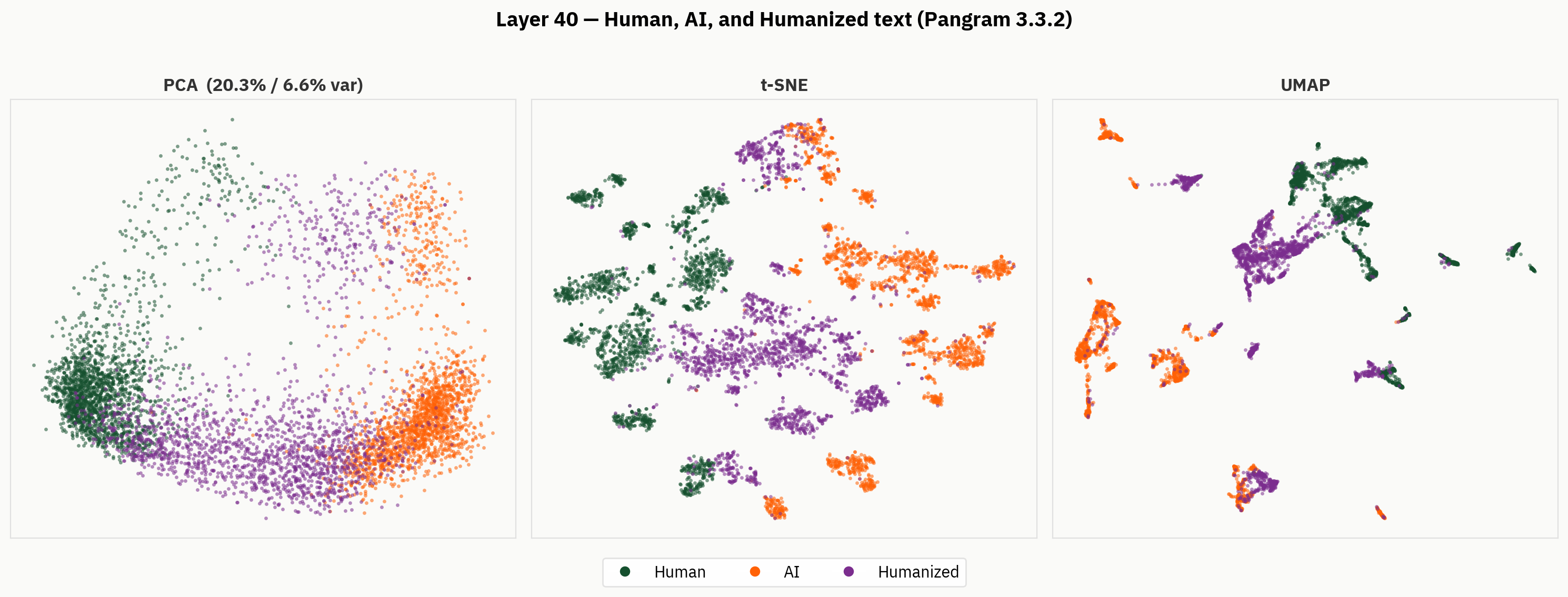
Humanizer dimensionality reduction with t-SNE, PCA, and UMAP at layer 40
Fig. 9. Human, AI, and humanized text at layer 40 via t-SNE, PCA, and UMAP. Humanized text occupies a distinct region separate from the main human and AI clusters.

Probe

To validate this hypothesis, we train a three-way linear probe with labels for AI, human, and humanized text. The probe reaches high top-1 accuracy early in the network and eventually flattens out at 98%.
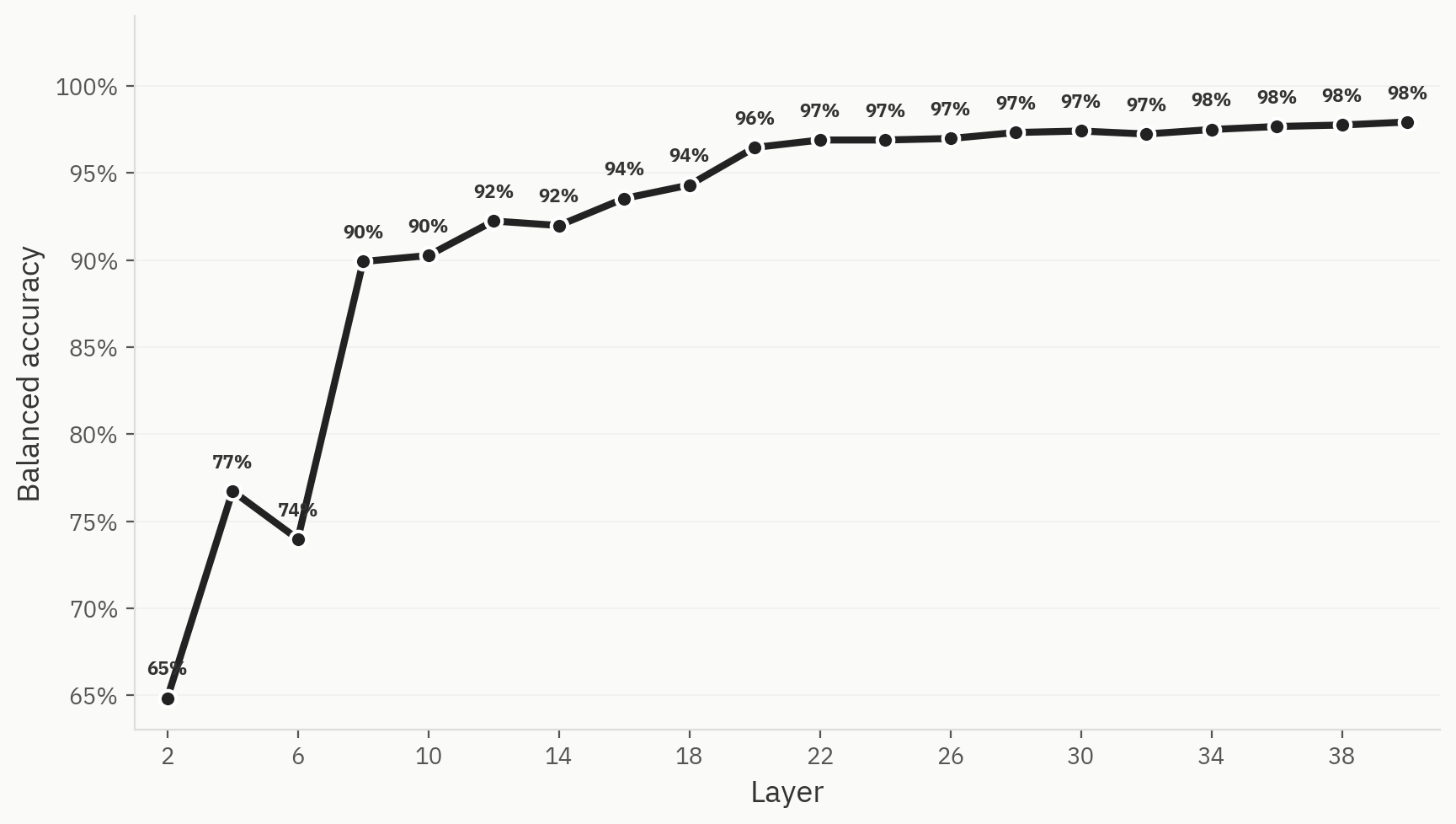
Three-way classification for human, AI, and humanized text
Fig. 10. Three-way classification probe accuracy (human / AI / humanized) across layers.
08

Conclusion

Our work here suggests that Pangram’s internal representations contain more structure than the final binary readout alone reveals. Across layers, we see human and AI documents separate, model-family information emerge, and humanized text occupy its own region of activation space. These findings are early, but they give us a useful map for understanding what the model learns before it collapses everything into a single detection score.

This post shows just the first steps in our interpretability efforts, but internally, we are excited and interested in this research direction.

Our vision for interpretability and explainability with Pangram models is that it can:

  • Provide better internal understanding of model behavior.
  • Provide supporting evidence and clearer explanations for individual Pangram results.

If you are a researcher interested in interpretability, AI detection research, or anything else in this work, please reach out to elyas@pangram.com.