
惯性聚合 高效追踪和阅读你感兴趣的博客、新闻、科技资讯
阅读原文 在惯性聚合中打开

推荐订阅源

Hacker News: Ask HN
Hacker News: Ask HN
WordPress大学
WordPress大学
H
Help Net Security
小众软件
小众软件
N
Netflix TechBlog - Medium
C
Check Point Blog
量子位
Last Week in AI
Last Week in AI
GbyAI
GbyAI
Martin Fowler
Martin Fowler
M
MIT News - Artificial intelligence
博客园 - 聂微东
Engineering at Meta
Engineering at Meta
让小产品的独立变现更简单 - ezindie.com
J
Java Code Geeks
D
DataBreaches.Net
Project Zero
Project Zero
P
Proofpoint News Feed
T
Threat Research - Cisco Blogs
Security Latest
Security Latest
Cisco Talos Blog
Cisco Talos Blog
Recorded Future
Recorded Future
I
Intezer
L
Lohrmann on Cybersecurity
Cyberwarzone
Cyberwarzone
博客园_首页
C
Cyber Attacks, Cyber Crime and Cyber Security
L
LangChain Blog
P
Palo Alto Networks Blog
V
V2EX
D
Darknet – Hacking Tools, Hacker News & Cyber Security
T
The Exploit Database - CXSecurity.com
The Hacker News
The Hacker News
Blog — PlanetScale
Blog — PlanetScale
G
GRAHAM CLULEY
T
The Blog of Author Tim Ferriss
C
Cisco Blogs
The Register - Security
L
LINUX DO - 热门话题
P
Privacy & Cybersecurity Law Blog
Scott Helme
Scott Helme
F
Full Disclosure
博客园 - 司徒正美
Recent Announcements
IT之家
IT之家
CTFtime.org: upcoming CTF events
Attack and Defense Labs
Cloudbric
Cloudbric
Help Net Security
Help Net Security
The Last Watchdog
The Last Watchdog

Hacker News: Front Page

SPICE simulation → oscilloscope → verification with Claude Code — Lucas Gerads GitHub - GainSec/AutoProber: Hardware hacker’s flying probe automation stack for agent-driven target discovery, microscope mapping, safety-monitored CNC motion, probe review, and controlled pin probing. Introducing Claude Opus 4.7 Qwen Studio The Future of Everything is Lies, I Guess: Where Do We Go From Here? GitHub - SeanFDZ/macmind: Single-layer transformer in HyperTalk for the classic Macintosh Virginia Bans Sale of Geolocation Data Show HN: Agent-cache – Multi-tier LLM/tool/session caching for Valkey and Redis Ancient DNA reveals pervasive directional selection across West Eurasia [pdf] AI cybersecurity is not proof of work Moving a large-scale metrics pipeline from StatsD to OpenTelemetry / Prometheus GitHub - Nightmare-Eclipse/RedSun: The Red Sun vulnerability repository GitHub - SethPyle376/hiraeth: Local AWS emulator focused on fast integration testing, with SQS support, SQLite-backed state, and a debug-friendly web UI. A Better Ludum Dare; Or, How to Ruin a Legacy GitHub - macOS26/Agent: Any AI, replaces Claude Code, Cursor, OpenClaw. Over 18 LLM providers (Claude, OpenAI, Gemini, Ollama, Zai, HF, Qwen) wired into a native Mac app that writes code, builds Xcode projects, bumps versions, manages git, automates Safari, use AppleScript, JS or Accessibility, extend Agent! w/ MCP Servers, run tasks from your iPhone via Messages. YouTube now lets you turn off Shorts I Made a Terminal Pager Burgers | マクドナルド公式 Commands — HackerNews CLI documentation ChatGPT for Excel PiCore - Raspberry Pi Port of Tiny Core Linux Live Nation illegally monopolized ticketing market, jury finds Google Broke Its Promise to Me. Now ICE Has My Data. Founding Engineer at Adaptional | Y Combinator CRISPR takes important step toward silencing Down syndrome’s extra chromosome GitHub - saffron-health/libretto: The AI toolkit for building reliable browser automations US v. Heppner (S.D.N.Y. 2026) no attorney-client privilege for AI chats [pdf] Unexpected €54k billing spike in 13 hours: Firebase browser key without API restrictions used for Gemini requests Fragments: April 14 Cal.com Goes Closed Source: Why AI Security Is Forcing Our Decision | Cal.com - Scheduling Software for Online Bookings Laravel raised money and now injects ads directly into your agent Codex Hacked a Samsung TV Tech Valuations Back to Pre-AI Boom Levels A perfectable programming language — Soter GitHub - halfwhey/claudraband: Claude Code for the Power User Partnership through Play: Investigating How Long-Distance Couples Use Digital Games to Facilitate Intimacy Textbooks and Methods of Note-Taking in Early Modern Europe (2008) Eternity in six hours: Intergalactic spreading of intelligent life (2013) Seven countries now generate 100% of their electricity from renewable energy Tell HN: OpenAI silently removed Study Mode from ChatGPT Pro Max 5x Quota Exhausted in 1.5 Hours Despite Moderate Usage Show HN: Oberon System 3 runs natively on Raspberry Pi 3 (with ready SD card) Tell HN: docker pull fails in spain due to football cloudflare block Bring Back Idiomatic Design No one owes you supply-chain security GitHub - xsawyerx/curl-doom: DOOM, played over cURL Apple update turns Czech mate for locked-out iPhone user The Grand Line Cache TTL silently regressed from 1h to 5m around early March 2026, causing quota and cost inflation Building a Z-Machine in the worst possible language The peril of laziness lost Iran war: We spoke to the man making Lego-style AI videos that experts say are powerful propaganda AI Will Be Met With Violence, and Nothing Good Will Come of It GitHub - duguyue100/midnight-captain: Inspired by Midnight Commander, tailored to my taste. How to build a `git diff` driver · Jamie Tanna | Software Engineer Center for Responsible, Decentralized Intelligence at Berkeley The Local Universe’s Expansion Rate Is Clearer Than Ever, but Still Doesn’t Add Up - A new synthesis of astronomical measurements confirms a persistent mismatch that could point to physics beyond current models The disturbing white paper Red Hat is trying to erase from the internet – OSnews NetBlocks (@netblocks@mastodon.social) The Future of Everything is Lies, I Guess: Annoyances ‘Abhorrent’: the inside story of the Polymarket gamblers betting millions on war Productive procrastination — Max van IJsselmuiden maps, territory and LMs 447 Terabytes per Square Centimetre at Zero Retention Energy: Non-Volatile Memory at the Atomic Scale on Fluorographane Show HN: Pardonned.com – A searchable database of US Pardons 20 Years on AWS and Never Not My Job The Seasons are Wrong The FAA wants gamers to apply for air traffic control jobs Artemis II crew splashes down near San Diego after historic moon mission Why weekends are under threat We gave an AI a 3 year retail lease in SF and asked it to make a profit | Andon Labs How a dancer with ALS used brainwaves to perform live On filing the corners off my MacBooks Installing every* Firefox extension OpenClaw’s memory is unreliable, and you don’t know when it will break Steve Blank Nowhere Is Safe Chimpanzees in Uganda locked in vicious 'civil war', say researchers watgo - a WebAssembly Toolkit for Go linux/Documentation/process/coding-assistants.rst at master · torvalds/linux GitHub - callumlocke/json-formatter: Makes JSON easy to read. Founding Product Engineer at Bild AI | Y Combinator A compelling title that is cryptic enough to get you to take action on it GitHub - Keychron/Keychron-Keyboards-Hardware-Design: Industrial design files for Keychron keyboards and mice. 100+ models with CAD assets in STEP, DXF, DWG, and PDF. Source-available, with commercial use allowed for original compatible accessories within the license terms. [ANNOUNCE] WireGuardNT v0.11 and WireGuard for Windows v0.6 Released 1D-Chess Helium Is Hard to Replace Keeping a Postgres queue healthy — PlanetScale Serenity Forge (@serenityforge.com) Our response to the Axios developer tool compromise Do Americans read print books, e-books or audiobooks more? Uncharted island soon to appear on nautical charts The Problem That Built an Industry Fragments: April 2 Python Release Python install manager 26.1 Bitcoin miners are losing $19,000 on every BTC produced as difficulty drops 7.8% God sleeps in the minerals Harness engineering: leveraging Codex in an agent-first world Apple Silicon and Virtual Machines: Beating the 2 VM Limit What have been the greatest intellectual achievements? The APL Programming Language Source Code
The Sigmoids Won't Save You
Tomte · 2026-05-15 · via Hacker News: Front Page

“All exponentials eventually become sigmoids” is an annoying AI talking point. If someone presents a graph like this…
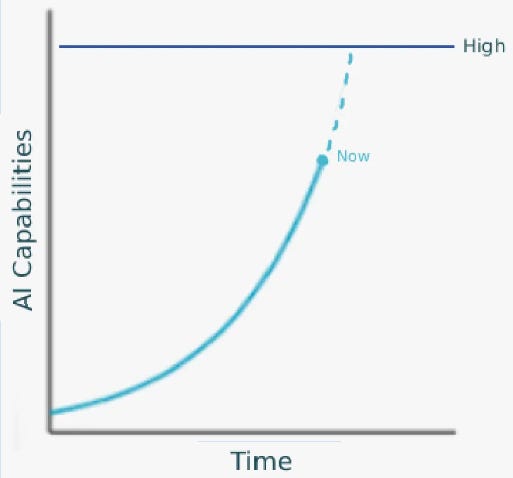
….and points out that it seems like AI capabilities could soon reach the level marked “High”, then the height of intelligent debate is to point out that actually, the trend could go like this:
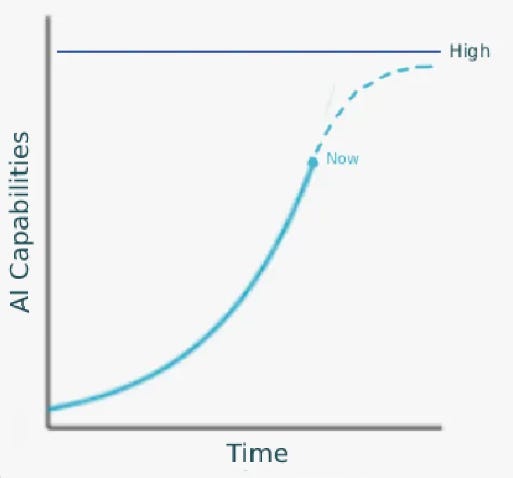
…and then it would never reach the level marked “High”!

In slogan form, this is “all exponentials eventually become sigmoids” (a sigmoid is the s-shape of the second graph, which starts exponential but gradually flattens out). It’s technically true. No process can keep growing forever; eventually it hits physical or practical limits. For example, total cases during an epidemic is classically sigmoid:
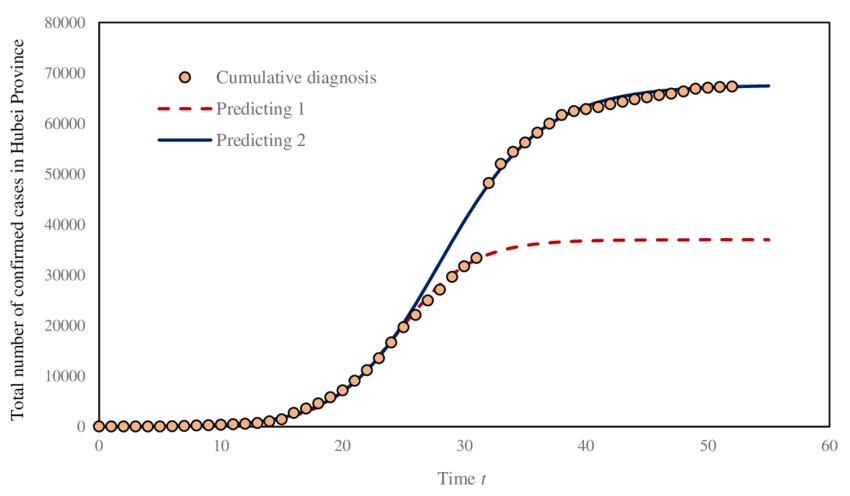
They start slow - patient zero infects patient one, and so on. They grow exponentially until most people are infected. Then, as almost everyone is infected and they can only mop up the last few holdouts, they slow down again. Finally, after everyone has been infected, the growth rate is zero.

Technological progress in a given field can also be sigmoid. Here’s airspeed record over time:
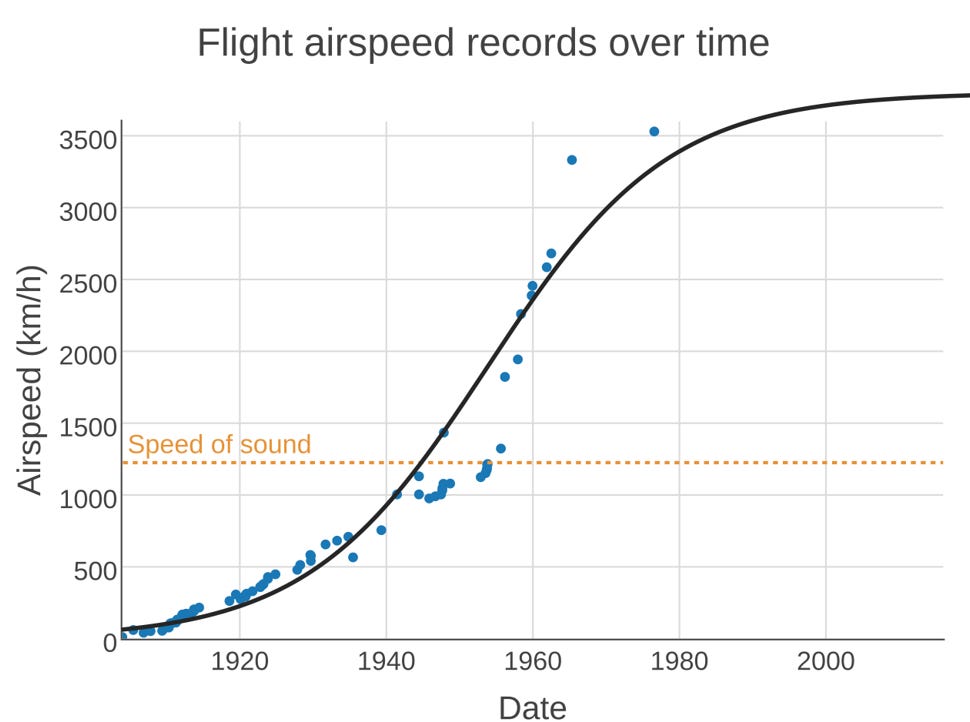
Source: https://en.wikipedia.org/wiki/List_of_flight_airspeed_records

My understanding is that this represents 3-4 “generations” of different technology (propellers, turbojets, etc). Each technology went through normal iterative improvement, then, when it reached its fundamental limits, got replaced by a better technology. The last technology, ramjets, reached its limit at about 3500 km/h, and there wasn’t the economic/regulatory will to develop anything better, so the record stands.

You can imagine something similar happening with AI at some point. Does that mean people are right, and there’s no need to worry that the graph will ever reach the line marked “high”?

Before we come up with a general answer, let’s look at the Sigmoid Misidentification Hall Of Fame.

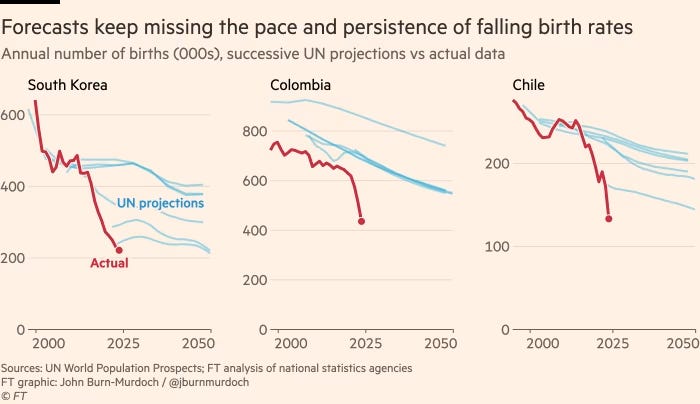
Third place goes to UN birthrate projections in countries with declining birthrates. These countries’ birthrates keep going down at a constant rate, and the UN keeps predicting they will flatten out and go down at some lesser rate. On this graph, red is the real data, and each blue line is a different UN attempt from a different year to “extrapolate” the “trend”.
Image

It’s true that birth rates must eventually flatten out and become sigmoid (this may have happened last year in South Korea, although Colombia and Chile are still declining), but this doesn’t necessarily happen at the exact moment that forecasters in the UN start feeling like the decline has gone too far.

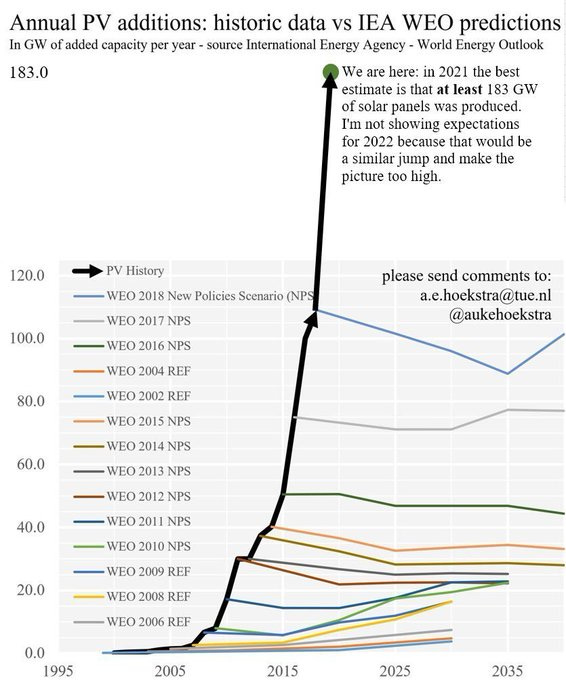
Second place goes to predictions of solar power deployment, as chronicled by A.E. Hoekstra.
Image

The various WEO lines are World Energy Organization predictions for how quickly solar power will get deployed. Every year, the WEO thinks “Wow, lots of solar power got added last year, probably this year it will level out and people might even back off a little”. Every year, the amount of solar power deployed grows at the same rate.

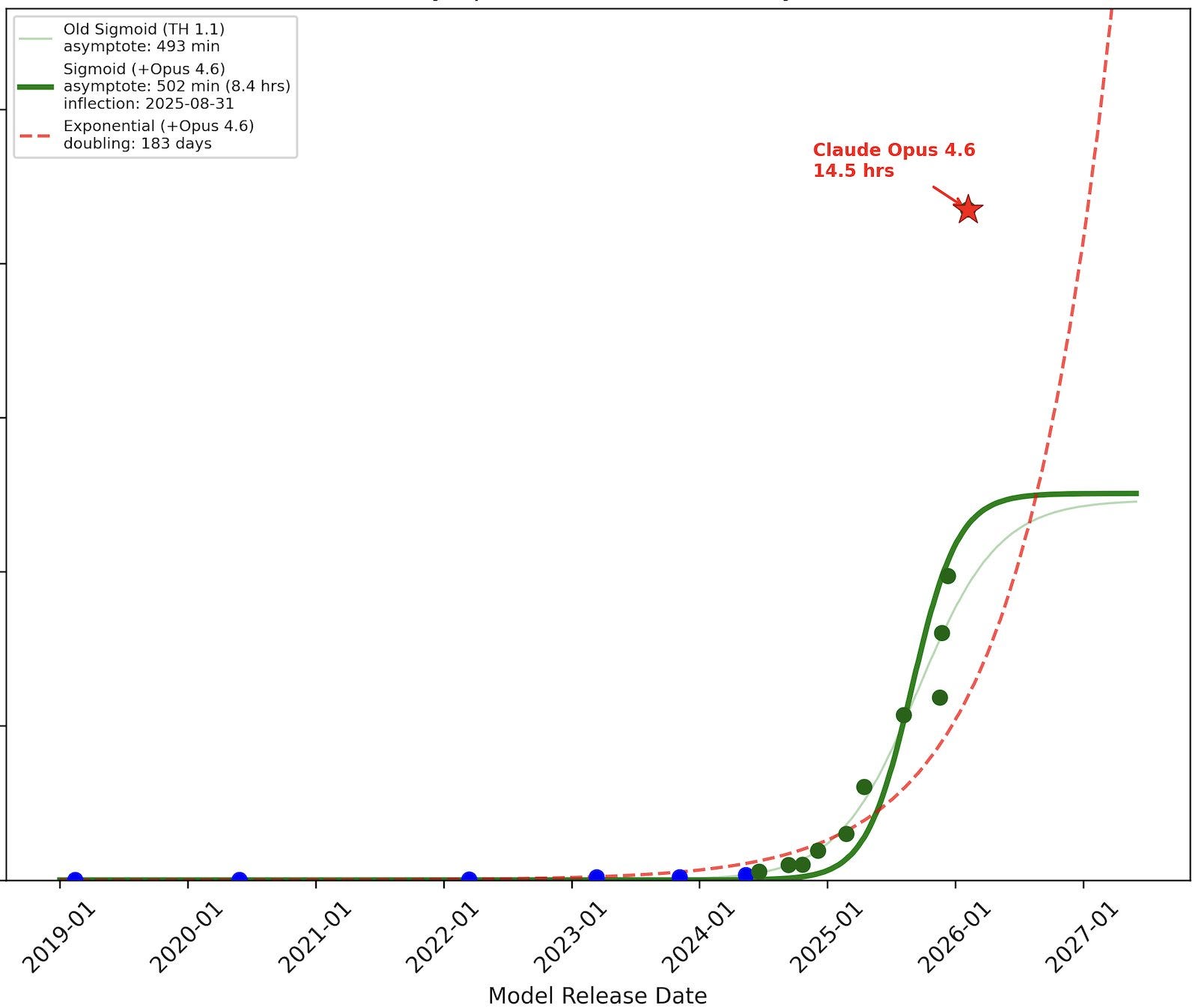
First place goes to this paper on the METR graph of AI capabilities. In early 2026, when the underlying data looked like this:
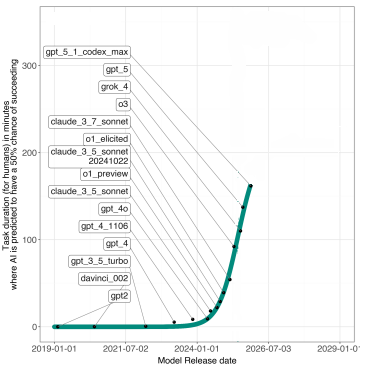
…a team from Wharton tried to model different curves and predicted that the likely future trajectory was this:
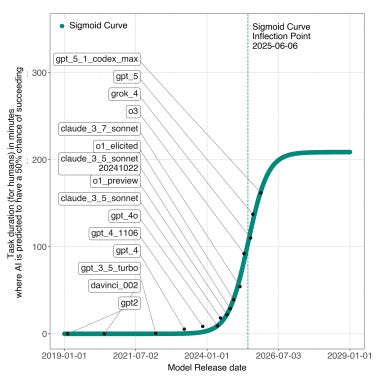
@Tenobrus ably chronicles what happened next (the green curve is their original; the star marks the next AI model to be released after their analysis):
Image

The moral of the story is that, even though all exponentials eventually become sigmoids, this doesn’t necessarily happen at the exact moment you’re doing your analysis. Sometimes they stay exponential for much longer than that!

How much longer?

The best way to predict this is to fully understand the process generating the trend. For example, you can forecast an epidemic by knowing how quickly it replicates, how likely it is to be cured, and how large the susceptible population is. Even in harder cases like airspeed records, a smart engineer could determine that ramjets max out around 3500 km/h, and a smart economist could predict that no country was incentivized to spend enough money to bring the next paradigm to fruition.

What if you don’t fully understand the process? AI forecasters know some things (like how data centers work and how much it costs to build them). But they’re unsure about other things (researchers keep inventing new paradigms of data generation that get over data walls, but for how long?), and other things are entirely opaque (What is intelligence really? Why do scaling laws work? Might they just stop working at some point?) Is there anything you can do here?

In conditions of true ignorance, the default assumption should be Lindy’s Law: on average, a process will continue about as long as it’s continued already.

To build intuition: suppose you walk past a geyser, and see a sign saying “This geyser last erupted 100,000 years ago”. You know nothing else about geysers. What’s the chance it will erupt in the next hour? It must be very low, right? If it erupted in the next hour, you would have walked past it 99.99999% of the way through its eruption cycle - in other words, your random sample had a higher value than 99.99999% of points. That’s not how random samples usually work! On the other hand, suppose you walk past another geyser, and see a sign saying “This geyser last erupted 10 minutes ago”. What is the chance that this geyser will erupt in the next hour? Pretty high, right? It seems like this geyser’s eruptions occur on a scale of every few minutes. When you calculate it out, your median prediction for the length of time until the next eruption should just be the number on the sign. In the same way, your median prediction for how long it should take before an entirely-mysterious trend changes shape should be the amount of time since the last change.

Applying this to AI: the forecasters who try to get deep understanding of the dynamics of AI progress think that we can keep scaling up AI at the current rate for another few years (by building more data centers, etc), and might or might not be able to scale it up faster after that by leveraging recursive self-improvement. But suppose you don’t trust those people. What should your default be?

AI has been improving dramatically since at least GPT-1 in 2017, although most people sort of arbitrarily date “the scaling era” as 2019 to present. So naively, ignoring everything we know and considering the whole field to be a total mystery, we might expect the trend to continue for, on average, another seven years. Assuming a Pareto distribution (what does this even mean in the case of AI? I don’t know) the chance that it continues for less than another two years is 22%.

It’s cheap and easy to make fun of people who extrapolate trends too far:

But if someone claims that the trend toward increasing AI capabilities will never reach some particular scary level, then the burden is on them to explain either:

  • If they’re not treating AI as a black box, and claim to be modeling the dynamics explicitly, then what is their model? Have they calculated the obvious things, like projected data center growth and speed of algorithmic progress? Are they familiar with the modeling work that’s already been done in this field, like the AI Futures Timeline Model? Do they have specific opinions on how the others went wrong, and where their model differs?

  • If they are treating AI as a black box, why isn’t their default expectation based on Lindy’s Law?